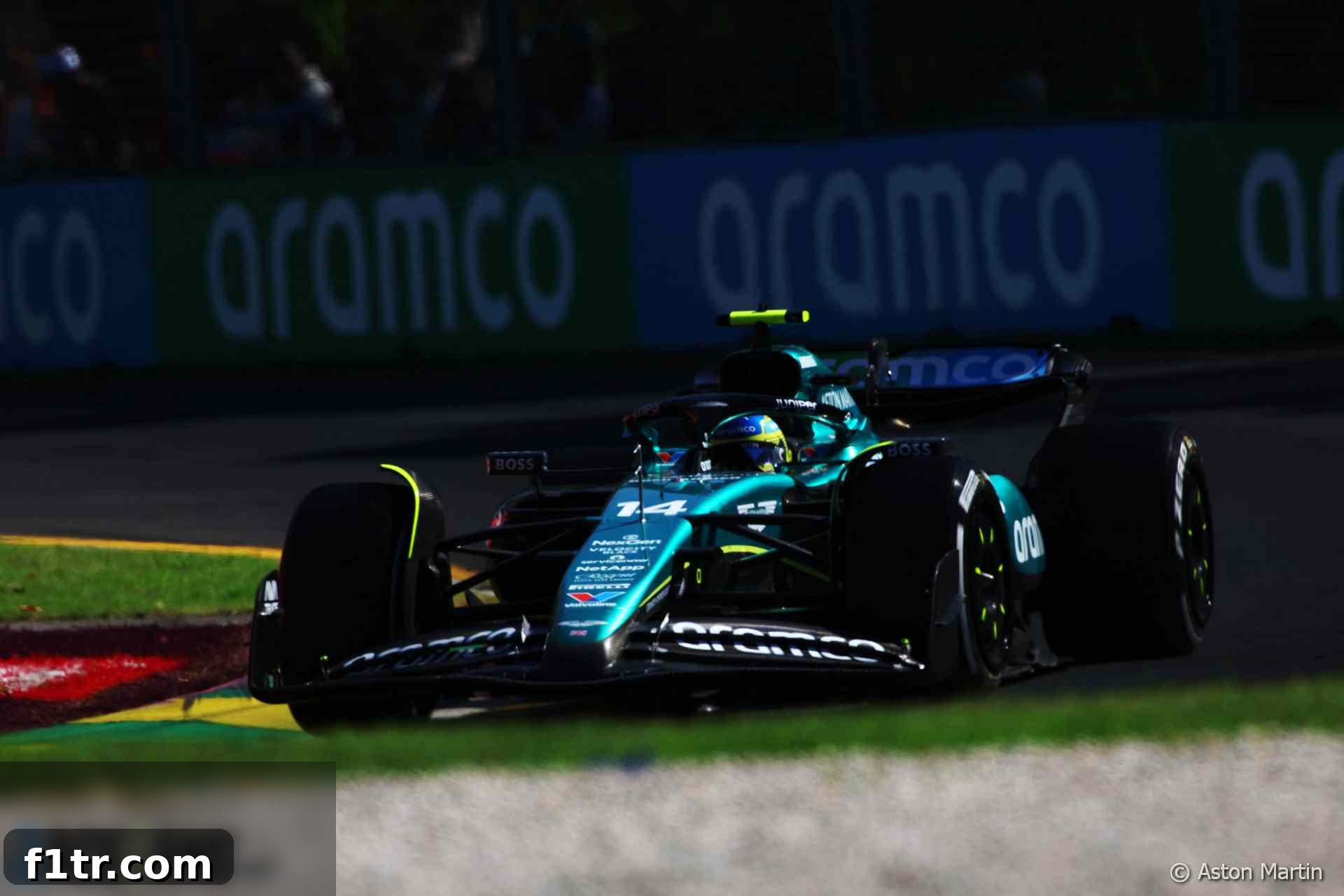
The 2024 Formula 1 Australian Grand Prix concluded with a dramatic twist for two-time world champion Fernando Alonso, who found himself demoted two places in the final classification after a post-race penalty. The Aston Martin driver was sanctioned by the race stewards for his driving ahead of George Russell’s high-speed crash on the penultimate lap, sparking considerable debate within the F1 community.
Key Incident Overview:
Driver Involved: Fernando Alonso (Aston Martin) and George Russell (Mercedes)
Event: 2024 Australian Grand Prix, Lap 57
Location: Turn 6, Albert Park Circuit
Penalty: 20-second time penalty (converted from drive-through), 3 penalty points
Result: Alonso drops from 6th to 8th position.
Reason: Driving “unnecessarily slowly, erratically or in a manner which could be deemed potentially dangerous” (FIA Sporting Regulations, Art 33.4).
The stewards’ decision, which added 20 seconds to Alonso’s race time, was based on their assessment that his actions prior to Russell’s accident were “potentially dangerous.” While no contact occurred between the two cars, Russell, who was closely trailing Alonso, experienced a sudden and unexpected reduction in the closing distance, leading to him losing control and crashing heavily at the exit of Turn 6.
The Dramatic Conclusion to the Australian Grand Prix
The Albert Park circuit in Melbourne played host to an enthralling Australian Grand Prix, but it was the closing stages that provided one of the most talked-about moments. On lap 57, with the race nearing its end, Mercedes driver George Russell was in hot pursuit of Fernando Alonso. As they approached the fast and challenging Turn 6, an incident unfolded that would have significant repercussions for Alonso and ignite a passionate discussion about defensive driving in Formula 1.
Russell, pushing hard to maintain position, found his car suddenly snap out of control as he entered the corner’s braking zone. The Mercedes speared off track, bouncing violently off the barriers before coming to rest in the middle of the circuit, creating a perilous situation that fortunately saw Russell emerge unharmed. The immediate aftermath focused on Russell’s dramatic accident, but closer scrutiny quickly turned to Alonso’s driving just moments before.
Understanding the Incident: Russell’s Crash and Alonso’s Maneuver
The core of the controversy lay in Alonso’s approach to Turn 6. According to the stewards, telemetry data revealed that Alonso significantly altered his driving style for that specific corner on lap 57. He lifted off the throttle approximately 100 meters earlier than he had at any other point during the race. Furthermore, he applied a very slight brake input at a point he typically wouldn’t, and performed an unusual downshift sequence before momentarily accelerating into the corner. Alonso then lifted again to navigate the apex.
This sequence of actions, which Alonso later described as an attempt to optimize his exit speed from Turn 6 to defend against Russell, had an unforeseen and drastic effect on the following Mercedes. Russell, anticipating a normal racing line and braking point from the car ahead, was caught off guard by the unexpected deceleration. This led to a dramatic and unusual closing speed between the two cars, reducing the air pressure over Russell’s front wing (known as “dirty air”) and contributing to a sudden loss of downforce. Russell recounted to the stewards that Alonso’s maneuver felt “erratic” and took him “by surprise,” causing him to close the distance far too rapidly to react effectively.
Stewards’ Investigation: Unraveling the Data
Following the race, the stewards launched a thorough investigation into the incident. They heard testimonies from both George Russell and Fernando Alonso, as well as team representatives from Mercedes and Aston Martin. To reconstruct the events, they meticulously reviewed an array of data, including positioning and marshalling system information, extensive video footage (including in-car cameras), telemetry data from both vehicles, and team radio communications.
Telemetry Unveils Unusual Driving Patterns
The telemetry data proved crucial in the stewards’ analysis. It unequivocally showed Alonso’s significant deviation from his usual driving pattern at Turn 6. He lifted off the throttle over 100 meters earlier than his previous laps. While the braking input was minimal, it occurred at an uncharacteristic point. The sequence of downshifts and a subsequent upshift before the corner was also noted as atypical. Alonso himself acknowledged to the stewards that while his intention was to slow earlier to gain a better exit, he “got it slightly wrong” and had to make “extra steps to get back up to speed.” It was this sequence of deviations, regardless of intent, that created the “considerable and unusual closing speed” between his car and Russell’s.
The Verdict: Breach of Sporting Regulations Article 33.4
In their deliberation, the stewards were careful to emphasize that their focus was solely on the wording of Article 33.4 of the FIA Formula 1 Sporting Regulations. This article explicitly states: “At no time may a car be driven unnecessarily slowly, erratically or in a manner which could be deemed potentially dangerous to other drivers or any other person.” They clarified that they did not consider the consequences of Russell’s crash when making their judgment, nor did they attempt to ascertain Alonso’s specific intent – whether he deliberately aimed to cause problems for Russell or simply misjudged his own strategy for a better exit.
Why Alonso’s Maneuver Was Deemed “Potentially Dangerous”
The stewards heard from the driver of car 63 (George Russell), the driver of car 14 (Fernando Alonso), team representatives and reviewed positioning/marshalling system data, video, telemetry, team radio, in-car video evidence and telemetry supplied by both teams.
Car 63 crashed at the exit to turn six on lap 57. The stewards have extensively reviewed the situation that occurred prior to the crash.
Car 63 (George Russell) was following Car 14 (Fernando Alonso) approximately 0.5 seconds behind as the cars approached turn six. Alonso explained to the stewards that he intended to approach turn six differently, lifting earlier, and with less speed into the corner, to get a better exit. Russell explained to the stewards that from his perspective, Alonso’s manoeuvre was erratic, took him by surprise and caused him to close distance unusually fast, and with the resulting lower downforce at the apex of the corner, he lost control and crashed at the exit of the corner. There was no contact between the cars.
Telemetry shows that Alonso lifted slightly more than 100m earlier than he ever had going into that corner during the race. He also braked very slightly at a point that he did not usually brake (although the amount of brake was so slight that it was not the main reason for his car slowing) and he downshifted at a point he never usually downshifted. He then upshifted again, and accelerated to the corner before lifting again to make the corner. Alonso explained that while his plan was to slow earlier, he got it slightly wrong and had to take extra steps to get back up to speed. Nonetheless, this manoeuvre created a considerable and unusual closing speed between the cars.
In considering the matter the stewards focused solely on the wording of the regulation which states “At no time may a car be driven unnecessarily slowly, erratically or in a manner which could be deemed potentially dangerous to other drivers or any other person.” (Art 33.4)
Specifically, in this case, the stewards have not considered the consequences of the crash. Further, the stewards considered that they do not have sufficient information to determine whether Alonso’s manoeuvre was intended to cause Russell problems, or whether as he stated to the stewards that he simply was trying to get a better exit.
Should Alonso have the right to try a different approach to the corner? – yes.
Should Alonso be responsible for dirty air, that ultimately caused the incident? – no.
However, did he choose to do something, with whatever intent, that was extraordinary, i.e. lifting, braking, downshifting and all the other elements of the manoeuvre over 100m earlier than previously, and much greater than was needed to simply slow earlier for the corner? – yes by his own account of the incident he did, and in the opinion of the stewards by doing these things, he drove in a manner that was at very least “potentially dangerous” given the very high speed nature of that point of the track.
This season, the FIA Formula 1 penalty guidelines, including for this breach have been reset and increased to a baseline of a 10s penalty. In addition, when there is some aggravating circumstance, we consider a drive-through penalty. In this case we consider that Alonso affirmatively choosing to perform an unusual manoeuvre at this point to be an aggravating circumstance, as opposed to a simple mistake. The stewards therefore order a drive through penalty, which will be converted to 20 seconds added to car 14’s elapsed time, along with three penalty points.
The crucial point for the stewards was not whether Alonso had the right to try a different corner approach – which they affirmed he did – or whether he was responsible for “dirty air” effects. Instead, they focused on whether his actions constituted an “extraordinary” maneuver that went beyond what was necessary to simply slow down earlier for the corner. By his own admission and the irrefutable telemetry, Alonso’s combined actions of lifting, braking, and downshifting over 100 meters earlier than usual, and performing an atypical sequence, were deemed to be an “affirmative choice” rather than a “simple mistake.” Given the high-speed nature of Turn 6, such an unusual and unexpected change in pace was unequivocally classified as “potentially dangerous.”
The Consequence: A Post-Race Drive-Through Penalty
Under the revised FIA Formula 1 penalty guidelines for the 2024 season, the baseline penalty for such a breach is a 10-second time penalty. However, in cases with aggravating circumstances, a drive-through penalty can be imposed. The stewards determined that Alonso’s “affirmative choice to perform an unusual manoeuvre” at a critical point on the track constituted an aggravating circumstance. Therefore, they issued a drive-through penalty, which, because it was applied post-race, translated into a 20-second addition to his total race time. This penalty caused Fernando Alonso to drop from his hard-fought sixth position to eighth in the final classification. Additionally, he was handed three penalty points on his Super Licence, bringing his total for the last 12 months to six.
Fernando Alonso’s Reaction: A Disappointed Veteran’s View
Unsurprisingly, Fernando Alonso expressed significant disappointment with the stewards’ decision. Known for his aggressive yet strategic racing style, he defended his actions as a standard part of competitive driving. “I wanted to maximise my exit speed from Turn 6 to defend against him,” Alonso stated after the ruling. “That’s what any racing driver would do, and I didn’t feel it was dangerous.”
He continued, highlighting his perspective on the incident: “It’s disappointing to get a penalty from the stewards for what was hard but fair racing. Still, I’m glad that George is okay. It was not nice to see his car in the middle of the track.” Alonso’s comments underscored his belief that the penalty was unjust and potentially stifled the spirit of genuine wheel-to-wheel competition, suggesting that such defensive tactics are a fundamental aspect of Grand Prix racing.
The Broader Debate: Setting a Precedent in Formula 1
The penalty handed to Fernando Alonso ignited a passionate debate across the Formula 1 paddock and among fans worldwide. Many questioned where the line should be drawn between aggressive, tactical driving and genuinely dangerous behavior. Supporters of Alonso argued that drivers should have the freedom to adjust their lines and pace to outsmart competitors, seeing his maneuver as a legitimate, albeit misjudged, defensive tactic.
Conversely, those who supported the stewards’ decision emphasized the paramount importance of driver safety. The speed and nature of Formula 1 cars mean that any unexpected or erratic change in pace can have catastrophic consequences, as evidenced by Russell’s severe crash. The penalty, in this view, served as a crucial reminder that while aggressive racing is encouraged, it must always remain within the bounds of predictability and safety for all competitors. The precedent set by this decision could influence how drivers approach defensive driving in future races, potentially making them more cautious about unexpected variations in their corner entry strategies.
Looking Ahead: Implications for Future Races and Driver Conduct
The Australian Grand Prix penalty against Fernando Alonso is likely to have lasting implications for how Formula 1 drivers approach defensive maneuvers and cornering strategies. It highlights the fine line between skillful, tactical racing and actions that could inadvertently endanger others. Drivers and teams will undoubtedly scrutinize this decision, re-evaluating their understanding of Article 33.4 and what constitutes “potentially dangerous” driving. This could lead to a more conservative approach to manipulating corner speeds or lines, particularly when a competitor is closely following.
The incident also reinforces the FIA’s commitment to prioritizing safety and ensuring that even tactical moves do not cross into territory that compromises the well-being of the drivers. As the season progresses, it will be interesting to observe if this penalty leads to any noticeable shift in driver behavior or if similar incidents spark renewed debate, further shaping the interpretation of racing regulations in modern Formula 1.
Related Articles: 2024 Australian Grand Prix Insights
- Alonso calls Australian GP penalty a ‘one-off I’ve had too many of’
- Red Bull saw warning sign of Australian GP brake problem on Saturday – Verstappen
- Failing to punish Alonso would have “opened a can of worms” – Russell
- Leclerc sure “many team principals” are pursuing Sainz for 2025 seat
- “Don’t put me under pressure” – The best unheard team radio from Melbourne
Browse all 2024 Australian Grand Prix articles