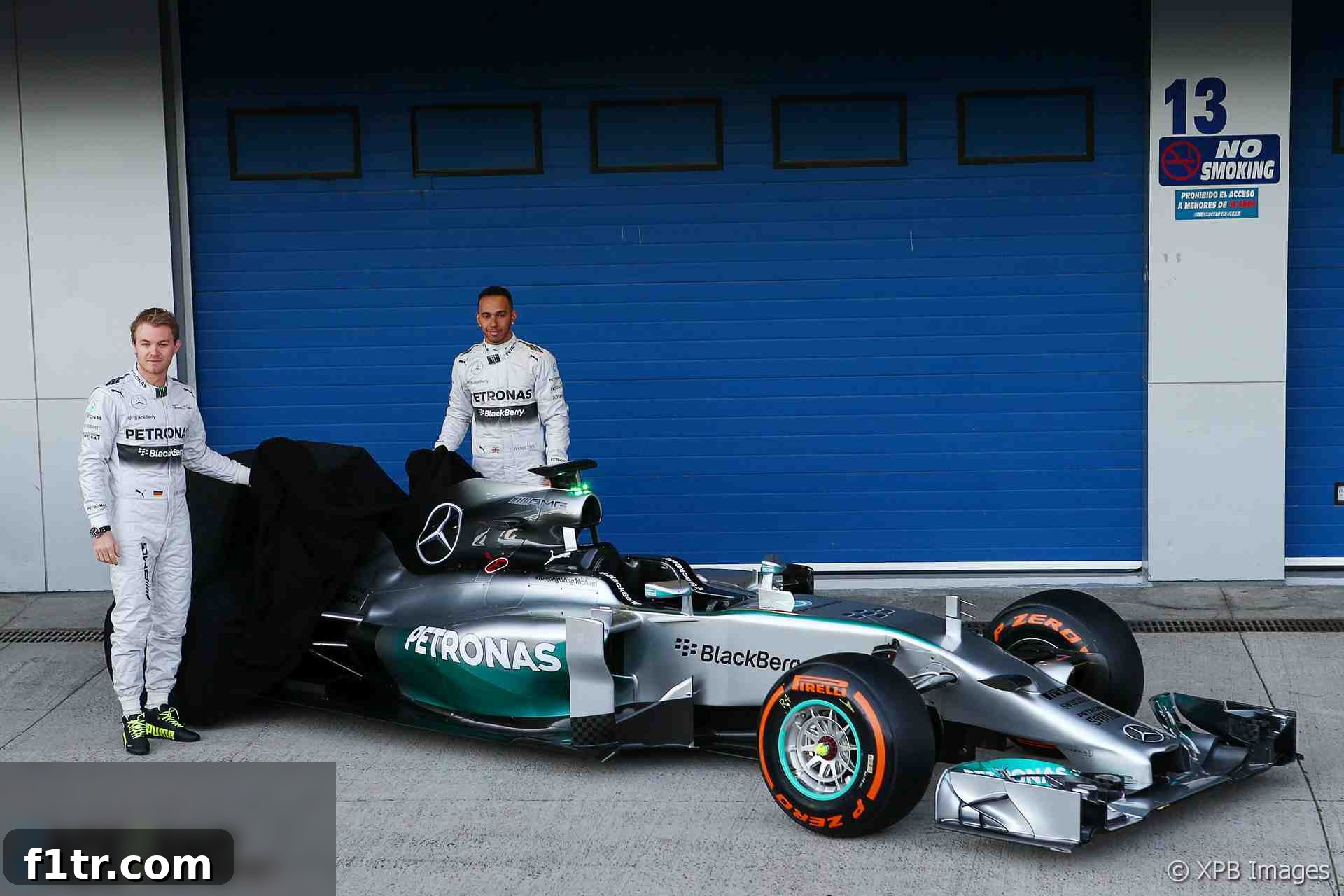
Unveiling the Mercedes W05: A New Era of Formula 1 Power and Precision
The highly anticipated Mercedes W05 has finally broken cover, marking a pivotal moment for the Mercedes-AMG Petronas Formula One Team and indeed, for the sport itself. These are the first official glimpses of the formidable machine that Lewis Hamilton and Nico Rosberg would pilot through the groundbreaking 2014 Formula 1 season.
The Dawn of a New Era: F1’s V6 Hybrid Turbo Regulations
The 2014 Formula 1 season ushered in the most radical technical overhaul in decades, shifting from the naturally aspirated 2.4-litre V8 engines to a new generation of 1.6-litre V6 hybrid turbocharged power units. This monumental change was designed to make Formula 1 more relevant to road car technology, promote energy efficiency, and challenge engineers like never before. The new regulations demanded a completely integrated power unit, comprising an internal combustion engine (ICE) and sophisticated Energy Recovery Systems (ERS) – specifically, the Motor Generator Unit-Kinetic (MGU-K) and Motor Generator Unit-Heat (MGU-H).
These complex systems were designed to recover energy from braking (MGU-K) and from the exhaust gases (MGU-H), deploying it to boost performance and improve fuel efficiency. With strict fuel flow limits and a maximum race fuel allowance, managing energy became as critical as raw power output. This seismic shift presented an unprecedented challenge for every team and engine manufacturer, requiring years of meticulous planning, research, and development.
Engineering the W05: A Symphony of Innovation and Challenge
Speaking at the launch, Toto Wolff, Executive Director of Business for the Mercedes-AMG F1 team, underscored the immense undertaking involved. He described the W05 and its revolutionary V6 hybrid turbo engine as “the result of several years of intense effort.” This sentiment captured the depth of commitment required to navigate the new power unit regulations, which demanded a holistic approach to car design where engine, chassis, and aerodynamics were inextricably linked.
Multi-Year Development Effort and Vision
Wolff’s statement highlighted that the W05 was not merely an evolution but a complete reimagining, born from a vision established long before its unveiling. The transition to hybrid technology meant that every component, from the engine block to the smallest electrical sensor, had to be redesigned, re-evaluated, and integrated seamlessly. This extensive groundwork laid the foundation for what Mercedes hoped would be a strong contender, capable of excelling under the new technical paradigm.
Yet, despite the palpable excitement surrounding the new car, Wolff cautioned against complacency: “But we know that the adventure has only just begun. We have a busy winter testing period ahead of us and a long season where both performance and reliability will be critically important.” His words reflected the inherent uncertainties of a new regulatory cycle, where robustness would be just as vital as outright speed.
Packaging Perfection: The Ultimate Integration Challenge
Paddy Lowe, the team’s Executive Director of Technical, elaborated on the intricate engineering challenges posed by the 2014 regulations. He noted that the new engines represented “the biggest change in packaging in Formula One for many years.” This was not just about making a smaller engine; it was about integrating a host of new components into an incredibly tight space while maintaining optimal performance and reliability.
The turbocharger, its associated intercooler for charge air, and the expanded hybrid systems (MGU-H, MGU-K, battery pack, control electronics) all demanded significant real estate within the car’s slim chassis. This meant engineers had to find ingenious ways to house these elements without compromising the car’s aerodynamic efficiency or structural integrity. The precise placement of each component became a critical factor in determining the car’s overall balance, weight distribution, and aerodynamic profile.
The Cooling Conundrum: Battling the Heat
A significant consequence of the new power units was the dramatic increase in heat generation. “There is a lot more equipment to cool,” Lowe explained, “more hybrid systems plus the intercooler for the charge air from the turbocharger. That has both a packaging and an aerodynamic dimension.” The turbocharger operates at extremely high temperatures, and the hybrid components also generate considerable heat, requiring robust cooling solutions.
Effective cooling is paramount for both performance and longevity. Overheating can lead to power loss, component failure, and reduced reliability. Engineers faced the daunting task of designing larger, more efficient cooling systems (radiators, oil coolers, intercoolers) while simultaneously minimizing their impact on the car’s aerodynamics. Bulky cooling inlets and outlets create drag, so striking the perfect balance between sufficient cooling and aerodynamic efficiency was one of the W05’s defining challenges.
Thermal Management and Energy Recovery
Beyond general cooling, managing heat specifically around the exhaust system was another critical area. Lowe emphasized: “With the introduction of a turbocharger, managing the heat around the exhaust system is important for both car integrity and also for performance.” High exhaust temperatures can damage surrounding components, but they also represent a valuable energy source.
The MGU-H, which recovers energy from the exhaust gas flow, depends on efficient thermal management to operate optimally. Lowe added, “If losses can be minimised in the primaries between the engine block and turbo, that is energy that can be recovered and used for car performance.” This highlights a key engineering philosophy for 2014: every joule of energy, whether from fuel, braking, or exhaust gases, had to be meticulously managed and utilized to maximize performance and comply with stringent fuel limits.
The Weight Battle: Every Gram Counts
Even with an increased minimum weight limit for 2014, achieving it proved to be a formidable task. “Although the minimum weight has been raised to 691kg, it is far more difficult to achieve than last year’s target,” Lowe stated. The new power unit, with its numerous hybrid components, batteries, and cooling systems, was inherently heavier than its V8 predecessor.
Furthermore, the FIA introduced new, heavier side-impact structures for enhanced driver safety, adding more mass to the chassis. Balancing the weight of these new, heavier elements with the need for a light and agile chassis presented a significant challenge. Teams had to employ advanced lightweight materials and innovative design techniques to shave off every possible gram, ensuring they could still add ballast strategically for optimal weight distribution and car balance.
Drivers’ Perspective: Hamilton and Rosberg at the Helm
The role of Lewis Hamilton and Nico Rosberg, Mercedes’ formidable driver pairing, was more critical than ever during this transitional period. Their feedback during testing and development was invaluable in shaping the W05’s characteristics. Adapting to the new V6 hybrid turbo engines – with their different power delivery curves, turbo lag management, and complex ERS deployment strategies – required immense skill and finesse.
Both drivers were at the forefront of understanding how to extract maximum performance from the W05 while managing fuel and energy recovery throughout a race. Their competitive dynamic, already a significant talking point, would be amplified by the need to master these new machines. The W05 represented not just a technological leap for Mercedes but a new challenge for its star drivers to conquer.
First Impressions from Jerez: The W05 Takes to the Track
The unveiling of the Mercedes W05 at the Jerez de la Frontera circuit in Spain coincided with the first official pre-season test session. This was the first real opportunity for teams to put their radically new cars through their paces. While the glamour of the launch focused on static beauty, the harsh reality of track testing quickly revealed the complexities and potential pitfalls of the new regulations.
Initial testing for all teams was marked by numerous reliability issues, as engineers grappled with unforeseen challenges in heat management, ERS integration, and software optimization. The W05, too, faced its share of early teething problems, but its fundamental design and the underlying strength of the Mercedes power unit quickly became apparent. Each lap at Jerez provided invaluable data, allowing the team to refine the car and prepare it for the demanding season ahead.
The Road Ahead: Ambition and Reliability
The sentiment from the Mercedes camp was one of cautious optimism mixed with a clear understanding of the monumental task ahead. The W05 was a product of unparalleled dedication and ingenuity, designed to exploit the new technical regulations to their fullest. However, as Toto Wolff indicated, the real test would come in the long season, where consistent performance and bulletproof reliability would separate the contenders from the rest.
Mercedes’ ambition was clear: to challenge for the Constructors’ and Drivers’ Championships. The W05, with its innovative design and powerful new engine, was their weapon. The winter testing period, therefore, was not just about speed, but about meticulously ironing out every potential flaw, building confidence in the car’s durability, and preparing for a season that promised to be one of the most unpredictable and exciting in Formula 1 history.
A Visual Journey: The Mercedes W05 in Detail
All images © XPB Images unless otherwise specified.
Beyond the Launch: The Legacy of a Game-Changer
The Mercedes W05, unveiled with such anticipation, was more than just a new car; it represented Mercedes-AMG’s audacious bid to conquer a radically new technical landscape in Formula 1. It was the physical manifestation of years of strategic planning, meticulous engineering, and a relentless pursuit of excellence. The challenges described by Toto Wolff and Paddy Lowe were not merely technical hurdles but opportunities for innovation that would define an era.
As the 2014 season unfolded, the W05 would prove to be a landmark car in Formula 1 history. It was a testament to how effectively a team could adapt to sweeping rule changes, demonstrating an unparalleled understanding of the new hybrid power unit philosophy. The foundation laid with the W05, driven by the talent of Lewis Hamilton and Nico Rosberg, would set Mercedes on a path of unprecedented success, fundamentally altering the competitive dynamics of Formula 1 for years to come. The journey “only just begun” at Jerez would indeed lead to a remarkable legacy.
Further Reading: Formula 1 Insights
- Controversies, Norris, Newey and more: Five new motorsport books reviewed
- One of F1’s greatest races happened 15 years ago today. Or did it?
- “Overtaking is overtaking”: Domenicali denies F1’s yo-yo racing is “artificial”
- The crashes F1 is trying to prevent may be rare – but the danger is obvious
- F1 returning to India soon after 2027 sounds like wishful thinking
Browse all Formula 1 articles