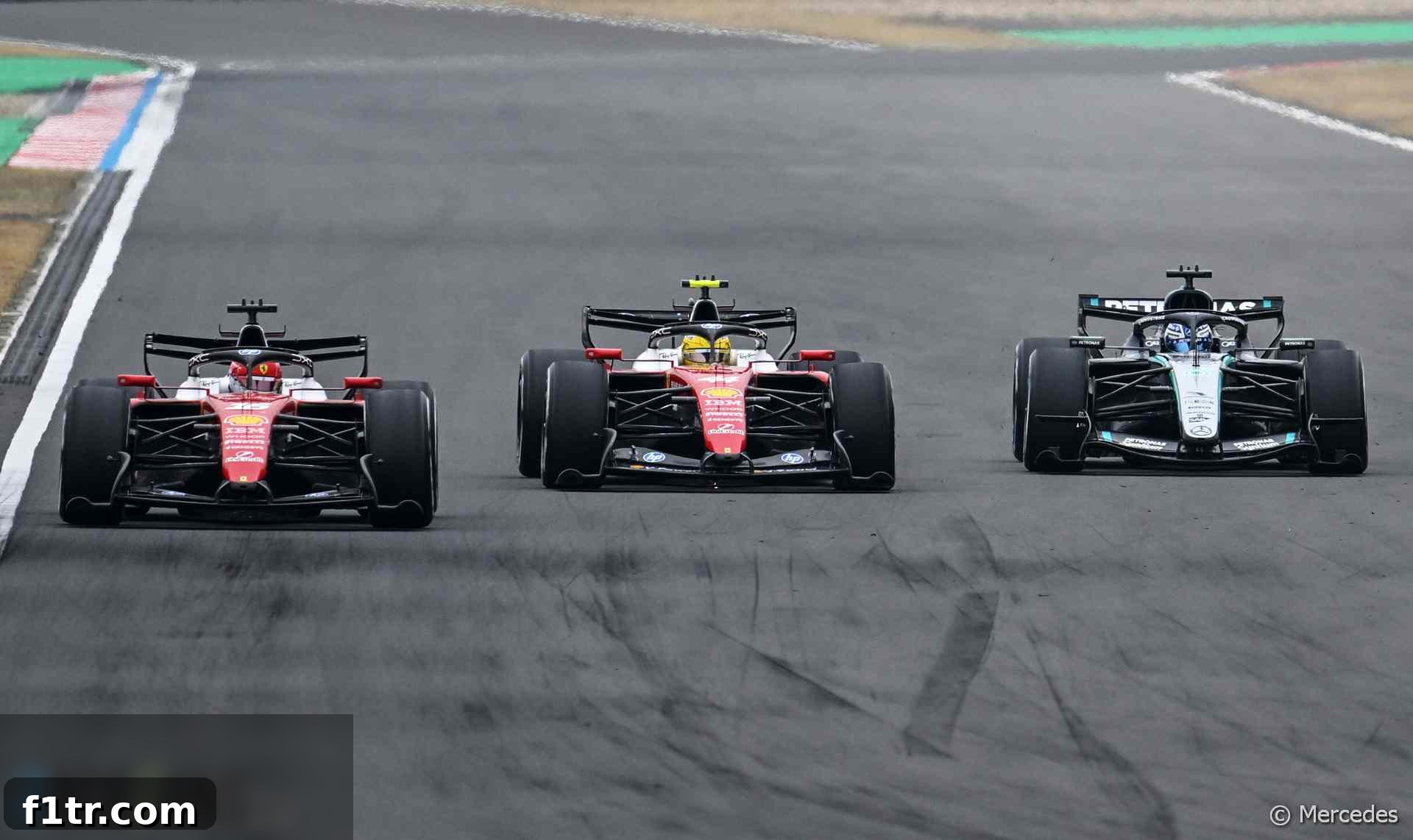
Ferrari team principal Frederic Vasseur has strongly rejected suggestions that this season’s changes have made Formula 1 racing feel overly “artificial.”
Advert | Become a Supporter & go ad-free
Several drivers, including Max Verstappen and Lando Norris, have criticised how easily positions can change under the new energy deployment rules and F1’s Overtake Mode. The measures have produced frequent position swaps during races, prompting some to call it “yo-yo racing.” Norris said he once overtook Lewis Hamilton’s Ferrari unintentionally because of how energy deployment played out in the race.
F1 CEO Stefano Domenicali recently dismissed claims that overtaking has become artificial. At today’s FIA press conference, Vasseur pushed back strongly when a journalist suggested “the first three races have left some question marks for those watching.”
“I would be less harsh than you on the show of the first three events,” Vasseur said. “Honestly, we had good races, a lot of overtaking.”
Last year F1 removed one traditional overtaking aid, the Drag Reduction System (DRS), which allowed drivers to reduce rear wing drag when within a second of the car ahead. That system has been replaced by Overtake Mode, which supplies extra power when a driver is within a second of the car in front. Unlike DRS, Overtake Mode has no external signal indicating it is in use.
Advert | Become a RaceFans supporter andgo ad-free
Vasseur argued the new rules result in less artificial racing than the DRS era. “You can say that perhaps you have the feeling that it’s a bit artificial, but for me it’s much less artificial than the DRS,” he said. “DRS was just [a] push on the button; today it’s energy management and it’s coming from the drivers or from the team. It’s not artificial at all.”
He did acknowledge that the regulations can be refined. “Thanks to the FIA, we had the capacity to discuss, after each event, to try to improve the system. It’s not easy to do it during the season, but we are, I think, all collaborative with this.”
Domenicali has compared the current approach to the turbo boost management of the 1980s, when drivers adjusted engine boost but had to balance performance against fuel consumption. That comparison was rejected by Nigel Mansell, who raced in that era and said the situations are not comparable.
“No, no we didn’t,” Mansell told The Pop-Up Hotel. “If we lifted-and-coasted, it was like feathering the throttle when you’re slipstreaming somebody and decid[ed] not to overtake them. That’s saving fuel and feathering. That’s smart. Having to have a computer just take over the running of the car and harvest for the battery, that’s something completely different. And we didn’t slow down by 50 to 70[kph] going into the fastest corners. It’s a bit of a stretch to compare that, I have to say.”
Advert | Become a RaceFans supporter andgo ad-free
Miss nothing from RaceFans
Get a daily email with all our latest stories – and nothing else. No marketing, no ads. Sign up here:
2026 Miami Grand Prix
- Miami stats: Mercedes have now won at every track on the F1 calendar – so far
- F1 drivers say they are still at the mercy of their power units over a flying lap
- McLaren’s Miami GP radio messages show the scars of Qatar GP tactical error
- ‘This is not the level F1 should be’: Norris tells F1 to ‘ditch the battery’
- Lawson was right: Racing Bulls should not have ordered him to let Verstappen past
Browse all 2026 Miami Grand Prix articles