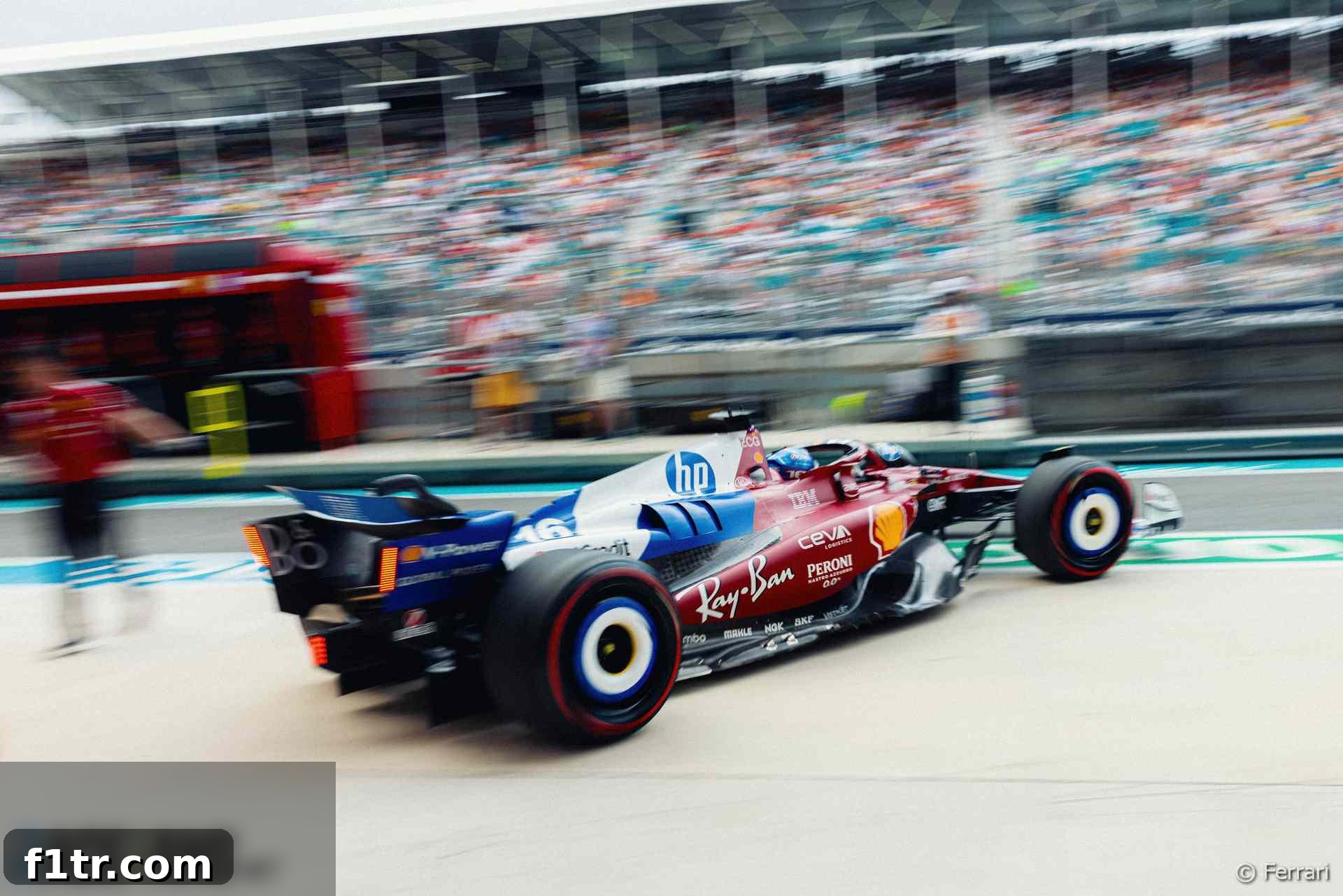
Ferrari’s Miami Misery: Vasseur and Leclerc Lament Devastating Qualifying Performance
Ferrari’s aspirations for a strong showing at the Miami Grand Prix were dealt a significant blow during what can only be described as a profoundly disappointing qualifying session. The iconic Scuderia found themselves in an unenviable position, with both their cars astonishingly out-qualified by the Williams drivers, a stark indicator of their struggles. Team Principal Frederic Vasseur openly expressed his dismay, acknowledging the severity of the performance deficit that left the entire team grappling for answers. This unexpected downturn casts a long shadow over their race prospects and raises serious questions about the team’s ongoing battle with qualifying pace.
Charles Leclerc managed only eighth place on the grid, positioning him directly behind the two surprising FW47s. Adding to Ferrari’s woes, Lewis Hamilton, a strong contender in the earlier sprint race, failed to even make the cut for Q3, consigning him to a distant 12th starting position for the main event. This collective underperformance highlighted a worrying trend that has plagued Ferrari throughout the nascent stages of the season, yet in Miami, it reached a critical peak, becoming a focal point of frustration for drivers and management alike.
Vasseur’s Frustration and Ferrari’s Persistent Tyre Troubles
“It was a bad quali,” Vasseur candidly admitted, his words echoing the palpable disappointment within the Ferrari garage. His primary concern revolved around the drivers’ inability to extract peak performance from fresh tyres – a fundamental aspect of successful qualifying. “We struggled a lot to put a lap together with the new soft [tyres],” he explained, pinpointing a crucial technical hurdle. Intriguingly, both Ferrari drivers found their fastest laps were achieved on scrubbed tyres, an anomaly that Vasseur was quick to identify as a significant flaw in their approach. “That’s not the right way to do quali,” he asserted, emphasizing the deviation from optimal strategy and execution.
This unusual preference for used rubber over fresh compounds suggests a complex interplay of factors, potentially including difficulties in generating optimal tire temperature, issues with car balance on peak grip, or even a narrow operating window for the specific tyre compound. Whatever the root cause, it clearly hindered Ferrari’s ability to maximize their one-lap pace when it mattered most. The discrepancy between new and used tyre performance often points towards a car that struggles with rapid warm-up or one that is overly sensitive to subtle changes in tire condition, making it challenging for drivers to confidently push to the absolute limit. This tactical misstep, or rather, this inherent car characteristic, proved incredibly costly in a qualifying session where every tenth of a second is fiercely contested.
A Season-Long Struggle Amplified in Miami
Ferrari’s difficulties in qualifying are not an isolated incident at the Miami Grand Prix; they represent a recurring challenge that has shadowed the team since the beginning of the season. However, the severity of the problem in Miami was unprecedented. “We are already from the beginning of the season struggling more in quali than in the race, but today was too much,” Vasseur elaborated. This consistent pattern of being stronger on race day than during qualifying suggests that the SF-24 might possess inherent traits that make it more suited to longer runs and sustained performance rather than outright single-lap speed.
While a strong race pace is undoubtedly crucial for securing championship points, starting further down the grid consistently puts the team at a significant disadvantage. It necessitates more aggressive strategies, increases the risk of being caught in midfield skirmishes, and makes it harder to compete for podium finishes, let alone race victories. The gap in performance between Saturday and Sunday is a puzzle Ferrari desperately needs to solve if they are to mount a credible challenge against their rivals. The Miami circuit, with its unique characteristics, may have exacerbated these underlying issues, bringing them into sharper focus and creating a more pronounced delta compared to previous events. The concrete layout and specific corner profiles might not have played to the strengths of the SF-24’s qualifying setup, further complicating their efforts.
Become a RaceFans supporter and go ad-free
A Glimmer of Hope: Leveraging Race Pace for Grand Prix Recovery
Amidst the gloom of their qualifying performance, Ferrari could perhaps draw a sliver of perspective from the earlier sprint race. While not directly involving Ferrari’s own cars, the strong drive by Lewis Hamilton to a third-place finish in the sprint offered a demonstration of what strategic acumen and effective tire management could achieve. Vasseur had noted, “Lewis did a very good race this morning with a good call for the strategy, the pit stop and so on.” Although Hamilton races for Mercedes, his successful sprint race, characterized by intelligent strategic decisions, highlighted the potential for a recovery drive in the main Grand Prix, assuming Ferrari could unlock their Sunday pace.
This distinction between sprint performance and main qualifying often reflects differing car characteristics or track conditions throughout the weekend. For Ferrari, their historical tendency to perform better on Sundays offers a lifeline. “Now, [the grand prix] will be another story. So far in the season we had always better pace on Sunday than Saturday, and let’s see what we can do,” Vasseur stated with a cautious optimism. This hope hinges on their ability to transform a challenging starting position into a points-scoring finish, relying on their presumed stronger long-run pace and strategic prowess during the full-length race. The challenge, however, remains immense, given the fiercely competitive nature of the modern Formula 1 grid.
Leclerc’s Mounting Frustration: The Driver’s Perspective
For Charles Leclerc, a driver of immense talent and ambition, the recent dip in Ferrari’s form has been a source of profound frustration. He secured his Q3 spot by a mere four-hundredths of a second, a testament to his pushing, but also a stark reminder of the car’s inherent limitations. “It’s just not good enough,” Leclerc declared, his voice undoubtedly carrying the weight of a driver who knows he’s capable of more. His personal assessment of his own performance offers a poignant insight into the struggles. “It’s frustrating because it’s those kind of days, it has been quite a few races already that I feel I’m doing a really good job but when you are finishing P4, P5, P6, P7, P8, it is just a shame.”
This sentiment underscores a critical dilemma for top-tier drivers in underperforming machinery: the mental battle of delivering peak performance yet seeing only middling results. Leclerc’s consistent finishes within the P4-P8 bracket, despite feeling he’s maximizing the car’s potential, are disheartening. It speaks volumes about the inherent pace deficit of the SF-24 in qualifying trim. For a driver accustomed to fighting for poles and victories, these results are not just disappointing; they erode confidence and make the pursuit of a championship feel increasingly distant. His candid admission, “I have no satisfaction of doing a good job,” reveals the psychological toll. The internal struggle between personal excellence and team performance is clearly evident, as he expressed a longing for a quick turnaround: “I’m just hoping that we can turn the situation around as soon as possible but at the moment that’s the situation we are in and there’s not much I can do.” This helplessness, coming from one of the grid’s brightest stars, is a stark indictment of Ferrari’s current competitive standing.
The Shock of Williams: A Wake-Up Call for the Scuderia
Perhaps the most jarring aspect of Ferrari’s Miami qualifying was being outpaced by both Williams cars. Historically, Williams has been a team battling at the rear of the grid, slowly working its way back to competitiveness. For a team of Ferrari’s stature, with its vast resources and illustrious history, to find itself behind a rival like Williams, even if it’s just for a single qualifying session, serves as a significant wake-up call. This unexpected turn of events highlights not only Ferrari’s struggles but also the significant strides made by other teams in optimizing their packages for specific track conditions or overall performance.
Such a result is more than just a momentary blip; it reflects a deeper competitive issue that Ferrari must address with urgency. It suggests that on certain tracks, or under specific conditions, their package is simply not operating at a level expected of a front-running team. This kind of comparative performance can have psychological implications for the team and drivers, potentially leading to increased pressure and scrutiny from the media and the passionate Tifosi. The contrast between Ferrari’s heritage and its current qualifying output in Miami could not be more stark, forcing a re-evaluation of their current competitive standing.
Navigating the Grand Prix: Strategy and Outlook
Heading into the main Miami Grand Prix, Ferrari faces an uphill battle. Starting from eighth and twelfth positions, Leclerc and his teammate will need flawless drives and impeccable strategy to salvage significant points. The expectation, as Vasseur noted, is for better race pace on Sunday. This optimism, however, must be tempered by the realities of grid position. Overtaking opportunities in Miami, while present, are not boundless, and getting stuck in the midfield pack can quickly compromise tire strategy and overall race execution.
The team will likely need to rely on their supposed superior long-run performance and clever pit-stop timing to make progress. Tire management will be paramount, particularly if the SF-24 continues to exhibit unusual characteristics with different compounds. A safety car period could either be a blessing or a curse, depending on when it occurs and how Ferrari reacts. The prospect of a strong recovery drive, while challenging, is not impossible, but it demands absolute precision and a significant improvement in overall car behavior compared to Saturday’s showing. The team’s engineers will undoubtedly be working tirelessly overnight to analyze data, fine-tune setups, and devise a strategy that can maximize their potential on race day.
The Road Ahead for Ferrari
The Miami Grand Prix qualifying session serves as a stark reminder of the intense competition in Formula 1 and the critical need for continuous improvement. For Ferrari, the path forward involves a thorough understanding of their car’s qualifying weaknesses, particularly concerning tire optimization and one-lap pace. Addressing these issues will require a multifaceted approach, potentially involving aerodynamic adjustments, suspension refinements, and a deeper dive into their tire usage protocols.
The Scuderia carries the weight of immense expectation, and while their race pace has shown flashes of promise, consistency across the entire weekend is vital for championship aspirations. Frederic Vasseur’s leadership will be crucial in guiding the team through these challenging times, ensuring that the frustration expressed by drivers like Charles Leclerc is channeled into constructive solutions. The Miami setback is a clear call to action, demanding that Ferrari redouble its efforts to unlock the full potential of its package and deliver performances worthy of its legendary status. The season is long, but every missed opportunity in qualifying puts them further on the back foot, making the urgency for a turnaround all the more pronounced.
Become a RaceFans supporter andgo ad-free
Stay Updated on Formula 1 News
Don’t miss a moment from the thrilling world of Formula 1. Get the latest news, analyses, and race updates delivered directly to your inbox.
Sign up to stay informed about Ferrari’s journey and all the action on the track.
More from the 2025 Miami Grand Prix
- Nothing for Ferrari to learn from Miami team orders episode – Vasseur
- Hamilton proud of Ferrari as ‘we’re taking a beating from media and people’s comments’
- McLaren legality never in doubt says Piastri as FIA’s post-race check clears car
- Albon did not disobey team orders in Miami says Vowles after Sainz’s complaint
- McLaren score their most emphatic win since Hamilton’s 2008 Silverstone triumph
Browse all 2025 Miami Grand Prix articles