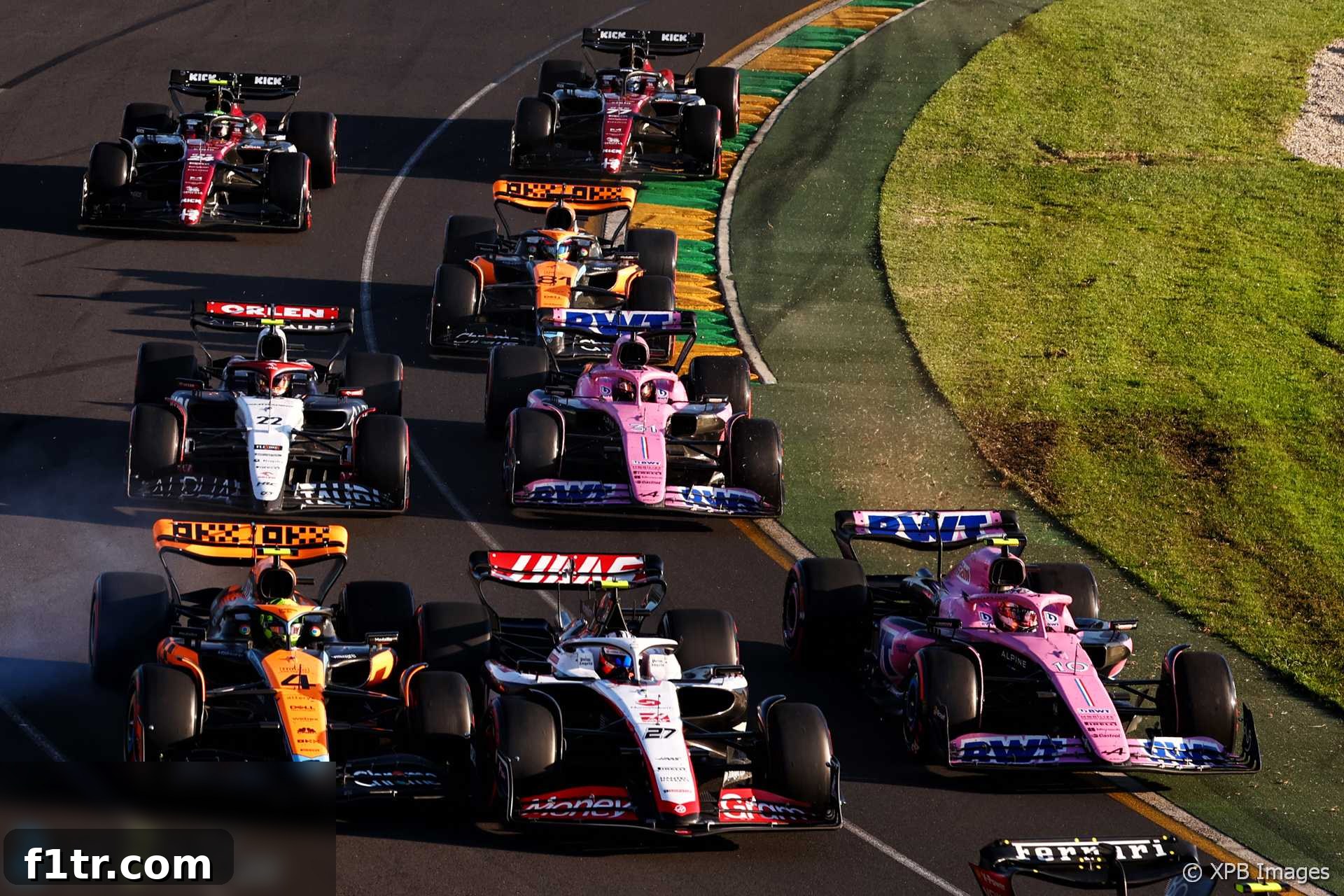
Pierre Gasly has been granted a significant reprieve, successfully avoiding any further penalty points on his Super Licence following a dramatic collision with his Alpine teammate, Esteban Ocon, during the tumultuous Australian Grand Prix. This decision by the race stewards is a monumental relief for Gasly, who currently finds himself on the precipice of an automatic race ban, with his current tally of 10 penalty points placing him just two points away from a mandatory one-race suspension from Formula 1 competition.
Advert | Become a Supporter & go ad-free
The incident, which saw both Alpine cars retire from the race, unfolded on lap 56 at Melbourne’s Albert Park Circuit. The 2023 Australian Grand Prix was already proving to be one of the most chaotic and action-packed races in recent memory, having been punctuated by no fewer than three red flags and three standing starts. It was after the final red-flag period and the third standing start of a truly frenetic day that the unfortunate collision occurred. Gasly, pushing hard amidst the chaos of the restart, ran wide at Turn 1. As he attempted to rejoin the racing line, he veered directly into the path of Ocon, who was running alongside him. The contact was swift and brutal, sending both French drivers and their A523 machinery crashing heavily into the barriers, prematurely ending what had been a promising, albeit dramatic, Grand Prix for the Alpine team.
The Stewards’ Rationale: Understanding a ‘First Lap Racing Incident’
Post-race, the Formula 1 stewards initiated a thorough investigation into the incident, a standard procedure for any significant on-track entanglement. They summoned both Pierre Gasly and Esteban Ocon, along with a representative from the Alpine team, to gather their perspectives and review all available telemetry and video evidence. After careful deliberation, the stewards concluded that the collision was a “first lap racing incident.” This crucial classification, particularly when considered in the unique context of it occurring immediately after a standing start, proved decisive in their decision not to impose any further sanctions on either driver.
In their official notes, the stewards provided clarity on their ruling: “Both cars [drivers] recognized and accepted this as such. In the circumstances, we took no further action.” This statement implies a degree of shared responsibility or, more accurately, an acknowledgment that in the intensely competitive and often unpredictable environment of a race restart, such incidents can occur without malicious intent or gross negligence. The unique challenges presented by a standing start – where cars are bunched tightly together, drivers are jostling for position, and tires are still cold – often lead to a greater degree of tolerance from the stewards for minor infringements. Harsher penalties are typically reserved for actions deemed truly egregious or demonstrably unsafe beyond the inherent risks of racing.
This leniency is not uncommon in Formula 1, especially when considering the dynamic and unpredictable nature of restarts. Drivers are expected to race hard and push the limits, and slight misjudgments can be easily made in the heat of the moment, particularly when rejoining the track after an excursion. The stewards’ primary role is to ensure fair play and safety, but they also acknowledge the inherent risks and intense competitive pressure of Grand Prix racing. Their decision here reflects a nuanced understanding of these complexities, differentiating between a genuine racing incident and a clear breach of sporting regulations.
Gasly’s Precarious Position: Averting an Automatic Race Ban
The stewards’ decision comes as an immense relief for Pierre Gasly, whose Super Licence currently carries a concerning tally of 10 penalty points. Under the stringent regulations of Formula 1, accumulating 12 penalty points within a 12-month period automatically triggers a mandatory one-race ban. With just two points shy of this threshold, Gasly has been driving under immense pressure for several races, forced to exercise extreme caution to avoid any incident that could lead to additional points. Had the stewards deemed him solely responsible for the collision with Ocon, even a minor penalty of two points would have resulted in him missing an upcoming Grand Prix, a significant blow to both his personal championship aspirations and Alpine’s constructors’ championship efforts.
The looming threat of a race ban is a significant psychological burden for any Formula 1 driver. It not only impacts their individual performance and career trajectory but also has tangible consequences for the team’s overall strategic objectives. Missing a race means a guaranteed loss of potential points, vital for the constructors’ standings, and a valuable opportunity for track time and data collection. Gasly’s current penalty points stem from a series of incidents over the past year, reflecting various infringements such as speeding under red flag conditions, exceeding track limits, and causing avoidable collisions. This accumulation serves as a stark reminder of the rigorous standards of conduct expected from F1 drivers and the unforgiving nature of the penalty system, designed to promote safe and fair racing.
This narrow escape means Gasly will remain eligible for the upcoming races, providing a temporary reprieve. However, the shadow of the ban will continue to hang over him until at least the Monaco Grand Prix at the end of May, when some of his older penalty points will begin to expire after reaching their 12-month limit. Until then, every on-track maneuver, every defensive move, and every overtake will be scrutinised, not just by competitors and fans, but by Gasly himself, acutely aware that any misstep could lead to him sitting out a race weekend, a scenario no driver ever wishes to face.
Teammate Dynamics and Alpine’s Strategic Response
In the immediate aftermath of the incident, both drivers demonstrated commendable professionalism and maturity, a crucial factor for maintaining team harmony. Esteban Ocon was quick to absolve his teammate of blame, acknowledging the challenging circumstances of the restart. “It was unfortunate to have both our cars come together at the third standing start,” Ocon commented, also confirming that Gasly had immediately apologised for the contact. This measured and understanding response from Ocon is vital for preventing intra-team rivalries from escalating into detrimental internal conflicts, especially within a highly competitive environment like Formula 1.
Team Principal Otmar Szafnauer echoed the sentiment of misfortune while primarily expressing relief regarding the drivers’ safety. “I’m glad both drivers are okay given the nature of the incident,” Szafnauer stated. The immediate priority for any team principal following a high-speed crash is always the well-being of their drivers. While undoubtedly frustrated by the double retirement and the loss of potential constructors’ points – Alpine had been performing strongly up to that point – Szafnauer’s public statements focused on safety and an understanding of the inherent perils of Grand Prix racing. He effectively managed the narrative to prevent any public blame game, which could destabilise the team.
A teammate collision is always a difficult pill to swallow for any Formula 1 outfit. It represents a lost opportunity for constructors’ points, and often creates unwanted tension and scrutiny. For Alpine, a team with clear ambitions to challenge the top three constructors, such incidents are particularly detrimental. The French squad has been working diligently to solidify its position as the ‘best of the rest’ in the midfield, and every single point counts in that fierce battle. The incident in Australia, while ultimately ruled a racing incident, serves as a harsh lesson and a potent reminder of the fine margins in Formula 1, where a single misjudgment can have significant consequences for both drivers and the team’s overall season objectives.
Maintaining a cohesive and productive environment between two highly ambitious and competitive drivers like Gasly and Ocon is a delicate balancing act for any F1 team. Both drivers are fiercely competitive and eager to prove their worth, especially in a team where both are relatively new to their respective positions as team leaders. Incidents like the one in Australia test the strength of those relationships and the team’s ability to manage them effectively. The immediate post-race reactions suggest that Alpine has successfully navigated this potentially fraught situation, at least publicly, allowing them to move forward with a unified front and minimise any lasting internal damage.
Looking Ahead: The Road to Redemption for Gasly and Alpine
With the chaotic Australian Grand Prix now firmly behind them, both Pierre Gasly and the Alpine F1 Team will be eager to put this incident behind them and focus intently on the remainder of the 2023 Formula 1 season. For Gasly, the immediate pressure of an impending race ban has been temporarily lifted, but the underlying threat remains a constant companion for the next few Grand Prix events. This will undoubtedly influence his approach to racing, forcing him to strike a careful balance between aggressive competitive driving and extreme caution to avoid further infringements that could trigger a suspension.
For Alpine, the double retirement was a deeply disappointing setback in their relentless quest for constructors’ championship points. However, the underlying performance shown throughout the race, prior to the unfortunate collision, indicates that the A523 car possesses decent pace and potential. The primary challenge now for the team is to convert that raw potential into consistent points finishes and to ensure that such teammate incidents are meticulously avoided in the future through clear communication, strategic race management, and comprehensive driver briefings. The team will undoubtedly be analysing the data from Australia extensively to understand the precise circumstances that led to Gasly’s off-track excursion and to identify any areas for improvement in their race management strategies during chaotic restarts.
The thrilling and unpredictable nature of the Australian Grand Prix, punctuated by multiple red flags and safety car periods, certainly added to the drama and unpredictability of the event. While the Gasly-Ocon collision was a regrettable outcome for Alpine, it ultimately reinforces the high-stakes environment of Formula 1 and the fine line between triumph and disaster that drivers navigate every race weekend. As the F1 circus moves to its next destination, all eyes will continue to be on Pierre Gasly, not just for his on-track performance, but for his continued navigation of the perilous penalty point system, which remains a sword of Damocles hanging over his season.
The saga of Pierre Gasly’s penalty points and his narrow escape from a race ban will undoubtedly be a talking point for weeks to come within the Formula 1 community. It vividly highlights the intricate balance drivers must strike between pushing the absolute limits of their machinery and adhering to the stringent rules designed to maintain fairness, safety, and sporting integrity in the fastest sport on Earth. For Alpine, the incident serves as a call to rally, learn from the experience, and press on in their ambitious quest to climb higher up the F1 constructors’ ladder.
Don’t miss anything new from RaceFans
Follow RaceFans on social media:
- Join RaceFans on Facebook
- Follow RaceFans on Twitter
- Get daily email updates from RaceFans
Advert | Become a RaceFans supporter andgo ad-free
2023 Australian Grand Prix Related Articles
- Australian GP to forbid fans from entering track at end of this year’s race
- I only missed one chance to score points this year – Albon
- Formula 1’s stewards should listen to drivers less, not more
- Mercedes unsure whether gains seen in Melbourne were ‘track-specific’
- Why Ferrari saw a ‘real step forward in pure performance’ in point-less Australian GP
Browse all 2023 Australian Grand Prix articles