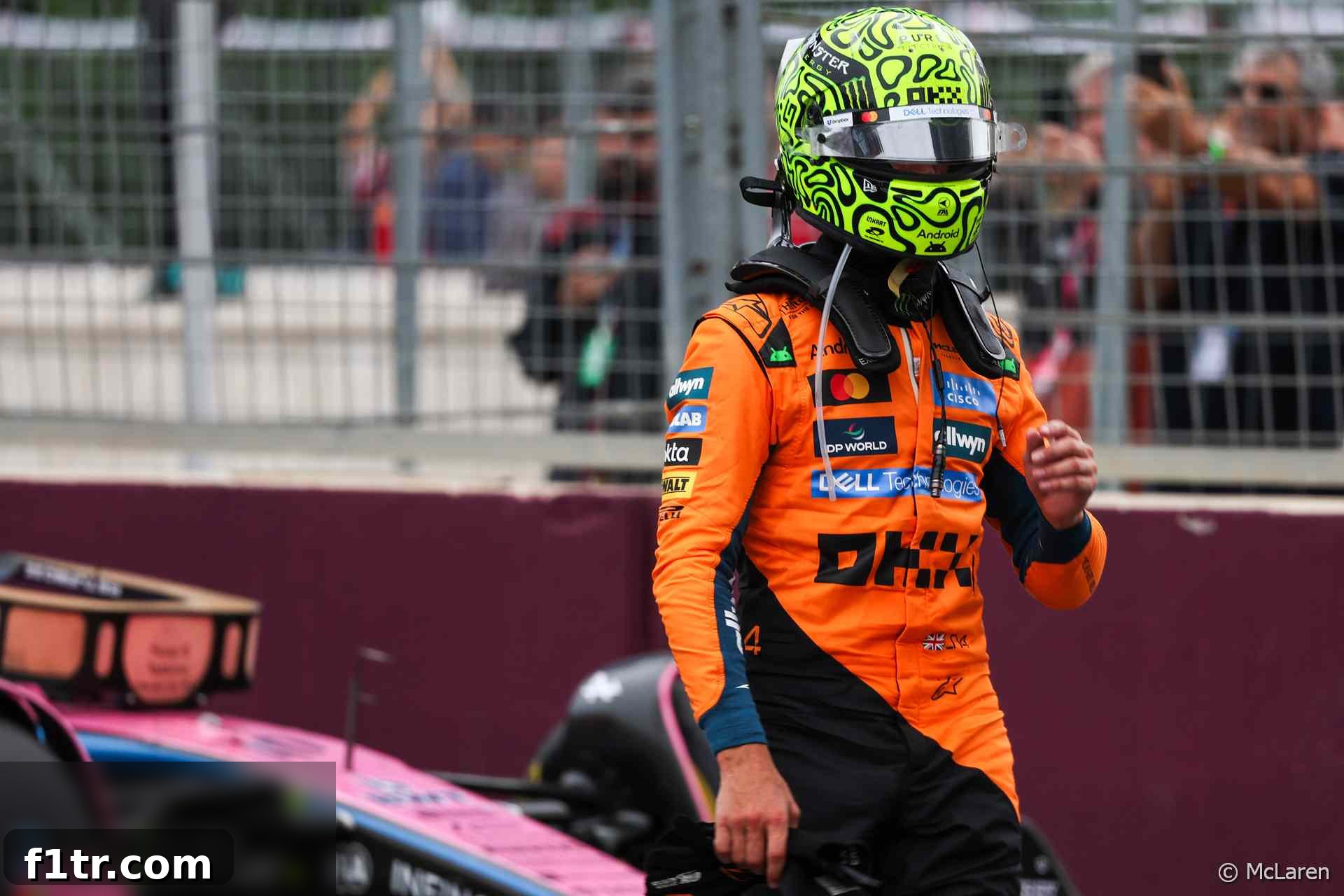
Lando Norris: Azerbaijan Grand Prix Not a Missed Opportunity, Despite Challenging Weekend
Lando Norris, the talented McLaren driver, delivered a firm statement following his seventh-place finish at the recent Azerbaijan Grand Prix, unequivocally denying that the outcome represented a missed opportunity for either himself or the team. His comments emerged from a demanding race weekend on the high-stakes Baku City Circuit, a unique venue celebrated for its thrilling combination of high-speed straights and incredibly intricate, often unforgiving, street sections.
Advert | Become a Supporter & go ad-free
Norris completed the Grand Prix in the exact position he started, seventh, a testament to the challenging nature of the race where track position proved paramount. While he did manage to gain a marginal advantage in the Drivers’ Championship standings over his teammate, Oscar Piastri – who, unfortunately, retired early on the first lap after an incident – the broader championship narrative saw race winner Max Verstappen extend his formidable lead by a substantial 19 points over Norris. This result naturally fueled discussions among Formula 1 enthusiasts and media outlets, prompting questions about whether a higher finish could have been achieved, especially given Norris’s widely acknowledged talent and McLaren’s visible advancements in car performance throughout the season.
Norris’s Insight: Baku’s Overtaking Paradox
Addressing the widespread speculation surrounding his performance, Norris provided a clear and unvarnished assessment, emphasizing the inherent difficulties of racing on the Baku circuit. “It was just too difficult to follow and overtake,” he articulated to the official Formula 1 broadcast channel, echoing a common refrain among drivers grappling with the specific characteristics of this challenging street circuit. This particular hurdle, as Norris pointed out, transcended the raw pace of his car. “So it didn’t really matter how quick the car was,” he elaborated, stressing that pure speed alone was insufficient to dramatically alter one’s position on a track where dirty air significantly impacts aerodynamic performance and thus, overtaking capability.
Further expanding on the McLaren MCL60’s performance, Norris stated, “I think the car was good, but it was just too difficult to follow and overtake.” His remarks paint a picture of a car possessing a solid underlying performance foundation, yet one that struggled to fully exploit its potential on a circuit notorious for its limited genuine overtaking zones, primarily confined to the expansive DRS-assisted main straight. This intrinsic limitation meant that even the most meticulously crafted strategic decisions would have yielded only marginal gains. “I couldn’t really do anything with strategy,” Norris concluded, conveying a sense of being constrained by the unique racing dynamics of Baku. “So I don’t think we could have done anything more today.” His perspective highlights a mature understanding of the sport’s complexities, where raw performance must align with circuit characteristics and strategic opportunities.
Qualifying Hurdles: A Challenging Precursor to Race Day
The groundwork for Norris’s seventh-place race finish was inadvertently laid during a particularly trying qualifying session. He secured his starting position on the fourth row of the grid, a direct consequence of a costly error during his sole Q3 lap. A momentary misjudgment saw him make contact with a barrier, compromising a crucial lap time and ultimately impacting his final grid slot. Reflecting candidly on the incident, Norris later confessed that the decision to be among the first drivers out of the pits at the end of the session proved to be a tactical miscalculation. This strategic choice meant he was deprived of the beneficial track evolution that subsequent runners often enjoy, compounding the pressure of being the first to set a competitive benchmark. Consequently, his grid position was a direct outcome of both a minor driving infraction and a strategic oversight, establishing a formidable challenge for Sunday’s main event.
The Race Unfolds: On-Track Battles and Unforeseen Setbacks
The Grand Prix itself served as a microcosm of Norris’s entire weekend, characterized by a series of struggles punctuated by moments of resilience and small victories. At the race start, he immediately relinquished a position, dropping behind Isack Hadjar. The early phases of the race were further complicated by the deployment of a Safety Car, an event that frequently reshuffles the running order and presents significant strategic dilemmas for teams, particularly concerning pit stop timings. Following this period of neutralization, Norris found himself losing yet another position, this time to the formidable Ferrari driver Charles Leclerc, a highly competitive adversary on any circuit.
However, Norris, renowned for his tenacious racing spirit and unwavering determination, refused to be sidelined. He meticulously worked his way back through the field, first reclaiming his position from Isack Hadjar with a decisive and well-executed maneuver. Later in the race, post his mandatory pit stop, he managed to execute a crucial overtake on Charles Leclerc, demonstrating his innate ability to capitalize on even fleeting opportunities when they presented themselves. Yet, despite these impressive displays of race craft, his pursuit of a higher finishing position was ultimately hindered by an unfortunate incident during his pit stop. A slightly slow pit stop cost valuable seconds, a significant detriment on a circuit where maintaining track position is paramount. This delay meant he emerged from the pits marginally behind both Yuki Tsunoda and Liam Lawson, positions he was unable to recover before crossing the finish line. The minimal gap to these drivers at the chequered flag starkly underscored the critical impact of that single, albeit brief, pit stop error, highlighting how fine the margins are in Formula 1.
Maximizing Every Opportunity: Norris’s Unwavering Philosophy
Norris’s post-race comments echoed the sentiments he had expressed on Saturday, where he had already confidently asserted that he missed no opportunities during the qualifying session. On Sunday, he extended this conviction to his race performance, maintaining a consistent, professional, and pragmatic outlook. “I did everything I can,” he stated emphatically, emphasizing his unwavering commitment and maximum effort throughout what proved to be a demanding Baku weekend. This perspective is central to his racing philosophy: an acute focus on what is within his control and a dedication to extracting the absolute maximum performance from every given situation, irrespective of the outcome.
He continued, “The opportunities were there, I maximise every single weekend like I can.” This particular statement highlights a key characteristic of top-tier athletes – the capacity to assess one’s performance objectively and avoid dwelling on speculative hypotheticals. For Norris, every race is approached with the mindset of a fresh opportunity, detached from previous results or perceived setbacks. “It’s not a missed opportunity, every race is an opportunity and today we just weren’t good enough and made too many mistakes yesterday.” This final, nuanced statement provides a deeper insight: while the race itself might have offered limited chances for significant advancement due to the circuit’s nature, the collective performance, including the qualifying errors, undeniably contributed to the ultimate seventh-place result. It represents a pragmatic acceptance of both the team’s and his own performance, rather than an insistence that a dramatically different outcome was easily achievable solely on race day. This holistic view acknowledges the intricate interplay of factors in Formula 1.
McLaren’s Weekend in Context: A Strategic Assessment
The Azerbaijan Grand Prix ultimately represented a challenging, yet informative, chapter for the McLaren team. While Lando Norris showcased his characteristic resilience and managed to score valuable points, Oscar Piastri’s early retirement meant the team could only tally points with one car. The idiosyncratic demands of the Baku street circuit frequently expose subtle nuances and weaknesses in car design and setup. It appeared McLaren, despite their evident performance improvements throughout the season, found themselves in a particularly tricky position in Baku. The MCL60, while demonstrating clear flashes of speed and potential, especially in clean air, struggled considerably when operating in the turbulent “dirty air” behind other cars. This directly impacted Norris’s ability to effectively advance through the field. This inherent limitation on overtakes necessitated a more defensive and positional race strategy, rather than one of aggressive and constant advancement, which is often McLaren’s preferred approach.
Strategic Implications and Future Trajectory
The strategic landscape of Baku, with its high-risk overtaking maneuvers, extensive DRS zones, and the ever-present threat of Safety Car interventions, demands impeccable execution from both drivers and the pit wall. McLaren’s pit stop performance, particularly the slightly slow stop experienced by Norris, emerged as a critical factor in determining his final track position. Such marginal errors, though seemingly minor in isolation, accumulate to significant track time loss within the ultra-competitive environment of Formula 1. For a team with aspirations of consistently challenging for podiums and victories, optimizing every single aspect of their operation, from the initial qualifying strategy to the seamless execution of pit lane procedures, becomes absolutely paramount.
Looking ahead, McLaren will undoubtedly undertake a meticulous analysis of the data gathered from Baku. Understanding precisely why the car struggled more than anticipated in traffic, and refining their qualifying strategy to better mitigate risks in dynamic sessions like Q3, will constitute key learning points. While Max Verstappen’s dominant performance in the race set a formidable benchmark for the entire grid, Norris’s commendable ability to extract points even on what was clearly a difficult weekend is a testament to his consistent driving prowess and maturity. The team will be keen to translate the inherent “good” aspects of the car into more tangible and consistent results at upcoming circuits, particularly those that offer more conventional and plentiful overtaking opportunities, allowing their drivers to unleash the MCL60’s full potential.
Conclusion: Resilience and Realistic Ambition Define Baku Outcome
Lando Norris’s seventh-place finish at the Azerbaijan Grand Prix, while not the podium finish he consistently strives for, was ultimately presented by the driver himself not as a failure to capitalize on chances, but rather as the absolute maximum achievable given the unique and often brutal circumstances of the race weekend. His detailed explanations offer valuable insight into the complex realities of Formula 1 racing on a circuit as peculiar and demanding as Baku. It was a weekend that unfolded with a challenging qualifying session marked by a minor error, a race fraught with minor setbacks such as a critical slow pit stop, and the overarching challenge of a circuit design that inherently stifled aggressive and free-flowing racing. Instead of lamenting a ‘missed opportunity,’ Norris underscored his unwavering commitment to maximizing every ounce of potential available to him and his team, race after race. This particular perspective, which prioritizes sustained effort and objective assessment over regret or what-ifs, strategically positions both Norris and McLaren for continuous learning and subsequent improvement as the highly competitive Formula 1 season progresses. The key lesson gleaned from Baku for McLaren is unequivocally clear: while the car’s underlying pace and potential are strong, the flawless execution of every single detail, from the initial strategic planning to the precision of pit lane operations, is absolutely crucial for elevating a ‘good’ performance into a truly ‘great’ one on every single Grand Prix weekend.
Advert | Become a RaceFans supporter andgo ad-free
Miss nothing from RaceFans
Get a daily email with all our latest stories – and nothing else. No marketing, no ads. Sign up here:
(Subscription form and related JavaScript elements removed as per instructions to clean JavaScript codes and produce only article-relevant HTML content.)
2025 Azerbaijan Grand Prix Related Articles
- Sainz praises “hardest working” engineer who wept after his Baku podium
- McLaren had best car for “95% of races” but Red Bull have caught up – Norris
- Norris couldn’t close a 69-point gap in 14 rounds. Verstappen has to do it in seven
- “That’s not what we discussed”: Ocon’s complaint about Haas’s team orders in Baku
- Verstappen has led more laps than Norris in 2025: Azerbaijan GP stats
Browse all 2025 Azerbaijan Grand Prix articles