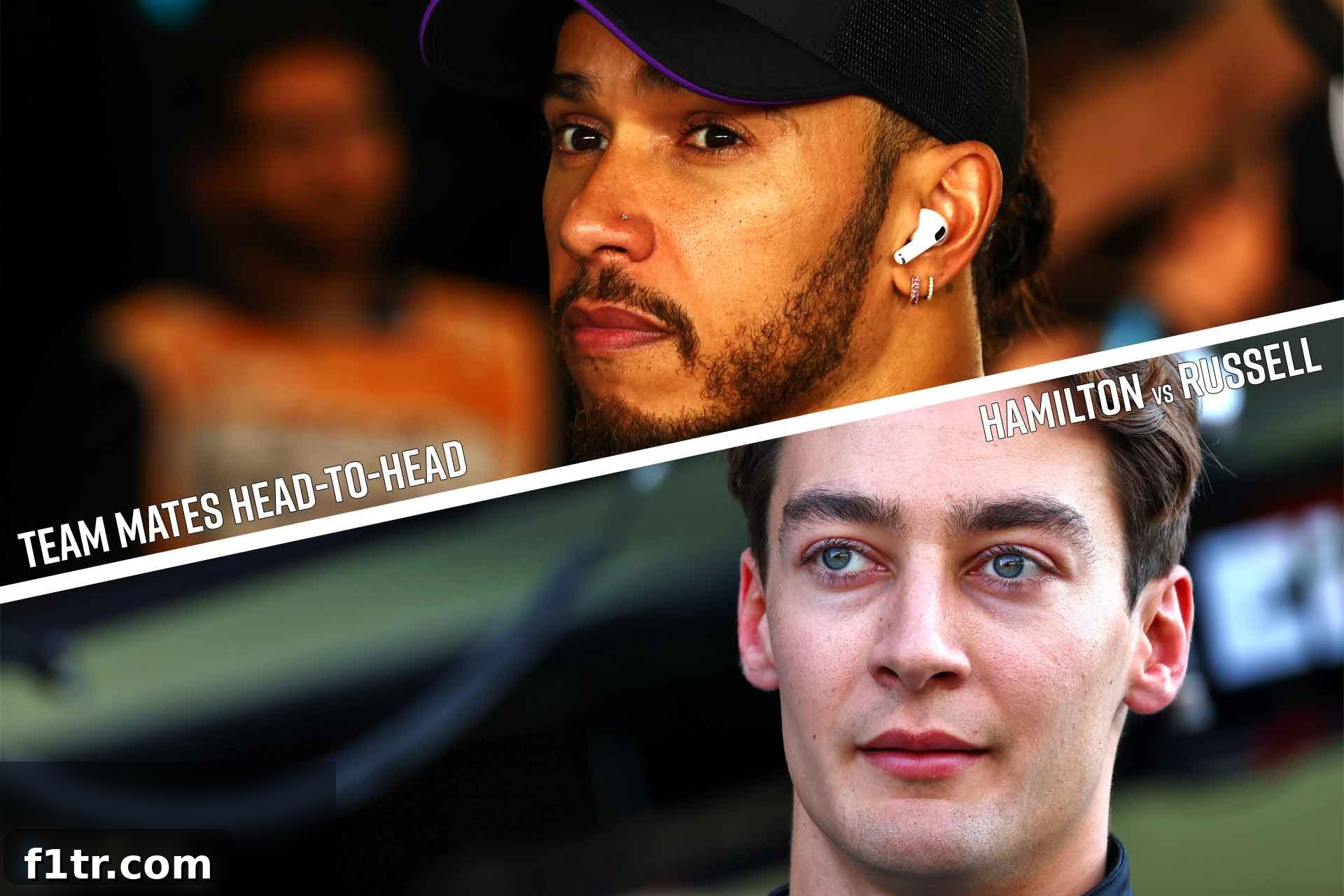
The conclusion of the 2024 Formula 1 season marked a pivotal moment for Mercedes, as the team bid farewell to Lewis Hamilton after a partnership that defined an era. While Hamilton’s last-lap maneuver to overtake George Russell in their final race together provided a dramatic flourish, it did not alter the overarching narrative of 2024: Russell had outscored the seven-time world champion over the course of the season. This significant achievement underscored Russell’s growing stature within the team and the broader paddock, solidifying his position as a formidable force.
However, the storyline extended beyond a single season. When considering their entire three-year tenure as Mercedes teammates, a truly remarkable statistic emerged: Hamilton narrowly edged out Russell in total points, accumulating 697 to Russell’s 695. This almost imperceptible two-point difference across three full seasons highlights the intense, high-stakes competition that unfolded between the two British drivers. It speaks volumes about Russell’s consistent performance and his ability to push a driver of Hamilton’s caliber, even as the team navigated a challenging period of performance dip.
Despite this fractional points deficit over three years, Russell’s overall performance metrics paint a clearer picture of his dominance across other critical aspects. From qualifying head-to-heads to average race pace in comparable conditions, Russell often held the upper hand. This comprehensive superiority, particularly evident in their final season together, will undoubtedly serve as a potent confidence booster for Russell. As he prepares to step into the role of de facto team leader alongside newcomer Andrea Kimi Antonelli for 2025, this strong showing provides a solid foundation for his aspirations to guide Mercedes back to championship contention. Russell’s consistent delivery, even in a struggling car, has demonstrated his capability and maturity, making him an ideal candidate to lead the team’s next chapter.
The dynamic between Hamilton and Russell fundamentally shifted following Hamilton’s bombshell revelation in the off-season: his decision to depart Mercedes for Ferrari in 2025. This announcement, coming before a single wheel had turned in competitive anger, created an unusual atmosphere within the Mercedes garage. From the very start of the 2024 campaign, Russell appeared to hold a psychological, if not always explicit, upper hand. By the time the Formula 1 circus arrived in Monaco, a circuit renowned for its reliance on precise qualifying performance, Hamilton had already suffered his seventh qualifying defeat in eight races. A visibly frustrated Hamilton openly admitted his low expectations, stating he didn’t foresee himself out-qualifying his teammate for the remainder of the year. This candid admission showcased the depth of his struggles and the growing gap in their single-lap performance.
While Hamilton’s initial despair about his qualifying prospects proved to be an exaggeration, the final statistics for the season were nonetheless stark: Russell out-qualified Hamilton by a significant 19-5 margin. This meant George Russell became the first driver to definitively out-qualify Lewis Hamilton over an entire season since Nico Rosberg achieved the feat a decade earlier, in their intense 2016 championship battle. The 2024 result sharply contrasted with their previous season, where their qualifying battle was a veritable nip-and-tuck affair, famously ending in a tie. This clear shift in fortunes underscored Hamilton’s difficulties in extracting peak performance from the W15 on Saturdays, a crucial element in modern Formula 1 where track position often dictates race outcomes. The qualifying disparity was not merely a statistical anomaly but a recurring theme that profoundly impacted Hamilton’s race weekends, often forcing him into recovery drives.
A significant factor contributing to this shift was Hamilton’s more pronounced struggles with the W15’s idiosyncratic behavior. The car, universally described as “perplexing” by both drivers and the team, presented a unique set of challenges. While Russell, perhaps due to his shorter tenure with the team’s championship-winning machinery or a different driving style, seemed to find a way to extract more consistent performance, Hamilton often found himself wrestling with its unpredictable nature. Over a full race stint, Hamilton’s unparalleled experience and finely tuned race craft often allowed him to coax the W15 into a more compliant state, enabling him to make progress through the field. However, by this point, the damage was frequently done. A disappointing qualifying session on Saturday regularly condemned him to a challenging grand prix, leaving him playing catch-up from a compromised grid position. This pattern became a source of palpable frustration for Hamilton, who repeatedly expressed satisfaction with the car’s balance early in weekend only to find himself sullen and disheartened after another sub-par qualifying performance.
Conversely, Russell’s 2024 season, while marked by a significant victory in Austria that somewhat ‘fell into his hands’ due to strategic circumstances, also featured a series of missed opportunities and unfortunate incidents that highlight his underlying pace and potential. He could easily point to other occasions where he felt genuinely short-changed, demonstrating that his strong performance was not merely a result of luck. Technical trouble struck with awful timing at Silverstone, robbing him of a strong result at his home race. A red flag during a critical moment in qualifying at Interlagos likely cost him a chance at pole position, and potentially a race win, altering the entire complexion of his weekend. And, of course, there was the bitter taste of his post-win disqualification at Spa, a result that, while nullified, did not diminish the dominant performance he had delivered on track. These instances collectively underscore a season where Russell consistently showcased front-running pace, even if external factors sometimes prevented him from converting it into more definitive results.
When George Russell joined Mercedes two years prior, few in the Formula 1 world anticipated the monumental shift that was about to occur. The eight-time constructors’ champions, a dominant force for nearly a decade, were about to endure not just one poor season, but the commencement of three challenging campaigns. This unprecedented downturn meant that both Hamilton and Russell were forced to recalibrate their expectations and accept a new reality. The pursuit of ultimate performance, the singular focus for Mercedes drivers in previous years, often had to take a back seat. Instead, their efforts were frequently directed towards understanding and mitigating the intricacies of another disappointing chassis, rather than simply optimizing a winning package. This period demanded an immense amount of patience, adaptability, and resilience from both drivers, as they navigated a landscape far removed from the winning environment Hamilton had been accustomed to.
With Lewis Hamilton approaching his 40th birthday, his often unconvincing final season at Mercedes will inevitably provoke widespread questions about whether he is truly past his prime, or if his struggles were merely a consequence of a car he plainly never fully gelled with. The W15’s characteristics, coupled with the underlying issues that plagued Mercedes since the 2022 regulation changes, undeniably posed a significant challenge. This fundamental question of driver versus machinery, a perpetual debate in Formula 1, will only find its definitive answer when Hamilton lines up alongside Charles Leclerc at Ferrari. The comparison with a young, highly-rated talent in a different environment will offer the clearest insight into Hamilton’s current performance ceiling. Until then, the discussion about his best remains speculative, fueled by the mixed results of his final Mercedes chapter.
Unsurprisingly, Frederic Vasseur, Hamilton’s future team principal at Ferrari, has given short shrift to any notion that the driver he just signed is losing his touch. Vasseur, an experienced and shrewd operator, is banking on Hamilton’s proven ability to adapt, his unparalleled experience, and his enduring motivation to bring success to Maranello. He will be hoping his faith is well-placed, and that Hamilton’s struggles were indeed car-specific rather than a sign of diminishing returns. However, the trajectory of Russell’s improving qualifying performance compared to Hamilton’s looks more like a discernible trend than a one-off statistical anomaly. This consistent edge on Saturdays from Russell adds weight to the argument that, at least in the final phase of their partnership, Russell had found a more effective way to extract performance from the Mercedes package, making the upcoming comparison with Leclerc all the more intriguing for Hamilton’s legacy.
Hamilton vs Russell: 2022-24
Hamilton vs Russell results summary
2022
| BAH | SAU | AUS | EMI | MIA | SPA | MON | AZE | CAN | GBR | AUT | FRA | HUN | BEL | NED | ITA | SIN | JAP | USA | MEX | BRZ | ABU | ||
| Hamilton | Q | ||||||||||||||||||||||
| R |
2023
| BAH | SAU | AUS | AZE | MIA | MON | SPA | CAN | AUT | GBR | HUN | BEL | NED | ITA | SIN | JAP | QAT | USA | MEX | BRZ | LAS | ABU | ||
| Hamilton | Q | ||||||||||||||||||||||
| R |
2024
| BAH | SAU | AUS | JAP | CHI | MIA | EMI | MON | CAN | SPA | AUT | GBR | HUN | BEL | NED | ITA | AZE | SIN | USA | MEX | BRZ | LAS | QAT | ABU | ||
| Hamilton | Q | ||||||||||||||||||||||||
| R |
Unrepresentative comparisons omitted. Negative value: Hamilton was faster; Positive value: Russell was faster