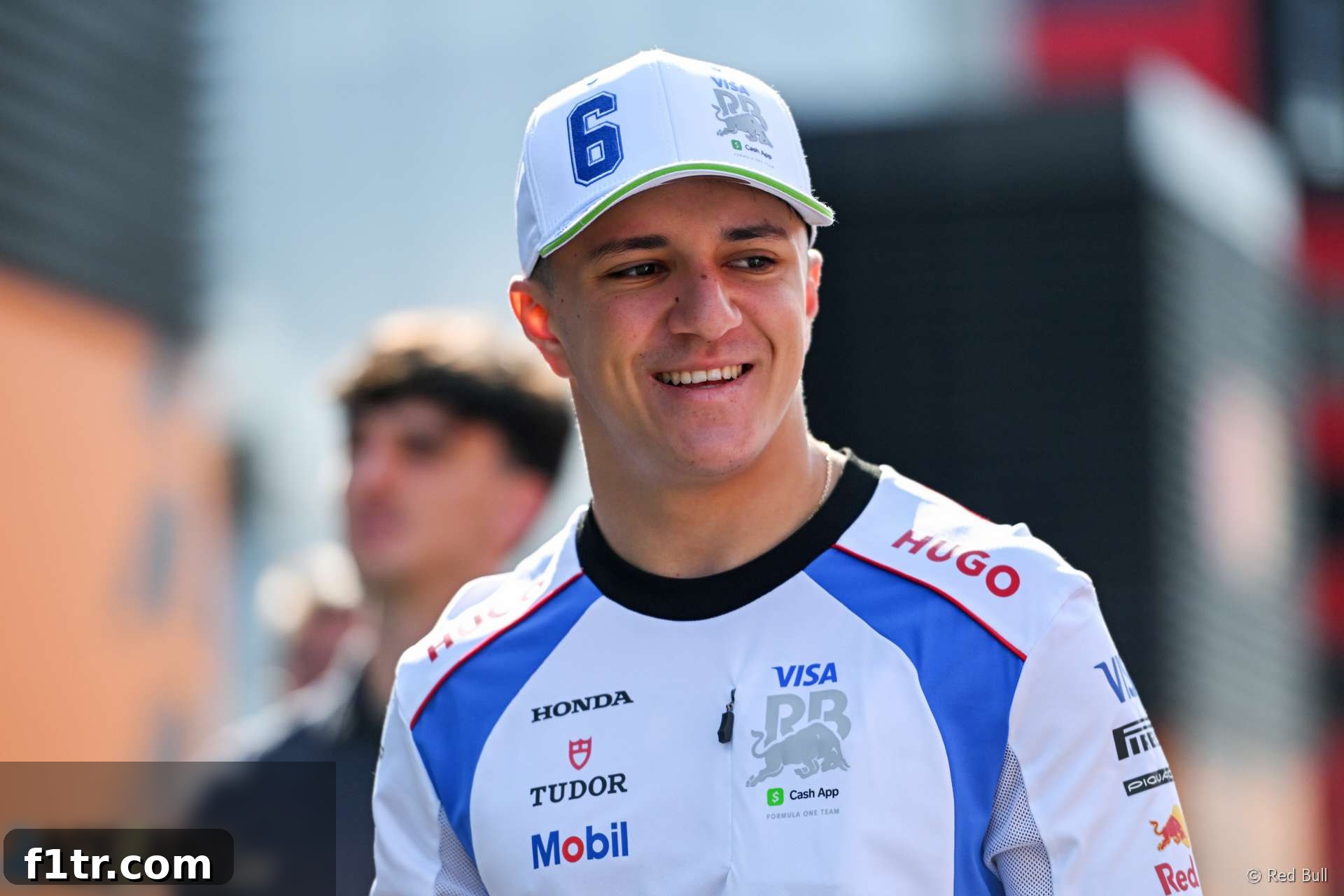
Isack Hadjar’s Formidable Rookie Season: A Deep Dive into His Formula 1 Performance and Potential
The exhilarating world of Formula 1 consistently introduces a fresh wave of talent, and the 2024 season has been no exception, shining a spotlight on promising newcomers. Among the crop of highly anticipated rookies, Isack Hadjar initially stood out as the undeniable frontrunner for the coveted ‘top rookie’ title. His early performances demonstrated remarkable potential, hinting at a future star in the making. However, the relentless nature of Formula 1 brings constant challenges, and Hadjar has since navigated a challenging period, experiencing a lean spell that saw fellow newcomer Gabriel Bortoleto raise his game significantly. Despite this shift in momentum, Hadjar’s initial surge and his overall journey through the first half of the season nonetheless mark a strong, albeit complex and evolving, start to his Formula 1 career. His debut has been a testament to his raw speed, adaptability, and the immense pressure placed on young drivers in motorsport’s premier category.
Navigating Early Challenges: Teammates and Rapid Adaptability
Isack Hadjar’s Formula 1 baptism by fire began with an immediate and considerable challenge: lining up alongside the significantly more experienced Yuki Tsunoda at Racing Bulls. Tsunoda, a known quantity within the Red Bull family and a driver with several seasons under his belt, represented a formidable benchmark for any rookie. His aggression and raw speed were well-established, making him a tough competitor. Yet, Hadjar wasted no time in making his presence felt. In the initial two races, he quickly adapted to the immense demands of F1 machinery and the intensely competitive environment. His prowess in qualifying became particularly evident, culminating in a notable achievement where he outqualified Tsunoda in his final appearance before a strategic reshuffle saw Hadjar’s teammate moved to Red Bull’s other sister team. This early demonstration of outright pace against an established F1 driver underscored Hadjar’s natural talent and his rapid acclimatization to the pinnacle of motorsport, setting a high bar for his rookie campaign.
The dynamic in the Racing Bulls garage shifted dramatically after just two Grands Prix. By his third event, Hadjar was already facing his second different teammate: the equally ambitious and highly-rated Liam Lawson. This unexpected and rapid change presented a unique set of challenges for a rookie. Adapting to a new internal dynamic, understanding different engineering feedback, and establishing a fresh competitive reference point would test even the most seasoned drivers, let alone a newcomer finding his feet in F1. Lawson himself had shown immense promise in previous substitute appearances, making this an immediate and fierce internal battle. Despite this constant flux, Hadjar continued to show flashes of brilliance, proving his resilience and determination to make an indelible mark in Formula 1, setting the stage for a compelling intra-team rivalry.
Moments of Brilliance and Setbacks: A Rollercoaster of Races
Hadjar’s rookie season has been characterized by a series of dramatic highs and challenging lows, comprehensively showcasing both his immense potential and the steep, often unforgiving, learning curve inherent in Formula 1. The third Grand Prix in Melbourne, Australia, proved to be a particularly trying event. A humiliating pre-race retirement in treacherous wet conditions, where he spun off before even reaching the grid, raised initial doubts and questions about his readiness for the sport’s highest level. For any driver, especially a rookie, such an incident can be mentally taxing, highlighting the fine margins and unpredictable nature of F1. However, Hadjar demonstrated remarkable character and mental fortitude, swiftly answering those doubts with a stunning performance on his inaugural visit to the iconic Suzuka Circuit in Japan, one of the most revered tracks on the calendar.
Suzuka became a watershed moment for the young Frenchman, solidifying his early promise. Despite enduring considerable physical pain – a testament to the brutal demands of Formula 1 cars and the punishing G-forces – Hadjar delivered a sublime qualifying session, placing his Racing Bulls car seventh on the grid. This was a hugely significant achievement for a rookie, especially on a track renowned for its complexity, high-speed corners, and unforgiving nature. In the race, he displayed impressive maturity and race craft, managing his tires and fending off experienced competitors. He only lost a single position towards the end of the race to the vastly experienced multiple world champion, Lewis Hamilton, a testament to his sustained pace. Crossing the finish line to claim the first points of his career at Suzuka was not just a personal milestone; it was a powerful statement of intent, showcasing his ability to perform under extreme pressure and overcome significant adversity.
Following a somewhat subdued weekend in Bahrain, where he struggled to find his rhythm, Hadjar quickly rebounded in Jeddah, demonstrating his race intelligence and opportunism. After a Safety Car restart, a crucial moment where composure and decisive action are paramount, he executed a smart, decisive pass on the seasoned veteran Fernando Alonso, a two-time world champion known for his cunning race craft. This maneuver secured him another crucial point and further solidified his reputation as a tenacious racer with excellent spatial awareness. The momentum continued, and Hadjar narrowly missed out on another point in Miami, where he could have capitalized had he managed to stay within five seconds of a penalized Red Bull driver. These early performances underscored his capability to consistently contend for points, a critical objective for any rookie aiming to establish themselves firmly in the midfield battle.
As the season progressed, Hadjar began to establish himself as a more regular fixture in Q3 sessions and the points-scoring positions, signaling a rising level of comfort and confidence. At Imola, he showed promising pace, potentially capable of starting even higher up the grid. Nevertheless, he added to his burgeoning points tally with a solid ninth-place finish, demonstrating his ability to convert qualifying efforts into race results. His qualifying prowess shone brightest in Monaco, one of the most demanding and iconic tracks on the calendar, where precision and bravery are paramount. Rebounding from a challenging build-up to the event, Hadjar produced another truly excellent qualifying performance. Navigating the narrow, unforgiving streets of the principality with breathtaking precision and confidence, he duly converted his strong grid position into a career-best sixth-place finish in what was a chaotic and unique F1 race. Scoring significant points in Monaco is a badge of honor for any driver, and for a rookie, it speaks volumes about their talent, composure under immense pressure, and potential for future success.
Isack Hadjar’s Key Performance Statistics (First Half of Season)
| Metric | Best Result | Worst Result |
|---|---|---|
| Grand Prix Start Position | 5th | 14th |
| Grand Prix Finish Position | 6th | 20th |
| Total Points Scored | 22 | |
Mid-Season Struggles and The Lawson Challenge
Despite the earlier successes and impressive points haul, the relentless nature of Formula 1 began to take its toll, and Hadjar’s impressive run of top 10 finishes eventually came to an end. In Spain, he finished a respectable seventh, but lost a position near the end to a fresh-tyred Nico Hulkenberg, signaling a slight shift in momentum and illustrating the ever-present challenge of managing tire degradation. The subsequent races in Canada and Austria proved to be more challenging. In both events, Hadjar struggled to find the consistent pace required to contend for points, a stark contrast to his earlier consistency. This period coincided with a notable upturn in form for his teammate, Liam Lawson, who delivered a strong sixth-place finish in Austria, further intensifying the internal team battle and adding pressure on Hadjar.
The British Grand Prix at Silverstone presented Hadjar with an unfortunate, largely unavoidable incident. In the treacherous conditions of blind spray, where visibility was severely hampered by torrential rain, he could do little to prevent colliding with fellow rising star Andrea Kimi Antonelli. Such incidents, while immensely frustrating for any driver and team, are often part and parcel of a rookie’s learning process in the unpredictable and high-stakes environment of F1. While he managed to salvage a point in the Spa sprint race, showcasing his ability to capitalize on shorter, more chaotic formats, his fortunes took another downturn in the Grand Prix itself. A technical problem plagued his car, causing him to plummet down the order and lose out on valuable championship points, adding to the growing list of mid-season frustrations and missed opportunities.
Hungary offered a brief glimmer of hope as Hadjar once again qualified impressively in the top 10, demonstrating his raw single-lap speed. However, the race saw him ultimately out-run to the points places by his teammate, Liam Lawson. This outcome was particularly significant, highlighting a worrying trend. Over the last four rounds of the season, Liam Lawson has decisively out-scored Hadjar by a stark margin of 16-1. This significant statistic indicates a potential shift in the narrative surrounding F1’s top rookie. While Hadjar certainly started strong, the latter part of the first half of the season suggests he may face a tougher and more demanding challenge in the second half, with the pressure to perform consistently intensifying dramatically. The internal team battle is a critical test for any F1 driver, and Hadjar will need to respond forcefully.
The Road Ahead: Sustaining Momentum and Proving Long-Term Potential
Isack Hadjar’s debut Formula 1 season has been a compelling narrative of immense potential, promising highs, and the inevitable challenges that define a rookie’s journey at the pinnacle of motorsport. His early performances, marked by strong qualifying efforts against experienced teammates and crucial points finishes at iconic venues like Suzuka and Monaco, firmly established him as a talent to watch. He displayed raw speed, impressive race craft, and a commendable ability to bounce back from significant setbacks, such as the early retirement in Melbourne, showcasing his mental resilience.
However, the mid-season dip in form and the growing performance gap to his increasingly competitive teammate, Liam Lawson, serve as a stark reminder of the relentless competition and unforgiving nature of Formula 1. Consistency is paramount in F1, and Hadjar will be acutely aware of the need to maintain his performance levels. While incidents like the collision at Silverstone and the technical issue at Spa were largely beyond his control, the struggle to consistently convert qualifying pace into race points in recent rounds indicates areas for refinement. Hadjar will need to analyze his performances closely, focusing on aspects such as tire management, strategic race execution, and maintaining peak performance across entire race weekends, especially as the season’s demands increase.
As the season progresses into its crucial second half, the spotlight on Hadjar will undoubtedly intensify. The narrative of ‘top rookie’ is fluid and ever-changing, and the battle with other newcomers, as well as the immediate comparison with his teammate, will be crucial. His ability to adapt further, learn effectively from his varied experiences, and regain his early-season momentum will define the ultimate success of his rookie year and, crucially, his prospects for a long-term future in Formula 1. The inherent talent is undeniable; the challenge now is to harness it consistently, demonstrate unwavering resilience, and prove his capability to thrive at the very pinnacle of motorsport. Isack Hadjar remains a driver with significant promise, and his journey will be keenly watched by fans, pundits, and, most importantly, the Red Bull hierarchy, as he strives to carve out his legacy in Formula 1.
Related Driver Rankings & Analysis
- 2025 Formula 1 mid-season driver rankings #1: Oscar Piastri
- 2025 Formula 1 mid-season driver rankings #2: George Russell
- 2025 Formula 1 mid-season driver rankings #3: Max Verstappen
- 2025 Formula 1 mid-season driver rankings #4: Charles Leclerc
- 2025 Formula 1 mid-season driver rankings #5: Alexander Albon
Browse all Driver Rankings