The 2021 Formula 1 season ignited into an exhilarating championship battle, pitting the might of Red Bull Racing against the reigning champions Mercedes-AMG Petronas F1 Team. At the heart of this intense rivalry were two phenomenal drivers, Max Verstappen and Lewis Hamilton, pushing each other to their absolute limits. However, as the season unfolded, it became increasingly clear that the outcome would not solely hinge on the primary protagonists but also on the crucial performances of their respective teammates.
Following the Spanish Grand Prix, Red Bull team principal Christian Horner unequivocally emphasized the critical reliance on Sergio Perez to provide strategic pressure on the dominant Mercedes drivers. His comments underscored a growing concern within the Red Bull camp: the necessity for both cars to operate within striking distance of their rivals to unlock vital strategic options and counter Mercedes’ formidable prowess.
The Strategic Chess Match at the Spanish Grand Prix
The Spanish Grand Prix at Circuit de Barcelona-Catalunya served as a vivid demonstration of Formula 1’s strategic complexities. Max Verstappen delivered a stunning performance, snatching the lead from Lewis Hamilton at the start and commanding much of the race with masterful car control. Despite Verstappen’s valiant efforts and impressive pace, he ultimately yielded to Hamilton, who executed a brilliant two-stop strategy that Red Bull was powerless to counteract. Hamilton’s second pit stop allowed him to charge on fresher tyres, easily overcoming the deficit and reclaiming the lead.
Crucially, Hamilton was able to make this “free stop” without losing significant track position, only briefly dropping behind his teammate Valtteri Bottas, who, in turn, offered little resistance. This strategic flexibility was directly attributable to the gap between the leading duo and the rest of the field, especially Sergio Perez. Had Perez been closer, perhaps in a podium position, Mercedes would have faced a far more difficult decision, risking Hamilton losing crucial points to a Red Bull car.
Sergio Perez’s Weekend in Catalunya: A Mixed Performance
For Sergio Perez, the Spanish Grand Prix weekend proved to be a challenging affair, highlighted by circumstances that prevented him from fully integrating into the leading battle. His qualifying session saw him start from a disappointing eighth position, significantly compromising his race prospects even before the lights went out. The Mexican driver experienced shoulder pain on Saturday, which undeniably impacted his comfort and confidence in the highly demanding Red Bull RB16B.
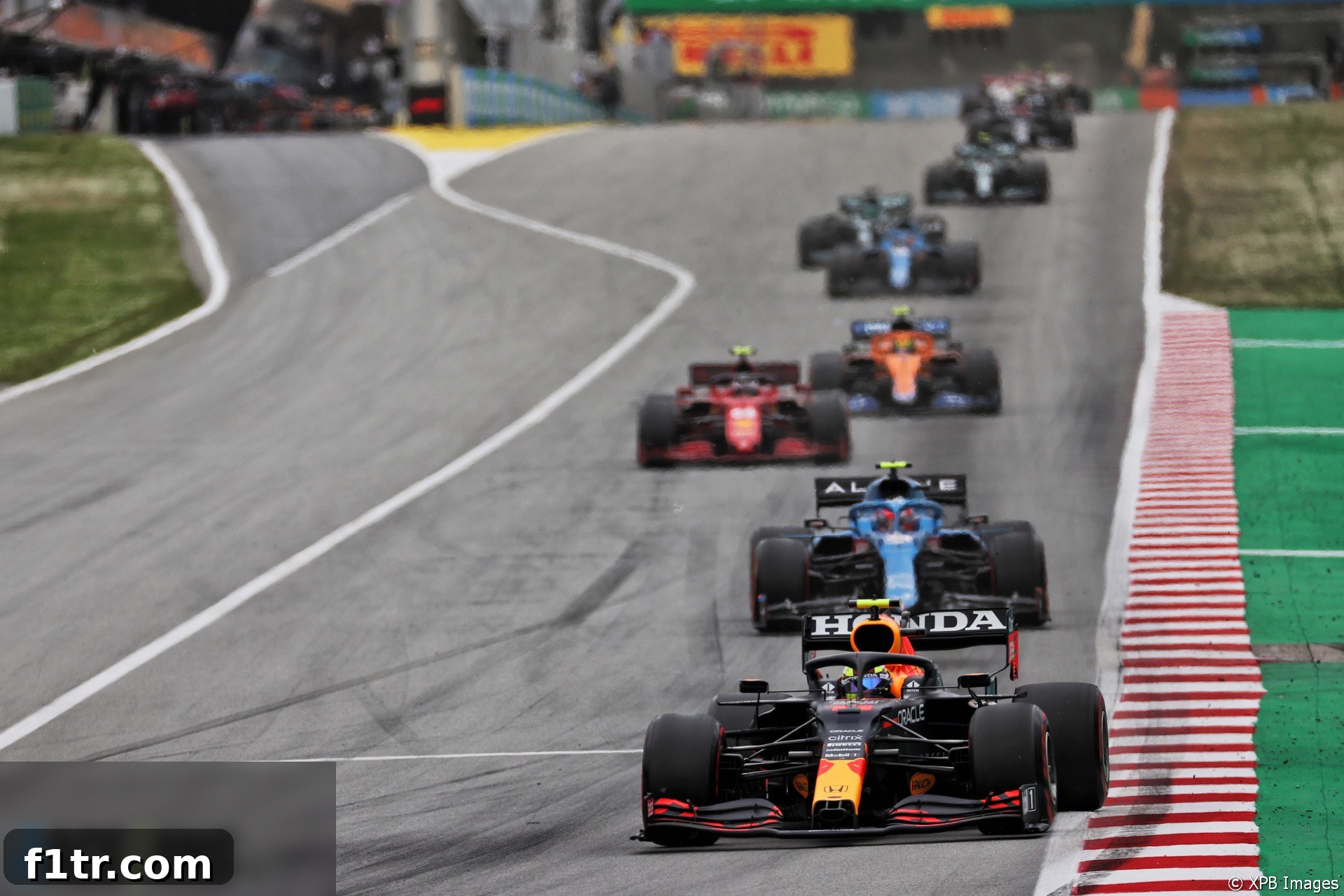
Adding to his woes, Perez suffered a spin during Q3, further hindering his ability to extract maximum performance and secure a higher grid slot. This chain of events meant he was already on the back foot when Sunday arrived. In the race itself, Perez demonstrated his characteristic tenacity, making progress through the field. He notably passed Daniel Ricciardo and pushed hard, eventually climbing to a respectable fifth place. While a solid points finish, it was not the top-four result Red Bull desperately needed to truly influence the strategic dynamics at the front.
Christian Horner acknowledged Perez’s recovery drive but also pinpointed the difficulties. “I think it’s coming together for him,” said Horner. “He had an off-day yesterday. He was compromised in the race behind Daniel, obviously. But then he didn’t manage to make the headway at a track that’s so difficult to pass.” Horner’s assessment underscored the inherent challenges of the Circuit de Barcelona-Catalunya, a track notorious for making overtakes incredibly difficult, especially when starting deep in the midfield.
Horner’s Strategic Imperative: The ‘Free Stop’ Dilemma
The core of Christian Horner’s strategic concern revolved around the concept of the “free stop.” This term refers to a situation where a leading car can make an additional pit stop for fresh tyres without losing a critical position to a rival. In Barcelona, with Sergio Perez significantly adrift of the leaders, Mercedes was granted this luxury. Hamilton pitted for a second time, emerging behind Valtteri Bottas but well ahead of Perez, effectively ensuring he would regain the lead from Verstappen once his fresher tyres allowed him to catch and pass the Red Bull.
“Of course we desperately need him to be in that gap so that Mercedes don’t have the strategic options that they had today,” Horner stated emphatically. His frustration was palpable, echoing a similar scenario from two years prior at the Hungarian Grand Prix, where Lewis Hamilton had also exploited a strategic advantage to win. Horner even radioed Max Verstappen after the race, referencing this past event: “Unfortunately, like Hungary, they had a free stop behind them, so they had all the options.”
Horner was quick to clarify that his comments were not a direct criticism of Perez but rather a stark statement of strategic fact. “The facts are that obviously Checo had been held up,” Horner explained. “So the facts are very clear that obviously the two lead guys were so far ahead of the rest of the pack, as it were, and gave Lewis a free stop as he had in Hungary, he’s only got to get it past his team mate that was never going to be an issue. So that’s why we need both cars up there strategically so that option isn’t available to Mercedes.” This explanation highlights the immense pressure on Perez to close the gap and deny Mercedes their tactical flexibility.
Sergio Perez’s Pivotal Role in Red Bull’s Championship Aspirations
Sergio Perez was brought into Red Bull Racing specifically for this purpose: to provide a consistent second scoring car, one capable of challenging Mercedes on two fronts and supporting Max Verstappen’s championship bid. Known for his exceptional tyre management, race craft, and vast experience, Perez was seen as the ideal candidate to stabilize Red Bull’s challenge against the might of Mercedes.
His adaptation to the unique characteristics of the Red Bull car, however, has been a gradual process. Red Bull cars are famously challenging to drive, often requiring a specific driving style that takes time to master. Perez himself has acknowledged the learning curve, emphasizing the need for more time in the car to fully unlock its potential. While he has shown flashes of brilliance, consistent top-tier performances, especially in qualifying, remain the key to fulfilling the role Red Bull envisioned for him.
The championship fight against Mercedes is not merely a contest of speed but a battle of strategic ingenuity and team depth. Having two cars consistently running at the front means Red Bull can split strategies, create roadblocks for Mercedes, or force their rivals into compromising decisions. Without this second car firmly in the mix, Mercedes enjoys a significant strategic advantage, as vividly demonstrated in Spain.
Looking Ahead: The Path to Consistency
The lessons from the Spanish Grand Prix are clear for Red Bull. For the team to truly contend for both the Drivers’ and Constructors’ Championships, Sergio Perez must consistently qualify and race closer to the front. The upcoming races on the calendar, including challenging street circuits and high-speed tracks, will demand unwavering performance from both Red Bull drivers.
Christian Horner expressed confidence that Perez would find his stride. “But I’m convinced that will come for Checo as he finds more confidence and time in the car,” he remarked. This sentiment suggests ongoing support and belief from the team, recognizing the talent and potential Perez possesses. Red Bull will undoubtedly be working tirelessly with Perez to help him maximize his performance, understand the car’s nuances, and translate his strong race pace into higher grid positions.
The stakes are incredibly high. In a championship battle as finely balanced as 2021, every single point, every strategic opportunity, and every driver’s performance will be absolutely critical. Red Bull cannot afford to concede strategic advantages to Mercedes if they are to successfully challenge for the ultimate prizes in Formula 1.
Conclusion: The Imperative for a Two-Car Strategy
The 2021 Formula 1 season is shaping up to be a classic, with the Red Bull vs. Mercedes rivalry delivering nail-biting action. Christian Horner’s frank assessment after the Spanish Grand Prix underscores the undeniable truth: for Red Bull to truly challenge Mercedes for the championship, Sergio Perez’s consistent presence at the sharp end of the grid is not just desirable but absolutely essential. His ability to apply pressure and deny Mercedes crucial strategic options will be a defining factor in Red Bull’s pursuit of Formula 1 glory.
2021 Spanish Grand Prix
- Two reasons why Catalunya may not predict the championship – at least this year
- McLaren to keep “drip-feeding” updates onto 2021 car
- Working group tackling F1’s track limits problem
- ‘We’ll discuss what went wrong’: Hamilton and Verstappen team radio transcript analysis
- 2021 Spanish Grand Prix Star Performers
Browse all 2021 Spanish Grand Prix articles