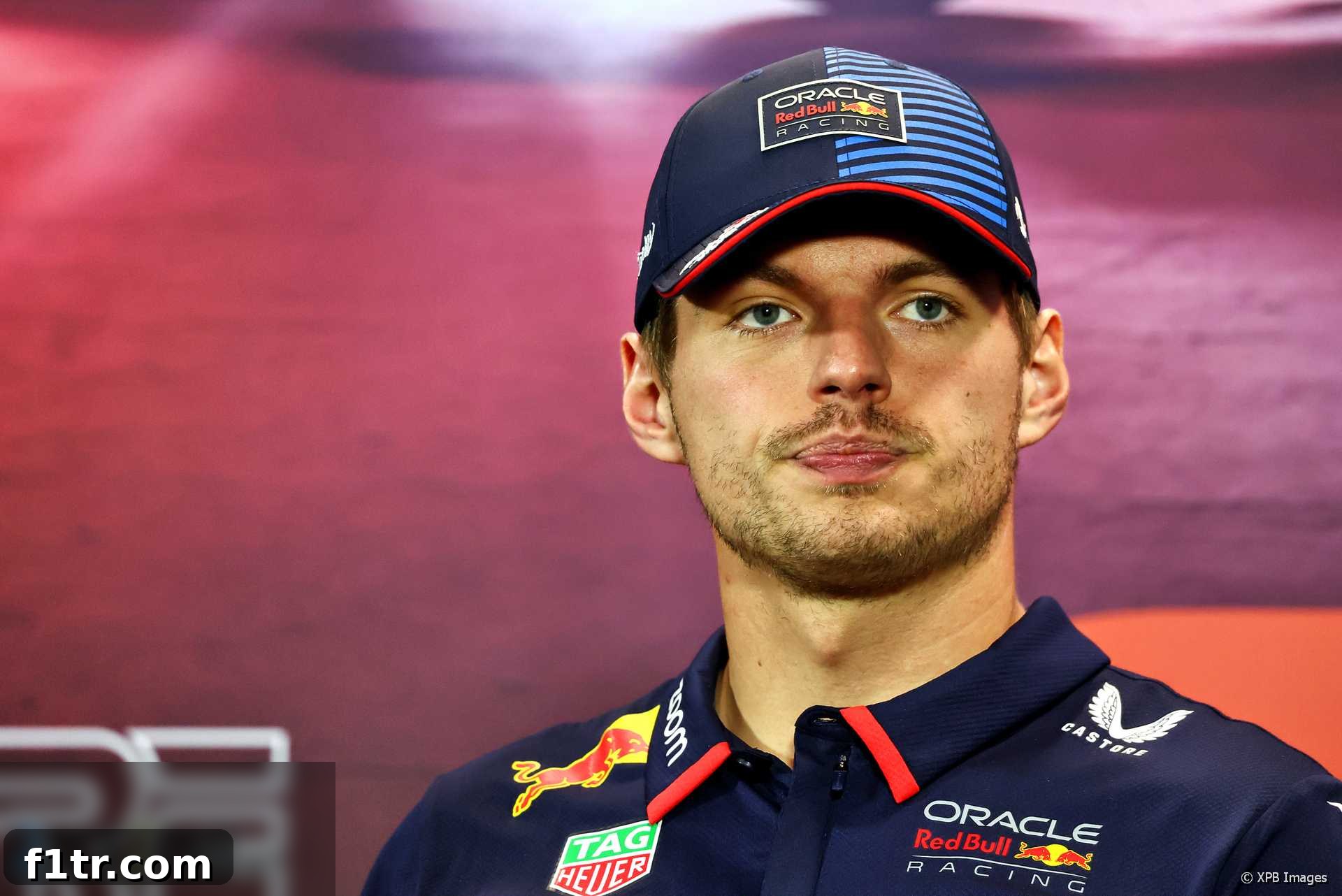
In the high-octane world of Formula 1, where split-second decisions and raw emotion often dictate performance, world champion Max Verstappen recently found himself under the scrutiny of the Singapore Grand Prix stewards for an unusual infraction: using strong language during an official FIA press conference. This incident, occurring ahead of one of the season’s most challenging races, has sparked widespread discussion about driver conduct, freedom of expression, and the ever-evolving standards of professionalism in elite motorsport.
The controversy unfolded during a mandatory press conference where Verstappen, as one of six drivers selected on a rotational basis, addressed the media. The session, a routine part of any Grand Prix weekend, took an unexpected turn when the Red Bull Racing star candidly reflected on his less-than-ideal performance at the preceding Azerbaijan Grand Prix. His choice of words, intended to convey his frustration with the car’s setup, immediately drew attention and eventually led to a formal investigation by the governing body, highlighting the increasing scrutiny on public statements by Formula 1 competitors.
During the press conference, when questioned about his disappointing result in Baku, Verstappen offered a blunt assessment. He stated, “as soon as I went into qualifying, I knew the car was fucked.” The remark, delivered without hesitation, prompted the moderator to issue a swift reminder against swearing. However, Verstappen, known for his outspoken nature, later challenged this admonition, setting the stage for a deeper examination of driver language in public forums and raising questions about the boundaries of acceptable expression within a highly regulated sport.
Following the initial practice session for the Singapore Grand Prix, the race stewards summoned Verstappen. The summons cited an alleged breach of Article 12.2.1.k of the FIA’s International Sporting Code, a comprehensive clause that empowers officials to penalize drivers for engaging in “any misconduct.” This broad definition allows the FIA considerable discretion in enforcing standards of behavior and communication within the sport, reflecting a growing emphasis on maintaining a professional and respectable image for Formula 1 globally, particularly in front of a diverse international audience.
After a thorough hearing with Verstappen, the stewards decided on a rather uncommon form of punishment: requiring him to carry out “some work of public interest.” This decision stemmed from their judgment that his language constituted “misconduct” because it was deemed “generally considered coarse, rude or may cause offence and is not considered suitable for broadcast.” The stewards emphasized the importance of drivers, particularly world champions like Verstappen, setting an example and maintaining decorum in public appearances that are widely disseminated to millions of fans worldwide, including younger demographics.
The stewards’ ruling highlighted that despite previous warnings issued for similar instances across the paddock, the issue of swearing in press conferences was “well known by the competitors.” This understanding led them to impose a “greater penalty than previously,” signaling a stricter stance from the FIA and a clear intent to enforce its conduct codes more rigorously. The nature of “public interest work” often involves participation in various FIA educational or outreach programs, designed to benefit the wider motorsport community, promote road safety, or engage with budding talent.
In his defense, Verstappen explained that “the word used is ordinary in speech as he learned it, English not being his native language,” as documented by the stewards. This argument underscores a common challenge in international sports, where linguistic nuances and cultural differences can lead to misunderstandings or unintentional breaches of conduct codes. However, while acknowledging this perspective, the stewards maintained that “it is important for role models to learn to be mindful when speaking in public forums, in particular when not under any particular pressure.” Ultimately, Verstappen offered an apology for his behavior, an action that likely played a role in the final nature of his penalty and demonstrated a recognition of the situation’s gravity.
This penalty bears a striking resemblance to a public service punishment Verstappen received previously, following a heated post-race confrontation with Esteban Ocon at the 2018 Brazilian Grand Prix. On that occasion, Verstappen completed his public service by observing stewards during the 2019 Marrakesh Formula E race and subsequently participating in a stewards workshop, contributing to the FIA’s International Stewards Programme. Such penalties aim not only to reprimand but also to educate and integrate drivers into the broader regulatory framework of motorsport, fostering a deeper understanding of the responsibilities that come with their influential roles and the impact of their actions.
The timing of Verstappen’s punishment also aligns with a broader push for stricter language control within Formula 1, spearheaded by FIA president Mohammed Ben Sulayem. The president has recently voiced criticism regarding drivers’ use of profanity over team radio during races, suggesting that the governing body might intervene to limit the broadcast of such team radio clips by Formula One Management (FOM) in the future. This indicates a concerted effort by the FIA to curate a more polished and family-friendly image for the sport, aligning with its global expansion and diverse audience demographic. The aim is to ensure that F1 remains appealing to sponsors, broadcasters, and families, reinforcing its status as a premier global entertainment spectacle.
Verstappen’s case, while high-profile, is not an isolated incident. His team mate, Sergio Perez, received a formal warning for breaching the same Article of the ISC after making critical comments about the stewards over team radio following a penalty at the end of the 2023 Abu Dhabi Grand Prix. Similarly, prominent figures such as Mercedes team principal Toto Wolff and Ferrari team principal Frederic Vasseur were also cautioned for using the same word as Verstappen in a team principals’ press conference in Las Vegas last year. Interestingly, Charles Leclerc used the identical profanity during an FIA press conference at the Monaco Grand Prix weekend without incurring any penalty, highlighting potential inconsistencies or evolving interpretations of the rules depending on context, severity, and specific circumstances.
Verstappen’s Candid Views on Language and Broadcasting
The Singapore Grand Prix press conference provided a platform for Max Verstappen to articulate his perspective on the ongoing debate surrounding language in Formula 1. His responses to specific questions reveal a thoughtful, albeit controversial, stance on freedom of expression versus the demands of public broadcasting, offering a unique insight into a top athlete’s mindset.
Q: A question to Max. Last weekend, for the first time of the season, your team-mate was in front of you in qualifying and then in the race until the crash. I would like to understand, as you guys watch all the telemetry, where he was faster or adapting better to the car, at least in qualifying.
MV: I don’t know, man. Different set-up. So as soon as I went into qualifying, I knew the car was fucked. Yeah, I tried to optimise the car all the time and this time it didn’t work out. So I knew that I was stuck with it. And then you tried to optimise it. But yeah, also, I mean, of course, my run one in Q3 that would have been enough for P3 in qualifying hurt me. And you start in the back of the top group. The balance was, of course, not there in the race. Then you get stuck behind two cars in the middle of the race. So you kill your tyres. So, you know, basically everything just went wrong from qualifying. Because the rules, of course, don’t allow you to change anything on the car. You’re stuck with it, and that’s what happened.Q: Max and Yuki, if I can ask you, please, as probably the most passionate and outspoken drivers, not afraid to call it how you see it, the FIA have announced that they want to stop and limit swearing. Max, obviously, I noticed your response earlier on. Do you think we’re being a bit too sensitive and you should be allowed to say what you think, not worry about all this bleeping out and all this sort of stuff, or do the FIA have a point about language?
MV: I think you will swear anyway. if it’s not in this room maybe somewhere else. Everyone swears. Some people a bit more than others. It also depends a bit what language you speak. Of course, abuse is something else. I think a lot of things get broadcast nowadays where in other sports you don’t run around with a mic attached to you. I think a lot of people say a lot of bad things when they are full of adrenaline in other sports, it just doesn’t get picked up. Where here, probably also for entertainment purposes, you know, things get sent out and that’s where people can pick up on it, discuss it on social media and you get all sorts of trouble. So I think it already just starts with not broadcasting it. I mean, if you don’t broadcast it, no one will know. Only the team, but with that you deal internally with these kind of things. But yeah, it’s just probably a bit the world that we live in, within the sport but also in general it seems like people are a bit more sensitive to stuff. Yeah, that’s how it goes. I guess the world is changing a bit, but I think it already just starts with not broadcasting it or not giving the option for people to hear it in general. Of course, there are a lot of apps where people can listen to radios and stuff. You have to probably limit it or have a bit of a delay that you can censor out a few things. That will help a lot more than putting bans on drivers because for example I couldn’t even say the f-word. i mean it’s not even that bad right? I mean the car was not working, the car is f-ed, yeah. And then, excuse me for the language but come on, what are we? Five-year-olds six-year-olds? Even if a five-year-old or six-year-old is watching I mean they will eventually swear anyway even if their parents won’t or they will not allow it. When they grow up they will walk around with their friends and they will be swearing. So you know this is not changing anything.
Verstappen’s detailed response to the question regarding swearing highlights a nuanced understanding of the issue, acknowledging its complexities beyond a simple good-vs-bad dichotomy. He acknowledges the ubiquitous nature of profanity, stating, “Everyone swears. Some people a bit more than others,” and points out the cultural and linguistic variations in what is considered offensive. Crucially, he draws a distinction between general swearing as an expression of frustration and outright “abuse,” implying that the latter is genuinely problematic while the former, in his view, can be an innocuous and natural part of human communication, especially under pressure.
A central tenet of Verstappen’s argument is that the problem lies not primarily with drivers’ spontaneous use of language, but with the broadcasting decisions made by Formula 1 and its media partners. He contends that unlike many other sports where athletes’ raw reactions often go unrecorded or unbroadcast, F1’s extensive use of microphones and real-time broadcasting, often for “entertainment purposes,” exposes drivers to undue scrutiny. His proposed solution is straightforward: “I think it already just starts with not broadcasting it. I mean, if you don’t broadcast it, no one will know. Only the team, but with that you deal internally with these kind of things.” He suggests implementing delays or limiting access to unfiltered radio communications, arguing that this would be far more effective than trying to police individual drivers’ natural, unscripted expressions.
Verstappen’s rhetorical question, “Come on, what are we? Five-year-olds six-year-olds?” powerfully conveys his frustration with what he perceives as an over-sensitive and perhaps unrealistic approach to language. He argues that children will inevitably encounter and use such language as they grow up, regardless of whether it’s censored in sports broadcasts. This perspective challenges the notion that F1 drivers must maintain an entirely sanitized public persona to protect younger audiences, suggesting a more pragmatic and realistic view of language acquisition and social interaction. His stance champions authenticity and the right to express genuine emotion, even if it occasionally involves language that some might deem inappropriate or unrefined for general broadcast.
The ongoing debate underscored by Verstappen’s penalty and his subsequent comments reveals a fundamental tension within modern Formula 1: how to balance the raw, unfiltered passion that makes the sport so compelling with the increasing need to present a polished, globally acceptable image. As F1 expands its reach into new markets and seeks to attract an even broader demographic, the line between authentic expression and corporate responsibility becomes increasingly blurred. Verstappen’s punishment and his articulate defense serve as a timely reminder that this conversation is far from over, and finding a universally agreeable solution remains a complex challenge for both the drivers, who operate under immense pressure, and the sport’s governing bodies.
Miss nothing from RaceFans
Get a daily email with all our latest stories – and nothing else. No marketing, no ads. Sign up here:
More from the 2024 Singapore Grand Prix
Here are some related articles and insights from the 2024 Singapore Grand Prix:
- Ricciardo’s brake woe and why Perez thought he had an engine problem: Singapore GP radio
- ‘Perez is only quicker when he has DRS’: How Hulkenberg’s Haas beat a Red Bull – again
- Mercedes explain “clear mistake” strategy call which left Hamilton “so angry”
- “Sometimes I wonder why I do this”: How Hamilton endured a slog to sixth in Singapore
- F1’s rules need surgery as well as sticking plaster after fastest lap controversy
Browse all 2024 Singapore Grand Prix articles