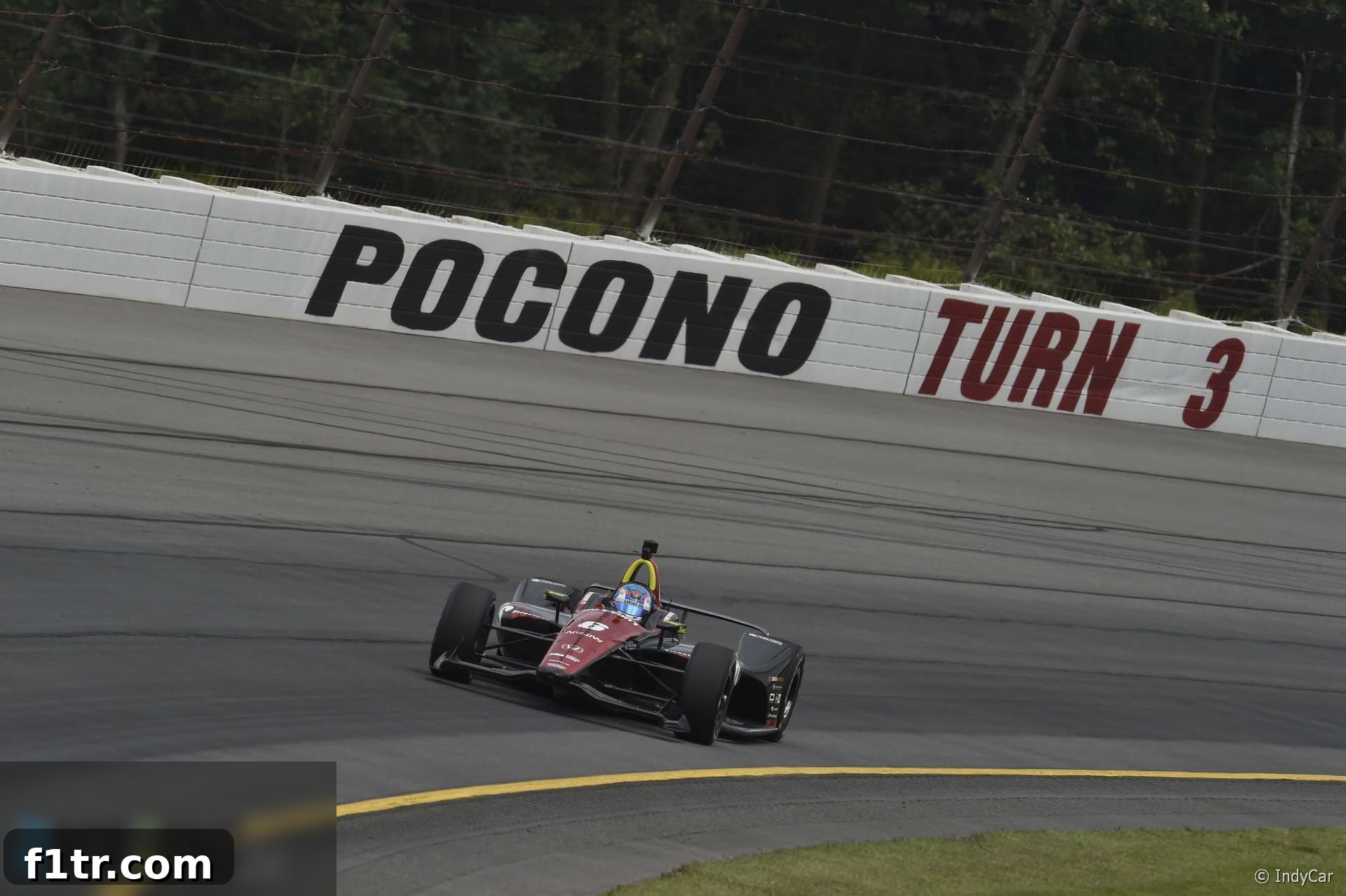
Severe Multi-Car Crash Red-Flags IndyCar Pocono 500: Robert Wickens Hospitalized
The exhilarating speeds of the IndyCar Pocono 500 were brought to an abrupt halt after a mere eight laps following a harrowing multi-car collision that sent Canadian rookie sensation Robert Wickens’ car violently into the safety barriers. The incident, occurring early in the highly anticipated race at the unique Pocono Raceway, immediately triggered a red flag, suspending all on-track activity and drawing the undivided attention of the motorsport world.
IndyCar racing, renowned for its breathtaking pace and fierce competition on a variety of challenging circuits, inherently carries significant risks. The Pocono Raceway, affectionately known as the “Tricky Triangle,” is a prime example of such a challenge. Its distinctive three-turn layout, each turn with a different banking and radius, demands immense skill and precision from drivers. Speeds regularly cresting 200 mph make even the slightest miscalculation or contact potentially catastrophic. On this particular Sunday, the harsh realities of open-wheel motorsport were undeniably laid bare.
The chain of events leading to the dramatic crash began when Schmidt Peterson Motorsports driver Robert Wickens, enjoying a stellar rookie season, made contact with Andretti Autosport’s Ryan Hunter-Reay. What followed was a terrifying sequence witnessed by thousands in attendance and millions watching globally. Wickens’ car was sent into a violent spin, its momentum carrying it with incredible force. In a heart-stopping moment, the vehicle lifted clear of the protective SAFER (Steel and Foam Energy Reduction) barrier, a critical safety innovation designed to absorb impact, before slamming into the catch fence positioned behind the track’s wall. The sight of a car breaching the primary safety layer is always a stark reminder of the immense energies involved in top-tier motorsport.
The incident was not confined to just two competitors. The unpredictable nature of high-speed racing meant that other drivers in close proximity were inevitably caught up in the melee. Among those involved were Wickens’ team mate, James Hinchcliffe, who had also experienced a life-threatening crash at Indianapolis just three years prior; Pietro Fittipaldi, representing Dale Coyne Racing; and Rahal Letterman Lanigan Racing’s Takuma Sato, a two-time Indy 500 winner known for his aggressive racing style. All four drivers found their races ending prematurely in a mangled heap of carbon fiber and twisted metal, a grim testament to the intensity of the impact.
The immediate response from IndyCar’s highly trained medical and safety crews was both swift and exemplary, a testament to the sport’s unwavering commitment to driver well-being. Within seconds of the impact, emergency vehicles were on the scene, converging on the wrecked cars. The primary focus was, as always, on the drivers. Fortunately, James Hinchcliffe, Pietro Fittipaldi, Takuma Sato, and Ryan Hunter-Reay were all able to extricate themselves from their damaged vehicles, a visible relief to concerned onlookers. Hunter-Reay, while able to climb out, was subsequently transported to the on-site medical center for evaluation, from which he was later released, a positive sign indicating no serious immediate injuries for the American driver.
The situation regarding Robert Wickens, however, was more complex and immediately raised greater concern. Due to the severity of his impact and the precarious position of his car against the fence, medical personnel worked meticulously and carefully to extract him from the cockpit. The process was lengthy and deliberate, underscoring the critical nature of his situation. Once safely removed from his vehicle, Wickens was immediately placed into an ambulance. IndyCar’s vice-president of communications, Curt Cavin, provided an initial, cautious but ultimately reassuring update, confirming that Wickens was “awake and alert” when he arrived at the infield medical center. Given the comprehensive medical protocols, and to ensure he received the highest level of care and diagnostic assessment, Wickens was subsequently transferred to Lehigh Valley Hospital-Cedar Crest, a facility equipped to handle complex trauma cases.
This tragic incident casts a shadow over what had been an incredibly promising rookie season for Robert Wickens. The 29-year-old Canadian, a highly decorated sports car and DTM (Deutsche Tourenwagen Masters) competitor, had transitioned to open-wheel racing this year with Schmidt Peterson Motorsports, and quickly established himself as a formidable talent. This race at Pocono marked only his 14th career IndyCar start, yet he had already demonstrated remarkable adaptability and speed. Entering the Pocono 500, Wickens was impressively placed sixth in the overall series standings, a testament to his consistent performance and multiple podium finishes, including a runner-up finish at the season opener in St. Petersburg. His aggressive yet controlled driving style had quickly earned him widespread respect within the paddock and among fans, leading many to tip him as a future champion. The crash at Pocono, his first ever competitive outing at the unique tri-oval, abruptly halted this burgeoning momentum and left the racing community holding its breath for updates on his condition.
The inherent dangers of motorsport are a stark reality, but advancements in safety technology have made these sports significantly safer over the decades. The presence of SAFER barriers, improved chassis integrity, and comprehensive medical support systems are all designed to mitigate the risks associated with speeds exceeding 200 mph. However, incidents like the one at Pocono serve as a powerful reminder that even with the most sophisticated safety measures, the forces involved can push the limits of protection. The sight of a car clearing the SAFER barrier and impacting the catch fence prompts continuous evaluation and innovation in track design and vehicle containment. IndyCar, in conjunction with track operators, consistently reviews safety protocols and infrastructure to ensure the utmost protection for its athletes and spectators.
Beyond the immediate human concern for Robert Wickens, the multi-car crash and the subsequent red flag had significant implications for the Pocono 500 itself. The race, which had just begun, was thrown into disarray. Teams and drivers had to recalibrate their strategies, contending with a lengthy delay and the emotional impact of witnessing such a severe accident. For the IndyCar championship, a lengthy absence for a top-contending rookie like Wickens could profoundly alter the dynamics of the season, impacting not just his own title hopes but also the points standings for other drivers who were closely battling him. The incident underscored how quickly the fortunes of an entire season can change in the blink of an eye, emphasizing the fine margins that define success and struggle in professional motorsports.
As the IndyCar community collectively holds its breath, the focus remains squarely on Robert Wickens’ recovery. His “awake and alert” status upon arrival at the medical center offered a critical glimmer of hope, but the full extent of his injuries will only become clear following thorough examination at Lehigh Valley Hospital-Cedar Crest. This incident serves as a poignant reminder of the incredible bravery and dedication exhibited by every driver who straps into an open-wheel machine, pushing the boundaries of speed and human endurance. It also highlights the tireless efforts of safety teams, engineers, and medical professionals who work to make motorsport as safe as possible in the face of its inherent dangers. The racing world now awaits further updates, sending collective thoughts and wishes for a comprehensive and swift recovery to Robert Wickens, a truly remarkable talent in the world of IndyCar.
Further Reading: IndyCar News and Analysis
- IndyCar driver McLaughlin cleared of injury after crashing through barrier at Barber
- Schumacher says his IndyCar feels like ‘an F2 car, just with better tyres’
- IndyCar “way faster than Formula 1” in some corners, says Grosjean
- FIA to award more F1 superlicence points to IndyCar drivers from 2026
- Schumacher to race full-time in IndyCar with RLL in 2026
Browse all IndyCar articles