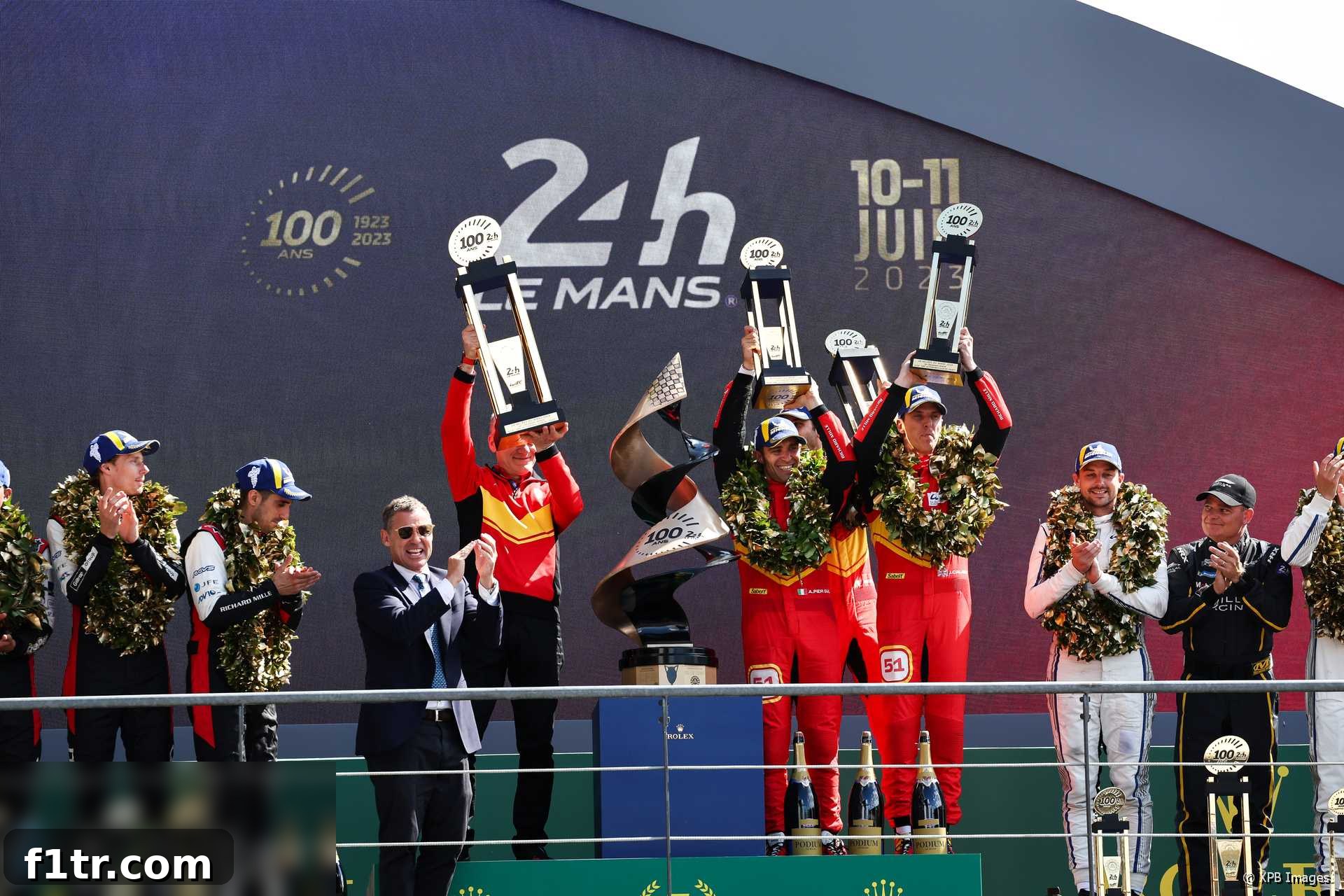
In a stunning display of grit, strategy, and outright speed, Ferrari achieved an monumental victory at the Le Mans 24 Hours, securing their first overall triumph in 58 years. The iconic Italian marque ended a nearly six-decade drought at the world’s most demanding endurance race, seizing the opportunity in the dramatic final hours as their fierce rival, Toyota, suffered a critical mishap. This historic win not only marked Ferrari’s return to the pinnacle of sports car racing but also delivered an unforgettable narrative of perseverance against a dominant force.
The 2023 edition of the Le Mans 24 Hours proved to be a true test of endurance, pushing both man and machine to their absolute limits. The Hypercar class, featuring an elite field of manufacturers, delivered nail-biting action from start to finish, culminating in a spectacular showdown between the #51 Ferrari 499P and the #8 Toyota GR010. The battle for supremacy was relentless, a testament to the unforgiving nature of the Circuit de la Sarthe and the intense rivalry that now defines modern endurance racing. Ferrari’s victory wasn’t just a win; it was a statement, a declaration that the Prancing Horse was back where it belonged – atop the podium at Le Mans.
Hours 19-20: The Unfolding Drama of Le Mans
As the sun began its ascent over the French countryside, signaling the dawn of the final four hours, the tension at Le Mans was palpable. The #51 Ferrari, piloted by the formidable trio of Alessandro Pier Guidi, James Calado, and Antonio Giovinazzi, found itself in a monumental duel with the reigning champions, Toyota Gazoo Racing. With the gap between the top two Hypercars almost non-existent, every lap, every pit stop, and every strategic decision became magnified, potentially swaying the outcome of the entire race. The Ferrari, under the command of Antonio Giovinazzi, had managed to build a crucial one-minute lead after 18 hours of grueling competition, a testament to their unwavering pace and flawless execution through the night.
However, the nature of endurance racing dictates that leads are never truly secure. This became abundantly clear when a lengthy slow zone period was initiated, prompted by an incident involving Antonio Felix da Costa in Jota Sport’s Porsche 963. Da Costa’s unfortunate error led to a guardrail being torn apart, necessitating extensive repairs and bringing the race under controlled conditions. This unexpected interruption provided a critical strategic window for teams. Giovinazzi, sensing the opportune moment, decided to pit the Ferrari, handing over to the experienced Alessandro Pier Guidi. Yet, the drama was far from over. As Pier Guidi prepared to rejoin the race, an unforeseen issue plagued the Ferrari – the engine struggled to refire. What was once a comfortable minute-long advantage evaporated in agonizing seconds, transforming into a 5.8-second deficit to Sebastien Buemi’s Toyota by the time the #51 car finally roared back to life.
The radio crackled with urgent instructions for Pier Guidi: “Show [Buemi] what you’re made of.” This was more than just a command; it was a challenge, a call to arms for the Italian driver. Despite the slow zone persisting for another ten minutes, Pier Guidi’s determination was evident. He aggressively attacked the remaining green sections of the track, relentlessly chipping away at Buemi’s lead. Within ten minutes behind the wheel, the gap was slashed to a mere two seconds. A lap later, executing a masterclass in slipstreaming, Pier Guidi positioned himself perfectly down the iconic Mulsanne Straight. He closed onto Buemi’s tail at the first chicane, then expertly utilized the aerodynamic tow to surge past the Toyota on the subsequent part of the straight, reclaiming the lead in a breathtaking maneuver that sent ripples of excitement through the paddock.
With the lead re-established, the gap between the two titans quickly began to grow. Buemi, keenly aware of the strategic disadvantage, immediately communicated his desire to pit while the slow zone was still active, hoping to reclaim the lead through a clever undercut. The tactical battle was heating up. As the 20th hour approached, Pier Guidi brought the Ferrari in for a swift pit stop, extending their advantage to almost nine seconds. Close behind, Buemi and the third-placed Cadillac, driven by Earl Bamber, followed suit. Buemi handed the Toyota over to Brendon Hartley, who emerged from the pits 18.8 seconds behind Pier Guidi. The lead stabilized, but not for long, as another lengthy slow zone period commenced shortly after, this time due to actor Michael Fassbender’s GTE Am-class Porsche crashing and damaging further barriers. This series of incidents underscored the chaotic and unpredictable nature of Le Mans.
Seizing the moment, Hartley opted to pit under this new slow zone, implementing the strategy Buemi had envisioned. This move saw him drop to 71 seconds behind the leading Ferrari. However, the ebb and flow of Le Mans continued. When Pier Guidi eventually pitted after the slow zone had cleared, handing the car over to James Calado, the gap dramatically reduced to a mere four seconds. Just as the prospect of intense wheel-to-wheel combat between the top two loomed large, yet another slow zone period was initiated at the very end of the hour, caused by Jack Aitken crashing the Action Express Racing Cadillac. This sequence of yellow flags and safety car interventions constantly shuffled the deck, keeping both teams on their toes and the outcome far from certain.
Hours 21-22: Strategic Battles and Mounting Pressure
The transition into the 21st and 22nd hours heralded a welcome return to extended periods of green flag racing, allowing both Ferrari and Toyota to unleash their full potential. This meant increased aggression, higher speeds, and a relentless push for every tenth of a second. While the gap between the leading Ferrari and the chasing Toyota had widened slightly, the intensity of their rivalry remained undiminished, evolving into a complex strategic chess match played out across 13.626 kilometers of asphalt.
Adding another layer of intrigue to this high-stakes contest was the presence of the #50 Ferrari, several laps down but by no means out of contention for its own strategic objectives. Miguel Molina, behind the wheel of the sister Ferrari, became a significant factor, diligently working to unlap himself. His target: Brendon Hartley in the #8 Toyota, who was under strict instructions from his team to manage an unprecedented triple-stint on his tyres. This daring strategy by Toyota aimed to gain track position and minimize pit stops, but it demanded extraordinary tyre management and defensive driving from Hartley. Molina’s initial attempts to pass were met with steadfast resistance from Hartley, who expertly blocked the lapped car, meticulously conserving his precious tyre life. Ultimately, the successful unlapping maneuver by Molina, while a necessity for his own race, inadvertently aided the leading #51 Ferrari, allowing James Calado to add a few crucial seconds to his advantage as Hartley navigated the traffic.
When Molina finally completed his pit stop, Hartley could afford no moment of respite. Toyota’s audacious plan to push his tyres even further meant he had to maintain an even stricter pace, balancing outright speed with meticulous conservation to avoid premature degradation or a catastrophic puncture. This demanding task placed immense physical and mental strain on the seasoned driver, who had to contend with both the clock and the constant threat of wear and tear.
The gap between the leading Ferrari and the #8 Toyota fluctuated with each passing lap and subsequent pit stops. During their next scheduled stops, the lead grew to ten seconds, a small but significant buffer in the high-speed world of Le Mans. By the 21-hour mark, the advantage for Ferrari had stretched to 14 seconds. Recognizing the need for fresh rubber, Hartley finally pitted for new tyres approximately 20 minutes later. Calado, demonstrating swift strategic thinking, reacted immediately, pitting the very next lap. This perfectly executed counter-strategy successfully amplified his lead even further, showcasing the Ferrari team’s sharp tactical prowess and their ability to respond under pressure.
Undaunted, Hartley redoubled his efforts, pushing the Toyota to its absolute limit to reel in the Ferrari. He managed to bring the gap back down to ten seconds, a remarkable feat given the tyre conservation he was undertaking. However, the #50 Ferrari once again proved to be a challenging obstacle, this time by being ahead of him on track. This forced Hartley to lose precious time and express his frustrations over the radio, highlighting the complex dynamics of multi-class racing. Just as Hartley voiced his concerns, Nicklas Nielsen in the #50 Ferrari made his pit stop, clearing the way for Hartley. As the race entered its final two hours, Hartley remained a steadfast ten seconds behind the leader, poised for any opportunity that might arise.
Meanwhile, the factory Cadillac entries maintained a strong and consistent performance, solidifying their hold on third and fourth positions, a testament to their reliability and speed. In contrast, the #93 Peugeot endured a torrid couple of hours, battling a persistent leak in its steering system. This critical issue necessitated several unscheduled pit stops, causing the stylish French Hypercar to plummet from a competitive fifth place down to ninth, effectively ending its challenge for a higher finish. Frederic Makowiecki, driving for Porsche Penske, inherited fifth place after Nielsen’s pit stop, setting up a potential strategic battle with the #50 Ferrari later in the race, underscoring the layered competition beyond the immediate front runners.
Hours 23-24: Ferrari’s Defining Moment and a Toyota Heartbreak
As the race plunged into its penultimate hour, the atmosphere was electric with anticipation. The stage was set for a climactic finish, a true test of nerve and machinery. Toyota, hoping to inject fresh impetus and maximize their chances, swapped Brendon Hartley for Ryo Hirakawa. This move placed immense pressure on Hirakawa to extract every ounce of performance from the GR010 and close the gap to the leading Ferrari. Antonio Giovinazzi, in a masterstroke of timing and strategy, pitted a lap later and emerged with a healthy 16-second lead. Hirakawa, fully aware of the stakes, pushed the Toyota relentlessly, determined to chip away at Ferrari’s advantage and ignite a final battle for victory.
But in the brutal crucible of Le Mans, the line between pushing hard and pushing too hard can be devastatingly thin. Less than ten minutes into his stint, disaster struck for Hirakawa. Approaching the notoriously challenging Arnage corner, a turn demanding precision and respect, the rear wheels of his Toyota locked heavily under braking. As he eased off the brakes, the rear of the car snapped violently, sending him careening into the barriers before spinning off track. It was a heart-wrenching moment for Toyota, a cruel twist of fate in the dying hours of the race. The incident tragically echoed Hartley’s earlier complaints about rear locking, suggesting an underlying issue. Hirakawa, devastated but determined, lost a precious minute trying to disentangle his damaged Toyota, get it turned around, and back on its way.
By the time Hirakawa nursed the wounded car back to the pits for urgent repairs, Giovinazzi had extended Ferrari’s lead to an astonishing 90 seconds. After the team worked feverishly to fix the #8 Toyota, Hirakawa returned to the track, now a staggering 3 minutes and 18 seconds behind the leader. Adding to the bizarre sequence of events, Hirakawa found himself a few seconds ahead of Giovinazzi on track, though technically nearly a full lap down. Giovinazzi, now with a monumental lead, drove a composed and calculated stint, simply following the Toyota without any need to pressure it, ensuring the car reached its next pit stop safely.
With just over an hour and nine minutes remaining, Giovinazzi pitted for a final set of fresh tyres, which temporarily saw his lead drop to just under two minutes. However, the advantage swung back immediately as Hirakawa also pitted to top up on fuel, pushing the gap back out to a commanding 3 minutes and 5 seconds. The path to victory was now clear for the Prancing Horse.
Alessandro Pier Guidi took the wheel of the Ferrari for the final triumphant sprint to the chequered flag. The race, however, had one more scare in store for the Italian driver. With only 23 minutes left, during his final pit stop, the Ferrari once again refused to fire up as he attempted to leave his pit box. The tension in the Ferrari garage was excruciating, a brief moment of horrifying déjà vu. Mercifully, after what felt like an eternity, the engine roared back to life, allowing Pier Guidi to continue his run. His temporarily reduced lead quickly grew again as Hirakawa made a final pit stop with 18 minutes remaining, effectively ending any minuscule chance of a dramatic comeback.
What had seemed destined to be a brutal, wheel-to-wheel fight to the very finish, with just ten seconds separating the two titans two hours prior, dissolved into a relaxed cruise for Pier Guidi. With well over one and a half minutes in hand, he was able to guide the #51 Ferrari across the finish line in glorious fashion, securing Ferrari’s first overall Le Mans win since 1965. It was a moment of pure ecstasy, a culmination of decades of yearning and a testament to the team’s unwavering commitment to their motorsport heritage. Hirakawa, despite his earlier mistake, continued to push valiantly, ultimately finishing 89.894 seconds behind in second place, bringing an end to Toyota’s remarkable winning streak at Le Mans, but securing valuable points and showing their resilience.
Rounding out the podium was the #2 Cadillac, expertly driven by Earl Bamber, claiming a highly commendable third position for Cadillac Racing. His team-mate Sebastien Bourdais, managing a slight issue in his final stint, brought the sister #3 Cadillac home in a strong fourth place, highlighting the impressive performance of the American manufacturer. The final hour saw further drama as a transmission issue forced Porsche Penske driver Michael Christensen into a lengthy pit stop, causing him to fall from fifth to ninth. This elevated Ferrari’s Antonio Fuoco in the #50 car to round out a stellar top five finish for the Scuderia. Both Glickenhaus cars defied expectations to finish an impressive sixth and seventh, even after Franck Mailleux crashed in his final stint in the seventh-placed car. Christensen’s woes also allowed the #93 Peugeot to recover to eighth place, a respectable finish despite its earlier fluid leakage issues. Finally, in a remarkable display of courage and skill, LMP2 class winner Fabio Scherer, driving with an injured foot for Inter Europol Competition, secured a top ten overall finish, taking the privilege of driving the final stint for his team.
Final Results after 24 Hours: Le Mans 2023
| Pos | No. | Class | Team | Car | Drivers | Laps |
|---|---|---|---|---|---|---|
| 1 | 51 | Hypercar (H) | Ferrari AF Corse | Ferrari 499P | Alessandro Pier Guidi/James Calado/Antonio Giovinazzi | 342 |
| 2 | 8 | Hypercar (H) | Toyota Gazoo Racing | Toyota GR010 | Sebastien Buemi/Brendon Hartley/Ryo Hirakawa | 342 |
| 3 | 2 | Hypercar (H) | Cadillac Racing | Cadillac V-Series.R | Earl Bamber/Alex Lynn/Richard Westbrook | 341 |
| 4 | 3 | Hypercar (H) | Cadillac Racing | Cadillac V-Series.R | Sebastien Bourdais/Renger Van Der Zande/Scott Dixon | 340 |
| 5 | 50 | Hypercar (H) | Ferrari AF Corse | Ferrari 499P | Antonio Fuoco/Miguel Molina/Nicklas Nielsen | 337 |
| 6 | 708 | Hypercar | Glickenhaus Racing | Glickenhaus 007 | Romain Dumas/Olivier Pla/Ryan Briscoe | 335 |
| 7 | 709 | Hypercar | Glickenhaus Racing | Glickenhaus 007 | Franck Mailleux/Nathanael Berthon/Esteban Gutierrez | 333 |
| 8 | 93 | Hypercar (H) | Peugeot Totalenergies | Peugeot 9X8 | Paul di Resta/Mikkel Jensen/Jean-Eric Vergne | 330 |
| 9 | 5 | Hypercar (H) | Porsche Penske Motorsport | Porsche 963 | Dane Cameron/Michael Christensen/Frederic Makowiecki | 329 |
| 10 | 34 | LMP2 | Inter Europol Competition | Oreca 07 – Gibson | Jakub Smiechowski/Albert Costa/Fabio Scherer | 328 |
| 11 | 41 | LMP2 | Team WRT | Oreca 07 – Gibson | Rui Andrade/Louis Deletraz/Robert Kubica | 328 |
| 12 | 30 | LMP2 | Duqueine Team | Oreca 07 – Gibson | Neel Jani/Rene Binder/Nicolas Pino | 327 |
| 13 | 36 | LMP2 | Alpine Elf Team | Oreca 07 – Gibson | Matthieu Vaxiviere/Charles Milesi/Julienal Canal | 327 |
| 14 | 31 | LMP2 | Team WRT | Oreca 07 – Gibson | Sean Gelael/Ferdinand Habsburg/Robin Frijns | 327 |
| 15 | 48 | LMP2 | Idec Sport | Oreca 07 – Gibson | Paul Lafargue/Paul Loup Chatin/Laurents Horr | 327 |
| 16 | 10 | LMP2 | Vector Sport | Oreca 07 – Gibson | Ryan Cullen/Gabriel Aubry/Matthias Kaiser | 325 |
| 17 | 311 | Hypercar (H) | Action Express Racing | Cadillac V-Series.R | Luis Felipe Derani/Alexander Sims/Jack Aitken | 324 |
| 18 | 23 | LMP2 | United Autosports | Oreca 07 – Gibson | Joshua Pierson/Tom Blomqvist/Oliver Jarvis | 323 |
| 19 | 35 | LMP2 | Alpine Elf Team | Oreca 07 – Gibson | Andre Negrão/Olli Caldwell/Memo Rojas | 322 |
| 20 | 45 | LMP2 Pro/Am | Algarve Pro Racing | Oreca 07 – Gibson | George Kurtz/James Allen/Colin Braun | 322 |
| 21 | 22 | LMP2 | United Autosports | Oreca 07 – Gibson | Philip Hanson/Filipe Albuquerque/Frederick Lubin | 321 |
| 22 | 6 | Hypercar (H) | Porsche Penske Motorsport | Porsche 963 | Kevin Estre/Andre Lotterer/Laurens Vanthoor | 320 |
| 23 | 37 | LMP2 Pro/Am | Cool Racing | Oreca 07 – Gibson | Nicolas Lapierre/Alexandre Coigny/Malthe Jakobsen | 317 |
| 24 | 28 | LMP2 | JOTA | Oreca 07 – Gibson | David Heinemeier Hansson/Oliver Rasmussen/Pietro Fittipaldi | 316 |
| 25 | 65 | LMP2 | Panis Racing | Oreca 07 – Gibson | Manuel Maldonado/Tijmen van der Helm/Job van Uitert | 316 |
| 26 | 33 | LMGTE Am | Corvette Racing | Chevrolet Corvette C8.R | Nicky Catsburg/Ben Keating/Nicolas Varrone | 313 |
| 27 | 94 | Hypercar (H) | Peugeot Totalenergies | Peugeot 9X8 | Loic Duval/Gustavo Menezes/Nico Mueller | 312 |
| 28 | 25 | LMGTE Am | ORT by TF | Aston Martin Vantage AMR | Ahmad Al Harthy/Michael Dinan/Charlie Eastwood | 312 |
| 29 | 86 | LMGTE Am | GR Racing | Porsche 911 RSR-19 | Michael Wainwright/Benjamin Barker/Riccardo Pera | 312 |
| 30 | 85 | LMGTE Am | Iron Dames | Porsche 911 RSR-19 | Sarah Bovy/Michelle Gatting/Rahel Frey | 312 |
| 31 | 54 | LMGTE Am | AF Corse | Ferrari 488 GTE Evo | Thomas Flohr/Francesco Castellacci/Davide Rigon | 312 |
| 32 | 43 | LMP2 Pro/Am | DKR Engineering | Oreca 07 – Gibson | Tom Van Rompuy/Ugo de Wilde/Maxime Martin | 311 |
| 33 | 98 | LMGTE Am | Northwest AMR | Aston Martin Vantage AMR | Ian James/Daniel Mancinelli/Alex Riberas | 310 |
| 34 | 9 | LMP2 | Prema Racing | Oreca 07 – Gibson | Bent Viscaal/Juan Manuel Correa/Filip Ugran | 310 |
| 35 | 56 | LMGTE Am | Project 1 – AO | Porsche 911 RSR-19 | PJ Hyett/Gunnar Jeannette/Matteo Cairoli | 309 |
| 36 | 100 | LMGTE Am | Walkenhorst Motorsport | Ferrari 488 GTE Evo | Chandler Hull/Andrew Haryanto/Jeffrey Segal | 307 |
| 37 | 39 | LMP2 Pro/Am | Graff Racing | Oreca 07 – Gibson | Roberto Lacorte/Giedo van der Garde/Patrick Pilet | 303 |
| 38 | 74 | LMGTE Am | Kessel Racing | Ferrari 488 GTE Evo | Kei Cozzolino/Yorikatsu Tsujiko/Naoki Yokomizo | 303 |
| 39 | 24 | CDNT | Hendrick Motorsports | Chevrolet Camaro ZL1 | Jimmie Johnson/Mike Rockenfeller/Jenson Button | 285 |
| 40 | 38 | Hypercar (H) | Hertz Team JOTA | Porsche 963 | Antonio Felix Da Costa/Will Stevens/Yifei Ye | 244 |
| 41 | 57 | LMGTE Am | Kessel Racing | Ferrari 488 GTE Evo | Takeshi Kimura/Scott Huffaker/Daniel Serra | 254 |
| 42 | 911 | LMGTE Am | Proton Competition | Porsche 911 RSR-19 | Michael Fassbender/Martin Rump/Richard Lietz | 246 |
| 43 | 80 | LMP2 Pro/Am | AF Corse | Oreca 07 – Gibson | Francois Perrodo/Ben Barnicoat/Norman Nato | 183 |
| 44 | 88 | LMGTE Am | Proton Competition | Porsche 911 RSR-19 | Harry Tincknell/Donald Yount/Jonas Ried | 170 |
| 45 | 4 | Hypercar | Floyd Vanwall Racing Team | Vanwall Vandervell 680 | Tom Dillmann/Esteban Guerrieri/Tristan Vautier | 165 |
| 46 | 777 | LMGTE Am | D’Station Racing | Aston Martin Vantage AMR | Satoshi Hoshino/Casper Stevenson/Tomonobu Fujii | 163 |
| 47 | 47 | LMP2 | Cool Racing | Oreca 07 – Gibson | Reshad de Gerus/Vladislav Lomko/Simon Pagenaud | 158 |
| 48 | 77 | LMGTE Am | Dempsey-Proton Racing | Porsche 911 RSR-19 | Christian Ried/Mikkel Pedersen/Julien Andlauer | 118 |
| 49 | 32 | LMP2 | Inter Europol Competition | Oreca 07 – Gibson | Mark Kvamme/Jan Magnussen/Anders Fjordbach | 117 |
| 50 | 63 | LMP2 | Prema Racing | Oreca 07 – Gibson | Doriane Pin/Daniil Kvyat/Mirko Bortolotti | 113 |
| 51 | 7 | Hypercar (H) | Toyota Gazoo Racing | Toyota GR010 | Mike Conway/Kamui Kobayashi/Jose Maria Lopez | 103 |
| 52 | 66 | LMGTE Am | JMW Motorsport | Ferrari 488 GTE Evo | Thomas Neubauer/Louis Prette/Giacomo Petrobelli | 89 |
| 53 | 923 | LMP2 Pro/Am | Racing Team Turkey | Oreca 07 – Gibson | Salih Yoluc/Tom Gamble/Dries Vanthoor | 87 |
| 54 | 75 | Hypercar (H) | Porsche Penske Motorsport | Porsche 963 | Felipe Nasr/Mathieu Jaminet/Nicholas Tandy | 84 |
| 55 | 72 | LMGTE Am | TF Sport | Aston Martin Vantage AMR | Arnold Robin/Maxime Robin/Valentin Hasse-Clot | 58 |
| 56 | 83 | LMGTE Am | Richard Mille AF Corse | Ferrari 488 GTE Evo | Luis Perez Companc/Alessio Rovera/Lilou Wadoux | 33 |
| 57 | 16 | LMGTE Am | Proton Competition | Porsche 911 RSR-19 | Ryan Hardwick/Zacharie Robichon/Jan Heylen | 28 |
| 58 | 60 | LMGTE Am | Iron Lynx | Porsche 911 RSR-19 | Claudio Schiavoni/Matteo Cressoni/Alessio Picariello | 28 |
| 59 | 55 | LMGTE Am | GMB Motorsport | Aston Martin Vantage AMR | Gustav Dahlmann Birch/Marco Sorensen/Jens Reno Moller | 21 |
| 60 | 21 | LMGTE Am | AF Corse | Ferrari 488 GTE Evo | Simon Mann/Julien Piguet/Ulysse de Pauw | 21 |
| 61 | 13 | LMP2 Pro/Am | Tower Motorsports | Oreca 07 – Gibson | Steven Thomas/Ricky Taylor/Rene Rast | 19 |
| 62 | 14 | LMP2 Pro/Am | Nielsen Racing | Oreca 07 – Gibson | Rodrigo Sales/Mathias Beche/Ben Hanley | 18 |
World Endurance Championship Insights
- WEC cancels its Qatar season-opener due to US-Iran war
- Porsche to end WEC Hypercar programme after just three seasons
- Mercedes won’t return to Le Mans because “we don’t like Balance of Performance” – Wolff
- “Luck” needed to win Le Mans because of Balance of Performance – Verstappen
- McLaren finally confirms it will enter the World Endurance Championship in 2027
Browse all World Endurance Championship articles