Formula 1’s Qatar Grand Prix Plunges into Tyre Crisis: An Embarrassment for the Sport
The pinnacle of motorsport, Formula 1, found itself in an unenviable spotlight at the Qatar Grand Prix, as unforeseen tyre integrity issues forced significant revisions to the weekend schedule and sparked widespread concern across the paddock. Haas team principal Gunther Steiner, known for his candid assessments, minced no words, labeling the situation a profound “embarrassment” for a series that prides itself on cutting-edge engineering and unwavering safety standards. This unexpected crisis not only disrupted the meticulous planning for the sprint race weekend but also cast a shadow of uncertainty over the main Grand Prix event.
Immediate Reaction and FIA Intervention
The alarm bells rang loud and clear on Saturday when the Fédération Internationale de l’Automobile (FIA) officially announced that critical problems had been detected with the Pirelli tyres. This alarming discovery followed a solitary hour of practice held on Friday, during which teams and drivers collected initial data on the demanding Losail International Circuit. The rapid deterioration and potential structural weaknesses observed prompted immediate action from the sport’s governing body, highlighting the severity of the situation.
In response to the identified risks, the FIA moved swiftly to implement new track limits regulations. These rules were specifically designed to deter drivers from aggressively utilizing the kerbs at two critical corners, Turns 12 and 13, which were pinpointed as major contributors to the tyre damage. To allow drivers ample time to adapt to these sudden changes and understand the revised racing lines, the start of the sprint race qualifying session was postponed. This afforded competitors an additional 10 minutes of practice, a crucial window for fine-tuning their approach and mitigating further tyre stress.
However, the immediate fixes were just the beginning. Looking ahead to Sunday’s highly anticipated Grand Prix, further drastic changes were under active consideration. These included potentially mandating a minimum of three pit stops for all drivers, a strategic curveball that would dramatically alter race dynamics. Furthermore, an unprecedented maximum stint length of 20 laps was proposed, meaning drivers would be prohibited from running on a single set of tyres for more than a third of the race distance. Such measures underscore the deep-seated concerns regarding tyre longevity and safety, transforming what was expected to be a straightforward race into a strategic chess match dictated by durability.
Steiner’s Concerns: A Bleak Outlook for F1’s Reputation
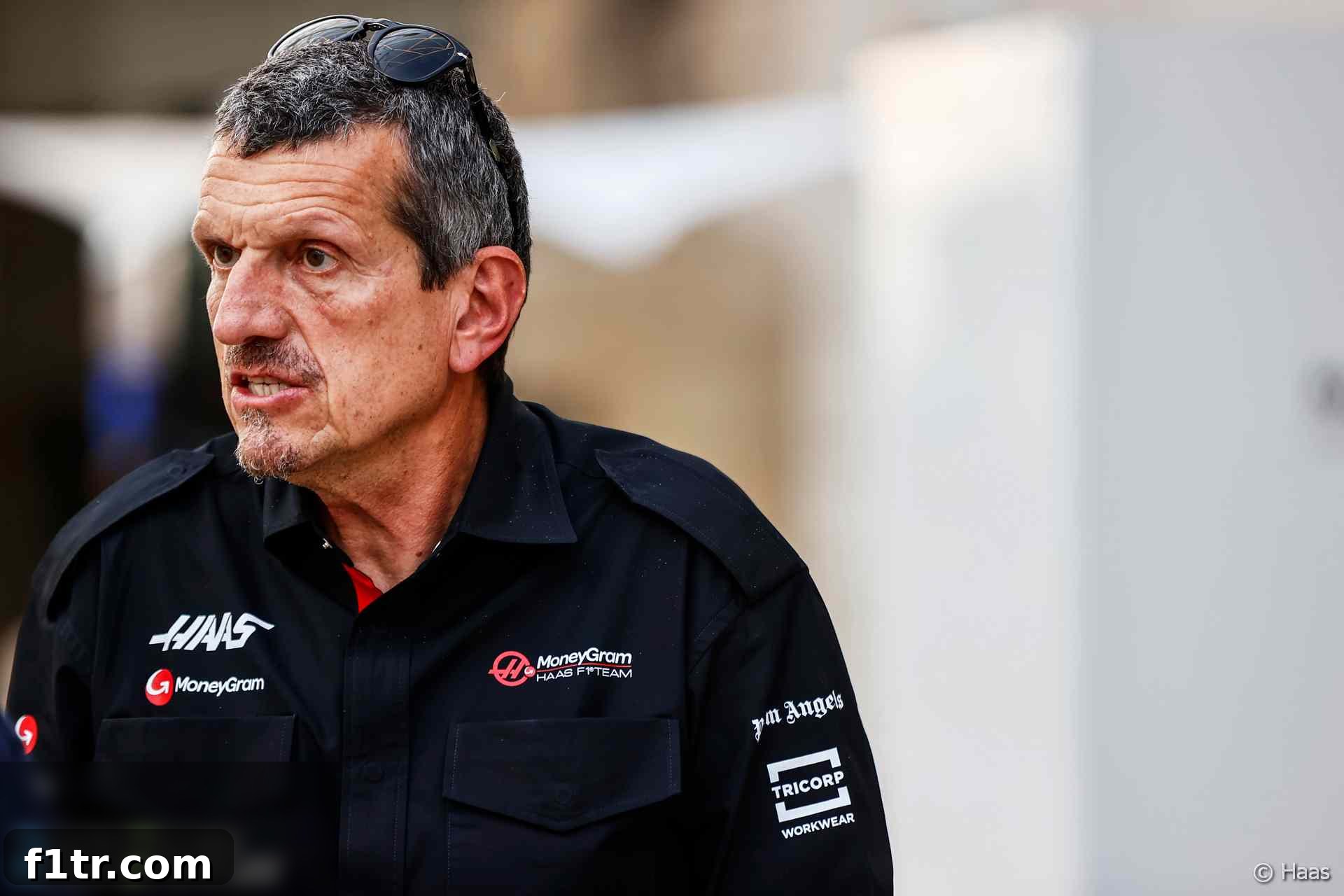
Haas team principal Gunther Steiner did not hide his dismay at the unforeseen development. He articulated his feelings of concern, stating unequivocally, “It shouldn’t happen. This should not happen in Formula 1.” His words resonated deeply within the paddock, reflecting a shared sentiment that a sport at the pinnacle of technological advancement should not face such fundamental issues with its most critical component – the tyres. The sentiment of embarrassment stemmed from the perception that F1, with its vast resources and expertise, should be immune to such basic safety oversights.
Steiner emphasized that while immediate solutions were being sought for the current race weekend, the long-term implications were more worrying. “But it has, and now we need to see how we get out of it,” he conceded. “I think the good thing with this coming out, there are solutions for this race weekend but going forward, this shouldn’t happen again.” His frustration was palpable, rooted in the understanding that such an incident tarnishes F1’s reputation for perfection and control. For a sport that prides itself on meticulous planning and engineering excellence, an avoidable tyre crisis represents a significant setback, raising questions about predictive analysis, track design, and material robustness.
“In the end it is embarrassing because this is not where we should be,” Steiner reiterated, highlighting the fundamental belief that Formula 1 operates at a level where such basic safety parameters should be rigorously controlled and guaranteed. The unexpected nature of the problem, surfacing after extensive preparations and track modifications, was particularly galling for teams and drivers alike, who rely on predictable performance from their equipment.
A Recurring Nightmare: Losail’s Troubled History with Tyres
This weekend’s event marked Formula 1’s second visit to the Losail International Circuit in Qatar, a track known for its challenging high-speed characteristics. Its inaugural appearance on the F1 calendar in 2021 was also marred by significant tyre failures, which at the time were primarily attributed to the circuit’s aggressive kerbs. Back then, several drivers experienced tyre delaminations and punctures, forcing teams to adopt more conservative strategies.
In the intervening period, conscious efforts were made to address these concerns. The Losail International Circuit underwent extensive refurbishment, including the installation of entirely new kerbs specifically designed to be less abrasive and more compliant with the demands of Formula 1 machinery. The expectation was that these modifications would definitively prevent a recurrence of the 2021 issues, ensuring a safer and more predictable racing surface. However, as Steiner pointed out, these efforts proved to be insufficient, or even counterproductive.
“There was some signs already here two years ago, we had issues but they were different kerbs,” Steiner explained, acknowledging the historical context. “I think they were supposed to develop some kerbs which don’t damage the tyres but apparently the kerbs we have developed they damage the tyres.” This statement points to a critical failure in the design or implementation process, where a supposed solution ironically exacerbated the very problem it aimed to solve. The irony was not lost on the paddock, further fueling the sense of frustration and disbelief.
Steiner admitted that he had not yet had the opportunity to speak directly with Pirelli, the sole tyre supplier for Formula 1, to understand the precise nature of the failure. However, he fully supported the proactive measures taken by the FIA and Pirelli. “I didn’t speak with Pirelli yet to see what actually is happening, but I think if they found issues with the tyres that is what they need to do to make sure that we are not having a scenario like a few years ago, that you have got tyres going down which is never good,” he added. The priority, above all, remains driver safety, and any action to prevent catastrophic tyre failures is a necessary evil, even if it compromises the sporting spectacle.
Uncertainty Lingers: Is the Problem Fully Understood?
The immediate resolution involved the repositioning of the white line that defines the edge of the track at Turns 12 and 13. This seemingly minor adjustment was intended to physically keep drivers away from the most problematic sections of the kerbs, thereby reducing the stress exerted on the tyre sidewalls. While a step in the right direction, Steiner expressed lingering concerns that the problem might be more widespread and not confined solely to these two specific corners.
The high-speed nature of the Losail circuit, combined with the aggressive forces exerted on tyres through its sweeping turns, could mean that other parts of the track are also contributing to tyre degradation. “At least they are proactively doing something for tomorrow and now going out changing some of the track limits that we are not going over these kerbs should help a little bit,” Steiner commented, acknowledging the swift response. “But I don’t know if that sorts the problem because it wasn’t clear to me.” This uncertainty is a significant factor for teams and drivers, who thrive on precise data and predictable conditions.
Steiner’s apprehension highlighted a potential lack of complete understanding from the authorities regarding the root cause of the issue. “They are doing three corners, the track limits will be changed so we don’t go on the kerbs. But I don’t know if it is only those kerbs or other ones as well. I think they don’t know as much as they would like to know, otherwise it wouldn’t have ended up in this place.” This candid observation suggests that the immediate actions, while necessary for safety, might be treating symptoms rather than the underlying cause. If the problem is indeed more systemic, affecting multiple sections of the track or the fundamental interaction between the tyre compound and the circuit’s surface, then more extensive solutions will be required in the future.
Given the serious safety implications of tyre failures at high speeds, Steiner fully expected stringent measures for the main Grand Prix. “So I think that for safety reasons, for sure if they see any risk of having flat tyres they will have a maximum running of the tyres of 20 laps is my understanding tomorrow for the proper race.” Such a restriction would fundamentally alter race strategy, forcing teams to perform at least two, and more likely three, pit stops. This would place a premium on pit stop efficiency, strategic timing, and adaptability, transforming the race from a flat-out sprint into a complex strategic puzzle.
The Deeper Implications for Formula 1
The Qatar tyre crisis extends beyond a single race weekend; it raises critical questions for Formula 1 as a whole. Firstly, it highlights the continuous tension between performance and safety. Pirelli is tasked with developing tyres that can withstand extreme forces, temperatures, and aggressive driving styles across a diverse range of circuits, while also providing the grip and speed that defines F1. When this delicate balance is disrupted, the consequences can be severe.
Secondly, it underscores the importance of circuit design and homologation processes. If newly installed kerbs, intended to be safer, are instead causing damage, it suggests a flaw in the testing, validation, or material selection process. This incident will undoubtedly prompt a rigorous review of how new or modified circuits are vetted for Formula 1 standards, ensuring that track characteristics do not inadvertently compromise driver safety.
Finally, the “embarrassment” felt by figures like Gunther Steiner reflects a deeper concern about the sport’s image. Formula 1 is a global spectacle, a showcase of human and technological prowess. Incidents that reveal fundamental safety weaknesses or necessitate last-minute, reactive rule changes can detract from its prestige and raise questions among fans and stakeholders alike. While safety is paramount and quick reactions are commendable, the underlying issue needs a definitive, long-term resolution to prevent future recurrences and restore full confidence in the sport’s foundational elements.
As the Qatar Grand Prix weekend unfolds, all eyes will be on how teams and drivers adapt to these unprecedented challenges. The crisis has undeniably introduced an element of unpredictability and strategic complexity, transforming what should have been a high-speed battle for supremacy into a meticulous exercise in tyre management and damage limitation.