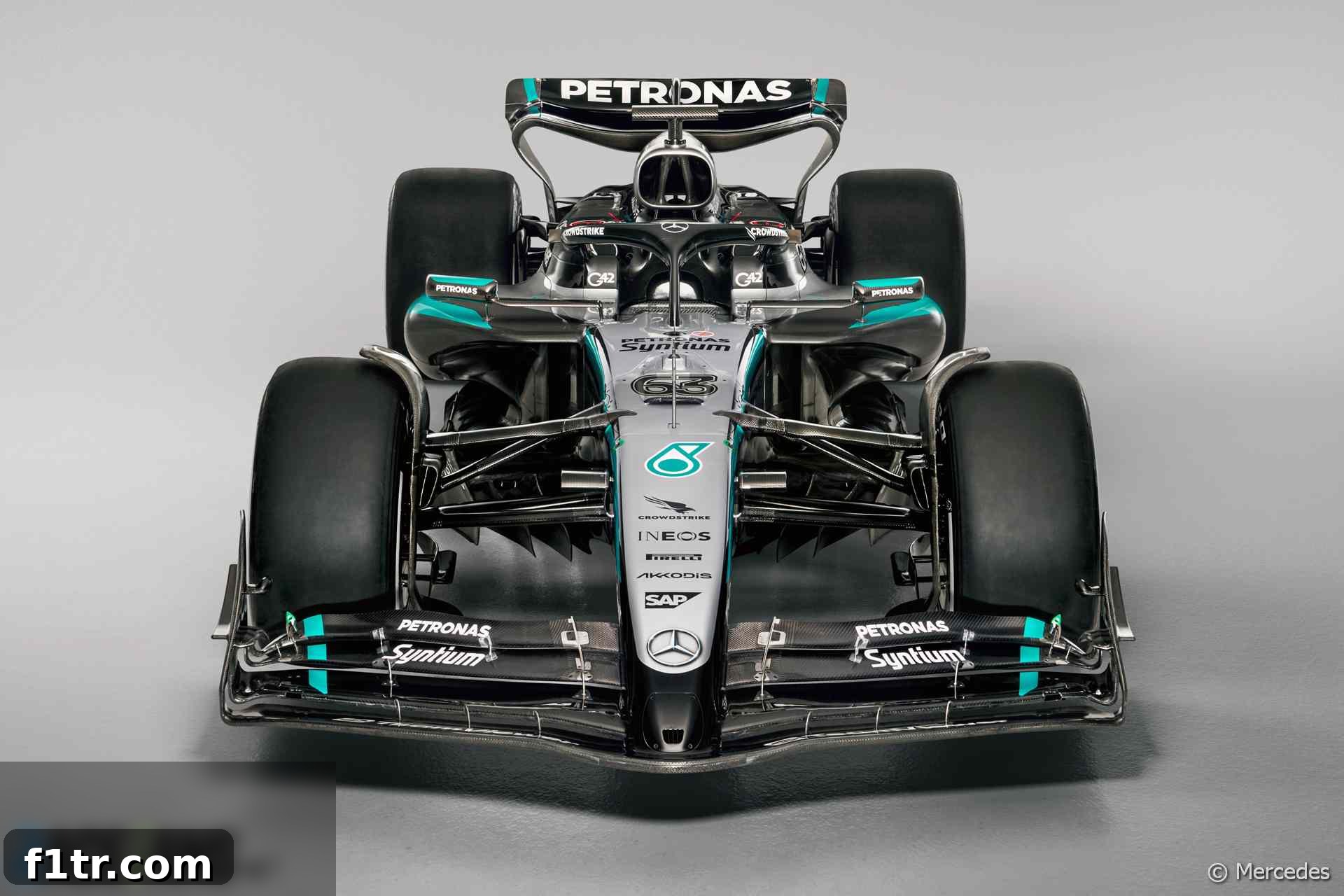
The dawn of a new Formula 1 season always brings with it a wave of anticipation, but for the Mercedes-AMG Petronas F1 Team, the reveal of their new challenger, the W16, for the 2025 Formula 1 season, signals not just a new car, but an entirely new chapter. Unveiling the first official images of the W16, Mercedes has provided the global motorsport community with a tantalizing glimpse into their future as they embark on what team principal and co-owner Toto Wolff describes as “an exciting new era.”
Mercedes Unveils the W16: A New Era for the 2025 F1 Season
Following a 2024 season that presented a complex mix of triumphs and frustrations, Mercedes is resolute in its pursuit of consistent victory. The team, whose livery for the new car was initially showcased at the F1 75 launch event, demonstrated flashes of brilliance last year, securing four Grand Prix wins. This marked their most successful run since the current ground effect regulations were reintroduced two years prior, a testament to their engineering prowess under specific conditions. However, the overall campaign saw them finish fourth in the constructors’ championship, their lowest standing since 2012, highlighting the inherent challenges in adapting their car to a diverse range of circuits and evolving track conditions.
The W16 represents a critical evolution, born from intensive analysis and a relentless drive for perfection. Mercedes’ dedication to returning to the pinnacle of Formula 1 is evident in every aspect of the new design, aiming to rectify the inconsistencies that plagued its predecessor. The focus is squarely on developing a car that performs optimally across the board, not just on specific high-speed layouts where the W15 sometimes excelled. This commitment to versatility and adaptability will be paramount in the fiercely competitive environment of modern Formula 1.
Learning from the Past: Analyzing the W15’s Performance and the Road to W16
The 2024 season offered valuable, albeit sometimes perplexing, lessons for the Brackley-based squad. While the Mercedes W15 proved particularly potent on circuits demanding high aerodynamic efficiency and straight-line speed, its performance spectrum across the calendar was notably inconsistent. The team often found themselves grappling with variations in car behavior, particularly as track conditions shifted throughout a race weekend – from free practice sessions to qualifying and the Grand Prix itself. This sensitivity to external factors presented a significant challenge for drivers and engineers alike, making it difficult to consistently extract maximum performance. Such unpredictability not only impacted their race results but also complicated their understanding of the car’s underlying characteristics, hindering incremental improvements.
Addressing these fundamental issues has been the central pillar of the W16’s development philosophy. The engineering teams have meticulously reviewed data, seeking to understand the root causes of the W15’s fluctuating performance. This involved a deep dive into aerodynamic stability, suspension kinematics, tire interaction, and overall chassis balance. The objective for the W16 is clear: to deliver a more predictable, robust, and versatile platform that allows drivers to extract peak performance regardless of circuit layout, ambient temperatures, or grip levels. This entails innovative solutions in areas such as ground effect optimization, weight distribution, and mechanical grip, ensuring that the W16 is a true all-rounder, capable of challenging for victories at every venue on the Formula 1 calendar.
The W16: Engineered for Consistent Victory
The W16 is more than just an iteration; it represents a comprehensive engineering response to the demands of modern Formula 1 and the specific challenges faced in recent seasons. The technical team at Mercedes has focused on several key areas to ensure the car’s improved versatility and performance stability. Aerodynamic refinements have been a major point of emphasis, with a concerted effort to create a more stable and efficient airflow structure, reducing sensitivity to ride height and pitch variations. This directly tackles the W15’s tendency to lose performance in varying conditions, particularly during cornering and over bumps.
Beyond aerodynamics, significant attention has been paid to the mechanical aspects of the car, including the suspension system. A more compliant yet precisely controlled suspension setup is crucial for managing tire temperatures and optimizing grip across different track surfaces. The power unit, a traditional strength for Mercedes, continues to be developed in close collaboration with their High Performance Powertrains division, ensuring maximum power delivery and efficiency within the stringent F1 regulations. The integration of the power unit with the chassis and aerodynamics is more critical than ever, and the W16 aims to achieve a seamless harmony between these complex systems. The ultimate goal is a car that not only has raw pace but also offers drivers a wide operating window and confidence-inspiring handling characteristics, enabling them to push the limits consistently throughout a Grand Prix weekend.
A Transformed Driver Lineup: Experience Meets Prodigy for 2025
The Legacy of Lewis Hamilton and the Dawn of a New Leadership
Perhaps the most significant change impacting the Mercedes-AMG Petronas F1 Team for 2025 is the departure of Formula 1’s most successful driver of all time, Lewis Hamilton, to Ferrari. Hamilton’s move marks the end of an unparalleled partnership that yielded six constructors’ championships and six drivers’ titles during his tenure with the Silver Arrows. His incredible talent, experience, and leadership were integral to Mercedes’ dominance for over a decade. His absence leaves a profound void, not just in terms of raw speed and race craft, but also in the invaluable developmental input and brand presence he brought to the team. Filling such colossal shoes is an unenviable task, but it also presents an opportunity for a fresh dynamic and a new generation to step forward.
This transition propels George Russell into an undisputed leadership role within the team. Having spent several seasons alongside Hamilton, Russell has absorbed knowledge and experience from one of the sport’s greatest. He now steps up as the most seasoned driver in the Mercedes lineup, carrying the primary responsibility for car development and the team’s on-track performance. This marks a pivotal moment in his career, demanding not just speed but also strategic insight, consistency, and the ability to rally the team around a common goal. The focus will undoubtedly be on how he embraces this new leadership mantle and guides Mercedes into their post-Hamilton era.
George Russell: Stepping Up as Team Leader
Having joined Mercedes in 2022 after an impressive apprenticeship at Williams, George Russell has steadily cemented his reputation as one of F1’s brightest talents. The 2024 season saw him continue his development, culminating in his third Grand Prix victory at Las Vegas, a testament to his racecraft and composure under pressure. While he also experienced the frustration of losing another potential victory at Spa due to a car disqualification (his car being found underweight after the race), these moments underscore his consistent speed and ability to be at the sharp end of the grid. Now, as the senior driver, Russell’s role extends beyond mere performance. He will be crucial in providing clear, consistent feedback to engineers, guiding the W16’s development path, and nurturing the talent of his new teammate.
His experience, acquired through both challenging and successful seasons, makes him uniquely positioned to lead. Russell’s meticulous approach to data analysis, combined with his natural speed and tactical awareness, will be indispensable as Mercedes aims to refine the W16 into a championship contender. The pressure on him will be immense, but it is a challenge he has visibly prepared for, eagerly anticipating the opportunity to stamp his authority on the team and deliver the consistent results Mercedes expects from its lead driver. His ability to perform under this increased spotlight will be a defining narrative of the 2025 season.
Andrea Kimi Antonelli: Mercedes’ Next Generation Star
Joining Russell is F1 rookie Andrea Kimi Antonelli, whose promotion to Formula 1 has been nothing short of astonishingly rapid. Heralded as a generational talent, Antonelli’s junior career has been a whirlwind of success. In 2023 alone, he secured three junior championships, most notably the highly competitive Formula Regional European title. What makes his ascent truly remarkable is his unprecedented jump directly from Formula Regional to Formula 2, bypassing Formula 3 entirely – a rare feat in the modern ladder system. After just a single season in Formula 2, where he continued to impress despite the steep learning curve, he was selected as Lewis Hamilton’s replacement, a clear indication of Mercedes’ profound confidence in his capabilities and long-term potential.
Antonelli’s arrival is not merely a driver change; it is a bold statement about Mercedes’ vision for the future. While the pressure to replace a legend like Hamilton will be immense, Antonelli’s calm demeanor and exceptional raw talent suggest he is well-equipped to handle it. His rapid progression through the junior categories highlights an innate ability to adapt quickly and extract maximum performance from new machinery. Working alongside George Russell, Antonelli will have the ideal mentor to guide him through his rookie F1 season, learning the intricate details of Grand Prix racing and contributing to the W16’s development. This blend of Russell’s growing experience and Antonelli’s prodigious talent could form a formidable partnership for Mercedes in the years to come.
Supporting Cast: Bottas and Vesti’s Crucial Roles
Beyond the primary driver lineup, the team benefits from a strong contingent of experienced and developing talent in supporting roles. Former Mercedes race driver Valtteri Bottas has returned to the fold as the third driver for the 2025 season. Bottas’s extensive experience, having spent five successful years with Mercedes during their dominant hybrid era, will be invaluable for simulator work, car development, and providing insights from a driver who intimately understands the team’s philosophy and technical demands. His return provides a reassuring presence and a wealth of knowledge to draw upon.
Complementing this, Frederik Vesti will continue in his role as reserve driver. Vesti, a promising talent from the Mercedes junior program, brings his recent Formula 2 experience and dedication to the team. His role involves significant simulator duties, supporting the race drivers, and being ready to step into the cockpit should the need arise. The combined expertise of Bottas and the fresh perspective of Vesti ensure that Mercedes has robust support for its primary lineup, contributing significantly to both present performance and future development.
Mercedes’ Road Ahead: Ambition and Anticipation for 2025
As Toto Wolff eloquently stated, Mercedes is focused on “challenging for victories more consistently” in 2025. The team’s off-season efforts have been dedicated to making significant gains, particularly in understanding and overcoming the W15’s performance limitations. However, as is always the case in Formula 1, the true measure of their progress will only become apparent when the W16 hits the track in competitive conditions. “We have made gains in the off-season, but we will only know where we stand come the first race in Australia,” Wolff wisely cautioned, acknowledging the ever-present competition from rivals like Red Bull, Ferrari, and McLaren, who are also relentlessly pushing their own development.
The pre-season testing period will be crucial for Mercedes to validate their design concepts, fine-tune the W16, and allow Russell and Antonelli to familiarize themselves with its characteristics. Every lap, every data point, will be vital in preparing for the opening Grand Prix. The expectation is not merely to compete, but to consistently challenge at the front, demonstrating the W16’s versatility across the diverse challenges of the F1 calendar. This season represents a pivotal moment for Mercedes, a chance to reassert their dominance and forge a new legacy with a fresh driver pairing and a car engineered for relentless pursuit of excellence.
First Glimpse: Pictures of the 2025 Mercedes W16
The reveal of the Mercedes W16 has ignited excitement among fans and pundits alike. These initial images offer a captivating first look at the machine tasked with carrying the hopes and ambitions of the Mercedes-AMG Petronas F1 Team into the 2025 season. While much of the car’s intricate technical details remain guarded secrets, these pictures provide a visual testament to the relentless innovation and meticulous craftsmanship that goes into creating a Formula 1 contender. The sleek lines, aggressive aerodynamic profile, and the iconic Silver Arrows livery all hint at the performance potential contained within this new challenger.
Beyond the W16: The Future of Mercedes in Formula 1
The launch of the W16 signifies far more than just a new car; it marks a strategic pivot for Mercedes in Formula 1. With a redefined driver lineup, spearheaded by the proven talent of George Russell and the electrifying potential of Andrea Kimi Antonelli, the team is clearly investing in its long-term future while simultaneously targeting immediate success. The lessons learned from the complexities of the ground effect era have been painstakingly applied, aiming for a car that offers both blistering pace and unwavering consistency. The journey to reclaim the top spot will be arduous, facing formidable competition from established rivals and rapidly improving challengers.
However, the spirit within the Mercedes camp remains undaunted. The pursuit of engineering excellence, coupled with a renewed focus on team synergy and driver development, forms the bedrock of their 2025 campaign. The W16 is not just a collection of carbon fiber and advanced mechanics; it is a symbol of Mercedes’ enduring ambition, their resilience, and their unwavering commitment to being at the forefront of motorsport innovation. As the world eagerly awaits the start of the 2025 F1 season, all eyes will be on the Silver Arrows, ready to witness if this new era can indeed deliver the consistent victories Toto Wolff and the entire team are striving for.
Related Formula 1 Insights
- F1 Technical Analysis & Innovations
- Driver Profiles, News & Career Paths
- Team Strategies & Development Updates
- Upcoming Season Previews & Predictions
- Formula 1 History & Legacy
Browse all Formula 1 articles