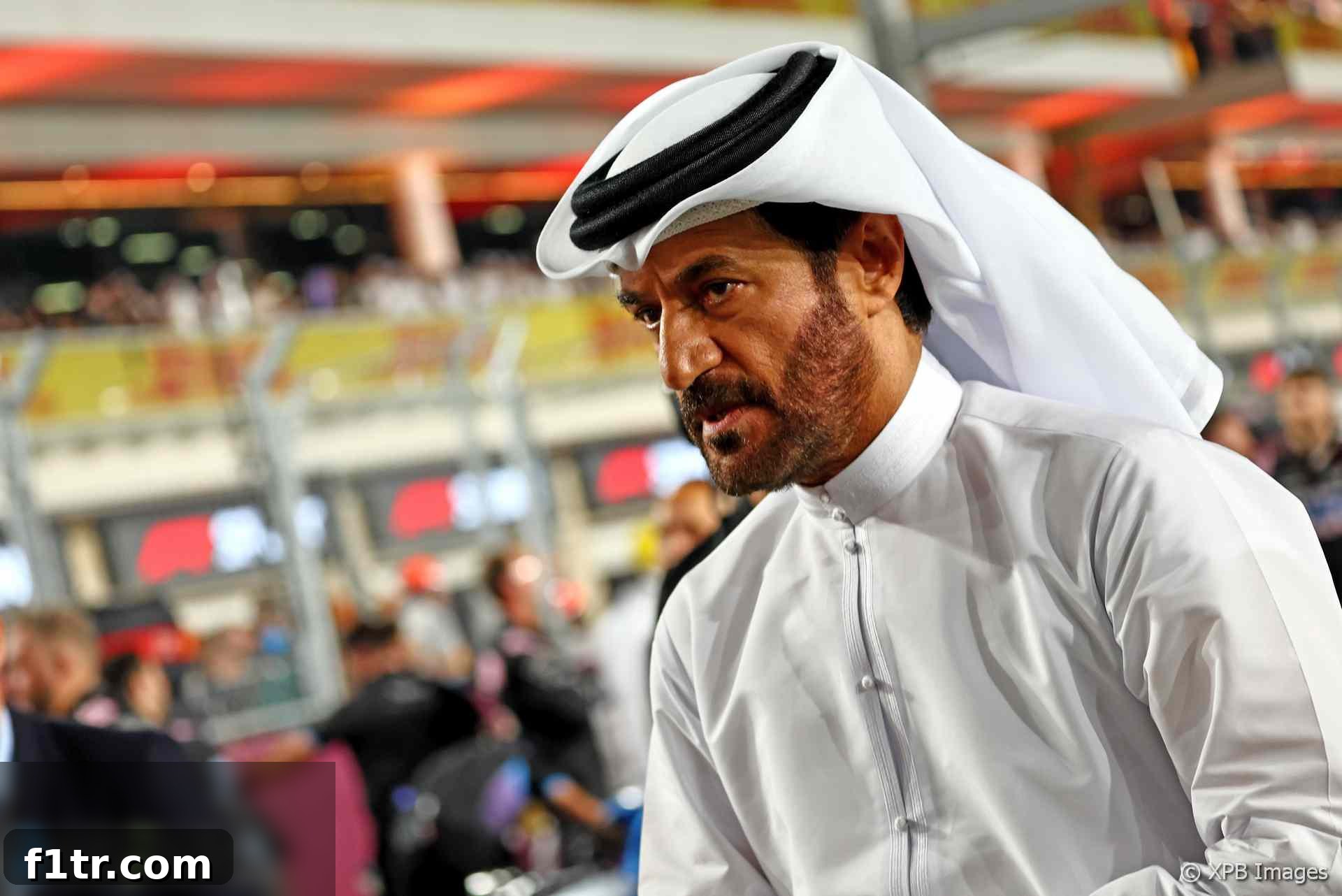
The global motorsport community is currently focused on the Fédération Internationale de l’Automobile (FIA) as the governing body has formally acknowledged serious allegations made against “certain members” of its leadership. These reports, which primarily concern FIA President Mohammed Ben Sulayem, have cast a significant shadow over the organization’s integrity and its relationship with Formula 1, the pinnacle of motorsport.
While the FIA’s initial statement remained deliberately vague regarding the precise nature of the allegations or the individuals involved beyond acknowledging “certain members,” subsequent detailed reports from the BBC have brought specific claims to light. These allegations revolve around President Ben Sulayem’s alleged actions concerning two high-profile Formula 1 events that took place last year: the inaugural Las Vegas Grand Prix and the Saudi Arabian Grand Prix.
Advert | Become a Supporter & go ad-free
The gravity of these accusations cannot be understated. They touch upon fundamental principles of fair play, impartial governance, and the safety protocols that underpin professional motorsport. The integrity of circuit approvals and race results is paramount, and any suggestion of interference from the highest office of the sport’s governing body naturally triggers widespread concern across the entire F1 paddock and among fans globally.
Allegations Surrounding the Las Vegas Grand Prix Circuit Approval
One of the most concerning claims detailed in the BBC’s latest report, published recently, stems from a whistle-blower who alleges direct interference by Mohammed Ben Sulayem. According to this individual, the FIA President instructed an official to deliberately seek out reasons to obstruct or prevent the FIA’s crucial approval of the Las Vegas Strip Circuit for its much-anticipated Formula 1 debut. The circuit was slated to host its first-ever world championship round in November of last year, marking a significant and costly expansion for F1 in the United States.
Circuit approval by the FIA is a critical and multi-faceted process, ensuring that a track meets stringent safety standards for both drivers and spectators. This includes detailed assessments of track layout, barriers, run-off areas, medical facilities, and overall operational readiness. Any instruction to actively search for flaws, rather than objectively evaluate compliance, would represent a severe breach of protocol and ethical conduct, potentially compromising safety standards for political or personal motives. Such an act could also undermine the extensive efforts and financial investments made by local organizers and Formula 1 itself.
The inspection of the Las Vegas circuit did indeed face delays, primarily attributed to ongoing construction work in the lead-up to the event. Despite these initial hurdles, the track ultimately received the necessary FIA approval, allowing the grand prix to proceed as scheduled. However, the event was not without its dramatic and troubling moments. Just 10 minutes into the first practice session, Scuderia Ferrari driver Carlos Sainz Jr. suffered a significant incident when his car struck a loose water valve cover on the track. The impact severely damaged his car, leading to a lengthy delay, cancellation of parts of the session, and significant disruption to the opening day of racing, much to the dismay of attendees and television audiences alike.
This incident, while seemingly unrelated to the alleged efforts to block approval, highlights the immense pressures and potential risks associated with rapidly prepared circuits, especially those built on temporary street layouts. If there were indeed attempts to undermine the approval process, even if ultimately unsuccessful, it raises serious questions about the diligence and impartiality expected from FIA officials involved in safety inspections. The Sainz incident served as a stark reminder of how critical robust and unbiased circuit certification is for the sport, reinforcing the need for absolute integrity in all safety evaluations.
Interference Claims at the Saudi Arabian Grand Prix
Preceding the Las Vegas allegations, a separate report, also citing the same whistle-blower, brought forth claims of Ben Sulayem’s alleged attempts to intervene in a critical race decision during last year’s Saudi Arabian Grand Prix. Specifically, it was claimed that the FIA President made efforts to overturn a post-race penalty issued to Aston Martin driver Fernando Alonso, which had initially cost him a podium finish.
The incident involving Alonso at the 2023 Saudi Arabian Grand Prix was contentious and drew considerable media attention. After serving an initial five-second penalty during his pit stop for an incorrect starting position on the grid, Alonso was later hit with an additional ten-second penalty post-race. This second penalty was imposed because the rear jack of his car was deemed to have touched the vehicle while the initial five-second penalty was still being served, a perceived violation of the sporting regulations concerning work on a car during a penalty. This subsequent penalty dropped Alonso from third to fourth place, robbing him of a memorable podium celebration.
However, Aston Martin successfully appealed the decision, arguing that there was no clear definition of “working on the car” in the regulations, and that similar minor touches had not been penalized in the past. The stewards eventually reversed the ten-second penalty, reinstating Alonso’s third-place finish and restoring his podium. The whistle-blower’s allegation now suggests that Ben Sulayem actively sought to influence this decision-making process to overturn the penalty, which, if true, would represent a direct and highly inappropriate interference in the judicial independence and autonomy of race stewards.
The impartial application of sporting regulations and the complete autonomy of the stewards in their decision-making are cornerstones of competitive motorsport. Any perceived or actual interference from the highest echelons of the FIA could severely undermine the credibility of race results and the entire regulatory framework, leading to pervasive questions about the fairness and transparency of Formula 1 competitions and potentially eroding public trust in the sport’s integrity.
The FIA’s Compliance Process and Internal Investigation
In response to these escalating and highly publicized reports, an FIA spokesperson provided a formal statement, confirming: “The FIA confirms that the compliance officer has received a report detailing potential allegations involving certain members of its governing bodies.” This acknowledgment signals the official initiation of an internal review process, a standard and necessary procedure when such serious claims emerge within a global sporting organization.
The spokesperson further elaborated on the next crucial steps: “The Compliance Department is assessing these concerns, as is common practice in these matters, to ensure that due process is meticulously followed.” This statement underscores the FIA’s stated commitment to a thorough, fair, and impartial investigation, strictly adhering to established internal protocols and ethical guidelines. The Compliance Department is a critical pillar of the FIA’s governance structure, specifically tasked with upholding the organization’s stringent Code of Ethics and ensuring adherence to all internal regulations and international sporting standards.
This vital department is currently headed by Paolo Basarri, a seasoned professional who has been leading the division since 2017. His role, and that of his dedicated team, is to objectively investigate allegations, rigorously gather evidence, conduct comprehensive interviews with relevant parties, and ultimately present findings without any external influence or prejudice. The “meticulous due process” mentioned signifies a comprehensive and detailed approach, specifically designed to ensure that all parties involved are heard, evidence is properly evaluated, and any conclusions reached are based solely on verifiable facts and established procedural justice.
It is noteworthy that the specific allegations mentioned in the reports primarily focus on Mohammed Ben Sulayem, distinguishing him as the central figure in these concerns. While the FIA’s official statement is broad in its wording, referring to “certain members,” the public and media focus remains firmly on the actions attributed to the President, given the significant implications for his leadership and the overarching governance of the sport.
Precedent: The Toto and Susie Wolff Investigation
The FIA’s Compliance Department has faced high-profile investigations recently, providing a significant precedent for the current situation. In December of last year, the department launched an investigation into an alleged exchange of confidential information between two prominent figures in motorsport: Mercedes team principal Toto Wolff and F1 Academy CEO Susie Wolff, who are married.
The allegations, stemming from a complaint reportedly made by a rival team principal, suggested a potential conflict of interest and unauthorized information sharing, particularly concerning discussions held during sensitive F1 Commission meetings. This sparked a wave of concern throughout the paddock, highlighting the delicate balance between commercial and sporting interests in Formula 1. The integrity of private discussions and the prevention of competitive advantages gained through improper channels are crucial for maintaining a truly level playing field across all participating teams.
However, in a swift and somewhat surprising turn of events, the investigation into the Wolffs was called off within a remarkably short period of two days. The FIA announced its decision after accepting that “FOM’s compliance management system is robust enough to prevent any unauthorised disclosure of confidential information.” This rapid resolution, following unanimous statements from all F1 teams denying having made the initial complaint, underscored the complexities, political sensitivities, and intricate power dynamics often inherent in such high-profile inquiries within motorsport’s upper echelons.
The speed with which the Wolff investigation was concluded, compared to what is likely to be a more protracted and intricate process concerning the FIA President, illustrates the differing scales and internal dynamics at play. Allegations directly against the head of the governing body carry a significantly heavier weight and necessitate an even more scrupulous, transparent, and undeniably thorough investigation process to maintain the institution’s credibility and public trust.
Broader Implications for F1 and Motorsport Governance
These allegations against Mohammed Ben Sulayem come at a critical juncture for Formula 1, a sport experiencing unprecedented global growth and popularity. Strong, unimpeachable governance is absolutely essential for F1’s continued success and to reassure all stakeholders, including teams, manufacturers, sponsors, and the vast global fanbase, that the sport operates with the highest standards of ethics, fairness, and accountability.
The FIA, as the ultimate regulatory body, is responsible for the rules, safety, and integrity of numerous motorsport disciplines worldwide, ranging from grassroots racing to Formula 1. Its President holds a position of immense authority, influence, and public trust. Therefore, any perceived breach of this trust, or any suggestion of impropriety, has far-reaching consequences not only for Formula 1 but for the entire spectrum of motorsport under the FIA’s extensive purview.
The ongoing investigation will undoubtedly be under intense scrutiny from all corners of the motorsport world, including media outlets, rival teams, and governing bodies of other sports. The outcome will have significant implications for Ben Sulayem’s leadership tenure and, more broadly, for the perceived independence and efficacy of the FIA’s internal compliance mechanisms. A transparent, thorough, and decisive resolution is imperative to uphold the fundamental values of integrity and fair competition that are truly fundamental to the very spirit of motorsport.
As the Compliance Department continues its assessment, the motorsport world awaits further developments with keen interest, hoping for clarity and a resolution that unequivocally reinforces the principles of unbiased governance and ethical leadership at the heart of global motorsport.
Advert | Become a RaceFans supporter andgo ad-free
Formula 1 Insights & Updates
- F1 returning to India soon after 2027 sounds like wishful thinking
- Verstappen loathes F1’s new generation of cars – but what do his rivals reckon?
- The ‘throwback weekend’ is back in fashion. But it’s a flawed concept – especially for F1
- Is Formula 1’s double race cancellation a blessing in disguise?
- Todt admits Schumacher crashed on purpose – but did it really cost him two titles?
Browse all Formula 1 articles