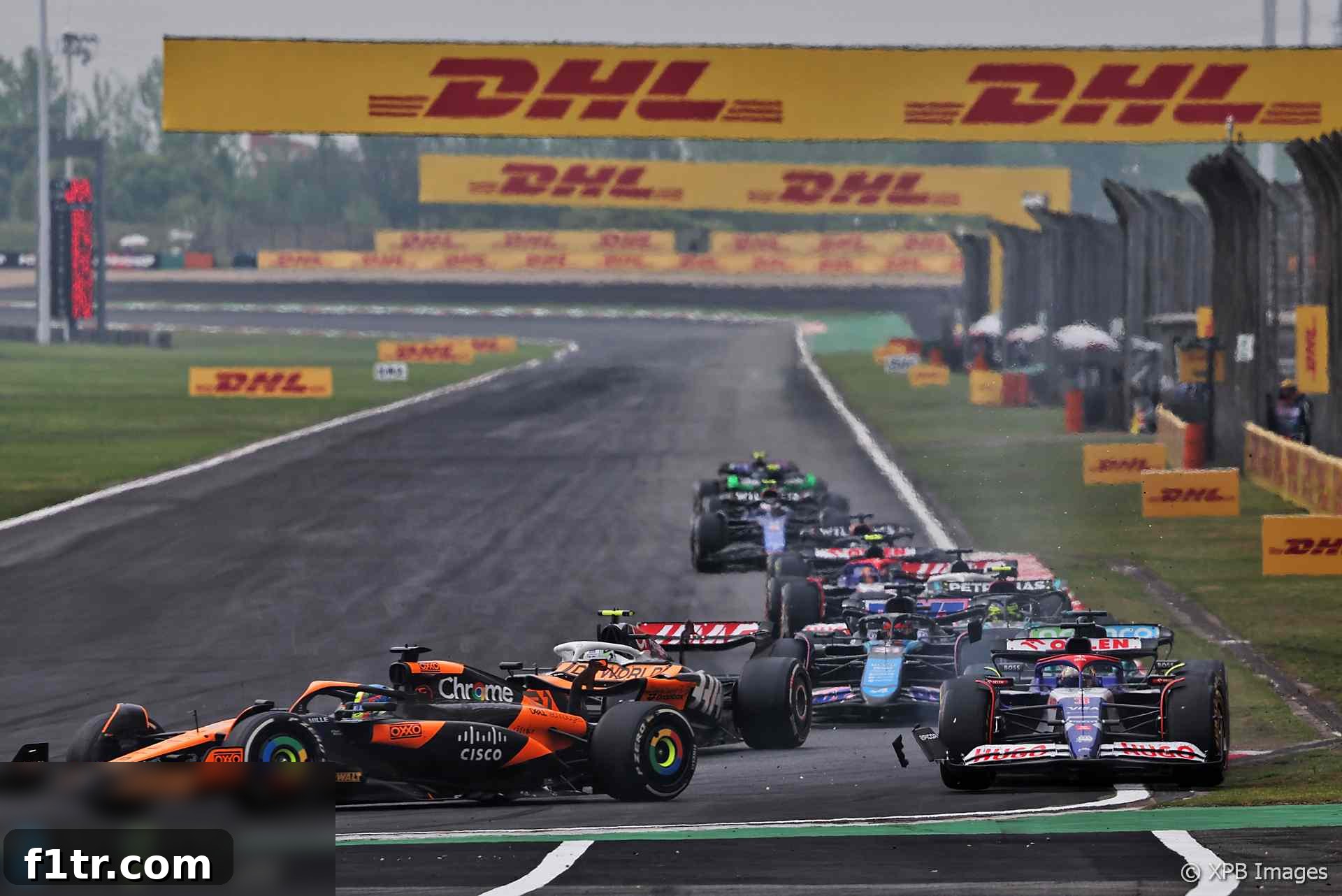
The recent Chinese Grand Prix delivered its usual dose of high-octane drama, but it was an incident under the Safety Car that ignited a fierce debate between two prominent Formula 1 drivers: Lance Stroll of Aston Martin and Daniel Ricciardo of RB. Their on-track collision led to a contentious penalty for Stroll, which the Canadian driver vehemently claims he does not understand, attributing the incident to a complex “concertina effect” initiated by another competitor. However, Ricciardo holds a starkly different view, accusing Stroll of inattentiveness and questioning his fundamental awareness during a crucial Safety Car restart.
The Controversial Collision: Unpacking the Chinese Grand Prix Safety Car Incident
The pivotal moment occurred during a Safety Car period at the Shanghai International Circuit. Following an earlier incident involving Valtteri Bottas, the Safety Car was deployed, bunching up the field. As the race prepared for a restart, drivers began to manage their pace, braking and accelerating in anticipation of the green flag. It was in this critical phase, particularly approaching the hairpin of Turn 14, that Stroll’s Aston Martin made contact with the rear of Ricciardo’s RB car, causing significant damage to both vehicles and abruptly ending Ricciardo’s race. The collision, which appeared to be a relatively low-speed impact, quickly escalated into a major point of contention, highlighting the fine margins and intense pressures drivers face even during regulated Safety Car conditions.
The incident wasn’t just a minor bump; it forced Ricciardo to retire from the race, a frustrating blow for a driver looking to rebuild momentum. The impact broke the floor of Ricciardo’s car, making it impossible to continue, while Stroll was able to limp back to the pits for repairs, though his race was also compromised. The immediate aftermath saw a flurry of radio messages, with both drivers expressing their confusion and frustration. The stewards were immediately notified, indicating the seriousness with which the incident was viewed, setting the stage for a thorough investigation into what exactly transpired on track.
Lance Stroll’s Defense: The “Concertina Effect” and Unfair Targeting
From Lance Stroll’s perspective, the collision was an unavoidable consequence of a chain reaction, which he termed a “concertina effect.” Speaking to the official F1 channel, Stroll explained his predicament: “Someone braked in front and then I think everyone kind of braked and the car in front of me just stopped right in front of me. I had nowhere to go. It was just one of those really weird racing incidents.” He argued that the sudden deceleration of cars ahead, possibly initiated by a driver further up the pack, left him with insufficient time and space to react, leading to the unfortunate contact with Ricciardo. This phenomenon, where a sudden braking by one car causes a ripple effect of braking down the line, can indeed compress the gaps between vehicles, making it extremely challenging for drivers to maintain appropriate distances.
Stroll expressed genuine bewilderment regarding the penalty handed down by the stewards. He firmly believes he was unfairly singled out for an incident he perceives as a collective consequence rather than a singular error on his part. “I don’t understand it, it was really just one of those concertina effect racing incidents,” he reiterated. “I guess because I was the one that hit the guy in front of me, I got the front of me. But someone caused that in front of him, someone hit the brakes. It was a weird one.” His argument hinges on the idea that the root cause of the pile-up lay upstream, implying that penalizing only him overlooked the broader context of how the queue of cars slowed down. This sentiment suggests a feeling of injustice, particularly given the often subjective nature of assessing blame in complex racing scenarios.
The Aston Martin driver’s frustration stems from his conviction that the sequence of events was beyond his immediate control. In his view, the incident was a typical “racing incident” – an unfortunate but unavoidable occurrence inherent to the competitive nature of Formula 1, especially under Safety Car conditions where the field is compressed and reactiveness is paramount. He highlighted the unpredictability of driver actions during such restarts, where the leader dictates the pace and drivers behind must be prepared for sudden changes in speed. This belief underscores a fundamental disagreement with the stewards’ assessment of his predominant culpability, framing the collision as a systemic issue rather than an individual lapse in judgment or awareness.
Daniel Ricciardo’s Stance: A Question of Driver Focus and Responsibility
Daniel Ricciardo, however, remained resolute and unequivocal in his view that Stroll was solely to blame. The Australian driver conveyed his intense frustration, particularly after hearing Stroll’s attempts to deflect responsibility. Speaking to Viaplay, Ricciardo minced no words: “The truth is at restarts we can’t predict what the leader is going to do so you have to be on edge and as aware as possible.” He emphasized that while leaders might choose different points to restart the race, drivers behind them must always be focused on the car directly in front, anticipating any potential changes in speed. This fundamental principle of racing, he argues, was evidently disregarded by Stroll.
Ricciardo’s analysis was piercing, directly challenging Stroll’s claim of a “concertina effect.” He vividly recounted his own actions, stating, “So I could see everyone started to brake for 14 for the hairpin, it was starting to bunch up, so I got on the brakes. And then as I started slowing more and closing in on Oscar [Piastri], I felt Lance underneath me, basically.” His account suggests he was reacting appropriately to the cars ahead, indicating that Stroll should have done the same. The critical piece of evidence for Ricciardo came from reviewing Stroll’s onboard footage, which he found particularly infuriating. “I was just told now that apparently he was blaming me for it and if that’s true – I was starting to calm down, but that really pisses me off because I watched his onboard and as soon as we start to brake he starts looking at the corner, and then as he starts getting closer, you can see he’s not even focussed on me.”
This accusation of inattentiveness forms the core of Ricciardo’s argument. He firmly believes that Stroll’s gaze was directed towards the corner, rather than maintaining crucial visual focus on the car immediately ahead – a cardinal rule during Safety Car periods and restarts. “On a restart you have to focus on the car in front of you. That’s the only car. You can’t overtake them so there’s no point looking three cars ahead anyway,” Ricciardo asserted. For him, this lapse in concentration, rather than any external “concertina effect,” was the direct cause of the collision. The implication is clear: proper driver awareness and adherence to basic racing protocols would have prevented the incident, regardless of how other cars were behaving further down the chain.
Ricciardo’s palpable anger underscores the high stakes of Formula 1 racing, where even a minor error can have significant consequences, not just for race results but also for driver reputations and championship standings. His frustration highlights the deeply competitive nature of the sport and the strong conviction drivers hold regarding their own actions and those of their rivals.
The Stewards’ Judgment and Penalties Imposed
Following a thorough investigation, the FIA stewards, after reviewing all available evidence including telemetry data, onboard camera footage from multiple cars, and driver testimonies, concluded that Lance Stroll was “predominantly” to blame for the collision. This finding directly contradicted Stroll’s narrative of an unavoidable chain reaction. The stewards’ decision implies that while a concertina effect might have been present to some degree, Stroll’s actions or inactions were the primary contributing factor leading to the contact. Their assessment often hinges on a driver’s ability to anticipate and react to the flow of traffic, particularly under Safety Car conditions where a degree of unpredictability is expected.
As a result of this judgment, Stroll was handed a 10-second time penalty, which was applied to his race time. This type of penalty is standard for incidents of this nature and can significantly impact a driver’s final classification. More critically, the stewards also imposed two penalty points on Stroll’s Superlicence. This system is designed to monitor driver conduct over a 12-month period and serves as a significant deterrent against repeated infringements. The accumulation of penalty points can have severe consequences, making this aspect of the penalty particularly noteworthy for Stroll’s season.
Superlicence Points and Future Implications for Stroll
The two penalty points levied against Lance Stroll in Shanghai brought his total Superlicence points over the last 12 months to seven. This is a crucial statistic in Formula 1, as the sport’s regulations stipulate that any driver accumulating 12 penalty points within a 12-month period will automatically receive a one-race suspension. With seven points, Stroll is now just five points away from triggering such a ban. This places him in a precarious position for the remainder of the season, requiring him to exercise extreme caution to avoid further infringements.
The implications of this tally are significant. A single, relatively minor incident in a future race could potentially lead to a forced absence from a Grand Prix, costing him valuable championship points and severely disrupting Aston Martin’s campaign. This proximity to a race ban adds considerable pressure on Stroll, potentially influencing his driving style and decision-making in subsequent races. It also serves as a stark reminder of the FIA’s commitment to maintaining safe and fair racing standards, holding drivers accountable for their actions on track, even in complex, multi-car scenarios.
Understanding Safety Car Restarts in Formula 1
Safety Car restarts are inherently one of the most challenging and unpredictable aspects of Formula 1 racing. The compressed field, the varying speeds, and the discretionary nature of the race leader’s restart point all contribute to an environment ripe for incidents. Drivers are tasked with maintaining optimal tyre temperatures, managing braking distances, and anticipating the actions of both the leader and the cars immediately around them. The “concertina effect” is a well-known phenomenon during these periods, where even a slight misjudgment by one driver can cascade down the pack, leading to sudden braking and potential collisions.
These incidents highlight the fine line between aggressive driving and reckless behavior, and the immense pressure drivers are under to maximize every opportunity while adhering to stringent safety regulations. The Shanghai incident between Stroll and Ricciardo serves as a powerful illustration of these complexities, underscoring why such moments often become flashpoints for debate and controversy within the Formula 1 community. The stewards’ ongoing role in interpreting these events and assigning culpability is vital for maintaining order and fairness in a sport defined by speed and competition.
The collision between Lance Stroll and Daniel Ricciardo at the Chinese Grand Prix encapsulates the intense debate surrounding driver responsibility during Safety Car periods. While Stroll maintains he was a victim of an unavoidable “concertina effect,” Ricciardo firmly believes his rival’s lack of focus was the root cause. The stewards ultimately sided with Ricciardo’s perspective, imposing a penalty that carries significant implications for Stroll’s Superlicence. This incident not only fueled a heated exchange between two seasoned F1 drivers but also reinforced the critical importance of unwavering attention and adherence to racing protocols, particularly during the high-pressure environment of a Formula 1 Safety Car restart.
Related Articles: 2024 Chinese Grand Prix Insights
- Alonso and Sainz incidents prompt changes to Formula 1’s rules
- Aston Martin fail in bid to have Alonso’s Shanghai penalty reviewed
- Mercedes cleared over Hamilton pit stop infraction as ‘nearly all teams in breach’
- Aston Martin petitions FIA to review Alonso’s penalty for Sainz collision
- “You need to be more on it”: 12 unheard radio exchanges from the Chinese GP
Browse all 2024 Chinese Grand Prix articles