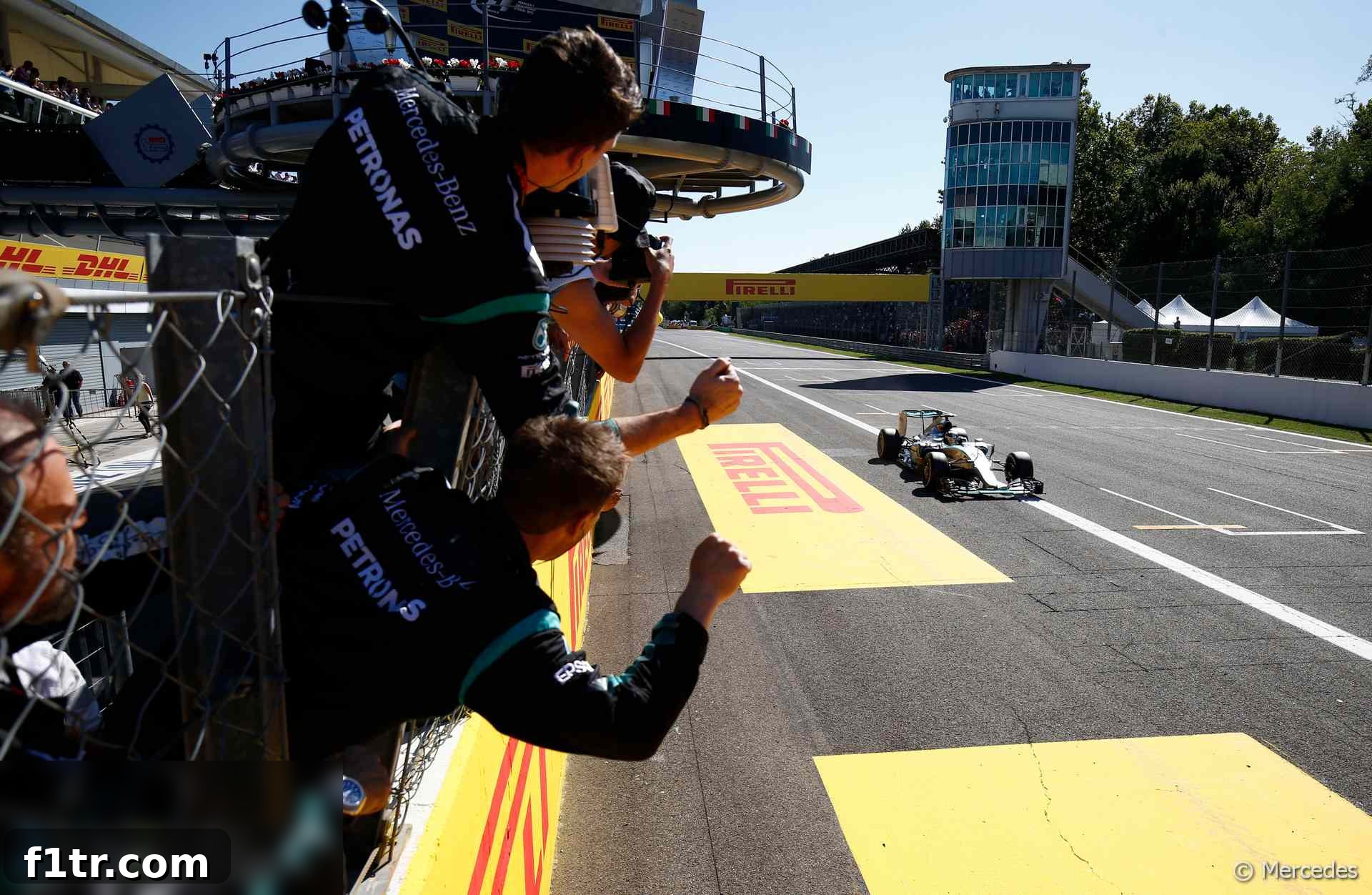
Lewis Hamilton Dominates Italian Grand Prix Amidst Tyre Controversy, Extends Championship Lead
The 2015 Formula 1 season reached a pivotal point at the legendary Monza circuit, home of the Italian Grand Prix. With seven victories already under his belt, Lewis Hamilton arrived in Italy poised to take a significant stride towards his third career World Championship. What unfolded at the “Temple of Speed” was a race filled with drama, strategic brilliance, and post-race controversy that ultimately reinforced Hamilton’s formidable position in the championship fight.
From the moment the lights went out, the race took an unexpected turn that would dramatically influence the championship narrative. As 19 cars surged forward, second-placed Kimi Raikkonen’s Ferrari suffered an anti-stall system engagement, leaving him motionless on the grid for several crucial seconds. This unfortunate incident saw the entire field stream past the Finn before the first corner, a calamitous start for the Scuderia at their home race.
Raikkonen’s immobility proved particularly detrimental for Nico Rosberg, Hamilton’s closest championship rival, who had qualified directly behind him. Forced to react and navigate around the stranded Ferrari, Rosberg emerged from turn one in a disappointing sixth position. For the occupant of car number 44, Lewis Hamilton, the path to a dominant victory already seemed clearer, with a crucial early advantage over his main competitor.
Rosberg’s Strategic Pit Stop Gamble
With Raikkonen out of contention at the start, Sebastian Vettel inherited second place, but the Ferrari’s race pace was clearly no match for Hamilton’s Mercedes. While Vettel delivered a commendable performance, he could only watch as Hamilton steadily extended his lead, building a gap of nearly six seconds by lap ten. Hamilton’s Mercedes was in a class of its own, effortlessly pulling away from the chasing pack.
Meanwhile, Rosberg faced a challenging recovery drive. After gaining one position from Sergio Perez on lap two, he struggled to make further inroads on the two Williams drivers ahead. Recognizing the difficulty of overtaking on the high-speed Monza circuit, Mercedes opted for an aggressive, early pit stop strategy. The team decided to bring Rosberg in much earlier than anticipated, a move designed to leverage the power of the undercut and gain track position through strategic tyre management.
The earliest window for a one-stop strategy was generally considered to be around lap 18. Both Rosberg and Nico Hulkenberg entered the pit lane at this point, with Rosberg rejoining in eighth position and Hulkenberg’s Force India in eleventh. While Hulkenberg’s medium tyres began to degrade prematurely, Rosberg’s early stop initially paid dividends. Williams reacted swiftly, pitting their lead car, but Rosberg’s rapid out-lap allowed him to jump ahead of Felipe Massa. This clever maneuver effectively set up Rosberg to overtake both Williams drivers once Valtteri Bottas completed his own pit stop.
Despite the successful undercut, Rosberg’s climb back to the podium was not immediate. Kimi Raikkonen, after his disastrous start, embarked on an extra-long first stint, attempting to regain lost ground. This strategy briefly propelled him into third place behind his Ferrari teammate after he efficiently passed several backmarkers, including McLaren and Red Bull cars. However, his eventual pit stop dropped him well behind Rosberg, solidifying the German’s provisional podium position.
“We Need to Pull a Gap – Don’t Ask Questions”
Hamilton continued to command the race with supreme authority, managing his tyres and pace effortlessly. He waited for Vettel to make his pit stop on lap 25 before coming in himself on the very next lap, leaving him with a 26-lap run on medium tyres to the chequered flag. Following the pit stops, Hamilton’s lead over Vettel had ballooned to over 18 seconds, a testament to his blistering pace and controlled drive.
The gap continued to grow, albeit more slowly, until a surprising and cryptic radio message reached Hamilton with approximately five laps remaining. His race engineer, Peter Bonnington, urged him: “We need to pull a gap. Don’t ask questions, just execute.” The instruction was repeated with an added sense of urgency: “Let’s just have some ‘Hammertime’ lap times, we just need some good lap times now, no need to ask questions.” The message, unusual in its tone and insistence on unquestioning obedience, hinted at an underlying issue that Mercedes was trying to manage away from the public eye.
The Pirelli Tyre Pressure Controversy and Rosberg’s Heartbreak
The reason behind Mercedes’ urgent and secretive instruction became clear shortly after the race. In the wake of several high-profile tyre blow-outs at the Belgian Grand Prix just weeks earlier, tyre supplier Pirelli had mandated new, stricter minimum tyre pressure levels for Monza. Post-race investigations revealed that one of Hamilton’s tyres had been found to be 0.3 psi too low prior to the start of the race. While a seemingly small deviation, it was a technical infringement with potentially severe consequences under the stringent new regulations.
Nico Rosberg found himself in a similar, and even more precarious, situation. His tyre was discovered to be 1.1 psi below the mandated minimum. Had these infringements been deemed deliberate or advantageous, both drivers, and potentially the team, could have faced penalties ranging from time additions to disqualification, completely altering the race result and the championship standings. The racing world held its breath, awaiting the stewards’ decision.
However, for Rosberg, the tyre pressure issue became academic with just two laps remaining. As he approached the Roggia chicane, his engine abruptly died, bringing his race to a sudden and heartbreaking end. This devastating reliability failure was attributed to an old power unit. Rosberg had been forced to switch back to a previously used engine after a problem was identified with his new-specification unit during practice. The well-worn engine, unable to withstand the demands of the race, failed precisely as he was beginning to apply significant pressure to Vettel’s Ferrari, robbing him of a crucial podium finish and a much-needed points haul.
Hamilton’s Victory Confirmed Amidst Scrutiny
Unaware of the full extent of the tyre investigation unfolding behind the scenes, Hamilton was understandably surprised to cross the finish line with a dominant 25-second lead and then immediately face questions about the potential impact of a slightly under-inflated tyre on his performance. Addressing the post-race press conference, he downplayed the significance: “Not really a huge amount on one rear tyre,” he stated, confident in his driving and the car’s performance.
The International Sporting Code is explicit that merely not having gained an advantage is not sufficient defense against a technical regulations infringement. However, after a thorough review, the stewards were satisfied with Mercedes’ explanation. They determined that Hamilton’s tyres “were at the minimum start pressure recommended by Pirelli when they were fitted to the car,” and that the subsequent variation was primarily due to the tyres losing temperature after fitting. Crucially, no evidence suggested an intentional breach or performance advantage. Consequently, the stewards allowed Hamilton to keep his hard-fought victory, cementing his dominance at Monza and sparing Mercedes a potential disqualification nightmare.
Rosberg’s retirement dramatically reshuffled the podium, elevating Felipe Massa to a popular third place. Massa spent the final laps under intense pressure from his Williams teammate, Valtteri Bottas, who launched a determined assault, but the Brazilian held firm. Kimi Raikkonen, after his recovery drive, utilized DRS effectively in his final stint to slice past both Force India drivers, demonstrating the Ferrari’s raw speed.
Among the midfield battles, Nico Hulkenberg, the first Force India driver passed by Raikkonen, vocalized complaints about a significant lack of rear grip during his long second stint. Despite this, he successfully fended off Marcus Ericsson’s Sauber until the very end. However, Ericsson himself was dramatically overtaken by Daniel Ricciardo for eighth place on the final lap, a testament to the Red Bull driver’s relentless pursuit. Daniil Kvyat in the other Red Bull also put in a strong performance, climbing from the back of the grid to snatch the final championship point.
The two Toro Rosso drivers also had a noteworthy day. Carlos Sainz Jnr finally saw the chequered flag after a string of car problems in previous races, finishing just outside the points. Max Verstappen secured 12th place on his first visit to Monza, overcoming a drive-through penalty incurred at the end of the first lap due to a qualifying drama that saw him lose part of his bodywork on the main straight.
Felipe Nasr finished 13th for Sauber, ahead of McLaren’s Jenson Button. Button had been locked in an intra-team battle with Fernando Alonso until the Spaniard’s McLaren unfortunately failed, adding to the Woking team’s woeful season.
It was a truly miserable day for the Lotus team. Despite a belated arrival at Monza due to ongoing financial wrangling after Spa, and hopeful that the high-speed track would suit their Mercedes-engined E23, both drivers, Romain Grosjean and Pastor Maldonado, suffered damage at the chaotic first corner and were forced to retire, a double DNF compounding their financial woes.
The Reliability Factor: A Crucial Twist in the Championship Battle
The 2014 championship fight between the two Mercedes drivers, Lewis Hamilton and Nico Rosberg, was heavily influenced by a series of technical failures. Hamilton initially suffered more problems, though by the end of the year, reliability issues had largely evened out, most notably with Rosberg’s car failing him in the season finale, securing Hamilton’s title.
Heading into the 2015 season, Mercedes had made significant strides in improving reliability, complementing what was already an exceptionally competitive and dominant package. As a result, Hamilton and Rosberg had rarely forfeited points due to mechanical issues, with most lost opportunities stemming from driver or team errors. Hamilton’s plainly superior speed had allowed him to gradually build a 28-point lead over Rosberg prior to the Italian Grand Prix, seemingly consolidating his advantage through sheer performance.
However, Mercedes’ remarkable reliability streak was dramatically interrupted at Monza. Through pure chance and the unpredictable fortunes of motor racing, it was Rosberg, not Hamilton, who was forced to revert to an older, less robust engine. This decision ultimately proved fatal, as the well-worn power unit failed him during the race. Such is the fickle nature of Formula 1: Hamilton left the circuit with a commanding 53-point margin over his team mate, a lead that could just as easily have been slashed to a mere three points had luck, and reliability, favored Rosberg. This dramatic shift highlighted how finely balanced the championship could be, with unforeseen circumstances capable of altering its trajectory in an instant.
Stay Connected with Formula 1 Insights
Receive our latest articles and race analyses directly to your inbox. No marketing, no ads, just pure F1 content.
Please check your junk email folder to ensure you receive our emails.
2015 Italian Grand Prix Coverage
- Perfect Hamilton wins Driver of the Weekend
- Little action in 2015 but Monza remains a favourite
- Mercedes investigation a “misunderstanding” – Pirelli
- 2015 Italian Grand Prix team radio transcript
- Top ten pictures from the 2015 Italian Grand Prix
Browse all 2015 Italian Grand Prix articles
F1 Race Reviews Archive
- Antonelli lucks in for second win and becomes youngest F1 championship leader
- Emotional Antonelli grabs first Formula 1 victory in Chinese Grand Prix
- Russell sees off Ferrari threat to lead Mercedes one-two in Melbourne
- Norris clinches F1 title by two points as Verstappen wins finale at Yas Marina
- McLaren strategy blunder in Losail hands Verstappen crucial win and shot at title
Read all F1 race reviews