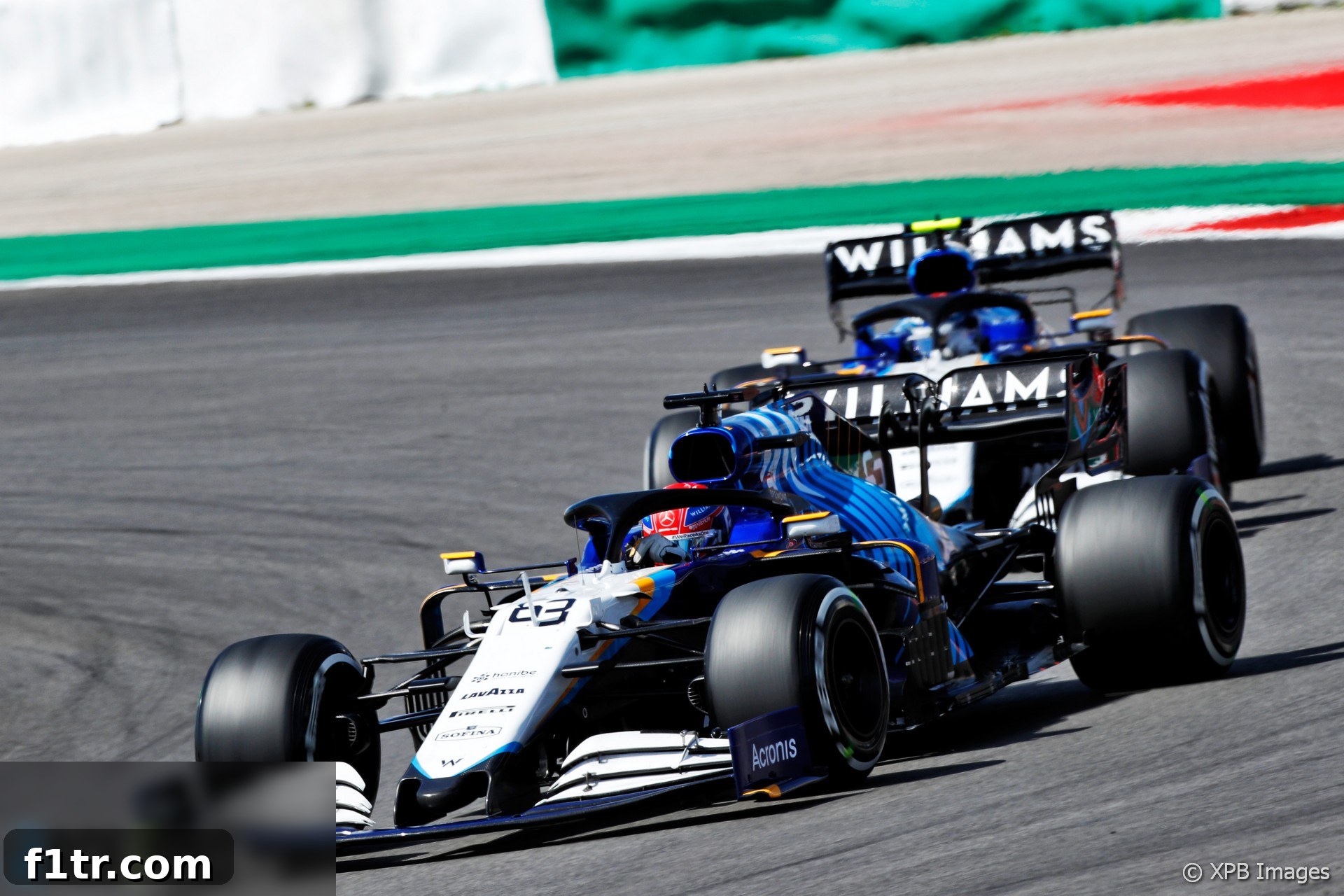
In the high-stakes world of Formula 1, driver performance is under constant scrutiny, particularly when it comes to the battle between teammates. At Williams, the dynamic between George Russell and Nicholas Latifi has provided a fascinating case study, highlighting contrasting strengths and unexpected outcomes. Since his arrival in F1 two years ago, George Russell has consistently asserted his dominance in qualifying sessions, establishing a remarkable record that has earned him the moniker “Mr. Saturday.” This unwavering performance has not only set him apart from his current teammate but also from his previous one, showcasing a rare blend of speed and consistency.
Russell’s qualifying record at Williams is nothing short of exceptional. Throughout the current season, he has maintained a perfect 11-0 qualifying advantage over Nicholas Latifi. This impressive streak extends beyond 2021; last season saw Russell out-qualify Latifi in every single session, and in 2019, he similarly bested Robert Kubica on every occasion. Such a pristine record underscores Russell’s inherent one-lap pace and his ability to extract the maximum performance from the Williams car, often elevating it beyond its perceived capabilities on a Saturday afternoon.
Advert | Become a Supporter & go ad-free
The only instance where Russell has been out-qualified by a teammate was during his stellar one-off appearance for Mercedes in the 2020 Sakhir Grand Prix. Even then, the margin was an infinitesimal two-hundredths of a second, an astonishingly close gap to a seasoned, multiple Grand Prix winner in Valtteri Bottas, driving a car Russell was completely unfamiliar with. This performance alone cemented his reputation as a future star and further highlighted the exceptional talent residing within the young Briton.
These formidable qualifying displays typically position Russell for a strong race outcome, often placing him ahead of Latifi on the starting grid. However, the path from a strong qualifying position to a points-scoring finish is fraught with challenges, especially for a team like Williams, which operates at the sharper end of the grid. Race day dynamics, strategic decisions, and the unpredictable nature of Formula 1 often dictate that qualifying heroics don’t always translate directly into superior race results, a reality that has occasionally played out in the Williams garage.
While Russell’s single-lap brilliance is undeniable, the race often unfolds differently. The critical first lap, in particular, has emerged as a nuanced area where Latifi has sometimes found an unexpected edge. A robust start and aggressive first-lap positioning can significantly alter a driver’s race trajectory, especially in the midfield or at the back, where traffic and close quarters racing are the norm. This initial phase of the race can either consolidate a strong qualifying effort or, conversely, undermine it, forcing a driver into recovery mode.
Indeed, Russell’s first-lap performances haven’t consistently matched Latifi’s standard, a factor that has, at times, diminished the impact of his superior qualifying efforts. Latifi has demonstrated a particular knack for gaining positions during the chaotic opening lap. This season, for example, Latifi has collectively gained a total of 11 places on lap one, showcasing his ability to navigate the initial melee effectively and capitalize on opportunities. In contrast, Russell has seen a net loss of six places during the crucial first lap, which can significantly compromise his race.
It is important to acknowledge that part of this disparity stems from Russell’s consistently higher starting positions. When you qualify significantly further up the grid – Russell has, on average, qualified more than four places ahead of Latifi this year – there are inherently more positions to lose at the start and fewer immediate opportunities to gain. Nevertheless, the statistics point to a tangible difference in their approach and execution during the initial moments of a Grand Prix, a critical phase that often sets the tone for the entire race.
The Hungarian Grand Prix provided a compelling illustration of this dynamic, serving as only the second time all season that both Williams drivers shared the same row of the grid. In Hungary, Latifi once again demonstrated his first-lap prowess, managing to get ahead of Russell at the start. Crucially, he then managed to hold his position, resisting Russell’s initial attempts to reclaim the spot. This early advantage proved pivotal, especially in a race that ultimately saw both Williams cars finish in the points.
Despite Latifi’s strong start, Russell’s underlying pace was evident in the latter half of the race. Once he found himself in clear air, Russell was able to unleash his true speed, quickly catching up to his teammate. The battle between the two was tight, showcasing the competitive spirit within the Williams garage. However, on this occasion, Latifi successfully defended his position, ultimately beating Russell to the larger points haul by just over a second. This result was a testament to Latifi’s tenacity and strategic driving, demonstrating that race craft and consistent performance can sometimes override sheer one-lap speed.
The implications of this intra-team battle extend beyond mere bragging rights. George Russell is widely and deservedly recognized as a prodigious talent, with many tipping him for a future as a Mercedes driver. His consistent qualifying brilliance and remarkable adaptability during his Mercedes stand-in appearance have painted a clear picture of a driver destined for the top echelon of the sport. His performances at Williams, often squeezing out results from a car that is not inherently competitive, have only amplified the clamor for him to move to a front-running team.
However, amidst the well-deserved praise for Russell, Nicholas Latifi can take significant satisfaction from his own performances. Despite being consistently out-qualified, Latifi has demonstrated an impressive ability to keep pace with his highly-rated teammate on race day, and occasionally, even surpass him in critical moments. This is no small feat when contending with a driver of Russell’s caliber, especially given the intense pressure and scrutiny that comes with being an F1 driver. Latifi’s capacity to hold his own and, at times, achieve a surprising dividend in terms of points, speaks volumes about his development and resilience.
Advert | Become a RaceFans supporter andgo ad-free
George Russell vs Nicholas Latifi: Key stats
Delving into the raw statistics provides a clearer picture of this fascinating rivalry. While qualifying times unequivocally favor Russell, a deeper look into race day metrics, such as lap one performance, average race pace over a stint, and final race position relative to starting position, reveals Latifi’s understated strengths. These quantitative insights are crucial for understanding the comprehensive performance profile of both drivers and their respective contributions to the Williams team’s efforts.
George Russell vs Nicholas Latifi: Who finished ahead at each round
The head-to-head comparison of who finished ahead in each race round offers a tangible measure of their Sunday performance. This data, while sometimes influenced by external factors like technical issues or race incidents, paints a more holistic picture than qualifying alone. It highlights the races where Latifi successfully converted his race craft into a superior finishing position, often surprising observers who solely focus on the qualifying ledger. Conversely, it underscores Russell’s consistent ability to battle through the field even when faced with early setbacks.
| BAH | EMI | POR | SPA | MON | AZE | FRA | STY | AUS | GBR | HUN | ||
| George Russell | Q | |||||||||||
| R | ||||||||||||
| Nicholas Latifi | Q | |||||||||||
| R |
George Russell vs Nicholas Latifi: Qualifying gap
The qualifying gap provides a precise metric of their one-lap speed difference. This detailed breakdown, presented in milliseconds or tenths of a second, vividly illustrates Russell’s consistent advantage. A negative value indicating Russell was faster, and a positive one for Latifi, these figures underscore the consistent edge Russell holds on Saturdays, a critical factor for any Formula 1 driver looking to make an impact. This numerical evidence further solidifies the reputation of Russell as a formidable qualifier, a skill highly valued in modern F1.
Times based on the last qualifying round at each race weekend in which both drivers set a time. Negative indicates George Russell was faster, positive means Nicholas Latifi was faster
Advert | Become a RaceFans supporter andgo ad-free
The dynamic between George Russell and Nicholas Latifi at Williams is a microcosm of the complexities within Formula 1. It showcases that while raw, explosive speed in qualifying is vital, consistent race craft, strategic intelligence, and the ability to perform under pressure on Sundays are equally, if not more, crucial for points accumulation, especially in a midfield or back-of-the-grid scenario. Both drivers, in their own ways, contribute significantly to the team’s ongoing development and aspirations.
Russell’s journey to the pinnacle of Formula 1 seems almost inevitable, his qualifying record a shining beacon of his immense potential. His consistent ability to perform at the absolute limit, often dragging his Williams further up the grid than many anticipate, has not gone unnoticed by the sport’s biggest players, particularly Mercedes. His career trajectory is being watched with great anticipation, as many believe he possesses the qualities of a future world champion.
Conversely, Latifi, often overshadowed by his highly-touted teammate, has quietly carved out a niche for himself. His ability to capitalize on race day opportunities, his consistent finishes, and his surprising points-scoring results demonstrate a valuable skill set. For Williams, having two drivers who, despite their different strengths, can contribute meaningfully to the team’s efforts is invaluable as they continue their journey back towards competitiveness. Latifi’s steady hand and knack for scoring points when they are available provide a crucial element of stability and tangible reward for the team’s hard work.
Looking ahead, the evolution of both drivers will be a compelling narrative to follow. Russell’s eventual move to a top team will undoubtedly test his ability to perform under even greater pressure, contending for wins and championships. Latifi, meanwhile, will continue to refine his race craft, aiming to further narrow the gap to any future teammates and continue proving his worth in Formula 1. The Williams garage has been a crucible for both, forging their respective paths in the challenging and exhilarating world of Grand Prix racing.
This intricate team dynamic underscores the multifaceted nature of success in Formula 1. It is not merely about raw speed, but also about consistency, adaptability, race intelligence, and the ability to convert potential into tangible results. George Russell and Nicholas Latifi, in their contrasting yet complementary performances, offer a rich tapestry of driver talent, illustrating that different routes can lead to valuable contributions within the demanding environment of an F1 team.
2021 F1 season
- Masi ‘basically gifted the championship’ to Verstappen says 2021 FIA steward Sullivan
- Las Vegas race backers looking to extend F1 deal beyond 2025
- Why Mercedes put ‘a reminder of joy and pain’ on display in their factory lobby
- Verdict on error in GT race suggests Mercedes would have lost 2021 Abu Dhabi GP appeal
- Title ‘stolen’ from Mercedes made us ‘underdogs people cheer for’ – Wolff
Browse all 2021 F1 season articles