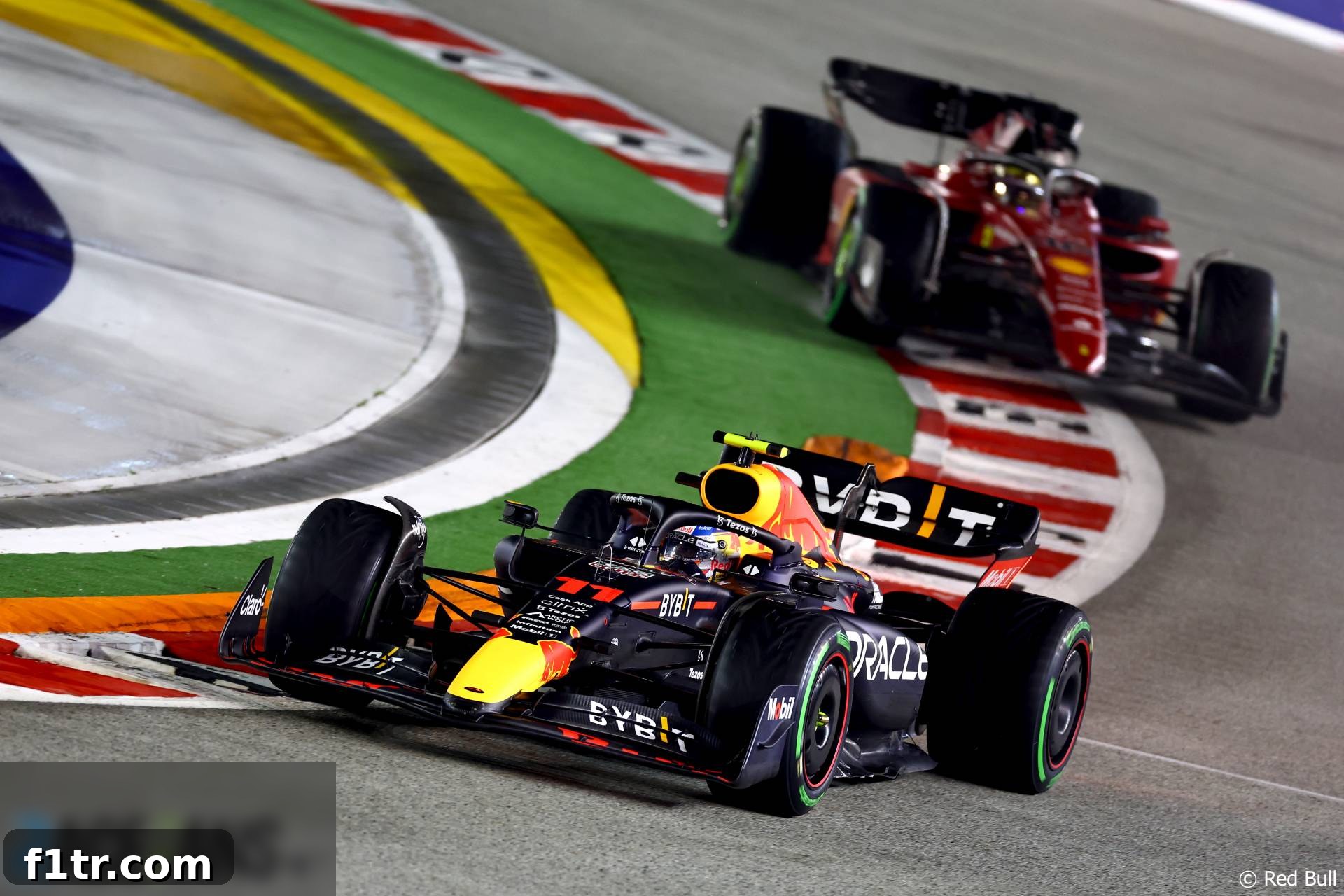
The 2022 Singapore Grand Prix delivered an unforgettable spectacle of Formula 1 racing, marked by torrential rain, dramatic incidents, and strategic masterstrokes under the dazzling night sky. At the forefront of this chaos, Sergio Perez of Red Bull Racing delivered a commanding performance, leading the majority of the race to cross the finish line first. However, the triumph was immediately overshadowed by a post-race investigation concerning a Safety Car infringement, leaving his victory in an unofficial status.
From the outset, the Marina Bay Street Circuit presented an extraordinary challenge. A colossal downpour hours before the scheduled start time transformed the already demanding track into a treacherous, waterlogged arena. This necessitated an extensive delay of over an hour, testing the patience of fans and demanding meticulous preparation from teams. When the formation lap finally commenced, all 20 cars were equipped with intermediate tyres, the only sensible choice for the still-sodden circuit, signaling that the race would be a test of nerve, skill, and strategic adaptability.
Perez Seizes Control Amidst Early Drama
As the five red lights extinguished, triggering the race proper, Sergio Perez executed a phenomenal start from the front row. He surged past pole-sitter Charles Leclerc almost instantly, claiming the lead by the first corner. Further back, Carlos Sainz Jnr capitalized on the damp conditions and fierce opening-lap skirmishes to move ahead of Lewis Hamilton, slotting into third. Championship leader Max Verstappen, starting from eighth on the grid, found himself struggling for grip and position in the melee, dropping to 12th by the end of a chaotic opening lap. Meanwhile, Perez quickly established a slim but crucial lead over Leclerc, demonstrating his prowess in challenging conditions.
The race’s rhythm was first broken on lap seven by a significant incident involving Zhou Guanyu. While attempting an audacious overtake on Nicholas Latifi around the outside of Turn 5, the two cars made contact. The collision resulted in a broken suspension for Zhou’s Alfa Romeo, forcing him into an early retirement. Latifi, the Williams driver, was later deemed responsible and received a five-place grid penalty for the subsequent race, highlighting the zero-tolerance approach to avoidable contact.
First Safety Car and Evolving Conditions
The deployment of the Safety Car to recover Zhou’s stricken car briefly neutralized the race. Despite the opportunity, most teams opted against pitting, choosing to preserve their intermediate tyres, which were still performing optimally on the slowly drying track. The race resumed on lap 11 with Perez maintaining his lead, closely followed by Leclerc and Sainz. During this period, Max Verstappen, who had quietly worked his way up to eighth before the Safety Car, quickly dispatched Pierre Gasly at Turn 13, continuing his charge through the field.
As racing got back underway, the top two of Perez and Leclerc once again pulled away from Sainz, showcasing their superior pace. The track conditions remained notoriously difficult, with drivers delicately managing their increasingly worn intermediate tyres, hoping to extend their stint as long as possible before the inevitable switch to dry weather slick tyres. This period was a careful dance between pushing the limits and preserving tyre integrity on a track that was drying in patches, creating a dynamic and unpredictable environment.
Virtual Safety Cars and Strategic Gambles
The mid-section of the race was punctuated by a series of Virtual Safety Car (VSC) periods, each adding another layer of strategic complexity. On lap 21, the veteran Fernando Alonso was forced to retire his Alpine, pulling off the track at Turn 10 due to an apparent engine issue, triggering the first VSC. This presented a crucial moment for teams to consider their tyre strategy.
Mercedes took a bold gamble, calling George Russell into the pits from 15th position to switch to medium slick tyres. This move dropped him to the very back of the field. Upon the restart, Russell found himself in an unenviable position, struggling desperately to find grip on his new dry tyres on a track that was still too damp for slicks. He lost nearly 10 seconds per lap to the rest of the field, highlighting the premature nature of the switch.
Shortly thereafter, Alexander Albon added to the drama, making contact with the wall at Turn 8 and losing his front wing. In a remarkable display of car control, he managed to reverse back onto the track and limp back to the pits, narrowly avoiding retirement. Another VSC was deployed to ensure the track was clear, but the race quickly resumed, with no other drivers opting to follow Russell’s lead into the pit lane.
The safety interventions continued when Esteban Ocon’s Alpine also succumbed to a technical issue, pulling off track at Turn 13 with smoke billowing from his car. This triggered yet another VSC. By this halfway point of the race, only Russell had dared to make the switch to slick tyres, and his struggles served as a stark warning to the other teams, who continued to nurse their intermediate compounds.
High-Stakes Incidents and the Critical Pit Window
Lewis Hamilton, who had been diligently pressuring Sainz for third position, then suffered an uncharacteristic error. Locking up into Turn 7, he understeered and hit the barrier head-on. Although he was able to rejoin the race, the incident cost him multiple positions and damaged his front wing, putting him just ahead of Verstappen. This moment seemed to signal a shift in conditions; the track was finally ready for slicks. Teams began to react decisively.
Leclerc was the first of the front-runners to pit, exchanging his intermediates for a set of medium slicks from second place. Race leader Sergio Perez followed suit a lap later, executing a rapid stop that allowed him to emerge from the pits still in the lead, maintaining his crucial advantage over Leclerc. The timing of these stops was critical, as the track had finally reached the crossover point.
However, the transition to slicks was not without its pitfalls. AlphaTauri’s Yuki Tsunoda, on his new medium tyres, misjudged his braking into Turn 10 and speared into the barrier, ending his race prematurely. This incident brought out yet another full Safety Car, once again bunching up the entire field. The race restarted on lap 40, with Perez leading from Leclerc and Sainz, as a majority of drivers now found themselves navigating the challenging circuit at racing speed on slick tyres for the first time.
The Final Sprint: Pressure, Penalties, and Perez’s Masterclass
The restart proved eventful for Max Verstappen. Attempting to overtake Lando Norris for fourth into Turn 7, he locked up heavily, forcing him to take to the escape road and spin his Red Bull around. The incident severely flat-spotted his tyres, necessitating another unscheduled pit stop for a fresh set of soft tyres, which dropped him further down the order to 12th position, effectively ending his hopes of a strong points finish.
With the multitude of Safety Car periods, the race was now time-limited, adding an extra layer of urgency. Sergio Perez still held the lead, but Charles Leclerc was now less than a second behind, relentlessly applying pressure. As the track was finally deemed dry enough for optimal racing, Race Director Eduardo Freitas activated DRS with just under 30 minutes of race time remaining, setting the stage for a thrilling climax.
Leclerc mounted an intense challenge, hounding Perez’s Red Bull lap after lap. However, the Mexican driver, known for his defensive capabilities, absorbed the pressure with remarkable composure. A small mistake from Leclerc allowed Perez to open the gap to just over a second, momentarily alleviating some of the immediate threat. But the tension remained high, especially when the stewards announced that Perez would be investigated after the race for allegedly breaching Safety Car procedure before the second restart. Specifically, he was deemed to have dropped too far behind the Safety Car. Red Bull immediately relayed this information to their driver, instructing him to build as large a gap as possible to cover any potential time penalty. Perez responded magnificently, pushing hard and delivering a new fastest lap of the race, showcasing his determination and raw speed under pressure.
Victory Secured, Pending Investigation
As the clock ticked down to zero, Sergio Perez continued to pull away from Charles Leclerc, extending his lead. When time expired, Perez crossed the finish line to take the chequered flag, a comfortable 7.5 seconds ahead of Leclerc. Carlos Sainz Jnr completed the podium in third, a further seven seconds adrift of his teammate, securing valuable points for Ferrari. The McLaren duo of Lando Norris and Daniel Ricciardo delivered an exceptional performance, finishing fourth and fifth respectively, a testament to their strong pace and smart strategy in the challenging conditions. Lance Stroll secured Aston Martin’s best result of the season with a commendable sixth place. Max Verstappen salvaged seventh after his earlier incident, ahead of Sebastian Vettel in eighth, Lewis Hamilton in ninth, and Pierre Gasly rounding out the points in tenth.
The Sergio Perez victory was a masterclass in wet-weather driving and resilience, yet the shadow of the Safety Car infringement investigation lingered, casting an element of uncertainty over the final result. The potential penalty, which could range from a time addition to a grid drop for a future race, would ultimately determine whether Perez officially retained his hard-fought win. Regardless of the outcome of the stewards’ inquiry, the 2022 Singapore Grand Prix will be remembered as a true test of man and machine, a thrilling night race filled with drama, strategy, and unyielding excitement.
2022 Singapore Grand Prix Post-Race Reaction and Analysis
- Check back shortly for more in-depth race reaction, driver interviews, and expert analysis on the controversial Safety Car decision and its implications for the championship.