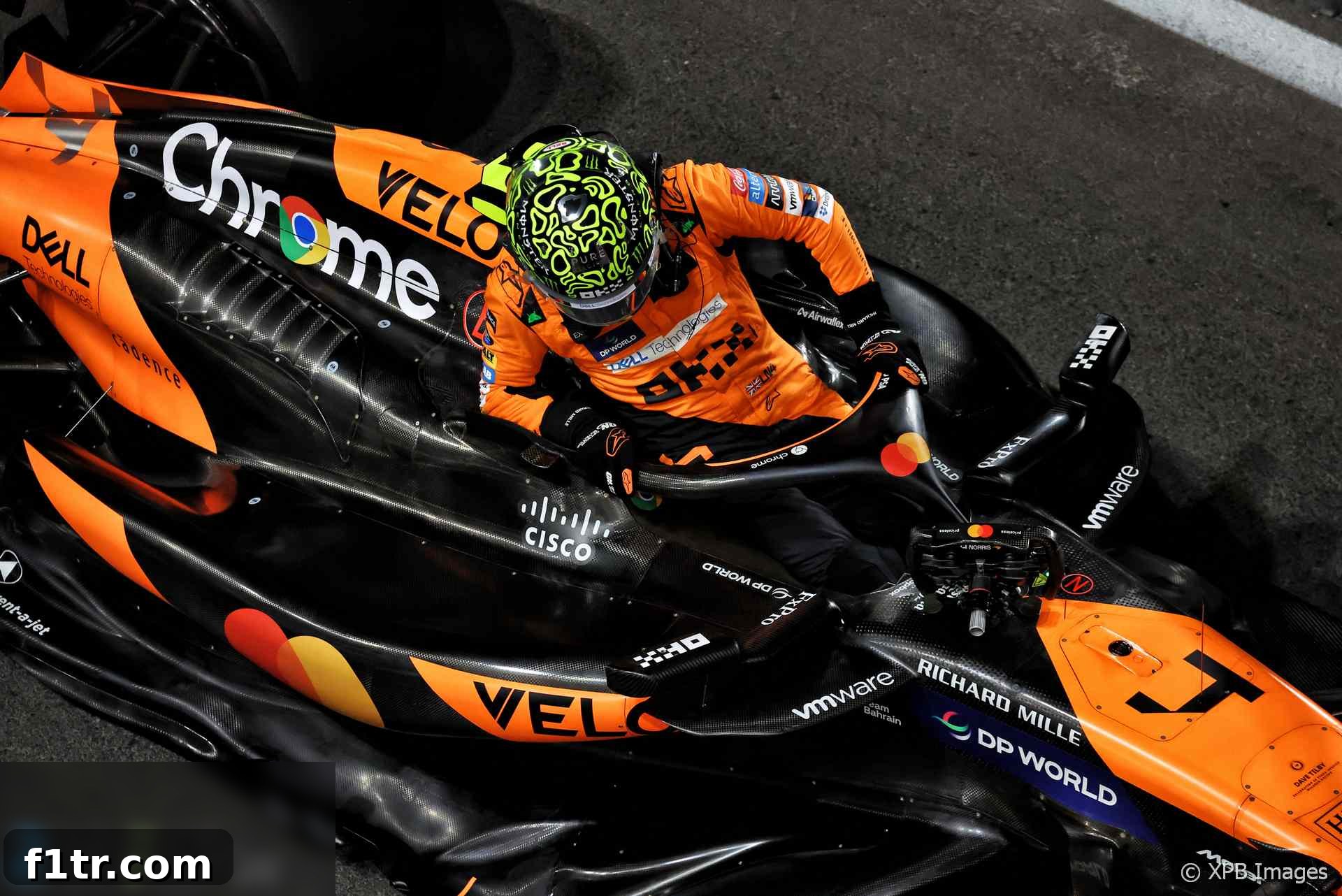
Lando Norris, the formidable McLaren driver, shared his insights following a dynamic and often challenging Qatar Grand Prix weekend, suggesting that his team quickly reached the peak of their car’s potential at the demanding Losail International Circuit. Despite showcasing blistering pace early in the weekend, Norris noted a distinct shift in the competitive landscape as rivals found significant performance gains, leaving McLaren feeling they had already extracted everything from their MCL38.
Advert | Become a Supporter & go ad-free
The weekend began on a high note for Norris, who spectacularly clinched pole position for the sprint race. His commanding performance in the shorter format demonstrated McLaren’s raw speed, and he was on track for a comfortable victory before a strategic decision saw him allow his teammate, Oscar Piastri, to take the win. This display of team unity underscored McLaren’s aspirations for the constructors’ championship, even if it meant Norris momentarily sacrificing individual glory. However, the subsequent qualifying session for the main Grand Prix saw Norris relegated to third on the grid, outpaced by the reigning champion Max Verstappen and Mercedes’ George Russell, setting a new tone for the rest of the event.
Norris expressed no surprise regarding the team’s inability to find further performance gains between the initial sessions and grand prix qualifying. “I don’t think we were expecting a step [in pace],” he stated, reflecting on the situation. He elaborated, “The car was already mint in FP1, and we couldn’t really get anything out of it.” This candid assessment highlights a particular characteristic of McLaren’s approach this season: their remarkable ability to arrive at a circuit and immediately find the ‘sweet spot’ for their car setup. This allows them to be highly competitive from the outset, often topping timing sheets in the early practice sessions.
This early optimization, while a significant strength, also presents a unique challenge. While some teams, notably Red Bull, might struggle initially but then unlock substantial performance through continuous development and setup changes over a race weekend, McLaren tends to hit its performance ceiling faster. “I think that’s what we’ve done a lot of times this year. We’re very good at just coming to the weekend and the car’s quick from the off. We put it straight away in the sweet spot,” Norris explained, contrasting his team’s methodology with their rivals’. “I think what Red Bull and Max showed is that not every team can do that. And I think that’s a strength from us.”
The stark difference in weekend trajectories was most evident in the performance of Max Verstappen and Red Bull. Verstappen endured a notably tough start to the Qatar Grand Prix weekend, struggling to find rhythm and pace in the early sessions, which saw him finish a relatively disappointing eighth in the sprint race. This initial underperformance from the dominant force in Formula 1 raised eyebrows, yet it also set the stage for a remarkable comeback.
True to their reputation for relentless optimization, Red Bull rebounded with incredible force in qualifying for the main Grand Prix. Verstappen clawed back significant time, stunningly taking pole position. However, this triumph was short-lived as he later incurred a grid penalty for driving unnecessarily slowly, dropping him down the order. The strategic genius behind Red Bull’s turnaround was partly attributed to their bold decision to extensively modify Sergio Perez’s car. With Perez qualifying a lowly 16th – far outside the points – the team chose to break parc fermé regulations, sacrificing his grid position to conduct crucial setup changes and test work on his car during the sprint race. This experimental approach provided invaluable data that was then applied to Verstappen’s car, proving instrumental in unlocking its hidden potential.
Advert | Become a RaceFans supporter andgo ad-free
Norris keenly observed this transformation, acknowledging Red Bull’s prowess in adaptability. “They showed how much they struggled yesterday and how much just a few little tweaks to the car, how much that can make a difference to go from where he was yesterday to where he was today,” Norris remarked, highlighting the fine margins and technical expertise that differentiate the top teams. This ability to dial in the car, sometimes seemingly overnight, is a benchmark McLaren aims to reach.
Reflecting on his own performance and McLaren’s consistency, Norris added, “So I think we just got a lot out of it yesterday. I did a good lap and I was happy. Today, same again.” He pointed out the deceptive nature of his sprint pole, where the gap to George Russell was a mere five hundredths of a second. “But when I’m on pole [on Friday] by whatever the gap was to George, five hundredths or something, that’s not like we’re way quicker and he’s slower. Today, George was ahead and Max was ahead again. So I don’t think we may be quite at the pace comparing to them, especially today. But hopefully tomorrow we can get something back.” This self-aware assessment underscores the brutal honesty required in Formula 1, where fleeting advantages can quickly dissipate.
The McLaren driver further suspected that his pole position for the sprint race, and the ensuing clean air he enjoyed at the front, might have flattered their overall pace. “I think the clean air that I had earlier today made us look probably a bit better than we were,” he conceded. This is a critical insight, as running in undisturbed air can significantly improve a car’s aerodynamic efficiency and tyre management, masking underlying pace deficiencies when battling in traffic. Norris’s analysis suggested that once the field truly settled and positions were fought for, Mercedes, in particular, appeared to hold a slight edge.
“I don’t think we’ve necessarily been the quickest, to be honest, this weekend, I think Mercedes have so I’m expecting a tough battle and excited to see what we can do,” Norris stated, setting realistic expectations for the main race. The Qatar Grand Prix, with its unique floodlit conditions and challenging circuit layout, promised a demanding test of endurance and strategy. Tyre degradation was a significant factor throughout the weekend, and managing the compounds would be paramount to success. The high-speed corners of Losail also placed immense strain on both drivers and machinery, ensuring a physically taxing event.
Advert | Become a RaceFans supporter andgo ad-free
Looking ahead to the grand prix, Norris was clear about his ambition, even as he acknowledged the formidable competition. “I would like to give the guys ahead a little battle tomorrow and of course go forward. Our target would be to try and win the race but [Verstappen and Russell] are probably going to make my life pretty tough tomorrow.” His words reflected the perennial challenge of competing at the pinnacle of motorsport, where even on your best day, victory is never guaranteed. McLaren’s consistent progress throughout the season has been commendable, but the Qatar Grand Prix served as a stark reminder of the ever-evolving competitive landscape and the relentless pursuit of perfection required to stand atop the podium.
The weekend encapsulated the fierce competition in Formula 1, highlighting McLaren’s strengths in rapid setup optimization versus Red Bull’s adaptability and Mercedes’ underlying pace. For Lando Norris and McLaren, it was a weekend of high hopes, early promise, and a dose of reality, setting the stage for more intense battles as the season progressed.
2024 Qatar Grand Prix
- Horner ‘believes 100%’ Verstappen did not threaten to crash into Russell
- Russell and Verstappen cast new light on clash which triggered explosive row
- Hamilton’s puncture not caused by mirror debris – Mercedes
- Another start-to-finish win shows Qatar GP could be F1’s most processional race
- “Am I dead last now?” Unheard radio from Hamilton’s disastrous Qatar GP
Browse all 2024 Qatar Grand Prix articles