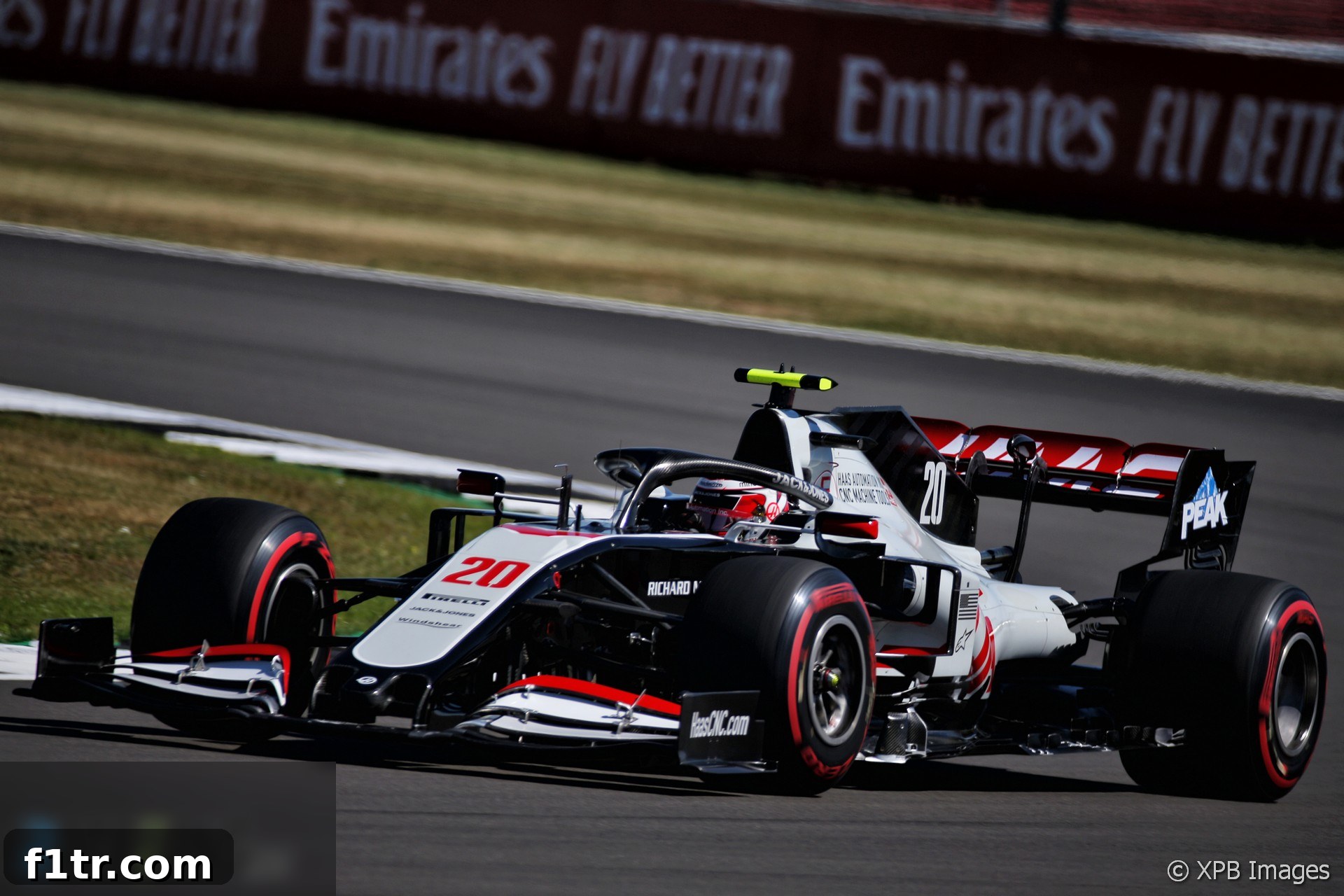
Haas F1 driver Kevin Magnussen has openly voiced his concerns regarding a significant and unexplained drop in pace compared to his teammate, Romain Grosjean, during yesterday’s qualifying session. Magnussen suspects that the root cause of this alarming performance deficit lies in the replacement floor fitted to his car after a first-lap collision with Alexander Albon in the preceding race weekend. This incident forced the team to revert to an older specification component, which Magnussen believes has fundamentally altered his car’s behaviour.
Advert | Become a Supporter & go ad-free
The Danish driver’s struggles were evident from Friday practice, where his car demonstrably lacked straight-line speed compared to Romain Grosjean’s. This performance disparity culminated in Q1, where Magnussen found himself a significant seven-tenths of a second slower than his French teammate. In the hyper-competitive world of Formula 1, such a gap is colossal and immediately raises red flags within the team and for the driver. It signifies not just a minor setup tweak, but a fundamental issue preventing the car from operating at its full potential.
The Impact of a Replacement Floor: A Driver’s Frustration
Magnussen’s hypothesis centers squarely on the replacement of his car’s floor. “After the crash last Sunday, we had to go back to an old floor,” Magnussen explained, highlighting the forced nature of the change. He further articulated his frustration, stating, “When you have a weekend like this, which is just massively off, you can’t help but question whether or not that has something to do with it.” This sentiment underscores the critical importance of every component, especially in the finely tuned ecosystem of a modern F1 car’s aerodynamics.
The driver was adamant that his own performance wasn’t lacking. “It’s not that I left a lot of lap time on the table,” he asserted, dismissing any notion of personal error. “I felt like my laps in qualifying were the best I could do, and yet I was still seven tenths off my team mate.” This unwavering belief in his own driving ability, coupled with such a significant performance gap, only amplified his suspicion that the problem originated from the car itself, rather than his input. The perceived lack of grip and balance issues he experienced pointed strongly towards an aerodynamic deficiency.
Following his unfortunate collision with Alexander Albon, the Haas team fitted an older floor to Magnussen’s car. Crucially, this replacement component was supposedly “of the same specification” as the original. Yet, the on-track reality was starkly different. Magnussen recounted, “It’s the same floor, just an old one, and suddenly we’re finding all these problems with the balance and really big lack of grip in the car.” This paradox — identical specification, vastly different performance — has left both the driver and the team searching for answers. The nuance in F1 often lies in minute details; even components built to the “same spec” can have subtle manufacturing differences or cumulative wear that impact their aerodynamic efficiency.
Quantifying the Performance Decline and the Aerodynamic Puzzle
The numbers themselves paint a grim picture of Magnussen’s weekend. In yesterday’s qualifying session, he managed a lap time of 1’28.2. This stands in stark contrast to his performance just a week prior on the very same track, where he recorded a significantly faster 1’27.1. A difference of over a full second on the same circuit, with the same driver, within the span of seven days, is almost unheard of in Formula 1 unless there’s a fundamental issue with the car.
Magnussen’s instinct immediately pointed to the floor. “The floor is the most obvious thing” that could be wrong, he stated, reasoning, “because the car was working really well last weekend and then suddenly isn’t working this weekend. Same track, same driver, just a second slower.” This logical deduction highlights the critical role of the car’s underbody in generating downforce and managing airflow.
Aerodynamics in Formula 1 are incredibly intricate, with the floor being one of the most vital components for generating ground effect downforce. Even minor damage, imperfections, or subtle variations in the manufacturing of a supposedly identical part can have a cascading effect on the entire aerodynamic package. A fractional difference in ride height, stiffness, or sealing efficiency of the floor can disrupt the delicate airflow underneath the car, leading to a significant loss of downforce, balance instability, and reduced grip. This makes the “same spec, old part” conundrum particularly puzzling and frustrating.
“Usually it doesn’t matter whether you swap around on the parts if they’re the same spec,” Magnussen added, emphasizing the unusual nature of this situation. “This time we’ve seen a very big drop in performance in the car and we can’t really say why that is. It’s an interesting one and obviously frustrating when the car was working very well last week.” This reflects the deep mystery surrounding the problem, indicating that the issue might be more subtle than a simple defect. Perhaps the older floor, while nominally the same specification, has accumulated wear, microscopic damage, or simply possesses slightly different aerodynamic characteristics that are only revealed under extreme F1 operating conditions. The consistency of performance is paramount, and its sudden disappearance is a major concern.
Team Principal’s Bafflement and the Search for Answers
The confusion isn’t limited to the cockpit. Haas team principal Guenther Steiner admitted he was equally “baffled” by the array of problems Magnussen had encountered. Steiner’s comments underscore the depth of the mystery, as the team’s engineers, with access to all data, were also struggling to pinpoint the exact cause.
“Kevin the whole weekend just didn’t get a good feeling, there’s not enough grip,” Steiner observed, contrasting Magnussen’s experience with that of his teammate. “While Romain was as happy as we can be at the moment.” This discrepancy between the two cars, despite theoretically being identical setups on the same track, is perplexing. Grosjean, while not setting the world alight, was at least able to extract a consistent level of performance from his VF-20, something Magnussen found impossible.
Steiner’s frank admission, “I cannot give you an answer why. We are looking into it but we are a bit baffled as well why it changed around so dramatically,” reveals the true extent of the challenge facing the Haas technical team. In an effort to rule out the suspected floor issue, the team even tried swapping the floor again. “We put another floor on as well, again, we changed the floor on Friday and it didn’t make a difference,” Steiner confirmed. “We thought it would be that but apparently it wasn’t. So we have to go back and do some homework and hopefully we find why the car is so inconsistent and why they’re so different between them.”
This statement suggests the problem might be more complex than a simple “bad part.” If changing the floor a second time didn’t alleviate the issue, it could point to a myriad of other factors: perhaps an undetected chassis misalignment, a suspension component that isn’t performing optimally, or even a subtle aerodynamic interaction that has been disturbed by the floor change, impacting other aero surfaces. The “homework” Steiner refers to will involve meticulous data analysis, potentially CFD (Computational Fluid Dynamics) simulations, and thorough inspection of every component on Magnussen’s car. For a smaller team like Haas, with more limited resources compared to the sport’s giants, diagnosing such a profound and elusive issue presents a significant hurdle.
The Critical Role of Consistency in F1 Performance
The saga of Kevin Magnussen’s performance highlights a fundamental truth about Formula 1: consistency is king. While raw pace is crucial, the ability to consistently extract that performance from the car, session after session, lap after lap, is what truly separates the contenders. When a car suddenly becomes “inconsistent,” as Steiner described, it not only impacts the driver’s confidence but also makes it incredibly difficult for the engineering team to optimize the setup. Without a reliable baseline, every adjustment becomes a shot in the dark, and valuable track time is wasted chasing an unpredictable beast.
The intricate dance between driver and machine, built on trust and predictability, is shattered when the car’s behaviour changes so dramatically. This can lead to overdriving, mistakes, and ultimately, a significant deficit on the stopwatch. For Magnussen, a driver known for his aggressive yet precise style, this lack of predictability would be particularly frustrating, preventing him from pushing the limits with confidence.
Understanding and rectifying such complex aerodynamic and mechanical issues is a core challenge in F1. Teams invest millions in research and development to ensure every component works in perfect harmony. When that harmony is disrupted by a seemingly innocuous part change, it can derail an entire race weekend, and potentially impact championship standings. The “homework” for Haas is not just about finding a solution for one car, but about gaining a deeper understanding of their VF-20’s sensitivities and ensuring such issues don’t plague them in future races.
Advert | Become a RaceFans supporter andgo ad-free
2020 F1 season
- Grosjean to make F1 test return tomorrow for first time since Bahrain horror crash
- Pictures: Wrecked chassis from Grosjean’s Bahrain fireball crash to go on display
- Bottas vs Rosberg: Hamilton’s Mercedes team mates compared after 78 races each
- F1 revenues fell by $877 million in Covid-struck 2020 season
- Hamilton and Mercedes finally announce new deal for 2021 season
Browse all 2020 F1 season articles