The exhilarating world of Formula 1 consistently delivers high-octane drama, unforeseen challenges, and captivating narratives. From intricate technical issues affecting championship contenders to on-track skirmishes and significant regulatory decisions, the sport never ceases to evolve. This comprehensive round-up dives into the latest developments, examining pivotal moments from recent races, exploring significant news from across the motorsport landscape, and reflecting on historical achievements that continue to shape the legacy of racing.
In a sport where every millisecond counts, teams and drivers push the boundaries of technology and skill. The recent Qatar Grand Prix, in particular, provided ample talking points, from surprising car performance quirks to crucial penalty decisions that impacted the final standings. Beyond the immediate race results, the broader F1 ecosystem buzzes with strategic shifts, driver movements, and the ever-present political undercurrents that define global motorsport. Join us as we unpack these stories, offering an in-depth look at the events and discussions shaping Formula 1 and its feeder series.
Formula 1 Insights: Post-Race Reflections and Driver Debriefs
Fernando Alonso’s Qatar GP Conundrum: Unpacking Aston Martin’s Straight-Line Speed Issue
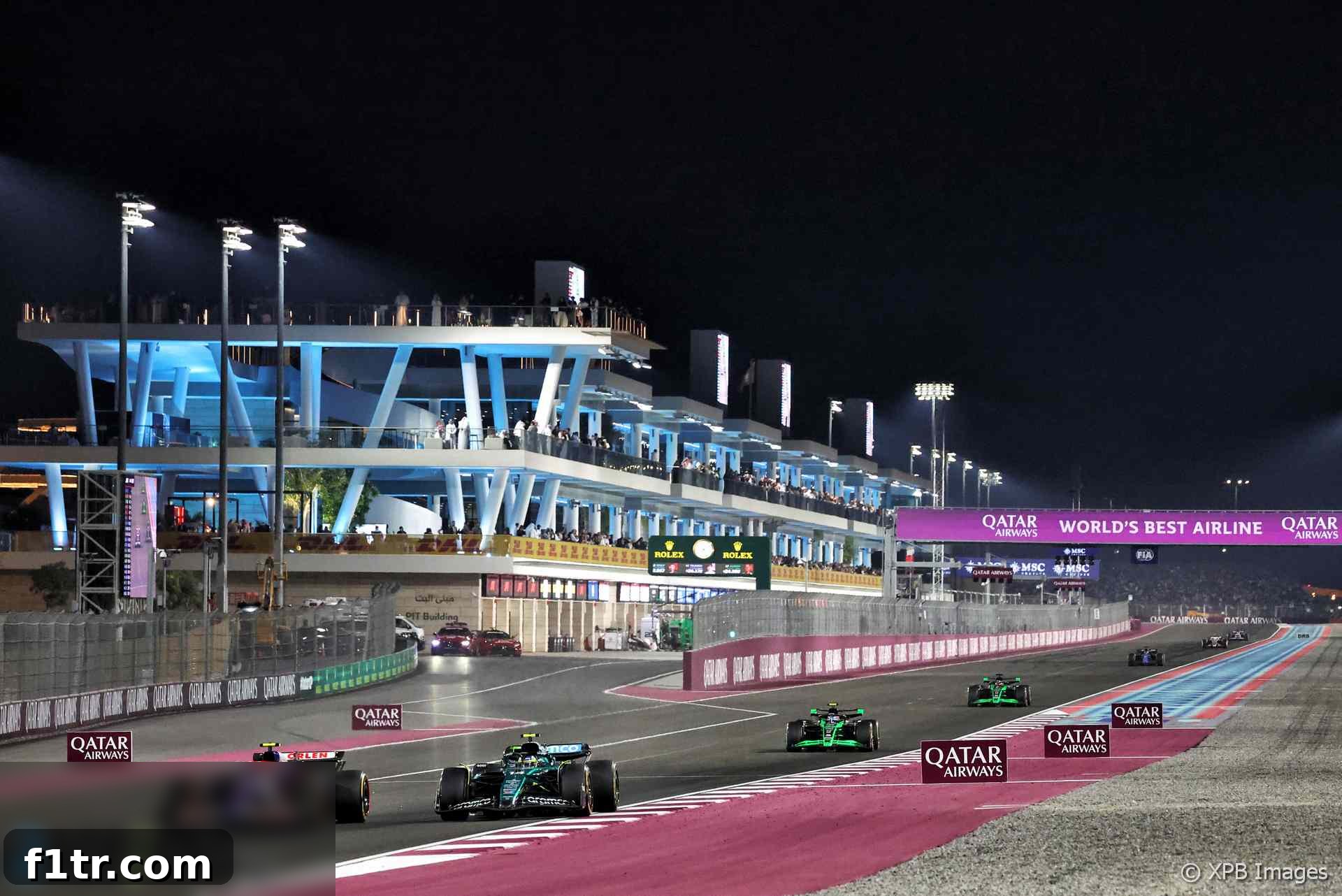
Fernando Alonso, the seasoned two-time world champion, found himself battling not just competitors but also an elusive technical problem during the Qatar Grand Prix. His radio messages, clearly indicating frustration with his Aston Martin’s lack of straight-line speed, highlighted a recurring issue for the team. Alonso later elaborated on the peculiar nature of this challenge, explaining that the car’s energy deployment system appeared to be confused, particularly after Safety Car periods.
“It’s a well-known problem we’ve been grappling with for a considerable time,” Alonso stated. He detailed how the car’s software, post-Safety Car intervention, seemed to retain a setting as if still operating under restricted conditions. “The car is still thinking that we are behind the Safety Car, so we don’t deploy all the energy on the electrical power. This deficiency results in a noticeable lack of top speed, leaving us vulnerable, especially during crucial phases of the race when we need to defend or attack.” This technical glitch underscores the complex interplay between advanced automotive engineering and software calibration in modern F1 machinery.
Despite this significant handicap, Alonso showcased his characteristic resilience and strategic acumen. He masterfully navigated the race, capitalizing on various retirements and penalties incurred by rivals to secure a commendable seventh-place finish. This result marked his best performance since the Azerbaijan Grand Prix and a strong showing in his 400th career race start. Reflecting on the outcome, Alonso expressed satisfaction, acknowledging the team’s ability to seize opportunities. “We were ready to take advantage of the circumstances. I’m happy for the team, and we aim to conclude this championship on a positive note in Abu Dhabi.” His performance in Qatar, against the backdrop of technical challenges, reinforced his status as one of the sport’s most adaptable and determined drivers.
Liam Lawson Offers Apology for Collision with Valtteri Bottas
The demanding conditions of yesterday’s race led to several on-track incidents, one of which involved rising star Liam Lawson and veteran Valtteri Bottas. Lawson later expressed sincere regret for the collision, explaining the complex factors at play during the race’s opening stages, particularly concerning tyre performance. “In these tricky conditions, all drivers are pushing hard to generate optimal tyre warm-up, and I genuinely believed I had more grip than was actually available,” Lawson explained.
Recounting the incident, he added, “I committed to turn one, intending to make a move, but halfway through the corner, I realized the grip simply wasn’t there. Honestly, from that point, I think I spun because I was actively trying to avoid hitting Valtteri. Unfortunately, I guess I still made contact. I’m truly sorry for that; it was absolutely not my intention to cause an incident.” This moment highlighted the razor-thin margins and instantaneous decision-making required in Formula 1, where a slight misjudgment, amplified by challenging track conditions, can lead to costly errors. Lawson’s prompt and forthright apology demonstrated his sportsmanship and maturity, qualities highly valued in the competitive paddock.
Formula 2 Penalties: Verschoor and Crawford Face Sanctions
The intensity of the Formula 2 feature race also brought its share of controversies, with two drivers receiving penalties that significantly altered their results and future prospects. Richard Verschoor, a Formula 2 front-runner, was handed an unusual penalty by the stewards. He received a 10-second stop-go penalty after it was ruled that he had unlapped himself without official permission during a Safety Car period. This specific infraction, which can destabilize the Safety Car procedure and potentially create an unfair advantage, is a rare but critical breach of regulations.
Meanwhile, Jak Crawford was also penalized following a collision with Rafael Villagomez. Crawford received a 10-second time penalty. However, as he retired from the feature race, this penalty translates into a five-place grid drop for the subsequent round. Such grid penalties often carry significant consequences, forcing drivers to start further down the field and making it more challenging to score points in the next event. These decisions underscore the rigorous scrutiny applied by race stewards across all levels of motorsport, ensuring fair play and adherence to the rulebook, even when the complexities of race conditions make compliance difficult.
Beyond the Track: F1 Headlines and Motorsport Developments
The world of motorsport extends far beyond the immediate action on the circuit, encompassing rich history, high-stakes business decisions, and intricate political dynamics. Here’s a closer look at some of the most compelling stories making waves across the F1 landscape and beyond.
Ecclestone Selling Off Entire £500 Million Collection of Rare F1 Cars, Including Schumacher’s (The Sun)
Former Formula 1 supremo Bernie Ecclestone is reportedly liquidating his astonishing collection of F1 cars, valued at an estimated £500 million. This extraordinary ensemble includes some of the most iconic vehicles in racing history, such as a car famously driven by Michael Schumacher, which alone represents a significant piece of F1 lore. The collection also boasts other legendary machines: the ‘Thin Wall Special,’ renowned for triumphing over the formidable Alfa Romeo, the Alberto Ascari Italian Grand Prix-winning 375 F1, and Mike Hawthorn’s World Championship-winning Dino. This sale marks a pivotal moment, offering a unique opportunity for collectors and enthusiasts to acquire genuine pieces of motorsport heritage, each with a story woven into the fabric of Formula 1’s rich past.
Verstappen Expresses Desire to Stay at Red Bull for Remainder of Career (The Independent)
Three-time world champion Max Verstappen has reiterated his commitment to Red Bull Racing, expressing a desire to remain with the team for the entirety of his Formula 1 career. This declaration comes amid ongoing speculation and media scrutiny, particularly regarding his relationship with certain segments of the F1 press. Verstappen openly addressed this, noting, “The problem in F1 is that 80 to 85 per cent of the media is British. And I did feel that some things which were written about me were not fair.” He further added, “I am not going to sit here and single out one broadcaster, but I just had to laugh about what was said. I was like ‘whatever’.” Verstappen’s comments highlight the intense media spotlight on F1 drivers and the challenges they face in managing public perception, particularly when cultural or national perspectives differ. His unwavering loyalty to Red Bull underscores the strong bond and shared success that has defined their dominant partnership in recent years.
The FIA’s Turbulent Era Under Mohammed Ben Sulayem: A Scrutiny of Leadership (The Telegraph)
The leadership of the FIA under President Mohammed Ben Sulayem has been a subject of considerable debate and controversy, with reports detailing significant internal upheaval and staff changes. Critics argue that while many agree on the fundamental need for a strong FIA—one capable of standing firm against Formula 1 and Liberty Media, and one that bolsters its own financial standing—the current approach is problematic. As one commentator noted, “Most people would agree the FIA needs many of the things Ben Sulayem advocates for; a strong president, someone to stand up to F1 and Liberty Media, someone to swell the coffers of the FIA. But not like this.” Concerns have been raised regarding a pattern of hiring and firing “on a whim” and perceived instances of settling “petty scores.” Such actions, as Mayer observed, “do not speak well of the management of the federation,” raising questions about stability, transparency, and the long-term governance strategy of global motorsport’s governing body. The ongoing internal strife presents a significant challenge to the FIA’s reputation and its ability to effectively lead the sport into the future.
F4 UAE Round 4: Yas Marina Highlights (F4 UAE via YouTube)
The latest round of the F4 UAE Championship at Yas Marina circuit offered thrilling junior single-seater action, showcasing the emerging talent that forms the future of motorsport. These introductory categories are crucial proving grounds for aspiring Formula 1 drivers, where they hone their skills, learn race craft, and gain vital experience on international circuits. The YouTube channel for F4 UAE provides a valuable window into these races, allowing fans to follow the progression of young drivers as they navigate their early professional careers. The intensity and competitiveness witnessed in championships like F4 UAE highlight the incredible depth of talent striving for a place at the pinnacle of motorsport.
We always endeavour to credit original sources. Got a tip for a link relating to single-seater motorsport? Please send it to us via the contact form.
Social Media Reactions: Voices from the Paddock and Beyond
Social media platforms continue to serve as a vital forum for immediate reactions, expert opinions, and fan engagement within the motorsport community. Here’s a snapshot of notable discussions and observations that have emerged following recent events, reflecting the diverse perspectives on Formula 1 and its various facets.
Just finish watching the Qatar F1 race. Gotta say that those penalties are quite unusual and bloody complicated to understand…
— Romain Grosjean (@RGrosjean) December 1, 2024
Former F1 driver Romain Grosjean’s comment regarding the Qatar F1 race penalties resonated with many viewers. The race saw a series of complex and, at times, unconventional penalty decisions, leading to confusion among even seasoned professionals. Grosjean’s observation highlights a broader issue in Formula 1: the desire for transparent and easily understandable stewarding, especially when decisions significantly impact race outcomes and championship standings. The intricate nature of some infractions and their resulting sanctions can make it challenging for both fans and participants to fully grasp the rationale, sparking debate about consistency and clarity in officiating.
Gravel traps in @F1 not the answer-makes such a mess ‘cos inevitably gets on track….
— Derek Daly (@DerekDaly500) December 1, 2024
Derek Daly, another experienced figure in motorsport, weighed in on the use of gravel traps on Formula 1 circuits. His criticism stems from the practical issue of gravel being dispersed onto the track, creating hazardous conditions for following cars. While gravel traps are often lauded for being a more severe deterrent to exceeding track limits compared to tarmac run-off areas, Daly’s point underscores a significant safety concern. When cars run wide and drag gravel onto the racing line, it can drastically reduce grip, potentially leading to accidents and necessitating costly safety car periods for track clearing. This debate between traditional gravel traps and modern tarmac solutions continues to be a contentious topic in circuit design and safety regulations.
There’s going to be questions over whether the debris from the wing mirror caused these punctures – and if so whether F1’s new race director should have neutralised the race much sooner so the mirror could be cleared.
#F1 #QatarGP #RaceFans
— Keith Collantine (@keithcollantine.bsky.social) 1 December 2024 at 16:57
Motorsport journalist Keith Collantine raised a crucial point concerning potential debris on track and its role in causing punctures, specifically questioning the race director’s timing in neutralizing the race. The presence of debris, such as a detached wing mirror, can pose a severe risk to tyres, potentially leading to costly punctures and compromising driver safety. Collantine’s observation highlights the immense pressure on the F1 race director to make swift and accurate decisions regarding safety car deployment or red flags. Timely intervention to clear hazardous debris is paramount, as delayed action can have significant ramifications for the integrity of the race and the well-being of the competitors. This discussion underscores the critical importance of effective race management in maintaining both fairness and safety.
- Find more official F1 accounts to follow in the F1 Twitter Directory
Community Voice: The Logic Behind F2 Penalty Adjustments
The complexities of motorsport regulations and their application often spark lively discussions among fans and pundits alike. Keith Campbell’s insightful comment regarding the Formula 2 stewards’ decision to modify penalties when a race concludes under Safety Car conditions resonated deeply within the community, offering a common-sense perspective on fairness and intent.
I’ve been saying this for years. My concept was that a penalty imposed at the end of the race should be say the lower of five seconds or one position (or however many positions deemed appropriate for a five second penalty). I think that would also be fair in racing conditions, where a few cars could also be within five seconds, not just when behind a safety car, but either way this seems like a common sense decision.
A five-second penalty is the minimum penalty that can be imposed for a reason – it’s not intended to drop you from say a podium to out of the points because you were unlucky enough to finish the race behind the Safety Car.
Keith Campbell (@Keithedin)
Campbell’s argument points to a fundamental principle of penalization: the punishment should fit the crime and not be disproportionately exacerbated by external race circumstances. A standard five-second penalty, intended to be a relatively minor deterrent, can become devastating if applied after a Safety Car period, as the condensed field means a small time addition can result in a loss of many positions, potentially dropping a driver from a podium finish to outside the points. He advocates for a more flexible system where end-of-race penalties are converted into a more equitable position-loss equivalent, ensuring that the spirit of the penalty—to punish a specific infraction—is maintained without unfairly penalizing a driver for the race’s concluding conditions. This thoughtful approach highlights the ongoing effort to refine motorsport rules for greater fairness and consistency, aligning disciplinary actions with their intended impact regardless of unpredictable race dynamics.
Happy Birthday!
Wishing a very Happy Birthday to Katederby and Us Williams Fan! We hope you both have a fantastic day filled with celebration.
On This Day in Motorsport History: A Look Back
-
40 years ago today, Stefan Bellof clinched the World Endurance Championship.
December 1st marks the 40th anniversary of a remarkable achievement in motorsport history: Stefan Bellof, partnered with Derek Bell in their formidable Porsche 956, secured the World Endurance Championship. Their victory at the season finale in Australia was a testament to their skill and the reliability of their machine, even under arduous conditions. The race was particularly memorable for the challenging track conditions at Sandown Park, which began to break up under the immense strain of the racing cars. Bellof, a prodigiously talented German driver, was a rising star known for his fearless driving style and exceptional speed, often compared to the greats of his era. His championship win with Porsche in the World Endurance Championship, a series that showcased cutting-edge sports prototype racing, solidified his place as one of the most exciting talents in endurance racing. This victory remains a poignant reminder of Bellof’s extraordinary career, which was tragically cut short, but his legacy as a true racing legend endures.