Ferrari’s Untapped Potential: Vasseur on SF-25 Development and Championship Hopes
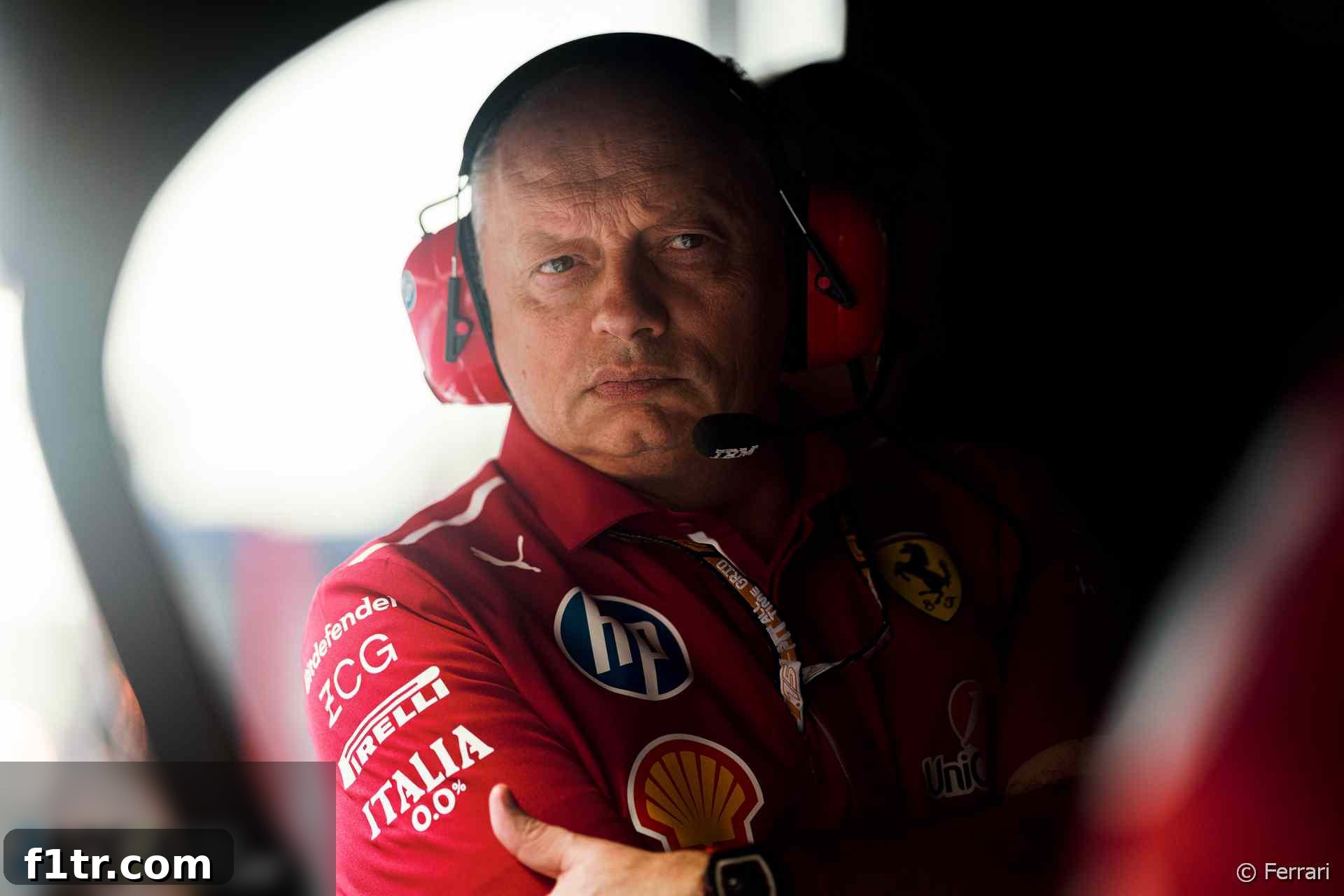
Ferrari Team Principal Frederic Vasseur remains optimistic about the inherent capabilities of their SF-25 challenger, asserting that significant untapped potential still lies within the car. Despite a challenging start to the Formula 1 season where the Scuderia is yet to secure a podium finish, Vasseur’s confidence stems from a deep understanding of the team’s development trajectory and the competitive nuances of modern F1.
Advert | Become a Supporter & go ad-free
The team introduced a crucial floor upgrade at the preceding Bahrain Grand Prix, a development that notably enhanced the SF-25’s overall balance and handling characteristics. This upgrade was a targeted effort to refine the car’s aerodynamic efficiency and stability, particularly through high-speed corners. Vasseur confirmed that the team anticipates this modification to yield even greater dividends at the forthcoming Saudi Arabian Grand Prix in Jeddah, a circuit renowned for its high-speed sweeps and demanding technical sections where aerodynamic performance is paramount. The successful integration and optimization of such upgrades are critical for unlocking the SF-25’s full potential and challenging the front-runners.
However, navigating the fiercely competitive landscape of Formula 1 presents unique challenges. With the top teams frequently separated by mere hundredths of a second, the intricate task of extracting the absolute maximum performance from their cars has proven exceptionally difficult for Ferrari. This tight margin signifies that even the slightest imperfection in setup, driver execution, or strategic calls can have a disproportionate impact on track position and ultimately, race results. Vasseur likens this challenge to a complex culinary endeavor, stating, “The ingredients are all there, but now it’s like cooking and you have to put the ingredients together at the right stage.” This analogy perfectly encapsulates the delicate balance and precise timing required to synthesize all elements — from chassis dynamics to engine power and tyre management — into a winning package.
Vasseur elaborated on his perspective, suggesting that Ferrari has not yet consistently hit its peak performance. “Honestly, I don’t have the feeling that we’ve extracted the best from the car so far. Perhaps on some occasions, in some sessions. But I’d say it’s true for us and for the others.” This candid assessment highlights a universal truth in contemporary F1: even leading contenders grapple with maximizing their machinery’s capabilities across every session and race scenario. He pointed to McLaren as an example, a team that has shown significant strides in performance, yet even they experience instances where one of their cars struggles more than the other, underscoring the delicate nature of car setup and operational consistency in an incredibly tight field.
The F1 landscape has transformed dramatically over the past few years, evolving into a realm where every millisecond counts. Vasseur recalled, “A couple of years ago, you could go [through] Q1 with a set of medium [tyres], do one lap, and you were in Q2. Today, even the top teams have to put on two sets of softs sometimes.” This observation vividly illustrates the heightened intensity of qualifying sessions and the sheer closeness of performance across the grid. The once comfortable margins have evaporated, forcing teams into aggressive tyre strategies and pushing drivers to the absolute limit from the very first lap of qualifying.
This unprecedented level of competition means that errors, no matter how minor, carry severe penalties. “Again, the field is very, very tight, and each time you make a mistake, you can lose five or six positions. Then the conclusion from [those] outside is that it’s a drama. We’re more focused on pure performance, and five hundredths is not a drama,” Vasseur asserted. His statement distinguishes between the external perception of performance fluctuations, often amplified by media and fan reactions, and the team’s internal, data-driven analysis. For Ferrari, a deficit of five hundredths of a second is not a cause for panic but rather a precise metric indicating areas for improvement, emphasizing a strategic approach over emotional responses.
Advert | Become a RaceFans supporter andgo ad-free
Maintaining a calm and analytical approach is paramount for continuous improvement. Vasseur believes this strategic mindset was one of Ferrari’s strengths in the previous season, enabling them to capitalize on marginal gains, sometimes by fractions of a second. “That means we need to stay calm in the analysis if we want to improve. I think it was one of the skills of the team last year to be able to capitalise by hundredths of a second at a time. I hope we’ll follow the same path this year.” This commitment to meticulous analysis and incremental progress underscores Ferrari’s long-term vision and their dedication to refining every aspect of their operation, from car design to race day execution.
During the Bahrain Grand Prix, both Lewis Hamilton and Charles Leclerc reported encouraging performance from the SF-25 on the medium tyre compound, particularly during the crucial middle stint of the race. This positive feedback provides valuable data and a clear direction for the team’s development. Vasseur stressed the importance of replicating this level of performance consistently throughout an entire race weekend, from practice sessions and qualifying to the grand prix itself. Achieving this consistency is not just about raw pace but also about setup stability, tyre management across different compounds, and adapting to evolving track conditions.
“It’s true that this stint went well for us. Unfortunately, the Safety Car came also a bit too early,” Vasseur noted, highlighting how external factors like Safety Car deployments can disrupt well-executed strategies and mitigate the advantages gained through strong tyre performance. He further elaborated on Ferrari’s primary objective: “Now the issue – or the project – is to be much more consistent [than] to have a good stint in the race or a good stint in Q3 or Q2.” This clarifies that the team’s focus extends beyond individual flashes of brilliance to an overarching aim of delivering top-tier performance reliably from Friday to Sunday, a benchmark for championship contenders.
The complexities of achieving this consistency were starkly illustrated by their experience at the Chinese Grand Prix. In that event, Lewis Hamilton (referring to a previous season’s example or a hypothetical scenario, as Hamilton joined Ferrari in 2025 – likely a factual error in the original prompt or a typo for Charles Leclerc, who won a sprint race for Ferrari) managed to win the sprint race, showcasing the car’s potential in shorter, high-intensity formats. However, the team’s performance in the subsequent Grand Prix was less stellar, culminating in both cars being disqualified for technical infringements. This dramatic swing underscores the fine line Ferrari walks between aggressive setup choices aimed at maximizing performance and adherence to stringent technical regulations. It serves as a potent reminder of the “on the edge” nature of modern F1.
“If we want to come back and fight for the win, we need to have much more consistent weekends,” Vasseur reiterated, outlining a clear mandate for the team. He reflected on the Chinese Grand Prix as a prime example: “This one has started in a good way. But I think it was a good example [in] China: The sprint race and the sprint quali went well and as you can imagine, we didn’t turn the car upside down after winning the first one for the day after. We are really on the edge.” This demonstrates that even minor changes or shifts in track conditions can dramatically alter performance when operating at the absolute limit. The car’s delicate balance means that optimizing for one scenario (like a sprint race) doesn’t automatically translate to success in another (like a full Grand Prix).
Advert | Become a RaceFans supporter andgo ad-free
The intense competition means drivers and engineers are constantly pushing boundaries. “I don’t want to speak about the others, but as soon as you push a bit too much, you pay the price with the tyres the corner after. It’s really on the edge, very difficult to find the right balance. But we are improving in this direction.” This statement from Vasseur encapsulates the fundamental challenge of Formula 1: maximizing pace without overstressing the tyres, a balance that shifts dynamically with track temperature, grip levels, and race duration. The continuous pursuit of this elusive balance is a testament to the engineering prowess and strategic acumen required to succeed at the pinnacle of motorsport.
Despite Ferrari securing podium finishes in each of the last three rounds of the previous year (2024 season end), the current year has seen them yet to reach the rostrum. This contrast highlights both the progress made in the latter half of the previous season and the fresh challenges and heightened competition of the current campaign. Vasseur’s measured optimism and focus on systematic improvement suggest that Ferrari is well-equipped to tackle these hurdles. The journey towards consistent podiums and ultimately, race victories, is a marathon, not a sprint, and the team principal’s steady hand is guiding the Scuderia through every turn.
Miss nothing from RaceFans
Get a daily email with all our latest stories – and nothing else. No marketing, no ads. Sign up here:
Go ad-free for just £1 per month>> Find out more and sign up
2025 Saudi Arabian Grand Prix Insights
- Red Bull made tactical decision not to avoid a penalty in Jeddah, Horner confirms
- Norris’s starts were far poorer than Verstappen’s last year but the balance is shifting
- McLaren’s rivals “just one upgrade away from being the lead car” – Brown
- Russell told race control what he thought of Verstappen’s first lap corner cut
- Doohan’s final corner pass on Bortoleto was F1’s closest fight for last place in seven years
Browse all 2025 Saudi Arabian Grand Prix articles