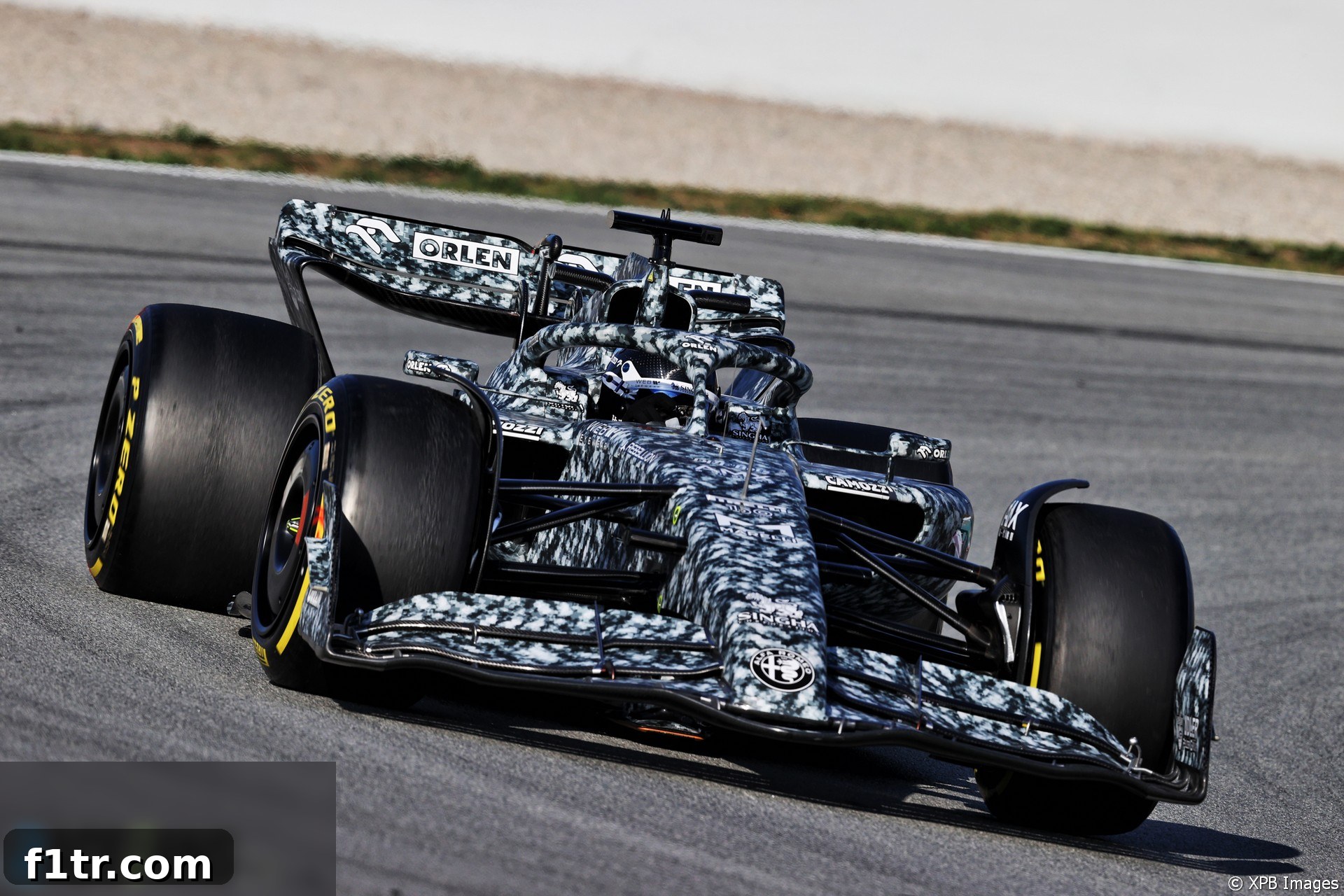
F1’s Ground Effect Era: Valtteri Bottas Dismisses Early Porpoising Safety Concerns
The dawn of the 2022 Formula 1 season ushered in a revolutionary new set of technical regulations, designed to promote closer racing and reshape the aerodynamic philosophy of the sport. As teams descended upon the Circuit de Catalunya for pre-season testing, an unexpected and visually striking phenomenon quickly emerged as a major talking point: ‘porpoising’. This cyclical bouncing motion, reminiscent of a porpoise surfacing for air, immediately sparked debate among drivers and engineers, particularly regarding its potential safety implications. Amidst growing concerns from some quarters, Alfa Romeo driver Valtteri Bottas offered a more composed perspective, confidently asserting that the issue, while significant, did not pose an inherent safety risk and would be swiftly addressed by the sport’s engineering prowess.
Understanding Porpoising: The Return of Ground Effect Aerodynamics
To fully grasp the nature of porpoising, it’s essential to understand the fundamental shift in aerodynamic design for the 2022 season. The new regulations marked a significant departure from previous eras, placing a renewed emphasis on ‘ground effect’. This principle, largely banned in F1 since the early 1980s, leverages the interaction between the car’s underbody and the track surface to generate vast amounts of downforce. Engineers were given greater freedom to sculpt elaborate floor designs, featuring Venturi tunnels that accelerate airflow beneath the car, creating an area of low pressure that effectively sucks the car towards the ground.
While ground effect is incredibly efficient for producing downforce, it introduces a unique challenge: the closer the car runs to the ground, the more potent the ground effect becomes. However, there’s a critical threshold. At very high speeds, as the car is pulled ever closer to the track, the gap between the car’s floor and the asphalt can become so minimal that the airflow beneath the car can ‘stall’. When this happens, the carefully managed underbody aerodynamics momentarily collapse, leading to a sudden and drastic loss of downforce. With the downforce gone, the car’s suspension pushes it upwards. As the ride height increases, the airflow reattaches to the floor, restoring the downforce, which then pulls the car back down towards the track, initiating the cycle once more. This rapid, uncontrolled rising and falling motion is what became known as porpoising.
The Safety Debate: Bottas’s Confidence vs. Russell’s Concerns
The severity of the porpoising observed during the Barcelona test immediately prompted discussions about driver comfort and, more critically, safety. One of the most vocal proponents of the safety concern was George Russell, Bottas’s successor at Mercedes. Russell, having experienced the violent bouncing firsthand, publicly stated that the phenomenon “has the potential to be a real safety concern.” His worries stemmed from the potential impact on driver concentration, visibility at high speeds, and the sheer physical toll of repeated, heavy impacts. Drivers reported feeling disoriented and experiencing significant jarring, leading to fears of fatigue, back pain, and potential long-term health issues, not to mention the risk of inadvertently making a mistake due to the unpredictable movement of the car, particularly during braking or over bumps on the track.
In stark contrast to Russell’s apprehension, Valtteri Bottas remained notably unfazed. “For now I don’t think it’s a safety issue,” he declared. Bottas’s perspective was rooted in his belief that porpoising was primarily an aerodynamic puzzle, a challenge to be overcome through engineering ingenuity, rather than an inherent design flaw threatening driver safety. He acknowledged the mechanism – the lower the car runs, the more downforce it generates – and framed it as a performance trade-off. While running the car incredibly low yielded performance gains, it came at the cost of ride quality, especially at high speeds and over track imperfections. Bottas expressed confidence that Formula 1 teams, with their vast resources and expertise, would quickly devise solutions. “I don’t think it’s going to be a big concern. As a team we need to work around it and we need to make sure that the car is reliable enough for these regulations and it’s the same case for every team,” he added, emphasizing the collective responsibility and capability of the grid.
Team Perspectives and Early Progress: Alfa Romeo’s Insights
Bottas’s optimism was echoed by his new teammate at Alfa Romeo, Guanyu Zhou. Despite Alfa Romeo covering the lowest mileage of any team during the three-day Barcelona test, Zhou noted significant progress had already been made in mitigating the porpoising effect. “When I first jumped in day two it felt already quite a good improvement,” Zhou commented, highlighting the immediate feedback loop between drivers and engineers. This demonstrated the rapid problem-solving capabilities within the sport, even in the initial stages of understanding the new cars. Zhou confirmed that while the problem persisted to some degree for all teams, it was clearly identifiable as the “biggest limitation” with the new generation of cars. Yet, his sentiment aligned with Bottas’s: it was a challenge that could be navigated to maximize downforce while minimizing the disruptive bouncing.
The collective understanding among teams during this testing phase was that porpoising, while prominent, was a solvable engineering problem. Pre-season tests are, by their very nature, designed to uncover such issues, allowing teams to gather crucial data, experiment with different setups, and identify potential design flaws before the competitive season truly begins. The initial widespread belief was that as teams accumulated more knowledge and data, and implemented various aerodynamic or suspension adjustments, the severity and prevalence of porpoising would diminish.
The Broader Aerodynamic Challenge: Performance vs. Ride Comfort
The phenomenon of porpoising highlighted a critical aerodynamic conundrum that teams faced in the new ground effect era: the delicate balance between maximizing performance and ensuring a stable, driveable car. Running the car as low as possible was the direct route to unlocking the full potential of the ground effect, translating into faster lap times. However, this aggressive approach inevitably exacerbated the porpoising, subjecting drivers to intense discomfort and potentially compromising their ability to perform consistently at the limit. Teams were therefore tasked with finding the ‘sweet spot’ – an optimal ride height and aerodynamic configuration that delivered strong downforce without triggering excessive bouncing.
This challenge prompted engineers to explore various mitigation strategies. These included adjustments to suspension stiffness and damping rates, modifications to the floor edge designs to control airflow stability, and even subtle changes to aero components that influence the car’s pitch and roll. The complexity lay in the interconnectedness of these elements; a change in one area could have unforeseen consequences in another. The initial stages of the 2022 season became a testament to the relentless pursuit of innovation and the iterative nature of Formula 1 development, as every team strived to understand, control, and ultimately exploit the new aerodynamic paradigm.
An Evolving Challenge: A Pre-Season Perspective
In essence, the pre-season debate surrounding porpoising underscored the transformative nature of the 2022 regulations. While some, like George Russell, voiced legitimate safety concerns born from the immediate physical impact, others, notably Valtteri Bottas and Guanyu Zhou, expressed a more pragmatic view, confident in the sport’s ability to innovate and adapt. Bottas famously predicted that as the season progressed and teams deepened their understanding of the new cars, porpoising would become “less of an issue and less of a talking point.” This perspective highlighted the dynamic environment of Formula 1, where complex technical challenges are not just identified but actively tackled and resolved through continuous engineering effort.
The initial emergence of porpoising during the 2022 pre-season testing was more than just a peculiar visual; it was a defining moment that set the tone for the early part of the new ground effect era. It showcased the immediate impact of radical rule changes, the contrasting perspectives within the paddock, and the unwavering belief in engineering solutions that has always been at the heart of Formula 1. This initial struggle ultimately became a key part of the narrative for the 2022 season, pushing teams to their limits in the quest for both performance and stability.
2022 F1 season
- Mercedes told me “you’re wrong” about 2022 car’s problems – Hamilton
- FIA confirms all 10 F1 teams complied with 2022 cost cap
- Steiner “not ashamed” of panning “slow” Schumacher in Drive to Survive
- Albon believes year out of F1 improved him as a driver
- Hamilton sees diversity gains in F1 years on from his ‘traumatising’ experience of racism
Browse all 2022 F1 season articles