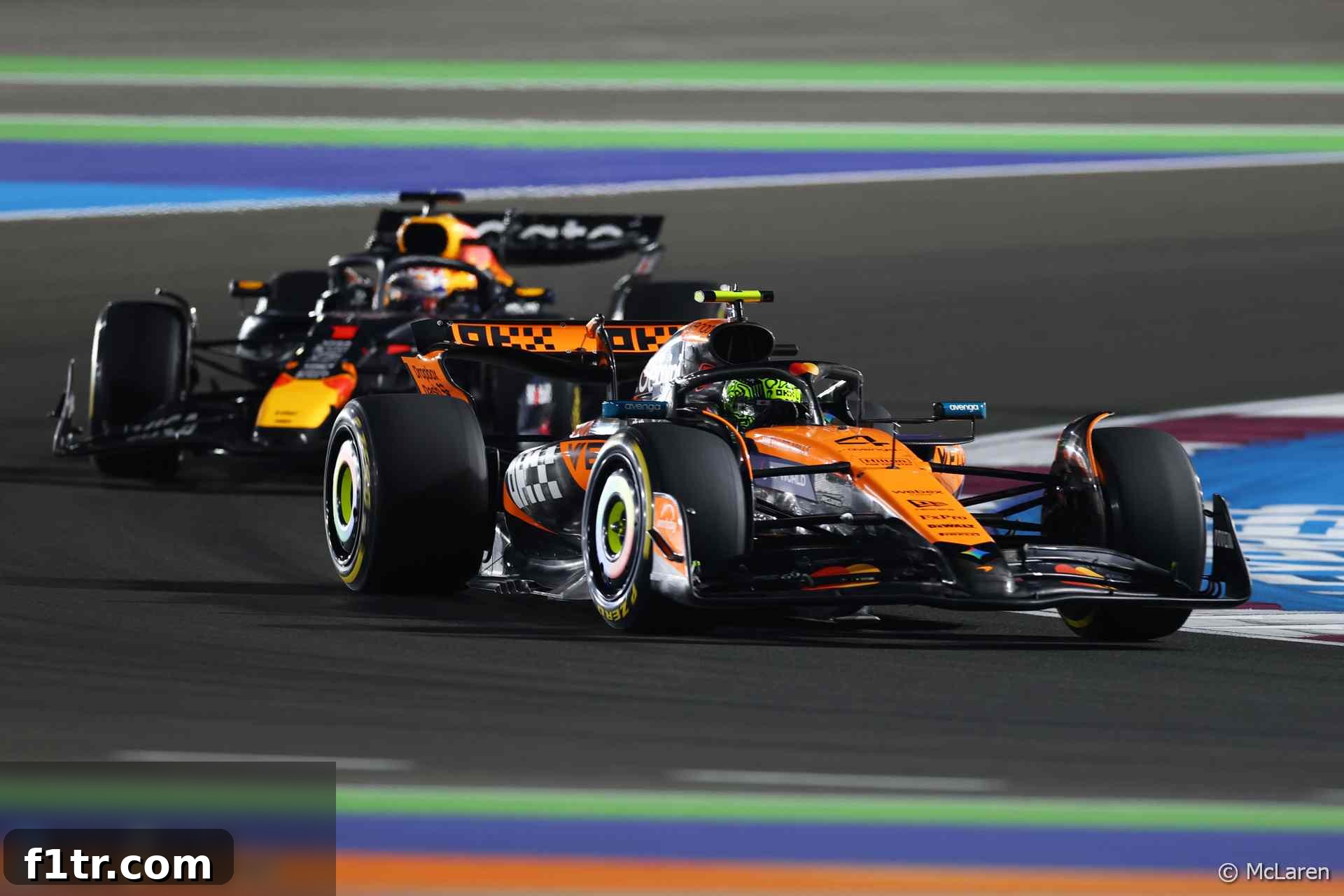
Lando Norris has unequivocally rejected Max Verstappen’s recent assertion that the Formula 1 championship would have been decided “a long time ago” had Verstappen been behind the wheel of a McLaren. The British driver for McLaren characterized Verstappen’s comments as an example of Red Bull’s “aggressive nature,” implying that his rival lacked a complete understanding of the situation.
Advert | Become a Supporter & Go Ad-Free
Norris Fires Back: Max Verstappen’s McLaren Championship Claim Deemed “Nonsense”
F1 Title Battle Intensifies as Drivers Engage in Verbal Sparring
As the Formula 1 season hurtles towards a dramatic conclusion, with Lando Norris poised to potentially secure his inaugural championship title in the upcoming Grand Prix, the off-track rhetoric has become as intense as the on-track action. The McLaren star, currently leading the drivers’ standings, wasted no time in responding to Max Verstappen’s provocative remarks, made earlier in the week. Speaking to the media during the customary press conference following the sprint race, Norris balanced acknowledging Verstappen’s monumental achievements with a sharp critique of his specific championship prediction.
“Max is very welcome to say everything he wants, to be honest,” Norris began, adopting a tone of measured respect before delivering his rebuttal. “He kind of earned the right, he’s won four world championships. I have a lot of respect, and I think that gives anyone a lot of credit in general. He’s achieved an incredible amount, more than anyone generally dreams of achieving.”
However, Norris quickly shifted focus to challenge the fundamental premise of Verstappen’s claim. “So Max generally has a good clue about a lot of things, but there’s also a lot of things he doesn’t have much of a clue about,” Norris added, delivering a subtle yet potent jab. This comment pointedly questioned the reigning champion’s insight into the intricacies of McLaren’s current performance, development trajectory, and the sheer effort behind their remarkable resurgence.
Red Bull’s “Aggressive Nature” Called Out by Norris
Norris’s response extended beyond a simple dismissal of Verstappen’s comments; he deliberately contextualized them within what he perceives as Red Bull Racing’s broader modus operandi. “But this is also Red Bull’s way of going about things,” Norris elaborated. “It’s this kind of aggressive nature and just talking nonsense a lot of the time. So it depends if you want to listen to it and talk about it – like you love to – or you do what we do as a team, which is just kind of keep our heads down, keep focused. Maybe he would have done but he hasn’t so far and he keeps trying.”
This statement brilliantly encapsulates a perceived philosophical divergence between the two leading teams. While Red Bull, often personified by Verstappen’s famously assertive and outspoken personality, frequently engages in verbal jousting, McLaren, under Norris’s articulation, positions itself as a more stoic, performance-driven unit. Norris’s remarks suggest a preference for allowing on-track results to serve as their definitive statement, rather than participating in the often-strategic psychological warfare that permeates high-stakes Formula 1 championship battles.
Advert | Become a RaceFans supporter andgo ad-free
Verstappen’s Championship Analysis: A Hypothetical McLaren Scenario
Max Verstappen’s initial controversial remarks, which ignited this spirited exchange, were made during an interview with the official F1 channel earlier in the race week. The Red Bull ace, renowned for his candid and often blunt communication style, offered his perspective on a hypothetical scenario involving him driving for McLaren in the current season. He prefaced his comments by stating, “It’s not going to change my life if I fail to win a fifth consecutive world championship title this year.” This initial declaration, while seemingly a display of composure, could also be interpreted as a strategic move to ease pressure on himself or to subtly diminish the significance of the ongoing championship battle for his rivals.
Verstappen then delved deeper into his analysis of the current championship landscape, suggesting that the tight nature of the title fight was not solely a testament to Red Bull’s performance this season, but rather a consequence of his competitors’ inconsistencies. “We are in this fight still because of other people’s failures, not because of if you look at the whole of a season, what we did,” he explained. “Yes, we did really well. We have really maximised all – pretty much all – races before the ones that I mentioned.” This perspective underscores Verstappen’s belief in Red Bull’s consistent performance, attributing the close standings to external factors rather than any intrinsic lack of pace or execution from his own team.
The core of his provocative statement, which directly drew Lando Norris’s sharp retort, was the direct comparison he made: “But if we would have been in the position of how dominant of a car they had, the championship would have been over a long time ago.” This powerful declaration carries multiple implications. It simultaneously acknowledges the McLaren car’s current competitive strength, implying it possesses a level of dominance, while also subtly questioning the ability of its current drivers to extract its absolute maximum potential. Essentially, Verstappen posited that if he were at the helm of the MCL39, the championship would already be a foregone conclusion, thereby casting a shadow over the ongoing efforts of Norris and McLaren.
The Intensifying 2025 F1 Title Fight: McLaren’s Rise Meets Red Bull’s Resilience
The 2025 Formula 1 season has undoubtedly emerged as one of the most compelling and unpredictable in recent memory, moving decisively away from the periods of singular dominance that have characterized previous eras. McLaren’s spectacular resurgence, particularly prominent in the latter half of the campaign, has become a pivotal narrative. The diligent efforts of their engineering team and strategic department have clearly unlocked substantial performance from the MCL39 chassis, transforming it into a formidable race-winning machine. This remarkable transformation has been instrumental in enabling Lando Norris to mount a serious and credible challenge for the drivers’ championship, a prospect many would have dismissed as improbable at the season’s outset.
Conversely, Red Bull Racing, while still a titan in the sport, has not enjoyed the same unchallenged supremacy observed in their preceding championship campaigns. While Max Verstappen has consistently delivered stellar performances, often maximizing the potential of the RB21, the car has faced much stiffer competition. The team has also encountered its share of strategic dilemmas or, on occasion, minor reliability concerns. These cumulative factors, which Verstappen himself implicitly referenced, have collectively contributed to keeping the championship battle wide open, preventing him from establishing the kind of unassailable lead that has been a hallmark of his previous title-winning seasons.
Verstappen’s narrative of the championship being open due to “other people’s failures” reflects a driver’s relentless pursuit of perfection. It suggests he believes Red Bull has largely optimized their own package and performance, and any narrowing of the points gap stems from inconsistencies, strategic missteps, or errors made by rival teams. While this perspective is understandable from an elite competitor, it also, perhaps inadvertently, understates the significant, hard-won advancements and heightened consistency achieved by competitors like McLaren in elevating their overall performance.
A graphical representation showcasing the comparative performance trends, championship points, and key race results for Lando Norris, Oscar Piastri, and Max Verstappen throughout the season would typically be presented here, offering visual insight into their championship trajectories.
The Dynamics of Psychological Warfare in Elite F1 Rivalries
The pointed exchange between Lando Norris and Max Verstappen transcends a mere casual disagreement; it exemplifies the intricate psychological warfare that is an inherent, often unspoken, component of elite-level motorsport, particularly when a world championship title hangs in the balance. Drivers, team principals, and even strategists frequently deploy verbal tactics and carefully crafted media statements as a means to gain a crucial mental edge over their direct competitors. Verstappen, with his well-established reputation for unwavering confidence and straightforward communication, often utilizes media platforms to assert his dominance, subtly challenge rivals, or reinforce his own team’s perceived superiority.
Norris’s response, though framed with respect for Verstappen’s remarkable career achievements, was equally calculated and strategic. By labeling Verstappen’s comments as “talking nonsense” and characterizing them as indicative of Red Bull’s “aggressive nature,” Norris shrewdly attempts to deflect the underlying criticism. Simultaneously, he endeavors to portray McLaren as the composed, internally focused, and resilient entity. This counter-narrative aims to bolster McLaren’s strong team ethos and their unwavering commitment to performance, deliberately contrasting it with what Norris perceives as unnecessary bravado or mind games emanating from the Red Bull camp.
Such highly publicized exchanges inject an additional layer of intrigue into an already thrilling championship narrative. They serve to heighten anticipation for the subsequent on-track battles, as fans and pundits alike eagerly watch to observe whether these verbal jabs translate into increased aggression, more decisive overtakes, or tactical masterstrokes during the actual races. The storied history of Formula 1 is rich with examples of such intense rivalries, from the legendary Prost-Senna battles to the more recent Hamilton-Verstappen showdowns, where the off-track rhetoric proved to be as captivating and defining as the wheel-to-wheel racing action itself.
The Road Ahead: The Crucial Qatar Grand Prix and Beyond
With the climax of the championship potentially unfolding at the impending Qatar Grand Prix, every utterance, every strategic decision, and every maneuver on track carries an immense weight of consequence. Lando Norris stands on the precipice of achieving a career-defining moment, a testament not only to his burgeoning talent but also to McLaren’s tireless development and unwavering commitment. Max Verstappen, a formidable four-time world champion, is engaged in a fierce battle to extend his reign and, critically, to deny Norris his inaugural title, embodying the sheer tenacity and competitive spirit that have indelibly defined his illustrious career.
The ultimate outcome of this enthralling championship will not merely be determined by raw speed, engineering brilliance, or strategic acumen. It will also be profoundly influenced by the drivers’ mental fortitude, their ability to withstand immense pressure, and their capacity to turn perceived slights into fuel for superior performance. Norris’s measured yet firm retort to Verstappen’s remarks strongly suggests a driver who is not only growing exponentially in confidence but is also increasingly unwilling to be intimidated by the established giants of the sport. As the season finale rapidly approaches, the global Formula 1 community watches with bated breath, eager to witness which formidable contender will ultimately emerge victorious from this compelling and deeply personal rivalry.
Miss nothing from RaceFans
Get a daily email with all our latest stories – and nothing else. No marketing, no ads. Sign up here:
2025 Qatar Grand Prix Related Articles
- Norris wins 2025 F1 title and ends Verstappen’s four-year reign as champion
- McLaren “helping Stefano with TV ratings” with Qatar strategy error, jokes Brown
- Alpine are guaranteed to finish last in 2025 – but will set an obscure points record
- Norris take note: The F1 points leader usually loses three-way title fights
- Mercedes grateful for Red Bull’s statement on Antonelli after “disappointing” online abuse
Browse all 2025 Qatar Grand Prix articles