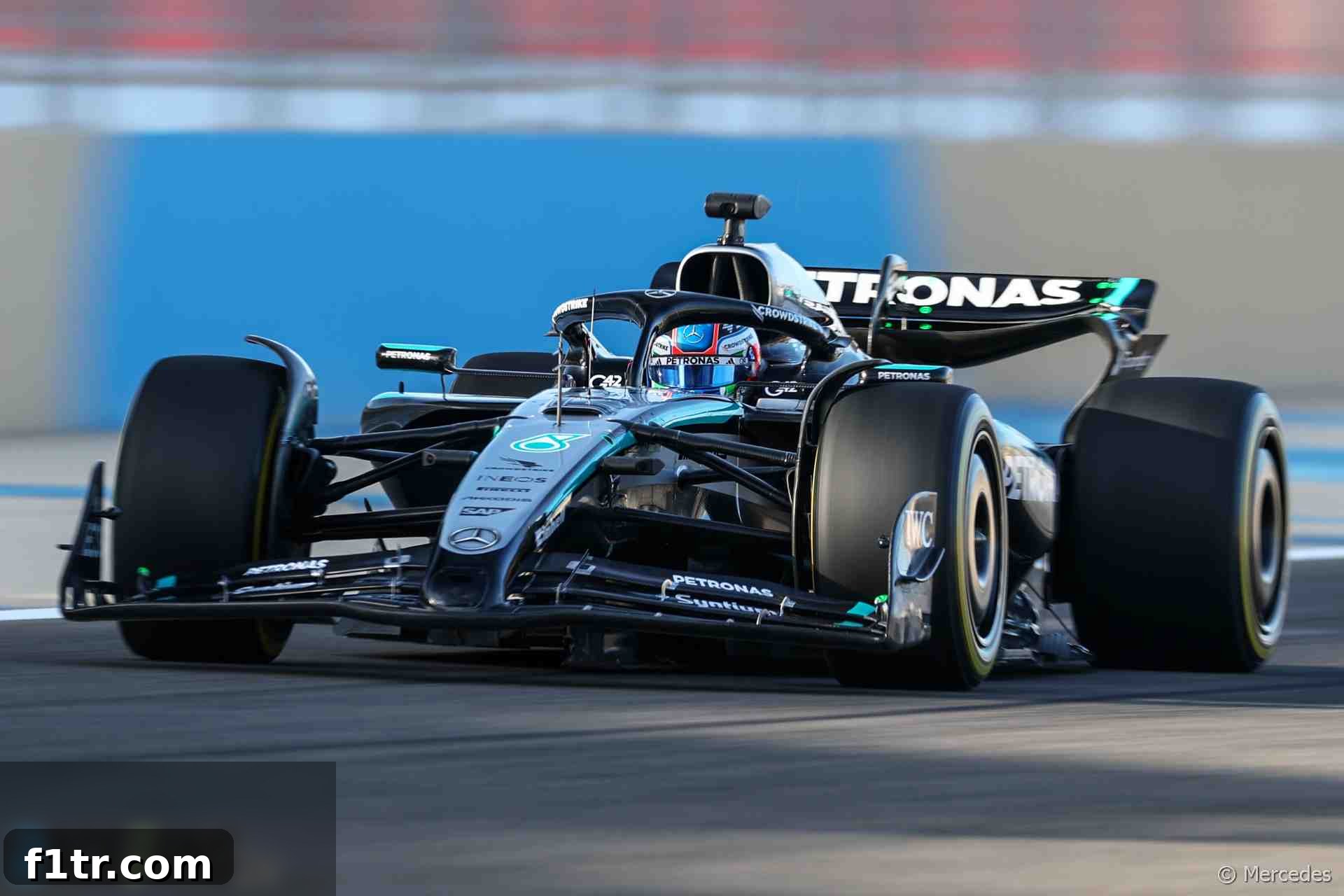
Mercedes W16 Unleashed: New F1 Challenger Makes Track Debut in Bahrain Ahead of Critical Pre-Season Test
The anticipation reached a fever pitch as Mercedes-AMG Petronas Formula One Team officially unveiled its latest contender, the W16, for the 2025 season. Just a day after revealing the first digital renderings and detailed specifications, the Silver Arrows brought their new machine to life on the tarmac of the Bahrain International Circuit. This pivotal shakedown event marks the true beginning of their 2025 campaign, setting the stage for what promises to be a fiercely competitive season.
On a day shrouded in expectation, George Russell, one of Mercedes’ promising young talents, had the distinct honor of being the first driver to put the W16 through its paces. The shakedown, a crucial initial run designed to check fundamental systems and gather rudimentary data, took place just hours before all ten Formula 1 teams are scheduled to converge on the very same track for the sole pre-season test. This immediate transition from unveiling to track action highlights the team’s aggressive approach to preparation, aiming to maximize every minute of development time before the competitive wheels truly begin to turn.
Toto Wolff’s Candid Assessment: Targeting Consistency and Reclaiming Dominance
Speaking on the eve of the extensive pre-season testing, Team Principal Toto Wolff offered a remarkably candid assessment of Mercedes’ priorities for the upcoming season. Wolff emphasized the paramount importance of eradicating the frustrating inconsistencies that marred their performance in the previous year. “We have to be realistic, always,” Wolff stated, reflecting on a period where flashes of brilliance were often overshadowed by unpredictable form. “We’ve been very good at times, we won a few races last year, but overall the performances weren’t stable enough.”
This pursuit of consistency is not merely about winning individual races but about establishing a sustained challenge for the championship – a position Mercedes grew accustomed to during an unprecedented era of dominance. Having secured an astonishing eight consecutive Constructors’ World Championships before the introduction of the current aerodynamic regulations, the team has since managed a mere five Grand Prix victories. This significant dip from their previous benchmark fuels Wolff’s determination to see Mercedes return to the apex of Formula 1.
“So this is what we are looking at,” Wolff continued, underscoring the deep dive into their operational and design philosophies. His characteristic pragmatism shone through as he added, “I’m always a glass half-empty guy rather than too optimistic.” This philosophy, far from being pessimistic, reflects a relentless drive for improvement and a refusal to rest on past laurels, ensuring every potential weakness is meticulously scrutinized and addressed. The focus for the W16, therefore, is not just about raw speed, but about delivering a car that performs reliably and predictably across a diverse range of tracks and conditions.
The Technical Imperative: Crafting a Predictable and Agile W16
Wolff delved into the specific technical challenges that have plagued the team since the regulatory overhaul. “It’s been a few years now into these regulations and the car was never, never happy,” he admitted, echoing frustrations felt throughout the team and by their dedicated fanbase. The core issue identified was the car’s unpredictability, a trait that makes it incredibly difficult for drivers to extract maximum performance consistently. “The drivers felt it was unpredictable, so this is the main area that we concentrated on: To make a car that’s a little bit better in the low-speed corners whilst not handicapping us in the high-speed.”
Achieving this delicate balance is a formidable engineering feat. Low-speed corner performance often demands excellent mechanical grip and sophisticated suspension geometry, allowing the car to rotate efficiently. High-speed corners, conversely, rely heavily on aerodynamic downforce and stability. Historically, optimizing one aspect can often compromise the other. Mercedes’ engineers have meticulously worked to bridge this gap, aiming for a chassis that offers predictable handling characteristics, empowering George Russell and his teammates to push the limits with greater confidence. A predictable car translates to quicker lap times, fewer driver errors, and a more effective race strategy, all critical components for a championship challenge.
The W16’s design philosophy, therefore, represents a fundamental shift in approach, moving beyond brute force aerodynamics to a more nuanced integration of mechanical and aerodynamic elements. The team’s commitment to addressing the root causes of their performance fluctuations rather than simply chasing incremental gains speaks volumes about their long-term vision and renewed determination to challenge the current dominant forces in Formula 1.
A New Chapter: Post-Hamilton Era and the Rise of Andrea Kimi Antonelli
The 2025 season marks the dawn of a truly new era for Mercedes, as the team embarks on its journey without seven-time world champion Lewis Hamilton. Hamilton’s departure to Ferrari leaves a significant void, ending a partnership that redefined Formula 1 history. However, Wolff confirmed that the team is embracing this change with a fresh perspective, highlighting the smooth integration of rookie Andrea Kimi Antonelli, who steps into a pivotal role within the team’s development structure.
Wolff acknowledged the palpable change in the garage dynamic. “It’s a bit unusual not seeing Lewis rock up in the garage,” he admitted, reflecting on over a decade of shared success. “It’s been a while.” Yet, the team principal quickly pivoted to the positive energy injected by Antonelli. “But Kimi is such a great value to the team, the dynamic is so positive. I see a bit of a new buzz going through the team because it’s new. We’re very much looking forward to see how he performs.”
Antonelli, a highly touted young driver from the Mercedes junior program, represents the future of the team. His presence not only fills a strategic gap but also brings a fresh perspective and enthusiasm that can reinvigorate the entire organization. The dynamic between Russell, now the senior driver, and Antonelli, the hungry rookie, is expected to foster a competitive yet collaborative environment, pushing each other to greater heights. This period of transition, while challenging, is also seen as an immense opportunity for Mercedes to redefine its identity and build a new legacy, leveraging emerging talent and a refined technical approach.
Bahrain Shakedown: First Impressions and Pre-Season Testing Significance
The Bahrain International Circuit serves as the traditional proving ground for Formula 1’s pre-season preparations, and the W16’s shakedown here is strategically vital. A shakedown is typically a short test, limited in mileage, primarily used for critical system checks: ensuring the engine fires up, the gearbox shifts smoothly, the brakes function, and all electronic systems are operational. It’s an initial validation of the car’s fundamental integrity before pushing its performance boundaries.
For Mercedes, this shakedown provides the first real-world data points on the W16’s behavior, allowing engineers to correlate simulator data with actual track performance. The immediate proximity to the full pre-season test means any major issues can be identified and potentially addressed before the pressure intensifies. With only one collective pre-season test now, every lap counts, and starting with a successful shakedown builds crucial momentum and confidence within the team. The W16’s inaugural run under the warm Bahrain sun represents more than just a test; it’s a statement of intent, a declaration of Mercedes’ readiness to fight for its place at the pinnacle of motorsport.
The detailed feedback from George Russell on the W16’s initial handling characteristics will be invaluable. Even during a limited run, a driver can discern fundamental aspects like steering feel, brake response, and the overall balance of the car. These early impressions guide the engineering team in their setup decisions for the forthcoming multi-day test, optimizing the allocation of track time to focus on performance development rather than basic troubleshooting. The seamless debut of the W16, without any reported hitches, is an encouraging sign for the demanding weeks and months ahead.
Pictures: Mercedes W16 Shakedown – Bahrain International Circuit, 2025
Video: Mercedes W16 Shakedown – The W16 hits the track for the first time!
Witness the Mercedes W16 in action as it completes its initial laps, a pivotal moment captured in this exclusive video. Experience the raw power and distinctive sound of Mercedes’ 2025 challenger as it carves through the Bahrain International Circuit for the very first time. This footage offers fans a unique insight into the shakedown process, showcasing the meticulous preparation and excitement surrounding the birth of a new Formula 1 contender.
Looking Ahead: Mercedes’ Ambitions for the 2025 Formula 1 Season
With the W16 successfully completing its shakedown and the pre-season test looming, Mercedes is now fully focused on its ambitious goals for the 2025 Formula 1 season. The underlying objective is clear: to re-establish themselves as consistent front-runners and a dominant force capable of challenging for both the Constructors’ and Drivers’ Championships. The lessons learned from the previous seasons of regulatory change have been deeply integrated into the W16’s development, signifying a mature and strategic approach to overcoming past challenges.
The synergy between George Russell’s growing experience and Andrea Kimi Antonelli’s fresh perspective will be a key dynamic to watch. Russell, now firmly established as a top-tier talent, will be expected to lead the charge, leveraging his profound understanding of the team and the new car. Antonelli’s rapid ascent and raw speed offer exciting potential, and his integration will provide valuable feedback and push the team forward. Under Toto Wolff’s steadfast leadership, Mercedes is not merely looking to contend; they are striving to innovate and dictate the pace of development once again.
The journey ahead will be long and arduous, but the initial signs from the W16’s debut are encouraging. The team’s commitment to addressing fundamental inconsistencies, combined with their renowned engineering prowess and a refreshed driver lineup, positions Mercedes for a strong comeback. Fans worldwide will eagerly watch as the W16 takes to the track in full pre-season testing, hopeful that this new chapter will bring Mercedes back to the glorious heights they once commanded in Formula 1.
More on Formula 1: Latest News and Analysis
Stay updated with the latest developments, insights, and breaking news from the world of Formula 1. Explore more articles covering race reports, technical analyses, driver interviews, and strategic reviews that shape the F1 landscape.
- F1 returning to India soon after 2027 sounds like wishful thinking
- Verstappen loathes F1’s new generation of cars – but what do his rivals reckon?
- The ‘throwback weekend’ is back in fashion. But it’s a flawed concept – especially for F1
- Is Formula 1’s double race cancellation a blessing in disguise?
- Todt admits Schumacher crashed on purpose – but did it really cost him two titles?
Browse all Formula 1 articles