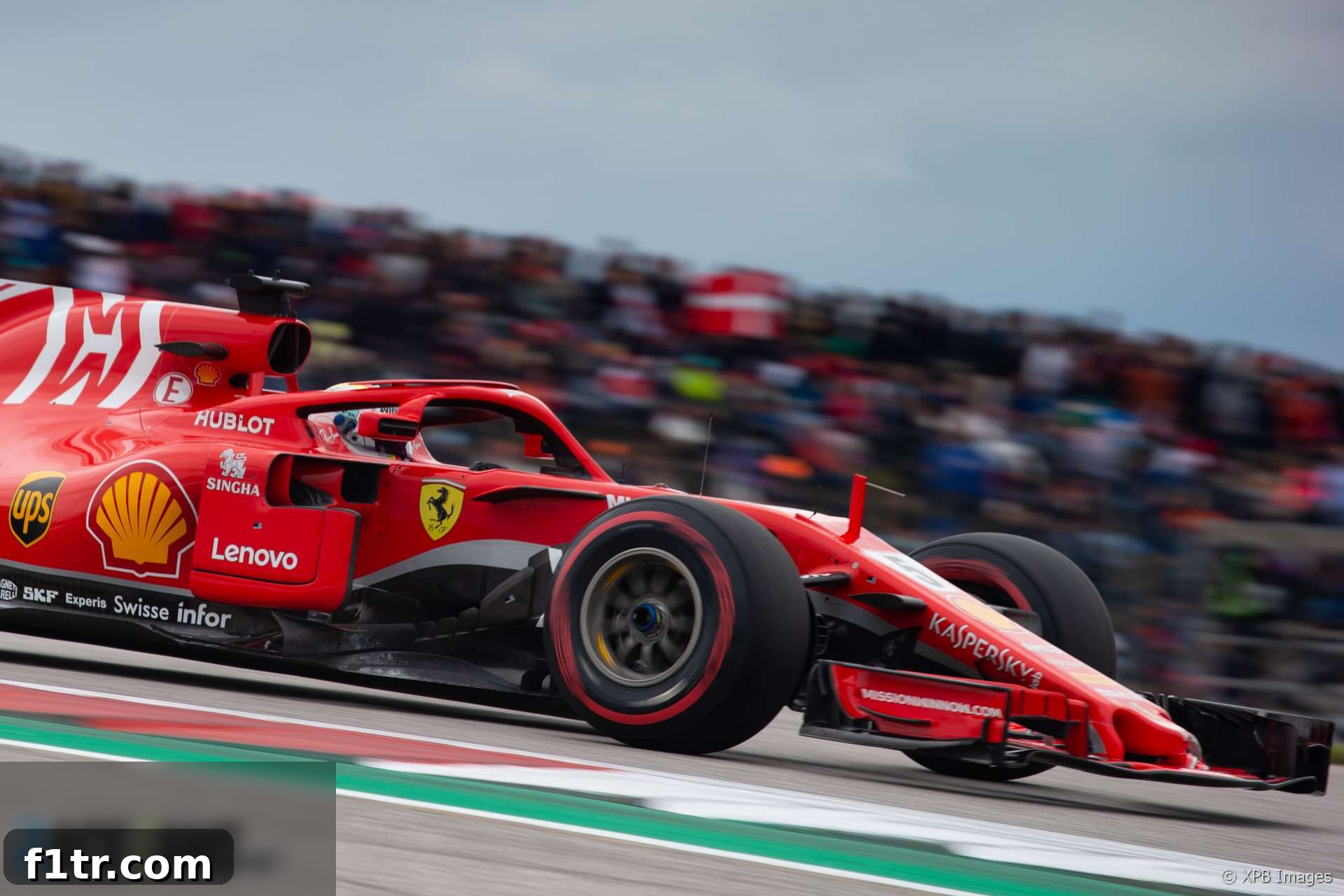
In a candid admission following a surprising performance at the United States Grand Prix, Sebastian Vettel revealed that Scuderia Ferrari found newfound competitiveness by essentially reversing months of technical development on their SF71H challenger. This strategic backtrack, which saw the team revert to an older specification of their car, allowed Kimi Raikkonen to clinch a memorable victory at the Circuit of the Americas, while Vettel himself, despite an early spin, fought back to a commendable fourth place.
Advert | Become a Supporter & go ad-free
The 2018 Formula 1 season had been a rollercoaster for Ferrari and their lead driver, Sebastian Vettel. Starting strong, the team looked poised to challenge Mercedes and Lewis Hamilton for both the Drivers’ and Constructors’ championships. However, as the season progressed into its latter stages, a noticeable dip in performance, coupled with strategic missteps and driver errors, saw their championship aspirations begin to unravel. The United States Grand Prix, therefore, presented a critical juncture, and the team’s decision to revisit their past development philosophy paid unexpected dividends.
Vettel’s reflections on the Austin weekend were tinged with a mix of relief and frustration. While the improved pace was undeniable, the realization of *how* it was achieved highlighted a deeper, more systemic issue within the team’s development pipeline. “You can see it as good news but you can also see it’s bad news,” Vettel commented, encapsulating the paradoxical nature of their breakthrough. “If we have to go back to a car that’s been competitive three or four months ago then surely it can’t be good news if you think about it.” This statement underscored the significant time and resources potentially misspent on updates that, in hindsight, detrimental to the SF71H’s overall performance envelope.
The Ferrari driver elaborated on the challenges faced by the team in identifying the root cause of their performance decline. In the fast-paced, highly competitive world of Formula 1, development is continuous, with teams constantly introducing new aerodynamic parts, chassis adjustments, and power unit calibrations. The expectation is always that these updates will lead to improvements, making it difficult to pinpoint when a new component might actually be a step backward. “Ferrari took a long time to realise the updates they brought to the car weren’t improving it,” Vettel noted, suggesting a disconnect between simulation data, track testing, and real-world race performance.
This struggle to diagnose an underlying problem is not uncommon in the complex engineering environment of F1. “It’s a bit hard to explain. If you don’t see that there’s a problem you don’t think that there’s a problem,” Vettel explained. The intricate relationship between various car components means that a seemingly logical update in one area can have unforeseen negative consequences elsewhere, often manifesting as subtle shifts in handling balance or tire degradation that are difficult to isolate. “Certainly we felt that the car was not as strong as it was before but if you don’t see that there’s anything wrong then you don’t know that there’s something wrong.” This speaks to the immense challenge of correlation – ensuring that what the engineers see in the factory or simulator accurately reflects what the drivers experience on the track.
Vettel’s introspection revealed a degree of uncertainty regarding where exactly the development path diverged from the optimal direction. “I think all the steps that we did they seemed to make sense but obviously now looking back they didn’t. Clearly there was something we missed and we haven’t understood yet why and where the error exactly took off, or started.” This honest appraisal highlighted the deep dive into technical analysis that Ferrari would need to undertake. The stakes were incredibly high; with the championship slipping away, every decision regarding car development carried immense weight. The realization that their progression was, in fact, regression, presented a harsh but necessary lesson for the team.
The decision to revert development was a bold move, likely involving stripping back newer aerodynamic elements, chassis components, or even suspension configurations that had been introduced since the summer break. The effectiveness of this strategy was immediately evident at COTA, providing a glimpse of the SF71H’s true potential when operating within its optimal window. For Kimi Raikkonen, this meant finally securing a long-awaited victory, his first since the 2013 Australian Grand Prix, offering a fantastic swan song in his final season with the Scuderia. For Vettel, it provided a car capable of fighting at the sharp end, even after an early setback.
The United States Grand Prix proved to be a pivotal moment not just for the immediate race result, but for the fundamental understanding of the SF71H’s DNA. The improved pace in Austin, achieved by effectively “undoing” months of work, underlined the critical importance of foundational car characteristics. It implied that some of the later updates, intended to improve the car, might have inadvertently compromised its inherent balance or its ability to extract performance from the tires – an aspect Ferrari had struggled with at various points in the 2018 F1 season.
For Ferrari, this discovery was a double-edged sword. On one hand, it provided a clear direction for the remaining races of the season and a valuable lesson for future car development cycles. On the other, it underscored the missed opportunities in the championship battle, where precious points were lost while the team pursued an incorrect development path. The delay in recognizing this fundamental flaw cost them dearly against the relentless consistency of Mercedes and Lewis Hamilton, who was on the verge of securing his fifth world title.
Vettel remained optimistic about the team’s ability to learn from this experience. “So as I said a lot of stuff we have to do and understand but I’m pretty sure we will do what is necessary and get on top of it.” This commitment to introspection and resolution would be crucial for Ferrari to move forward. The episode highlighted the relentless demands of Formula 1 engineering, where the smallest deviation from an optimal path can have significant consequences. It served as a stark reminder that sometimes, less is more, and understanding the core strengths of a package is paramount before chasing marginal gains that might, paradoxically, detract from overall performance.
The 2018 United States Grand Prix will be remembered not just for Kimi Raikkonen’s triumph or Sebastian Vettel’s recovery, but for the profound engineering revelation it brought to the fore for Ferrari. It forced the team to confront difficult truths about their development process and provided invaluable insights that would shape their approach to future F1 seasons. The path to championship glory often involves more than just pushing forward; sometimes, it requires the wisdom to look back and understand where the true strengths lie.
Advert | Become a RaceFans supporter andgo ad-free
2018 F1 season
- F1 feared “death knell” for Drive to Survive after Ferrari and Mercedes snub
- McLaren staff told us we were “totally crazy” to take Honda engines in 2018 – Tost
- ‘It doesn’t matter if we start last’: How Red Bull’s junior team aided Honda’s leap forward
- Honda’s jet division helped F1 engineers solve power unit problem
- McLaren Racing losses rise after Honda split
Browse all 2018 F1 season articles