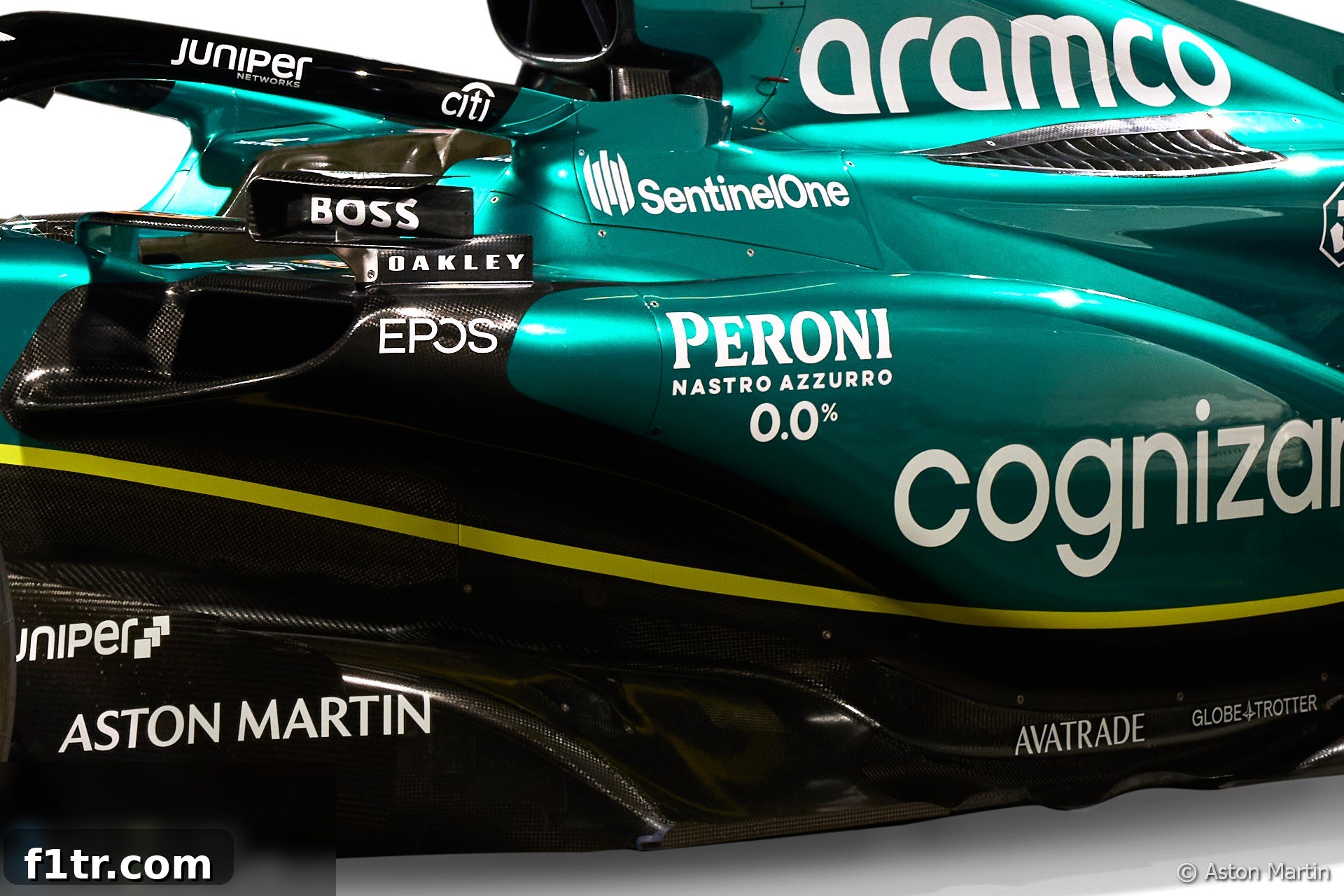
Aston Martin AMR23: Unveiling an Aggressive Aerodynamic Revolution for the F1 Season
The highly anticipated reveal of Aston Martin’s AMR23 Formula 1 car has captivated enthusiasts and experts alike, primarily due to its striking and profoundly refined sidepod design. This visually distinctive feature stands as the most prominent indicator of the team’s “aggressive” and bold development philosophy, a clear statement of intent for the upcoming season, as articulated by the car’s lead designer.
The Striking Sidepod Design: A Masterclass in Aerodynamics
From the moment the AMR23 broke cover, its sidepods commanded immediate attention, signifying the extraordinary extent of development and meticulous engineering invested in this crucial aerodynamic component. Building upon the considerable progress seen in this area during the previous season, the AMR23’s sidepods represent a significant leap forward in design and functionality.
Distinguishing themselves from their predecessors, the AMR23’s sidepods exhibit a markedly steeper undercut, a design choice engineered to optimize airflow around and beneath the car. This innovative approach is complemented by a more pronounced curve around the air intake, precisely sculpted to channel air efficiently into the cooling systems while minimizing drag. Furthermore, towards the rear of the car, these sidepods ramp downwards with increased steepness, a deliberate design element aimed at accelerating airflow over the diffuser and maximizing aerodynamic gains, thereby generating superior downforce and improving overall stability.
Technical Director Dan Fallows underscored the significance of these design choices, responding to inquiries about the car’s most apparent changes. “The sidepods are quite a big area of difference,” Fallows explained. “I wouldn’t say that’s been our majority focus, I think there are improvements and changes throughout the whole car. There’s obviously quite a lot that you can’t see.” This sentiment highlights a holistic approach to car development, where visible advancements are merely the tip of the iceberg.
Beyond the Surface: Hidden Innovations and Systemic Enhancements
While the sidepods serve as a vivid external manifestation of Aston Martin’s ambition, Fallows emphasized that numerous less obvious but equally critical advancements lie elsewhere within the AMR23. These unseen improvements are a testament to the team’s comprehensive and “bold” approach to its latest Formula 1 challenger. “Underneath the skin there’s quite substantial engineering improvements to a lot of the mechanical components as well as the aerodynamics,” Fallows elaborated, hinting at a deep dive into every facet of the car’s performance.
These ‘under-the-skin’ improvements likely encompass a wide array of areas crucial for competitive F1 performance. Enhancements to the suspension system, for instance, could provide better mechanical grip and more consistent tire performance across different track conditions. Significant upgrades to the gearbox and powertrain integration might lead to improved reliability and more efficient power delivery. Furthermore, optimization of the chassis structure for increased rigidity and reduced weight would contribute to a more agile and responsive car. The meticulous redesign extends to internal cooling systems and brake ducting, all working in concert to extract maximum performance while managing critical operating temperatures under extreme racing conditions. These sophisticated, behind-the-scenes developments are often the unsung heroes of F1 success, providing the crucial foundation upon which the visible aerodynamic prowess can truly shine.
“There’s obviously a lot of other aspects of the aerodynamics, which I’m rather hoping you can’t see as well just yet,” Fallows added, hinting at proprietary solutions and subtle refinements that grant a competitive edge. This discreet approach to innovation is a hallmark of Formula 1, where every fractional gain can be the difference between victory and defeat. The combined effect of these visible and invisible changes signifies a truly comprehensive redesign aimed at propelling Aston Martin further up the grid.
A “Bold” and “Aggressive” Development Philosophy
The philosophy underpinning the AMR23’s design is unequivocally bold and aggressive. Fallows revealed during the car’s launch event that the AMR23 is “very, very different from last year,” quantifying the transformation with an impressive statistic: “Around 95% of the car is actually completely different from AMR22.” This astonishing figure underscores a fundamental overhaul rather than an evolutionary step, indicating a complete re-evaluation of design principles and engineering solutions.
This radical departure from its predecessor reflects Aston Martin’s unwavering commitment to learning from past experiences and adapting rapidly to the demanding technical landscape of Formula 1. “We went into this year, this development phase, trying to be bold, trying to be aggressive and trying to take on the lessons from last year,” Fallows affirmed. The team has evidently embraced a no-compromise approach, unafraid to discard elements that did not deliver optimal performance in pursuit of a truly competitive package. This proactive stance is essential in F1, where stagnation is synonymous with falling behind.
The Scale of Change: 95% New Components
The assertion that 95% of the AMR23 is new compared to the AMR22 is a profound statement about Aston Martin’s ambition and the sheer volume of engineering work undertaken during the off-season. Such a high percentage indicates that nearly every component, from major aerodynamic surfaces to intricate internal mechanisms, has been re-evaluated, redesigned, or significantly modified. This is far more than a simple iteration; it represents a comprehensive ground-up development effort, almost akin to designing a new car within the same regulatory framework.
This extensive redesign is crucial for several reasons. Firstly, it allows the team to correct any inherent weaknesses or conceptual flaws present in the AMR22, which might have limited its performance ceiling. Secondly, it provides an opportunity to fully integrate new ideas and technologies that emerged from intense simulation, wind tunnel testing, and computational fluid dynamics (CFD) analysis throughout the previous season. Lastly, a new design offers a fresh platform for development, optimizing the car for the current F1 regulations and paving the way for more efficient in-season upgrades. The commitment to such a vast overhaul highlights the depth of resources and expertise Aston Martin is pouring into its Formula 1 project, signaling a serious intent to challenge the established order.
A Platform for Relentless In-Season Development
The unveiling of the AMR23 is merely the beginning of its journey. Fallows anticipates that the car will undergo continuous and significant evolution throughout the 2023 season, with a majority of its components being renewed again before the championship concludes in November. “This is a fundamental basis for the development we’d like to do. It is definitely a step on last year’s car, but we always see that this is a platform to keep developing on,” he stated.
This perspective underscores the dynamic nature of modern Formula 1, where the car launched at the start of the season is vastly different from the one that finishes it. Fallows boldly predicted, “I would say you could expect up to two-thirds of the car to be different by the time we get to the end of the season. It’s as much of that.” This ambitious development target signifies a relentless pursuit of performance, driven by real-world data from testing and races, coupled with ongoing simulation work.
The team’s strategy involves treating the AMR23 as a living, evolving entity. Each race weekend provides invaluable data on how the car performs in various conditions, allowing engineers to identify areas for improvement. These insights feed into a continuous cycle of design, testing, manufacturing, and implementation of upgrades. Factors such as tire degradation, balance issues, and straight-line speed deficits can all trigger targeted development efforts. With the budget cap now a significant constraint, teams must be incredibly efficient and strategic in their upgrade packages, ensuring that every modification delivers tangible performance benefits. For Aston Martin, this means a sustained push to bring new parts to every possible event, ensuring the AMR23 remains competitive against rivals who are also constantly upgrading. “We are always looking to be ambitious about the changes that we make so I think we need to look at it. By the time we get to the end of this season, we’ll be looking back on this car and thinking ‘oh, that looks so old now’,” Fallows humorously remarked, encapsulating the rapid pace of F1 innovation.
Targeting the Top: Aston Martin’s Ambitions
With an “aggressive” development strategy and a car that is 95% new, Aston Martin’s ambitions for the 2023 Formula 1 season are clear: to significantly improve their standing and consistently challenge higher up the grid. The team’s investment in state-of-the-art facilities, recruitment of top engineering talent, and a robust technical philosophy under Dan Fallows all point towards a long-term goal of becoming a front-running team and eventually competing for championships.
The AMR23 is a critical step in this journey. For the upcoming season, the team will be looking to establish themselves as strong midfield contenders, capable of challenging for points in every race and perhaps even securing podium finishes on merit. The extensive changes and continuous development plan suggest a confidence in their design direction and a belief that they have found a promising performance window. While competing directly with established giants like Red Bull, Ferrari, and Mercedes will be a monumental task, the AMR23’s radical design signals Aston Martin’s intent to close the gap and disrupt the pecking order. The true measure of their success will be seen on track, where the synergy between driver talent, strategic execution, and the raw performance of the AMR23 will determine their fate.
Conclusion: A Statement of Intent
The Aston Martin AMR23 emerges not just as a new Formula 1 car, but as a definitive statement of intent from a team determined to ascend the ranks of motorsport’s elite. Its “aggressive” aerodynamic philosophy, epitomized by the extensively redesigned sidepods, combined with an almost entirely new chassis and a commitment to relentless in-season development, positions the AMR23 as one of the most intriguing machines on the 2023 grid. Under the astute technical leadership of Dan Fallows, Aston Martin is clearly embracing innovation and bold decision-making to carve out its competitive advantage.
As the F1 season unfolds, all eyes will be on the AMR23 and its journey of continuous evolution. The anticipation of seeing a car that could be two-thirds different by year-end speaks volumes about the team’s ambition and engineering prowess. This dedication to pushing boundaries promises an exciting campaign for Aston Martin, as they strive to translate their meticulous design and development efforts into tangible success on the track, aiming for a future where their current machinery will indeed look “so old.”
2023 F1 season
- FIA president cleared of alleged interference in two 2023 races
- First week viewing figures for new Drive to Survive season fall again
- Max who? Drive to Survive season six prefers its favourite faces
- RaceFans’ complete 2023 season review
- The F1 drivers who pulled off the 10 biggest charges through the field in 2023
Browse all 2023 F1 season articles