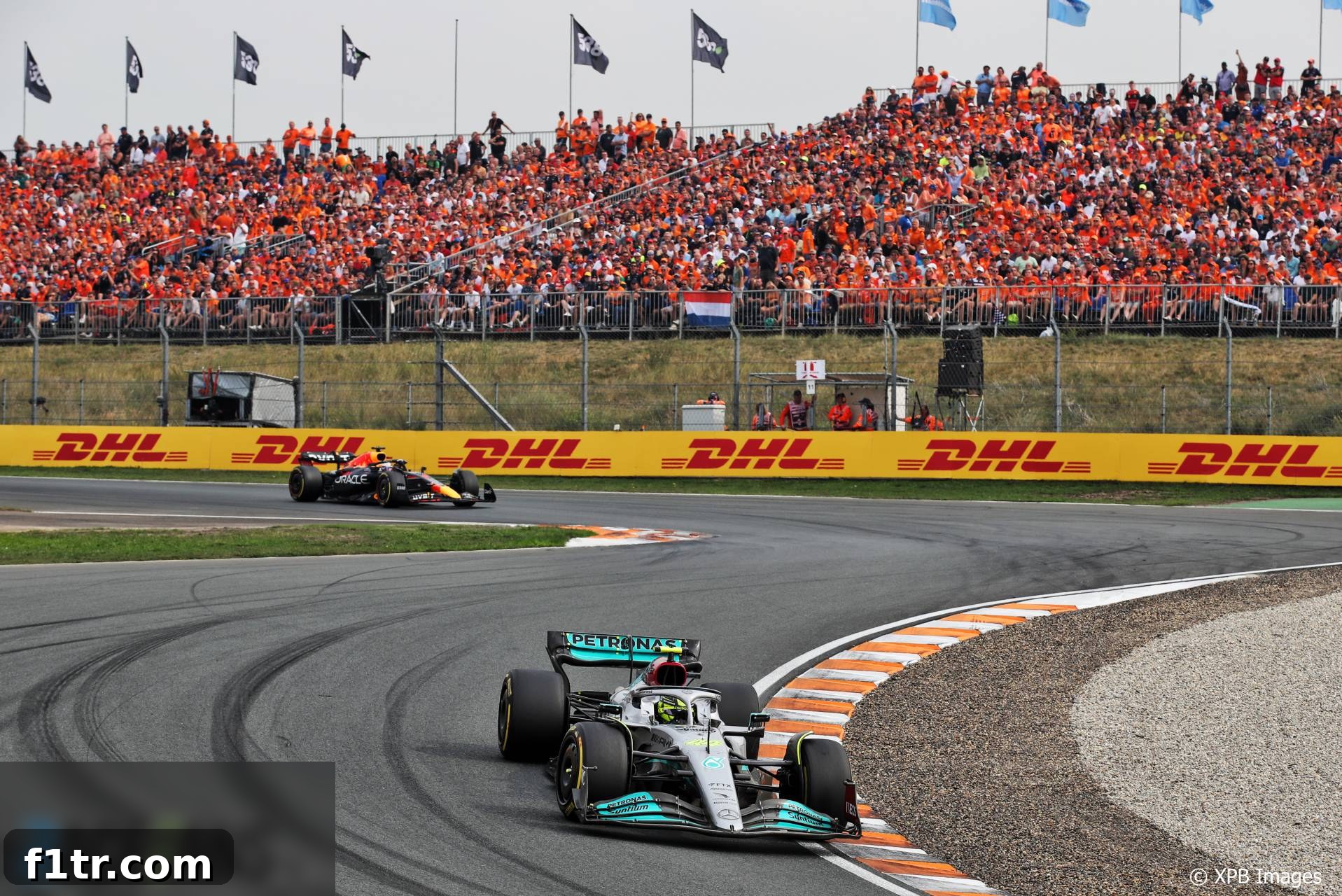
The 2022 Formula 1 season at the Dutch Grand Prix presented a tantalizing prospect for Mercedes-AMG Petronas F1 Team and their seven-time world champion, Lewis Hamilton. In a season where victories were elusive for the German outfit, strategic simulations conducted by Mercedes indicated that Hamilton had a genuine chance to clinch the win at Zandvoort, a victory that was ultimately snatched away by an untimely Virtual Safety Car (VSC) period. This incident not only reshaped the immediate outcome of the race but also sparked considerable debate regarding race fairness and the impact of seemingly innocuous events on championship narratives.
The Crucial Turning Point at Zandvoort: Mercedes’ Missed Opportunity
The Dutch Grand Prix, held at the challenging Zandvoort circuit, was shaping up to be a tactical masterclass with high stakes for all competitors. Max Verstappen, competing on home soil and enjoying a dominant season with Red Bull Racing, was leading the charge. However, Mercedes, with their improved W13 package and Hamilton’s relentless pursuit, was mounting a credible challenge. The team had meticulously planned their strategy, observing Verstappen’s tire wear and anticipating his necessary pit stops. Their calculations suggested a window of opportunity for Hamilton to move ahead.
Mercedes’ Bold Strategy and Hamilton’s Calculated Pursuit
As the race progressed, Lewis Hamilton was locked in a determined chase of Max Verstappen. Mercedes’ strategic analysts were actively running real-time simulations, projecting various scenarios based on tire degradation, pit stop timings, and track position. These simulations painted an optimistic picture for Hamilton. Verstappen, needing a final pit stop to change tires, was on course to emerge from the pits behind both Hamilton and his Mercedes teammate, George Russell, should the race proceed without any neutralizations. This would have given Hamilton clear track position, a crucial advantage on a circuit where overtaking can be challenging.
Advert | Become a Supporter & go ad-free
The Virtual Safety Car: A Game-Changer
However, the carefully constructed Mercedes strategy was dramatically derailed when a Virtual Safety Car period was triggered. The VSC allows drivers to make pit stops while losing significantly less time compared to a full-speed race lap, as all cars must reduce their pace and maintain specific delta times. For Max Verstappen, this VSC came at an opportune moment. It enabled him to make his final pit stop without sacrificing track position to Hamilton. Had the race remained green, Mercedes believed their driver was in a prime position to challenge for, and potentially secure, the victory.
Mercedes’ Strategic Simulations: A Clear Path to Victory
Mercedes team principal, Toto Wolff, later confirmed the team’s strong belief in their strategy. “The simulation says that Max would have come out eight seconds behind us with 20 laps to go,” Wolff explained, outlining the significant advantage Hamilton would have held. He continued, “But obviously he would have probably pitted on the hard at that time and I think we would have had a fair shot at the win. The race planner said the win is on – tight, but on.” This revelation underscores the confidence within the Mercedes camp that they had crafted a winning strategy, only for external factors to intervene.
The VSC effectively nullified Mercedes’ tactical advantage, allowing Verstappen to maintain his lead comfortably. Wolff’s simulations further suggested that even if Verstappen had pitted onto harder tires, the time deficit would have been too great for him to overcome Hamilton and claim victory under normal race conditions. The thought of Verstappen catching them only in the final six laps, as Wolff noted, suggests a fierce but ultimately successful defense by Hamilton, especially given his proven ability to manage tires and defend track position.
The Controversial Incident: Yuki Tsunoda’s Double Stop
The circumstances that led to the VSC were, to say the least, unusual and quickly became a focal point of discussion and speculation. Yuki Tsunoda, driving for AlphaTauri, Red Bull’s junior team, initially pulled over to the side of the track, complaining about a loose wheel following a pit stop. After a brief pause, he drove back to the pits, where his mechanics attended to the issue. Astonishingly, Tsunoda then returned to the track, only to almost immediately pull over and stop his car once again, ultimately triggering the Virtual Safety Car.
Wolff’s Scrutiny: Safety, Outcome, and Speculation
This sequence of events, particularly given Tsunoda’s affiliation with Red Bull, naturally raised eyebrows within the paddock. The incident directly benefited Max Verstappen, allowing him a “free” pit stop and cementing his position at the front. Toto Wolff was forthright in his assessment, acknowledging the gravity of the situation. “If we were to fight for a championship, that would be something that I would closely look at,” he stated, hinting at potential implications beyond a single race result.
Wolff’s concerns were not limited to the perceived strategic advantage gained by Red Bull. He also highlighted critical safety aspects of Tsunoda’s actions. “I think what needs to be investigated for the safety of drivers and everybody out there [is] the driver stopped, unbuckled, did a full lap [and] came in. The problem wasn’t solved, they put the seat belts back on and he drove out and stopped the car again.” This sequence, from unbuckling to driving a full lap with an unresolved issue and then stopping again, presented significant safety risks and raised questions about team communication and driver protocols. While Wolff concluded by saying, “That probably has changed the outcome of the race that we maybe could have won. But this word ‘maybe’ or not, it’s anyway irrelevant for me. I’m not thinking about that anymore, it’s gone,” the underlying sentiment of a lost opportunity and lingering questions remained.
Revisiting the “What If”: A Victory That Eluded Hamilton
For Mercedes, the Dutch Grand Prix represented a poignant “what if” moment in a challenging 2022 season. A victory at Zandvoort would have been immensely significant, not just for Hamilton’s personal record but for the team’s morale and momentum. Having battled reliability issues and performance struggles throughout the year, a strategic triumph based on sheer pace and astute decision-making would have validated their persistent efforts to improve the W13 car.
Advert | Become a RaceFans supporter andgo ad-free
The team’s simulations were clear: without the VSC, Hamilton was strategically positioned to win. The frustration of seeing a meticulously planned strategy undone by an external factor beyond their control is a common but bitter pill to swallow in motorsport. For Lewis Hamilton, a driver renowned for his ability to convert opportunities into victories, this particular race at Zandvoort remains a reminder of a potential win that slipped through his fingers due to circumstances that, arguably, lay outside the pure racing battle.
Broader Implications for F1 Strategy and Fair Play
The Zandvoort incident highlights the profound impact that Safety Cars and Virtual Safety Cars can have on the outcome of a Formula 1 race. While intended to ensure driver safety and clear track incidents, these neutralizations often dramatically alter the strategic landscape, sometimes to the detriment of teams that had built up a significant advantage or were executing a superior strategy. They introduce an element of unpredictability that can be thrilling for spectators but agonizing for teams whose hard work is undone by chance.
The perceived controversy surrounding Tsunoda’s incident also opens up a wider discussion about the integrity of the sport, especially when a junior team’s actions inadvertently benefit a senior team in a championship fight. While no foul play was ever officially proven or implied by the FIA, the optics and the timing of such events inevitably fuel speculation among fans and rival teams. This underscores the need for absolute transparency and rigorous investigation of any unusual occurrences to maintain faith in the fairness of competition.
Mercedes’ 2022 Season: A Fight for Redemption
For Mercedes, the 2022 season was a journey of recovery and adaptation. The W13 proved to be a challenging car, plagued by porpoising and performance inconsistencies. While the team eventually made significant strides, consistently fighting for wins remained a struggle against the dominant Red Bull and competitive Ferrari. A victory at the Dutch Grand Prix would have been a landmark achievement, a testament to their resilience and strategic acumen. It would have provided a much-needed boost in a season where they were often playing catch-up, and undoubtedly influenced the narrative around their development path.
Conclusion: A Zandvoort Race Etched in Memory
The 2022 Dutch Grand Prix will be remembered as a race of strategic might, tantalizing potential, and controversial interruptions. Mercedes’ belief that Lewis Hamilton had a clear path to victory, only for it to be thwarted by a Virtual Safety Car triggered by an unusual incident involving Yuki Tsunoda, remains a defining moment. While Toto Wolff sought to move past the “maybe,” the echoes of that lost opportunity resonated deeply within the team. It serves as a stark reminder of how fine the margins are in Formula 1, where every decision, every incident, and every strategic call can irrevocably alter the course of a race and, potentially, a championship.
2022 Dutch Grand Prix
- Ferrari’s season of missed chances led to “difficult” criticism for Binotto
- How many victory chances did Hamilton have in his first winless F1 season?
- Why F2’s role as F1’s sustainable fuel guinea pig ‘isn’t going to be a reliability issue’
- Straight-line speed deficit will continue to “bite” Mercedes in qualifying – Wolff
- Verstappen achieves his longest winning streak with second home victory
Browse all 2022 Dutch Grand Prix articles