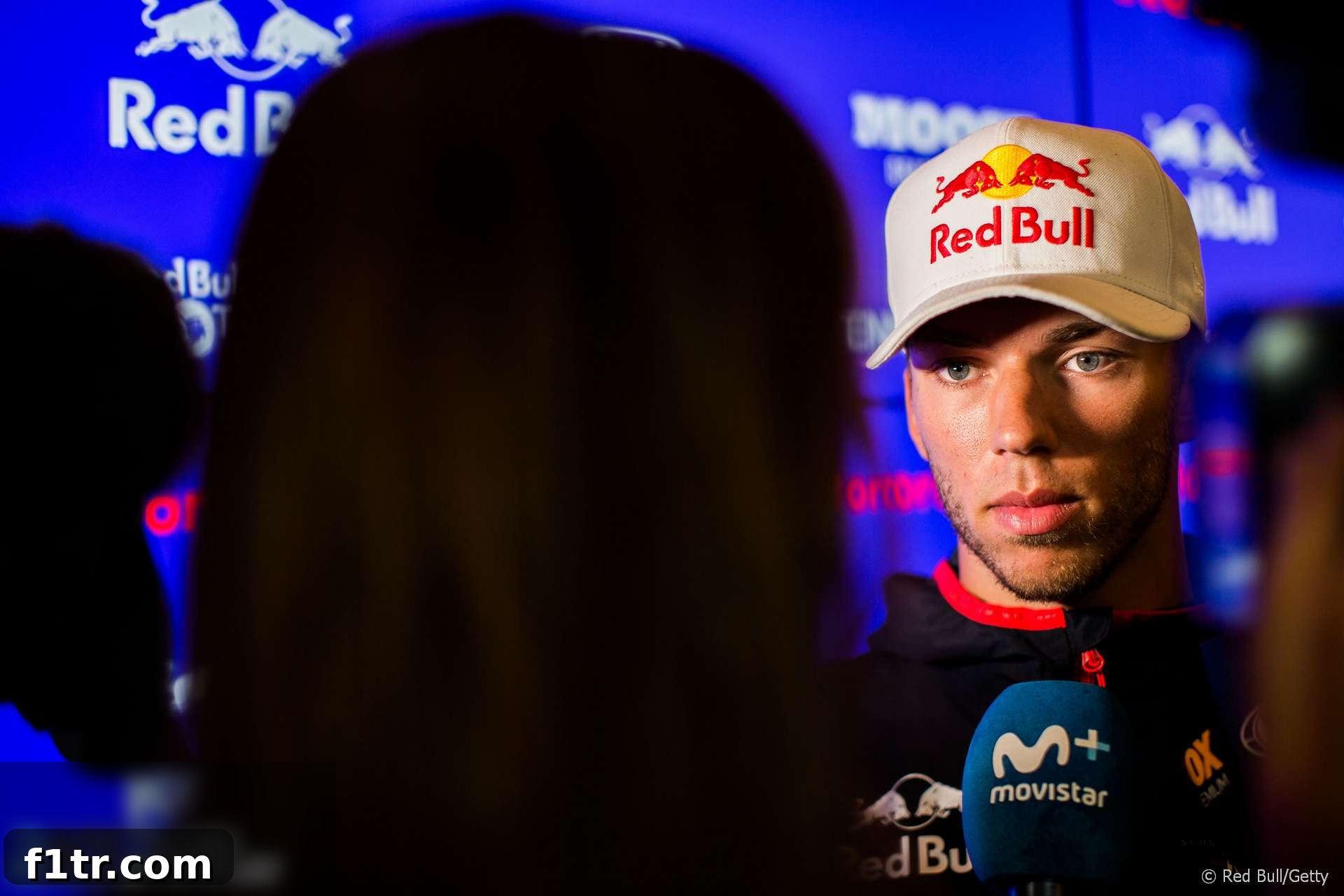
In a surprising mid-season shake-up that sent ripples through the Formula 1 paddock, Red Bull Racing made the decisive move to replace Pierre Gasly with Alexander Albon after just 12 races into Gasly’s debut season with the senior team. This bold decision, announced little over a week after the Hungarian Grand Prix, marked a pivotal moment in the 2019 F1 season and underscored Red Bull’s uncompromising approach to driver performance. Team Principal Christian Horner, initially stating intentions to keep Gasly until year-end, later offered a detailed explanation for the abrupt change, highlighting the unique pressures of racing for one of Formula 1’s top outfits and the strategic advantages afforded by Red Bull’s multi-team structure. The move sparked considerable debate and immediately placed a spotlight on young Albon, as he stepped into one of the most coveted yet challenging seats in motorsport alongside the formidable Max Verstappen.
The Intense Scrutiny and High Stakes at Red Bull Racing
Driving for Red Bull Racing is undeniably one of the most prestigious positions in Formula 1, yet it comes with an unparalleled level of scrutiny and pressure. The team, known for its aggressive pursuit of championships, demands absolute peak performance from both its drivers. Competing alongside a talent like Max Verstappen, who consistently extracts maximum potential from the car, only amplifies this pressure. For any driver, matching Verstappen’s pace and delivering consistent results is a monumental challenge. The expectation is not merely to score points, but to be a genuine contender, capable of supporting the team’s championship aspirations. This demanding environment, while fostering excellence, can also be unforgiving for those who struggle to adapt. The intricate balance of car development, race strategy, and mental fortitude required to thrive at Red Bull means that any perceived dip in performance is quickly magnified, leading to intense speculation and internal evaluation. The team’s history is peppered with examples of drivers who have risen to the occasion, and others who, despite their undeniable talent, found the pressure overwhelming. It’s a testament to the cutthroat nature of elite motorsport, where even a slight deficiency can have significant consequences for a driver’s future.
Pierre Gasly’s Arduous Journey and the Hungarian Grand Prix Turning Point
Pierre Gasly’s promotion to Red Bull Racing for the 2019 season was met with anticipation, a testament to his promising performances at Toro Rosso. However, his tenure at the senior team proved to be an uphill battle from the outset. Throughout the initial 12 races, Gasly consistently struggled to find comfort and pace in the RB15 chassis. A stark performance gap between himself and teammate Max Verstappen became a recurring theme, often leaving Gasly detached from the front-running battle and, at times, even battling in the midfield. He frequently faced difficulties in qualifying, failing to match Verstappen’s formidable one-lap speed, which then put him on the back foot for the races. His race pace, too, was often inconsistent, with Red Bull strategists reportedly finding it challenging to incorporate his performance into broader team strategies.
The mounting pressure from the media, fans, and perhaps most crucially, within the team, was palpable. Each race brought renewed questions about his future, creating a compounding effect that only intensified his struggles. Christian Horner candidly reflected on this, stating, “The situation was getting worse and worse and compounding itself.” The Hungarian Grand Prix, the final race before the summer break, proved to be the ultimate catalyst for change. It was a particularly challenging weekend for Gasly, where his performance failed to meet the team’s expectations. Despite Horner’s initial public support, suggesting Gasly would remain until the end of the year, the post-Hungary reflection led to a stark realization: the current dynamic was not beneficial for either the driver or the team. The decision to remove him was, as Horner articulated, “almost fairer for Pierre,” providing an opportunity to de-escalate the immense pressure and allow him to rebuild his confidence in a more familiar environment at Toro Rosso.
Alexander Albon: A Rapid Promotion and a Crucial Nine-Race Audition
The decision to replace Pierre Gasly with Alexander Albon underscored Red Bull’s unwavering commitment to its junior driver program and its relentless pursuit of optimal performance. Albon, a rookie in Formula 1 having only just made his debut with Toro Rosso at the start of the 2019 season, found himself catapulted into one of the most high-profile seats in motorsport. His promotion was not merely a reaction to Gasly’s struggles but also a proactive step to evaluate new talent within their extensive pool of drivers. Horner explained, “We’re in a unique position where we’ve got four cockpits in Formula 1… to give Alex the chance.” This strategic flexibility, unique to Red Bull with its two F1 teams, allowed for a direct swap, offering Gasly a chance to reset while giving Albon an invaluable opportunity.
Albon’s performances at Toro Rosso had been quietly impressive, showcasing a blend of raw speed, intelligent racecraft, and a calm demeanor. These attributes, combined with his dedicated work in the simulator, caught the eye of the Red Bull management. Horner highlighted this, noting, “With Alex we’ve seen his potential as well with the simulator running he’s been doing and so on.” The move presented a critical nine-race period for Albon, effectively an audition to prove his worth as a potential long-term partner for Max Verstappen. This evaluation would be instrumental in deciding Red Bull’s driver lineup for the 2020 F1 season, adding another layer of intrigue and pressure to Albon’s sudden promotion. His ability to adapt quickly, perform consistently, and withstand the immense scrutiny would be the ultimate test of his talent and temperament.
Seamless Transition: Albon’s Impressive Debut Performance and Car Adaptation
Alexander Albon’s immediate performance in his first outing with Red Bull Racing at the Belgian Grand Prix served as a strong vindication for the team’s decision. During the first practice session, Albon managed to place his new RB15 chassis within a mere tenth of a second of the seasoned Max Verstappen – a remarkable feat for a driver stepping into an entirely different car mid-season. Christian Horner was visibly impressed by this seamless transition, acknowledging the inherent challenges of such a move. “I think the characteristics, speaking to Alex, they’re pretty different cars,” Horner commented. “Aerodynamically, the characteristics are very different. About the only similarity is the engine but even the way we use the engines between the teams is different.”
This statement underscores the complexity of transitioning between two Formula 1 cars, even those sharing the same power unit supplier. Beyond the engine, every aspect of the car – from aerodynamics, chassis balance, steering feel, brake characteristics, to even the specific operational philosophies of each team – can vary significantly. Albon’s ability to quickly grasp these nuances and extract competitive lap times highlighted his exceptional talent and dedication. Horner praised his analytical approach, noting, “He’s a very intelligent young driver. I think using that intelligence, using the preparation he’s done in the simulator, he’s done a really good job in his first outing.” This swift adaptation was crucial, as it immediately alleviated some of the pressure on the team and offered a glimpse into Albon’s potential to truly contend at the highest level of motorsport.
Red Bull’s 2020 Driver Dilemma: Internal Talent vs. Experienced Outsiders
Looking ahead to the 2020 F1 season, Red Bull Racing faced a crucial decision regarding Max Verstappen’s teammate. Christian Horner outlined the primary strategy: “Ideally we’re going to be looking within that pool of three,” referring to Alexander Albon, Pierre Gasly, and Daniil Kvyat. This internal pool represents the culmination of Red Bull’s extensive and successful junior driver program, which has historically been their preferred source for talent. Each driver presented a compelling case: Albon, the current incumbent, had the opportunity to solidify his position; Gasly, given a chance for redemption at Toro Rosso, could potentially regain his confidence and demonstrate the form that initially earned him the Red Bull seat; and Kvyat, with his prior experience at Red Bull and a strong return to form, offered a mature and consistent option.
However, Horner did not entirely rule out the prospect of bringing in a driver from outside the Red Bull family, specifically mentioning Nico Hulkenberg. Hulkenberg, a respected and experienced driver with a long career in Formula 1, was known for his consistency and ability to deliver solid points finishes. The fact that he was potentially on the market presented an interesting external option. While Red Bull’s preference remained firmly with its own talent, the acknowledgement of Hulkenberg hinted at a pragmatic approach, where the team would consider all viable options to secure the strongest possible lineup for their championship ambitions. Ultimately, the performance of Albon, Gasly, and Kvyat in the remaining races of 2019 would be the most significant factor in Red Bull’s final decision, but the door, however slightly, was left ajar for an external veteran.
The Uncompromising Red Bull Philosophy and the Path Forward
Red Bull Racing’s history is characterized by a bold, decisive, and often ruthless approach to driver management. Their philosophy prioritizes team performance and championship aspirations above all else, making tough decisions when necessary to optimize their chances of success. The mid-season driver swap of Gasly for Albon perfectly encapsulates this ethos – a willingness to make unpopular choices for the perceived greater good of the team. It is a system designed to identify and cultivate world champions, and it demands unrelenting performance from every driver who enters its fold. The coming races of the 2019 season would serve as a crucial crucible, not only for Alexander Albon’s fledgling Red Bull career but also for Pierre Gasly’s potential rehabilitation at Toro Rosso and Daniil Kvyat’s continued push for a top-tier seat. The unfolding narrative promised high drama and intense competition, as Red Bull sought to solidify its driver lineup for a competitive assault on the 2020 Formula 1 World Championship, demonstrating once again their unwavering commitment to finding the perfect complement to their superstar driver, Max Verstappen.
Reflecting on the 2019 F1 Season and Beyond
- Crying in the Melbourne car park at 2019 grand prix was my career low – Ocon
- McLaren Racing reports reduced £71 million loss in 2019
- Kvyat: Hockenheim podium last year was “my biggest achievement” so far
- How the FIA’s new encrypted fuel flow meter targets Ferrari’s suspected ‘aliasing’ trick
- “He smashed my office door”: 23 must-see moments from ‘Drive to Survive’ season two
Browse all 2019 F1 season articles