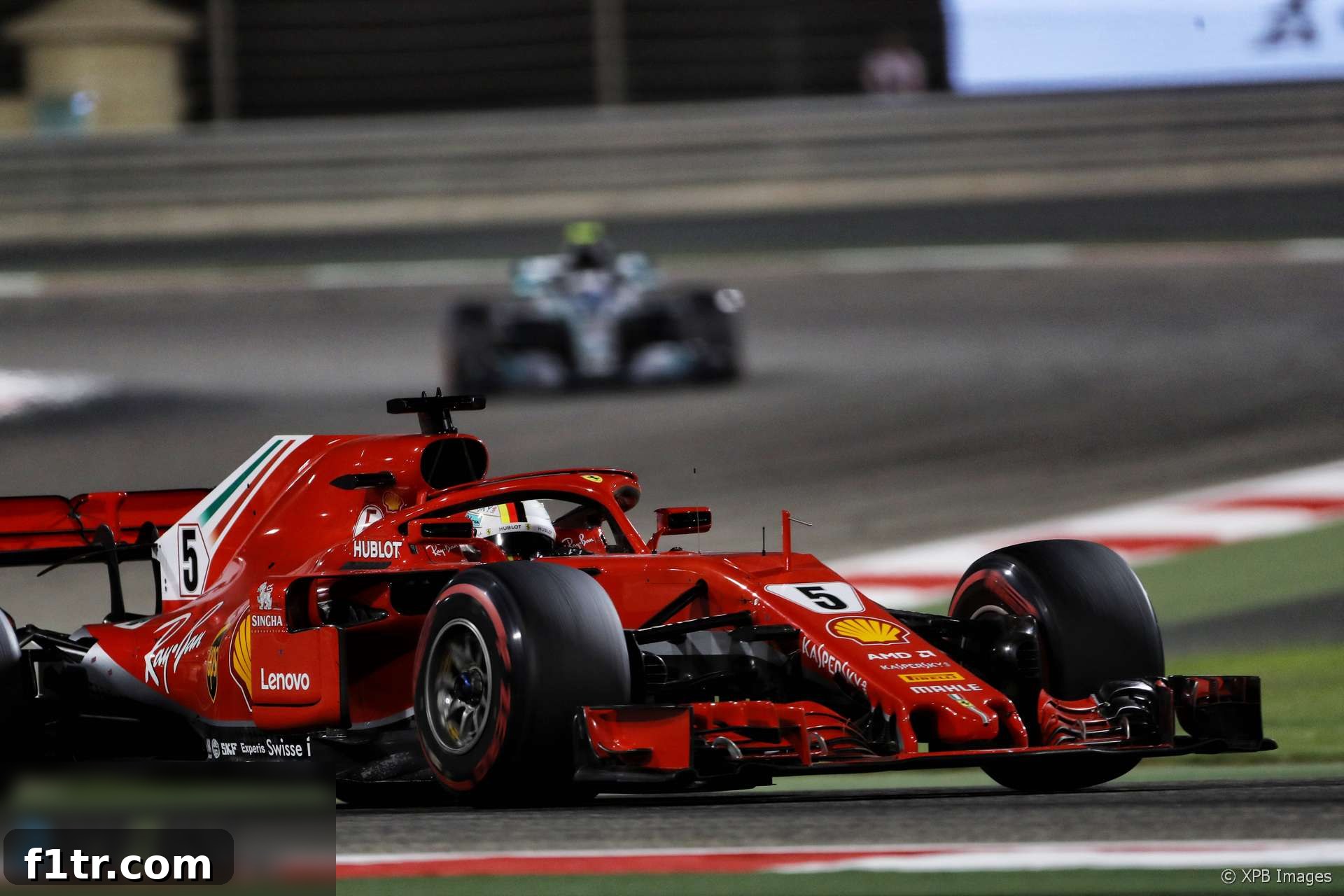
The exhilarating world of Formula 1 often boils down to split-second decisions and strategic foresight, where a single miscalculation can dramatically alter the outcome of a race. Such was the case at the 2018 Bahrain Grand Prix, a race that saw Ferrari’s Sebastian Vettel secure a nail-biting victory over Mercedes’ Valtteri Bottas, largely due to a pivotal strategic gamble. Mercedes technical director James Allison candidly admitted post-race that the Silver Arrows’ command centre was a “little bit too slow” to fully grasp and respond to the ingenious one-stop strategy deployed by Ferrari for Sebastian Vettel.
This strategic oversight proved costly. Initially, Ferrari had theoretically planned a conventional two-stop strategy for Vettel, which was considered the faster route given the track characteristics and tyre degradation. Mercedes, on the other hand, had opted for a one-stop approach for Valtteri Bottas, switching him to the more durable medium tyres after Vettel’s anticipated first pit stop. The expectation within the Mercedes camp was clear: Vettel would surely have to pit again, opening up an opportunity for Bottas to gain track position or close the gap significantly. However, Ferrari had other plans, brilliantly executing a high-risk, high-reward move that redefined the race.
The Pivotal Strategic Shift: Ferrari’s Audacity
The Bahrain Grand Prix is notorious for its abrasive track surface and high ambient temperatures, making tyre management a critical factor. For many, a two-stop strategy was the safer, more conservative choice, allowing drivers to push harder on fresher rubber. However, as the race unfolded, Ferrari, observing Vettel’s exceptional tyre preservation skills and the SF71H’s gentle nature on its tyres, made the audacious call to stretch his soft compound tyres for an unexpectedly long final stint. This decision was a testament to both Ferrari’s confidence in their car’s performance and Vettel’s supreme ability to manage tyre degradation.
Allison openly acknowledged the delay in Mercedes’ recognition of this daring play. “We were probably a little bit too slow to recognise the threat that Sebastian was actually going to take those soft tyres all the way to the flag,” he confessed. This admission highlights the immense pressure and rapid decision-making required in the heat of an F1 race. The expectation of another pit stop for Vettel lingered in the Mercedes pit wall, causing them to miss the critical window to adjust their own strategy or exert maximum pressure on the Ferrari driver.
Consequences of the Delayed Reaction
Had Mercedes reacted more swiftly, the race narrative could have been entirely different. Allison speculated on the potential outcome, stating, “Had we been slightly quicker to react to it, we probably would have kept more pressure on him in the laps 35 to 45 and we might have had a better outcome as a result.” This period was crucial, as Vettel was painstakingly nursing his tyres while Bottas was pushing hard, slowly but surely chipping away at the lead. A more aggressive stance from Mercedes, perhaps by informing Bottas earlier or adjusting his pace, could have destabilized Vettel’s rhythm and pushed his tyres beyond their breaking point.
The technical director praised Vettel’s masterful tyre management, acknowledging, “We expected him to stop again but he did very well in nursing those tyres all the way to the flag.” This comment not only underlines the effectiveness of Ferrari’s strategy but also the skill of the driver in executing such a demanding plan. It was a race that showcased the nuanced interplay between driver talent, car performance, and strategic brilliance.
Mercedes’ Tyre Advantage and Unexplored Potential
Interestingly, Allison also hinted that Mercedes’ own W09 chassis possessed the capability to replicate such a daring one-stop strategy. He pointed out a significant strength of the Mercedes package in 2018: its exceptional tyre wear characteristics. “The tyre wear of our car this year has been very good and in general better than the field,” Allison remarked. This assertion suggests that Mercedes might have had an untapped strategic advantage they didn’t fully exploit in Bahrain.
When asked if Mercedes could have made the soft tyres last for a similar number of laps as Vettel, Allison’s response was optimistic yet cautious. “Whether specifically we could have made the soft tyres last the number of laps Sebastian did we would only know by trying,” he stated, adding, “My guess is we would because our car is looking after its tyres very well in the races this year.” This reflects a potential “what if” scenario that must have haunted the Mercedes strategists after the race. The W09’s ability to manage its tyres effectively, even on aggressive compounds, was a known strength, and not leveraging it to counter Ferrari’s gambit became a significant learning point.
The Art of Tyre Management in Modern F1
The 2018 Bahrain Grand Prix served as a stark reminder of the paramount importance of tyre management in contemporary Formula 1. With Pirelli’s sensitive compounds, the difference between victory and defeat often hinges on a driver’s ability to extract performance while preserving tyre integrity. Vettel’s performance was a clinic in this art, demonstrating how a skilled driver can transform a seemingly risky strategy into a race-winning advantage. For teams, it emphasizes the need for real-time data analysis, accurate degradation models, and decisive strategic calls that can adapt to evolving race conditions.
Mercedes’ momentary lapse in judgment in Bahrain was a crucial lesson, underscoring the dynamic and unpredictable nature of F1 strategy. It highlighted the fine line between calculated risk and missed opportunity, a line that Ferrari navigated with precision on that particular Sunday. While Mercedes eventually went on to secure both titles in 2018, this race remained a vivid example of the strategic battles that defined the intense rivalry between the two titans of Formula 1.
Exploring the 2018 F1 Season Further
The 2018 Formula 1 season was a thrilling championship battle, marked by fierce competition, strategic gambles, and memorable performances. To delve deeper into the captivating narratives and key events that shaped this remarkable season, explore the related articles below:
- F1 feared “death knell” for Drive to Survive after Ferrari and Mercedes snub
- McLaren staff told us we were “totally crazy” to take Honda engines in 2018 – Tost
- ‘It doesn’t matter if we start last’: How Red Bull’s junior team aided Honda’s leap forward
- Honda’s jet division helped F1 engineers solve power unit problem
- McLaren Racing losses rise after Honda split
Browse all 2018 F1 season articles