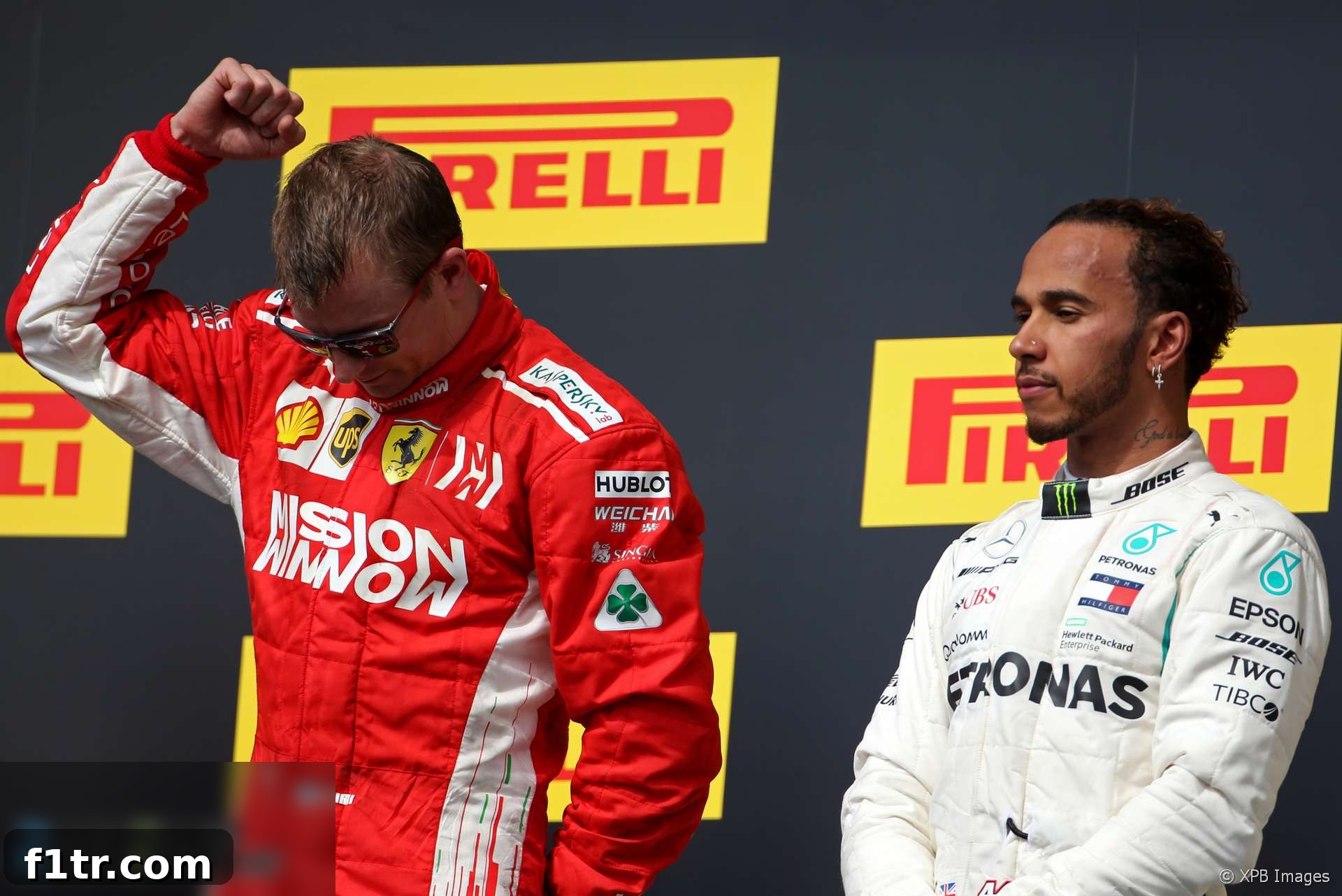
The Circuit of the Americas was buzzing with anticipation as Lewis Hamilton arrived, poised for a monumental weekend. Not only was he chasing his fifth consecutive victory in the United States Grand Prix and a remarkable fifth win in a row for the season, but more significantly, he stood on the brink of securing his fifth Formula 1 World Championship title. The stakes couldn’t have been higher, and the narrative seemed perfectly set for a historic coronation in Austin, Texas.
Advert | Become a Supporter & go ad-free
Yet, the script of destiny had an unexpected twist. Ferrari, Hamilton’s primary championship rival, engineered a remarkable turnaround in performance by taking an unconventional step: they removed nearly four months’ worth of car updates. This bold decision, later revealed by Sebastian Vettel, transformed the SF71H’s competitiveness, providing a crucial speed injection that the Scuderia desperately needed. This newfound pace should have empowered Vettel to launch a formidable counter-attack against Hamilton’s title charge. Instead, through a series of familiar missteps, he once again allowed his championship rival a reprieve, paving the way for a different Ferrari driver to seize the spotlight.
The true beneficiary of Ferrari’s rediscovered form was Vettel’s teammate, Kimi Raikkonen. The stoic Finn, known for his calm demeanor, embraced the opportunity with relish, claiming his first Grand Prix victory in a staggering five-and-a-half years. It was a win that was not only personally significant but also served as a stark reminder of Ferrari’s potential when their machinery performs at its peak, even if achieved through an unorthodox development strategy.
Vettel’s Costly Grid Penalty: A Self-Inflicted Wound
The build-up to the United States Grand Prix qualifying session had hinted at a familiar front row lineup, mirroring the previous year with Hamilton on pole and Vettel alongside. However, a critical error during practice dramatically altered the grid. Sebastian Vettel incurred a three-place grid penalty for failing to slow sufficiently under a red flag infringement, relegating him from a potential front-row start to an unenviable fifth position. This penalty was a significant blow to his championship aspirations, forcing him to start behind not only Hamilton but also his teammate Raikkonen.
Following the decision, Vettel was quick to voice his displeasure, attempting to portray himself as the victim of an overly zealous stewards’ ruling. He argued that the conditions were not clear, and his reaction time was affected. However, the facts presented a different picture. The grid penalty he received was entirely consistent with precedents set for identical infractions by other drivers in previous seasons. In fact, it could be argued that the stewards’ decision was rather lenient, given that the FIA’s own guidelines recommend a more stringent five-place penalty for such a safety breach.
During the incident, a total of 14 drivers were on track when the red flag was deployed. All 13 other competitors, without exception, responded appropriately and reduced their speed as mandated by the regulations. This group included test drivers such as Lando Norris and Sean Gelael, both of whom possessed considerably less experience at this elite level of competition compared to Vettel. If these less experienced drivers could adhere to the safety protocols, there was simply no justifiable excuse for a four-time world champion to take nearly half a minute to adequately reduce his speed.
This incident at COTA was not an isolated event but rather another chapter in a concerning litany of errors committed by Sebastian Vettel and, by extension, Ferrari throughout the season. These recurring mistakes have proven to be at least as detrimental to their championship campaign as any recent deficit in car performance. Unfortunately for Vettel, this would not be the last error he would make during what proved to be a challenging weekend.
Advert | Become a RaceFans supporter andgo ad-free
Vettel’s Race Day Blunder: A Repeat Offender
As the lights went out for the start of the United States Grand Prix, Kimi Raikkonen executed a masterclass, echoing Sebastian Vettel’s own brilliant start from twelve months prior. The Finn launched his Ferrari off the line with exceptional traction, dive-bombing past Lewis Hamilton into the first corner to snatch the lead. Ferrari had deliberately split their tyre strategies between their two drivers – the penalized Vettel and the unpenalized Raikkonen – and Raikkonen’s softer compound tyres proved highly effective in the opening phase of the race.
Further back in the pack, Sebastian Vettel was initially making amends for his qualifying indiscretion. He swiftly edged past Daniel Ricciardo, securing fourth position and showing promising early pace. However, this recovery proved to be short-lived. Just moments later, as he approached Turn 12, Vettel locked up his brakes and ran wide, conceding the position back to Ricciardo. The Red Bull driver, sensing an opportunity, immediately re-engaged in the battle.
As the pair rounded the subsequent corner, Ricciardo drew alongside Vettel on the outside. In a desperate attempt to defend his position, Vettel squeezed the Red Bull, resulting in wheel-to-wheel contact. Predictably, and tragically for his race, Vettel’s Ferrari spun – a recurring theme that had plagued his season. This incident marked the third significant clash of the year for Vettel, and the third time he had spun despite holding the inside line against a different rival. This pattern highlighted a concerning vulnerability in high-pressure wheel-to-wheel scenarios.
Reflecting on the collision, Vettel explained: “I think initially he had a bad exit out of 12 but then I came back. I had the inside but I guess he didn’t see me so we went side-by-side. Then it was quite clear he tried to go around the outside and we touched pretty much wheels-on. After the touch I lost the car and spun.” Despite his explanation, the optics were not favourable for the German driver, whose championship challenge was already faltering due to such incidents.
Once again, Vettel was forced to embark on a recovery drive from the back of the field. The midfield drivers had become all too accustomed to seeing the number five Ferrari looming large in their mirrors during the opening laps of a race. Remarkably, by lap 12, Vettel had battled his way back up to fifth place. This recovery, while impressive, was overshadowed by the astonishing drive of Max Verstappen, who, starting from 18th on the grid, had already reached fifth place by the seventh lap and was clearly on his way to an excellent, unexpected result, further highlighting the opportunities Vettel had squandered.
Advert | Become a RaceFans supporter andgo ad-free
Mercedes’ VSC Gamble Backfires Spectaularly
In the initial laps of the race, Lewis Hamilton strategically kept Kimi Raikkonen within striking distance, hoping that the Ferrari driver’s softer compound tyres, which offered initial pace but often suffered from higher degradation, would fade quickly. Adding to the strategic complexity, Sunday’s track temperatures were significantly hotter than Saturday’s, and with no meaningful dry running on Friday due to adverse weather, teams were largely in the dark regarding the true performance and longevity of their tyres. Further complicating matters, a pre-race instruction from Pirelli mandated teams to increase their rear tyre pressures by 1.5 psi, a change that could significantly impact tyre behaviour and wear.
On lap nine, the race saw a pivotal moment when Daniel Ricciardo’s Red Bull suffered a total power unit shutdown, a frustratingly familiar issue reminiscent of his retirement in Bahrain. This incident triggered the deployment of the Virtual Safety Car (VSC), a period during which cars must maintain a regulated delta time to the safety car. Mercedes, ever alert to strategic opportunities, immediately spied a chance to gain an advantage.
Hamilton was promptly instructed by his race engineer to do the “opposite” of Raikkonen at pit entry. As Raikkonen continued his stint, Hamilton duly dove into the pits. He swapped his super-soft tyres for a fresh set of softs, rejoining the track in third position behind his teammate Valtteri Bottas, with Raikkonen just eight seconds ahead. This seemed, at the time, a tactical masterstroke. The expectation was that Bottas would not hold up Hamilton, allowing him to quickly chase down Raikkonen with fresher, more durable tyres. However, instead of conservatively managing his new tyres to the end of the race, Hamilton pressed on aggressively in pursuit of Raikkonen. This aggressive approach raised questions: were Mercedes actually planning an audacious two-stop strategy?
By lap 19, Hamilton was right on the tail of the Ferrari, applying immense pressure. However, he remained understandably circumspect, unwilling to engage in a risky physical battle with his championship rival’s teammate. Raikkonen, demonstrating his veteran experience, defended impeccably and cleanly, refusing to yield easily. “For sure my purpose is not to be any more aggressive against him than anybody else,” Raikkonen stated post-race. “I don’t believe in doing crazy things.”
Being bottled up behind Raikkonen for an extended period was detrimental to Hamilton’s tyre life, yet his options were limited. On lap 21, Raikkonen finally conceded and headed for the pits. “At a certain point the tyres are going to fall off and there is not a lot you can do,” he explained. “We had a pretty good battle. I tried to stay as far as I could.” Soon after Raikkonen’s stop, Hamilton’s tyres began to show severe signs of degradation. The blistering on his rear tyres became visibly apparent, and to compound his woes, he soon encountered traffic, which further exacerbated the tyre wear. As Raikkonen, on fresher tyres, began to swiftly close the gap, Mercedes bowed to the inevitable and pitted Hamilton for a second time, effectively ending his hopes of a straightforward victory and revealing their VSC gamble had ultimately failed.
A Thrilling Three-Way Battle for Victory
Raikkonen
Hamilton’s second pit stop dropped him behind not only Kimi Raikkonen but also Max Verstappen, who had executed a brilliant recovery drive from 18th on the grid. Verstappen had managed to jump Valtteri Bottas during the pit sequences, partly aided by the time Bottas lost allowing his teammate Hamilton through. This reshuffling set the stage for an incredibly tense and dramatic finish to the United States Grand Prix. Verstappen, on faster super-soft tyres, steadily began to close in on Raikkonen, while Hamilton, on his freshest set of tyres, was rapidly gaining on both of them, creating a captivating three-way battle for the lead.
With Sebastian Vettel only managing to climb as high as fifth position, the championship mathematics were clear: if Lewis Hamilton could dislodge Max Verstappen from second place, he would clinch his fifth world championship title right there in Austin. The tension was palpable as the final laps unfolded. With just two laps remaining, Hamilton made his decisive move. He strategically positioned his Mercedes, drawing Verstappen off-line, and then audaciously dived for the outside through the fast, sweeping Turns 16, 17, and 18. Verstappen, known for his aggressive defense, initially allowed his rival some room. However, Hamilton carried too much momentum for the available grip on the outside of the corner, pushing his car beyond its limits, and inevitably took to the run-off area.
This critical error extinguished Hamilton’s immediate hopes of securing the championship. His title celebrations were put on hold for at least another week, allowing Kimi Raikkonen’s hard-fought triumph to be assured. Adding to the drama, Verstappen lost a crucial second to Raikkonen during Hamilton’s failed overtake attempt, solidifying the Finn’s lead. On the penultimate lap, Sebastian Vettel managed to overtake Valtteri Bottas for fourth place, meaning that even if Hamilton had successfully taken second, the championship wouldn’t have been decided at COTA, as Vettel would have maintained enough of a points gap.
Reflecting on the race afterward, Hamilton expressed his belief that he could have won had Mercedes committed to a one-stop strategy. However, he acknowledged that losing the lead to Raikkonen at the very start of the race had significantly compromised his entire plan. “Pace-wise, I think we were very, very close,” Hamilton stated. “But the whole deficit, they kept putting me so far behind, I could have told you exactly what was going to happen once we had those big gaps that we had to catch.” Mercedes team principal Toto Wolff candidly admitted that they “underestimated how easy or how fast he could overtake.” Despite the excitement of Verstappen and Vettel’s recovery drives, it was notably one of the races with fewer overtakes elsewhere in the field, making the battles at the front even more significant.
Midfield Battles and Post-Race Disqualifications
The midfield battle at the United States Grand Prix provided its own share of drama and controversy. Excellent starts by both Renault drivers put them in a strong position, initially on course to secure a coveted ‘best of the rest’ one-two finish. Such a result would have significantly bolstered their chances of maintaining their hard-fought fourth position in the constructors’ championship. Their prospects were further enhanced by unforeseen post-race disqualifications affecting one car from each of their principal rivals, both due to violations related to fuel usage.
Esteban Ocon’s Force India and Kevin Magnussen’s Haas were both thrown out of the official results after the race. Magnussen’s car was found to have exceeded its maximum allocation of 105kg of fuel, a critical breach of regulations. The Haas team had even urgently warned Magnussen about his “critical” fuel situation in the closing laps, indicating their awareness of the impending issue. These disqualifications dramatically reshuffled the points-paying positions: Sergio Perez was promoted to eighth, while Brendon Hartley and Marcus Ericsson gratefully moved into the final two points-scoring positions, benefiting immensely from their rivals’ technical infringements.
Meanwhile, for Fernando Alonso, who wouldn’t be racing as extensively in America the following year as initially speculated, the race proved to be another frustratingly short affair. The two-time world champion managed only a single lap before being punted out of the race by Lance Stroll. Alonso, who had become increasingly vocal in his criticisms of Formula 1, made no exception this time, launching into a scathing assessment of the driving quality after yet another first-lap exit. His comments, though perhaps becoming somewhat predictable in their frequency, were difficult to disagree with.
Lance Stroll’s move on the McLaren was unequivocally a “zero-percent” chance maneuver, an over-optimistic dive that the stewards rightly penalized with a drive-through penalty. Stroll, however, struggled to accept his share of the blame, offering a somewhat defensive assessment: “I had a portion of my car there and I don’t think he saw me,” a sentiment that did little to appease a frustrated Alonso or the race stewards.
Hamilton Set for Inevitable Coronation
In the aftermath of the United States Grand Prix, Sebastian Vettel reflected on Ferrari’s surprising step forward. He acknowledged that while the car’s improved performance was a positive sign, the very fact that this leap came from *downgrading* their car’s specification, by removing recent updates, was a stark indicator that their development program had gone seriously awry throughout the season. This admission highlighted a fundamental misdirection in Ferrari’s technical direction, costing them crucial performance gains when it mattered most. However, Vettel’s own string of errors, particularly in recent races, had undoubtedly compounded these underlying technical problems, widening the gap to Hamilton.
Speaking about his frustrating first-lap error and the season’s difficulties, Vettel candidly remarked: “For sure once shit hit the fan it didn’t get better. I think there were too many of those incidents.” He further added, trying to contextualize the run of misfortune: “I don’t believe in luck or bad luck but surely here and there maybe things didn’t go our way entirely. But it’s how it is.” This sentiment captured the essence of a season filled with missed opportunities and self-inflicted wounds for the German driver.
While Vettel’s championship challenge continued to unravel with another slip-up, Kimi Raikkonen proved to be a formidable and deserving foe for Hamilton in Austin, delivering a masterclass performance to secure his long-awaited victory. His composure and pace were a testament to Ferrari’s potential, even if their strategy was unorthodox. However, despite Raikkonen’s triumphant return to the top step of the podium and Vettel’s best efforts to recover, it was clear that neither driver, nor Ferrari as a whole, would likely be able to stop Lewis Hamilton’s inevitable coronation at the very next round of the championship. The momentum, the consistency, and the sheer brilliance of Hamilton throughout the season had created an insurmountable lead, making his fifth world title a question of ‘when,’ not ‘if.’
Go ad-free for just £1 per month>> Find out more and sign up
Quotes: Dieter Rencken
2018 United States Grand Prix Insights
- Verstappen leaving rivals breathless in Mexican altitude
- Raikkonen ends longest-ever wait between wins
- 300 team radio messages from the United States Grand Prix
- 2018 United States Grand Prix Star Performers
- Top ten pictures from the 2018 United States GP
Browse all 2018 United States Grand Prix articles
Latest F1 Race Reviews
- Antonelli lucks in for second win and becomes youngest F1 championship leader
- Emotional Antonelli grabs first Formula 1 victory in Chinese Grand Prix
- Russell sees off Ferrari threat to lead Mercedes one-two in Melbourne
- Norris clinches F1 title by two points as Verstappen wins finale at Yas Marina
- McLaren strategy blunder in Losail hands Verstappen crucial win and shot at title
Read all F1 race reviews