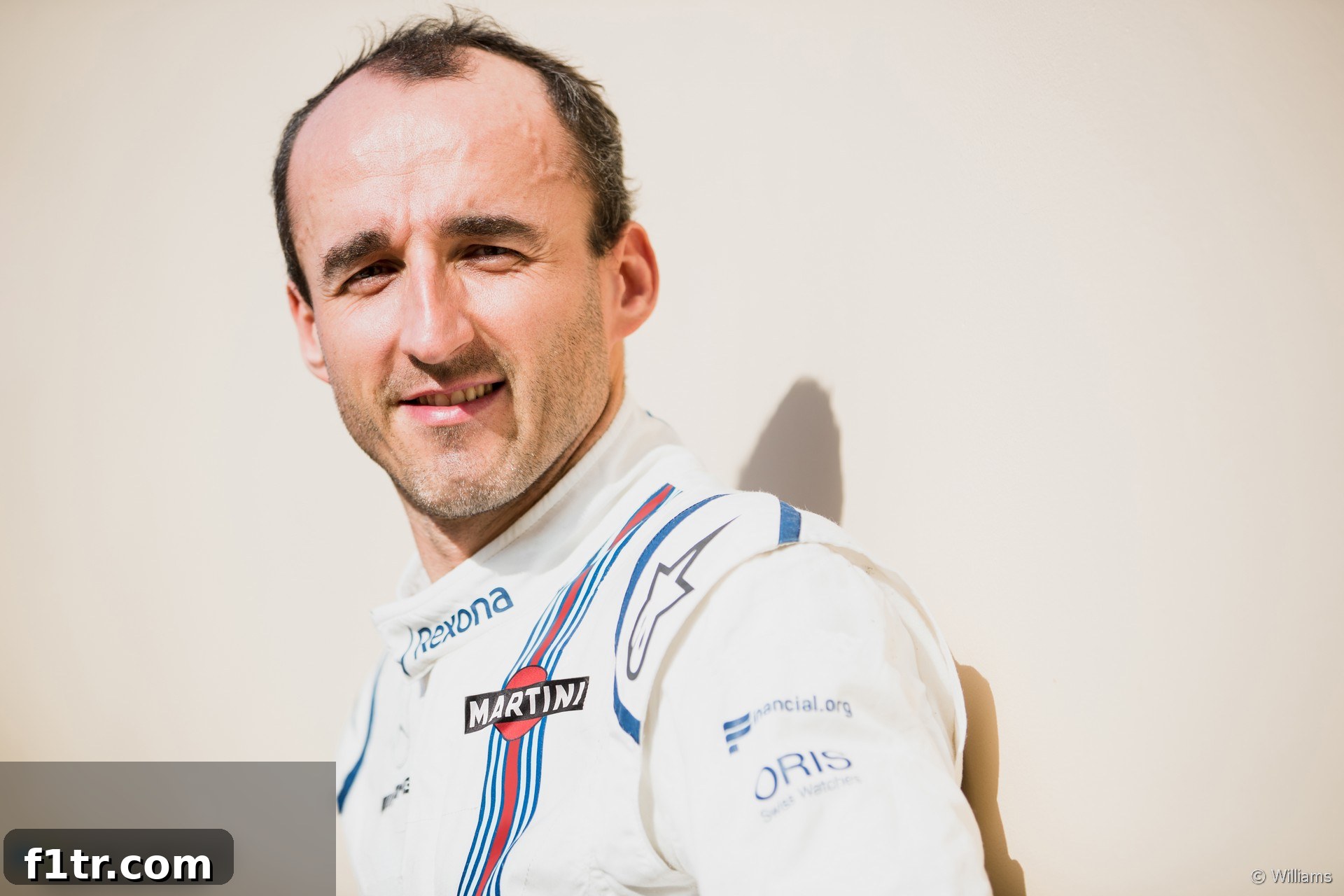
Robert Kubica’s Remarkable Comeback: A New Chapter with Williams F1 in 2018
The world of Formula 1 has always been captivated by stories of resilience and raw talent, and few embody this spirit more profoundly than Robert Kubica. After years of relentless dedication following a life-altering rally crash, Kubica officially re-entered the Formula 1 paddock in a significant capacity, securing a crucial role as reserve and development driver for Williams in the 2018 season. This appointment was not merely a job offer; it was a testament to his unwavering determination and an inspiration to motorsport fans globally, marking a pivotal step in what many hoped would culminate in a full-time return to the pinnacle of motor racing.
For Kubica, who turned 33 that year, the announcement was met with profound satisfaction. “I am extremely happy to have earned a place as reserve and development driver at Williams for 2018,” he stated, reflecting on the arduous path he had travelled. His journey back to F1 has been one of the most compelling narratives in recent sporting history, battling against severe injuries sustained in a 2011 rally incident that prematurely halted a promising Grand Prix career. Yet, his resolve never wavered, and his focus remained singular: to return to the grid.
The Long Road to Recovery: A Testament to Human Spirit
Robert Kubica’s career before his accident was nothing short of brilliant. Debuting with BMW Sauber in 2006, he quickly established himself as a future star, known for his aggressive driving style, precise technical feedback, and immense natural speed. He secured his first Grand Prix victory at the 2008 Canadian Grand Prix, a defining moment that showcased his capabilities and hinted at a championship-contending future. His move to Renault in 2010 further cemented his reputation as a top-tier driver, consistently outperforming his machinery and delivering memorable performances. Had fate not intervened, many pundits believed Kubica would have been a multiple race winner, potentially even a world champion.
However, tragedy struck in February 2011 during a minor rally in Italy. A high-speed crash left Kubica with severe injuries to his right arm and hand, requiring multiple surgeries and an extensive, gruelling rehabilitation period. The immediate aftermath saw his Formula 1 career come to an abrupt halt, with doctors initially unsure if he would ever regain full mobility, let alone race again at an elite level. What followed was a multi-year odyssey of painful recovery, relentless physical therapy, and an unshakeable belief that he could defy medical expectations. His ability to endure and overcome such a catastrophic setback transformed him into a symbol of incredible human resilience.
Through the years of his recovery, Kubica remained connected to motorsport, participating in various disciplines from rallying to endurance racing, constantly testing the limits of his physical capabilities and proving that his racing instinct was as sharp as ever. These endeavours were not mere hobbies; they were crucial steps in his bid to regain the necessary fitness and confidence to once again handle the immense demands of a Formula 1 car.
The 2018 Williams Role: More Than Just a Stepping Stone
Kubica’s appointment at Williams was the culmination of significant effort, including extensive testing with both Renault and Williams in the preceding years. These tests were critical, not only for him to re-acclimatize to modern F1 machinery but also for teams to assess his physical capacity and the quality of his feedback. His performance in the FW36 and FW40, two previous Williams chassis, evidently impressed the team, leading to this significant opportunity.
As reserve and development driver, Kubica’s responsibilities were multi-faceted and crucial for Williams’ 2018 campaign. His role involved extensive work in the factory simulator, translating valuable data into real-world performance improvements. He would also participate in official test sessions and potentially some free practice sessions during Grand Prix weekends, providing direct feedback on the car’s performance and handling characteristics. His vast experience from his prime F1 years meant he possessed an unparalleled understanding of car setup, tyre management, and race strategy – knowledge that would be invaluable to the engineering team and the race drivers.
Williams themselves confirmed the gravity of his role, stating that Kubica would “be available to stand in as the race driver if required.” This underlined the genuine belief in his ability to perform under pressure, a testament to the comprehensive evaluation he had undergone. For a team striving to climb the constructors’ championship ladder, having a driver of Kubica’s calibre and experience readily available was a significant asset.
Kubica himself articulated his enthusiasm for the challenge ahead, highlighting his renewed physical condition: “I feel in the best physical shape that I have ever been, but it has taken a lot of work to get to where I am now, so I’d like to thank Williams for the opportunities they have given me so far, and for putting their faith in me with this appointment.” This statement was not just a platitude; it was a powerful declaration of his commitment and the fruits of years of arduous effort.
He continued, expressing his eagerness to contribute directly to the team’s performance: “I have enjoyed being back in the Formula One paddock over these past few months, and I now look forward to working with the Williams technical team, both at the factory and at the track, to really help push forward the development of the FW41 and to make a real difference to their 2018 campaign.” His focus was clear: to leverage his expertise to refine the FW41, Williams’ new contender for the 2018 season, and help maximise its potential on track.
Having experienced previous iterations of Williams’ cars, Kubica was uniquely positioned to understand the team’s engineering philosophy and identify areas for improvement. “Having driven both the FW36 and the FW40, I’m looking forward to seeing how the FW41 measures up on track and working with the team to ensure we can maximise the performance of the car,” he added. This hands-on approach and technical insight were precisely what Williams needed to gain a competitive edge.
The Ultimate Goal: A Full-Time F1 Return
While the reserve and development driver role was a monumental achievement in itself, Robert Kubica made it unequivocally clear that his ambition extended beyond it. His ultimate objective remained a full-time return to Formula 1 racing. “My ultimate goal remains to race again in Formula One and this is another important step in that direction. I cannot wait to get started,” he declared. This steadfast determination captivated fans and experts alike, transforming his journey into one of the most compelling narratives in contemporary motorsport.
His last competitive F1 start was a distant memory, the 2010 Abu Dhabi Grand Prix. The prospect of seeing him line up on the grid once more, after such a long and challenging absence, resonated deeply with anyone who appreciates perseverance against overwhelming odds. The 2018 season, therefore, was not just about aiding Williams; it was about Kubica meticulously preparing himself for that potential comeback, demonstrating to the F1 world that his speed, precision, and fighting spirit were still intact.
Kubica’s story served as a powerful reminder of the human capacity for recovery and aspiration. His presence in the paddock, his technical contributions, and his unwavering pursuit of a full-time seat provided an inspiring backdrop to the 2018 Formula 1 season. For many, his journey was a beacon of hope, proving that with enough dedication and belief, even the most formidable obstacles can be overcome.
The F1 community watched with bated breath, hoping that this significant step with Williams would indeed lead to the fulfilment of Robert Kubica’s ultimate dream: to once again compete at the highest level of motorsport. His remarkable return to the F1 environment, first in a testing capacity and then in this crucial development role, paved the way for a future that once seemed impossible, solidifying his legacy as one of the sport’s most courageous and inspirational figures.
2018 F1 season
- F1 feared “death knell” for Drive to Survive after Ferrari and Mercedes snub
- McLaren staff told us we were “totally crazy” to take Honda engines in 2018 – Tost
- ‘It doesn’t matter if we start last’: How Red Bull’s junior team aided Honda’s leap forward
- Honda’s jet division helped F1 engineers solve power unit problem
- McLaren Racing losses rise after Honda split
Browse all 2018 F1 season articles