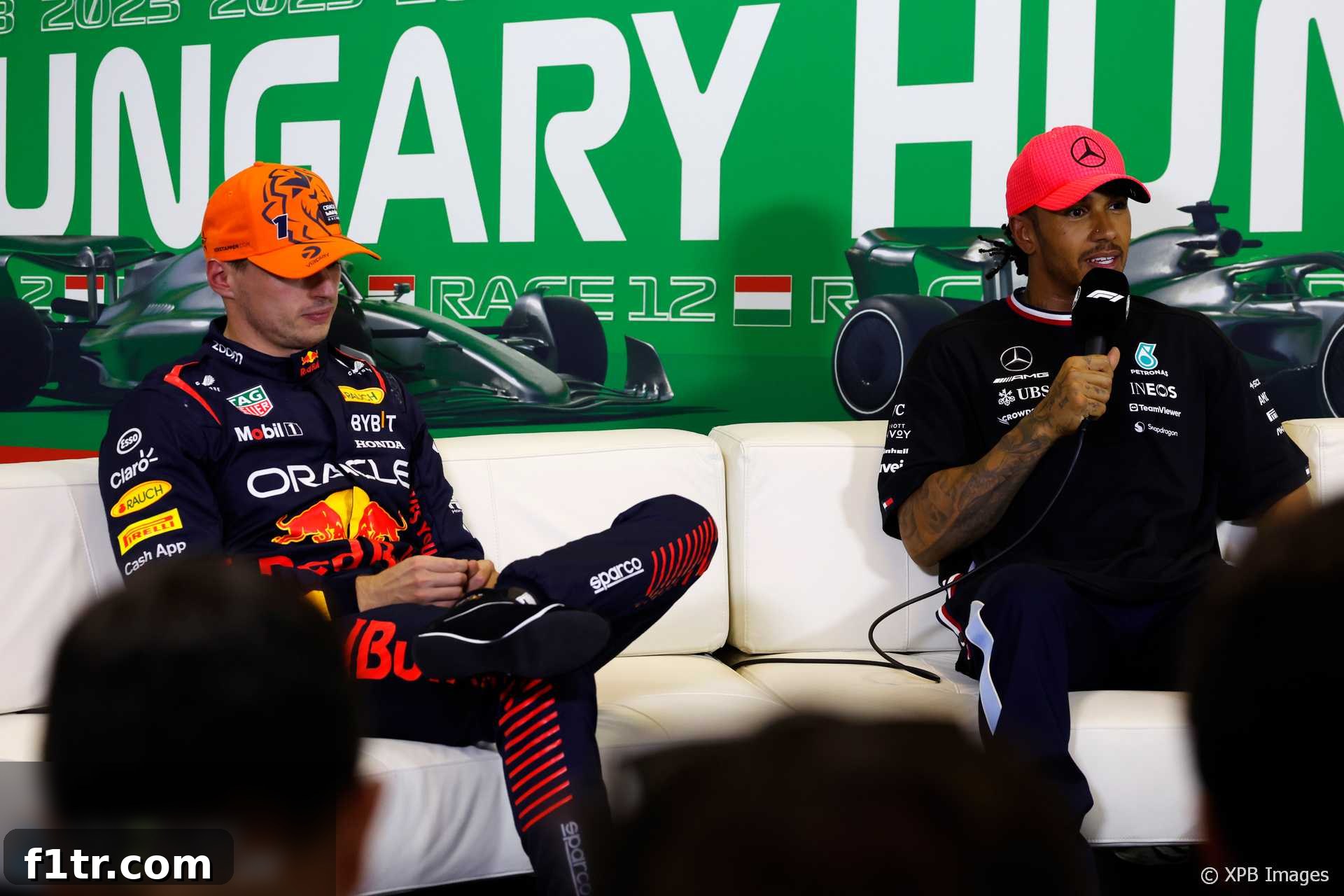
Lewis Hamilton, the seven-time Formula 1 world champion, expressed a critical strategy for the Hungarian Grand Prix: he must “hold position” over championship leader Max Verstappen from the very start to stand any realistic chance of securing a victory. This declaration underscores the high stakes and the immense challenge facing Mercedes in their quest to return to the pinnacle of motorsport.
Advert | Become a Supporter & go ad-free
Hamilton’s pole position at the Hungaroring was a momentous achievement, snatched by an incredibly narrow margin of just three thousandths of a second from Verstappen. While Mercedes-AMG Petronas has often demonstrated superior race pace compared to their qualifying performance throughout the current season, the formidable showing by Verstappen during Friday practice sessions left Hamilton under no illusions about the uphill battle ahead. The Red Bull driver’s consistent speed hinted at a significant advantage, making the task of keeping them behind a daunting one on race day.
“Normally, it’s not a bad race car; we tend to have decent race pace,” Hamilton acknowledged after the qualifying session. He further elaborated on the formidable challenge posed by their rivals: “Max’s race pace yesterday was, I think, quite extraordinary. I think they were quite a bit quicker than us.” Despite this candid assessment of Red Bull’s raw speed, Hamilton maintained a glimmer of hope: “But if there’s a way to hold position, then maybe there’s a fighting chance for us.” This statement highlights the critical importance of the first few corners at a track known for its difficulty in overtaking, where track position can be as crucial as outright pace.
The significance of Hamilton’s pole position cannot be overstated. It marked his first front-row start in a regular qualifying session since the dramatic finale of the 2021 season, where he and Verstappen battled intensely for the world championship title. Two years of relentless development and unwavering commitment had finally culminated in a tangible return to the front. “Just even being up there in the top three is new,” Hamilton remarked, acknowledging the long and arduous journey the team has endured. His enthusiasm was palpable as he looked ahead to the race, adding, “We’re going to have a great race, for sure.” This renewed confidence and competitive spirit were a welcome sight for fans and the entire Mercedes team.
Mercedes’ Resurgence: Overcoming Adversity and Renewed Faith
The period since 2021 has been particularly challenging for Mercedes. The team, which had dominated Formula 1 for eight consecutive constructors’ championships, secured only one victory in the preceding two seasons – a memorable win by George Russell at the 2022 Brazilian Grand Prix. This stark contrast to their previous era of dominance was largely attributed to their struggles in fully mastering the radical technical regulations introduced for the 2022 season. The ground-effect cars proved to be a complex puzzle, leading to issues like ‘porpoising’ and a general lack of performance that left Mercedes uncharacteristically off the pace.
Despite these significant setbacks, Lewis Hamilton’s belief in his team never wavered. “Last year we were nowhere,” he candidly admitted, reflecting on the challenging 2022 season with the W13. “There were ups and downs, there was a moment where George was up here, but I don’t think I’ve been on the front row since 2021.” His unwavering faith stemmed from a deep understanding of the team’s capabilities and dedication. “I’ve always had belief that someday if we apply ourselves in the right way, we will get there. I guess it was just a question of how long would that be.” This resilient mindset has been a hallmark of Hamilton’s career, and it proved vital during Mercedes’ period of introspection and recovery.
Advert | Become a RaceFans supporter andgo ad-free
The start of the current season presented its own anxieties. Hamilton described the new W14 car as feeling “like the twin sister or brother of the previous year’s car.” The immediate familiarity was “worrying,” as it suggested a continuation of the same fundamental issues that plagued the W13. This meant the team had embarked on an intensive “journey of trying to undo some of the wrong decisions that we’ve taken.” This process, encompassing a fundamental re-evaluation of their car concept and aerodynamic philosophy, had “taken far longer than we ever hoped it would take.” The intricate nature of F1 car development, where every adjustment can have cascading effects, required patience and precision. The engineers and strategists at Brackley and Brixworth had to meticulously analyze data, test new components, and refine their approach, often working against the clock. This iterative process, though frustratingly slow at times, was finally beginning to yield results. “But we’re starting to see those benefits slowly,” Hamilton stated, acknowledging the incremental gains. He also cautioned that while progress was evident, there were “still some big steps that we need to take to really be even more comfortable in the car, to be consistently challenging the front row.” This pole position, therefore, was not merely a standalone triumph but a significant marker on a longer path towards consistent competitiveness.
From Friday Frustration to Saturday Prowess: The Overnight Transformation
The path to pole position at the Hungarian Grand Prix was far from straightforward. Mercedes opted not to run the soft tyre compound during Friday’s practice sessions, a strategic decision that often leaves teams near the bottom of the timesheets as they focus on long-run data and understanding the harder compounds. Indeed, both Mercedes drivers concluded Friday near the bottom, creating a sense of apprehension. However, this seemingly subdued start belied the intense behind-the-scenes work that would follow. The team, known for its formidable engineering capabilities, implemented significant changes to their car’s setup overnight, an effort that spectacularly paid off.
Hamilton’s candid remarks shed light on the unpredictable nature of F1 car development and setup. “The simulator sometimes feels good, sometimes feels terrible, and then we come to the track and you’re just always hopeful that when you get in, you’ve got somewhat of a decent balance and the car doesn’t feel bad,” he explained. The reality, he revealed, is often harsher: “But nine times out of ten you get in the car and you’re like, damn it, this really feels terrible, the balance is off, front to rear temperatures, there’s always just an imbalance going through corners.” This frankness underscores the incredible challenge of fine-tuning these complex machines to extract maximum performance within the narrow operating windows they possess. “Yesterday just wasn’t great for us,” he admitted, referring to the initial struggles on Friday.
The turning point came through the relentless dedication of the Mercedes team. “But what we do best is we work hard through the night,” Hamilton affirmed. “The team work hard on the simulator and we get new direction for Saturday.” This intricate process involves engineers analyzing vast amounts of data, running countless simulations, and making precise adjustments based on driver feedback and track conditions. The synergy between the human element and advanced technology is paramount. “We made some really great changes to the car, naturally, last night, and it put us in a much better window,” he said. This optimal ‘window’ refers to the sweet spot where the car’s aerodynamics, suspension, and tyre performance are harmonized. Being in this window allows the driver to push the car to its limits with confidence. “So I was then able to just build on that.” The transformation was evident as Hamilton topped the final practice session ahead of qualifying, setting the stage for his pole-winning lap. His concluding remarks encapsulated the joy and renewed competitive spirit: “But as I said, these guys were rapid. It feels great to be up here fighting with these guys.”
Advert | Become a RaceFans supporter andgo ad-free
The Hungarian Grand Prix represented a pivotal moment for Lewis Hamilton and Mercedes. It signified a significant step forward in their journey to reclaim their position at the forefront of Formula 1. While the race against Max Verstappen and the dominant Red Bull team promised to be an immense test, the pole position itself was a testament to the team’s resilience, strategic acumen, and tireless pursuit of performance. The focus now shifted to the start, where Hamilton’s ability to “hold position” would be the ultimate determinant of their fighting chance for victory.
2023 Hungarian Grand Prix
- Was F1’s Alternative Tyre Allocation test successful? Drivers and teams have their say
- How far can McLaren climb with car rivals now say is the second-fastest in F1?
- Why Ricciardo says McLaren’s car “speaks Lando’s language” – but Norris disagrees
- Mercedes reveal cooling error behind loss of pace in Hungarian GP
- Perez answered critics in Hungary but needs to qualify better – Horner
Browse all 2023 Hungarian Grand Prix articles