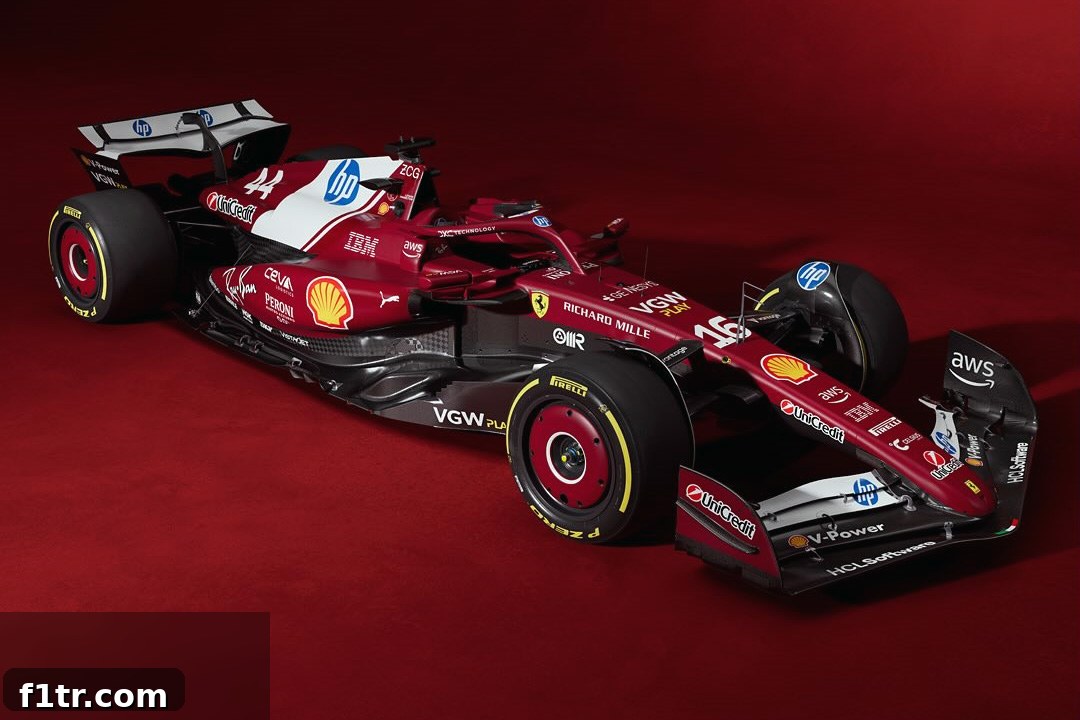
Ferrari Unveils SF-25: A Bold New Vision for the 2025 F1 Season
The anticipation reached a fever pitch as Scuderia Ferrari proudly pulled back the covers on its formidable new challenger for the 2025 Formula 1 season. Christened the SF-25, this latest iteration from Maranello represents not just an evolution, but a strategic re-imagining of their F1 aspirations, blending a rich racing heritage with cutting-edge innovation designed to propel them to championship glory. For the millions of Tifosi worldwide, the unveiling of a new Ferrari F1 car is always a momentous occasion, symbolizing hope, ambition, and the relentless pursuit of perfection that defines the iconic Italian marque.
While the team initially showcased a captivating new livery during Formula 1’s official pre-season launch event, the full visual reveal of the 2025 car has now captivated fans worldwide. This staggered presentation, first teasing the aesthetic changes and now unveiling the meticulously engineered machine beneath, builds considerable excitement around a season that promises to be momentous for the Prancing Horse. The strategy allows for both commercial fanfare and technical focus, ensuring that every detail of the SF-25 gets its moment in the spotlight, setting the stage for what Ferrari hopes will be a triumphant year.
Advert | Become a Supporter & go ad-free
Revolutionary Design: The Shift to Pull-Rod Front Suspension
At the heart of the SF-25’s design philosophy lies a truly striking and impactful technical modification: a fundamental overhaul of the front suspension system. Ferrari’s visionary design team, operating under the shrewd leadership of technical director Loic Serra, has made the bold move from a traditional push-rod configuration to a sophisticated pull-rod setup. This architectural shift is not merely cosmetic; it signals a profound commitment to optimizing the car’s aerodynamic performance and unlocking new avenues for development, demonstrating Ferrari’s proactive approach to addressing its competitive challenges.
In a detailed statement, the team elaborated on the rationale behind this significant engineering decision. “The thinking behind this change in architecture was to clean up the airflow around the car, while also giving greater scope for further aero development, which had pretty much been exhausted with the previous iteration,” Ferrari stated. This explanation highlights the intricate interplay between mechanical components and aerodynamic efficiency in modern Formula 1, where every millimeter and airflow path is meticulously analyzed for performance gains.
For those uninitiated in F1 technicalities, the distinction between push-rod and pull-rod suspension systems is crucial. A push-rod system features a connecting rod that pushes upwards on the rocker arm when the wheel moves up, typically mounted higher on the chassis. Conversely, a pull-rod system utilizes a connecting rod that pulls downwards on the rocker arm, usually positioned lower within the chassis. The pull-rod configuration, as adopted by Ferrari for the SF-25, offers distinct advantages for aerodynamicists. By lowering the internal suspension components, it creates a cleaner, more streamlined upper surface of the front wishbones and chassis. This allows for superior management of airflow over and around the front of the car, leading to enhanced downforce generation and reduced drag—critical factors for competitive performance on the track, especially in corners and through high-speed sections.
This strategic pivot is a clear indication that Ferrari is leaving no stone unturned in its quest for marginal gains and a significant performance edge. The previous car, while capable of winning five rounds, likely reached the limits of its aerodynamic potential within its existing push-rod architecture. The SF-25’s pull-rod design opens up a fresh canvas for engineers to sculpt airflow, refine downforce profiles, and continuously evolve the car’s performance throughout the demanding 2025 season. It underscores Loic Serra’s immediate impact since joining the team, bringing a fresh perspective and a willingness to implement significant, even revolutionary, changes to address past limitations and set the foundation for future success.
Beyond Appearances: A “Completely New” Challenger
While an initial glance might suggest similarities between the SF-25 and its predecessor, which proved its mettle by securing five victories last year, Ferrari firmly asserts that the SF-25 is “completely new.” This declaration emphasizes that beneath the familiar skin, extensive and fundamental redesigns have taken place across various aspects of the vehicle. In the high-stakes world of Formula 1, where regulations often constrain radical external changes, even seemingly minor external refinements can mask profound internal overhauls, and the SF-25 is no exception to this nuanced reality.
This philosophy speaks to the continuous innovation required at the pinnacle of motorsport. A car can appear similar externally due to stringent regulatory constraints or because the overall concept proved successful in the prior season, yet feature entirely new chassis components, updated power unit integration, revised cooling systems, and innovative internal aerodynamic solutions. Ferrari’s commitment to a “completely new” car signifies a holistic approach to address every performance avenue, building upon the strengths of the previous machine while meticulously rectifying its weaknesses. It represents a ground-up development effort aimed at delivering a more consistent, faster, and ultimately, championship-winning package, showcasing the relentless efforts of hundreds of engineers and designers in Maranello.
Championship Ambitions Amplified: The Hamilton Effect
The 2024 season saw Ferrari narrowly miss out on the coveted Constructors’ Championship, falling short by a mere 16 points. This agonizingly close finish has undoubtedly fueled the team’s determination, transforming the near-miss into a powerful motivator for the 2025 campaign. Such a slender margin underscores the intensity of competition in Formula 1 and the critical importance of every single point, highlighting the fine line between victory and second place that Ferrari is so keen to cross.
However, beyond the technical innovations embodied by the SF-25, Scuderia Ferrari has made a seismic strategic move that reverberated throughout the motorsport world: the monumental signing of seven-time World Champion Lewis Hamilton. Lured away from the formidable Mercedes-AMG Petronas F1 Team, Hamilton’s arrival at Maranello is perhaps the most significant driver transfer in recent memory, sparking a wave of excitement and speculation across the globe. While he will join the team in 2025, his impending presence already casts a long shadow, influencing the team’s trajectory, public perception, and the aspirations now explicitly tied to the SF-25.
Hamilton brings an unparalleled wealth of experience, an insatiable hunger for victory, and a unique perspective on car development honed over nearly two decades at the highest level. His proven ability to lead a team, extract maximum performance even from challenging machinery, and contribute to a winning culture will be invaluable as Ferrari pushes to reclaim its dominance. This audacious signing, combined with a technically ambitious car like the SF-25, sends a clear, unequivocal message to rivals: Ferrari is more serious than ever about challenging for both the Drivers’ and Constructors’ titles in the forthcoming seasons. The “Hamilton Effect” isn’t just about his driving prowess; it’s about the psychological boost, the engineering insight, the marketing power, and the global attention he brings, all coalescing to dramatically elevate Ferrari’s championship aspirations and intensify the battle at the front of the grid.
A New Look: Livery Reflects Evolving Partnerships
The arrival of Lewis Hamilton and the dawn of a new competitive era coincide with several significant shifts in Ferrari’s commercial landscape, all visibly reflected in the SF-25’s striking new livery. Motorsport sponsorships are a dynamic and vital aspect of Formula 1, mirroring the economic health, strategic alliances, and global ambitions of a team. Ferrari’s latest car showcases a fresh blend of established partners and exciting new collaborations, signaling a robust and expanding commercial portfolio.
The team proudly welcomes major global players like IBM and Unicredit to its esteemed roster of sponsors. These additions not only inject crucial financial backing but also signify a broadening appeal and increased corporate confidence in the Scuderia’s future, reinforcing its status as a premium platform for global brands. Conversely, the prominent red and white logos of Santander, the Spanish banking giant, are noticeably absent from the SF-25. Santander has transitioned its sponsorship efforts, shifting its backing to the Williams Racing team, a testament to the fluid and competitive nature of commercial partnerships within F1.
Adding another layer to Ferrari’s evolving commercial identity, Hewlett Packard (HP) joined the team as its title sponsor after the start of last season. This partnership is a colossal endorsement, further cementing Ferrari’s status as a premier global brand and bringing a technological giant into its fold. The HP branding is expected to feature prominently on the SF-25, reinforcing the synergy between high-performance engineering and cutting-edge digital technology, a narrative that resonates deeply with modern F1.
These dynamic sponsorship changes have naturally translated into an aesthetically redesigned livery for the SF-25. While retaining the iconic Rosso Corsa that is synonymous with Ferrari, the team has opted for a darker, more intense shade of red, lending the car an even more aggressive and sophisticated presence on track. Crucially, the livery incorporates a greater presence of white, strategically placed to recall classic Ferrari liveries that often featured elegant white accents. Most notably, the rear wing now prominently displays a distinctive splash of blue, a bold and unexpected departure from recent designs. This combination of darker red, increased white, and the surprising blue creates a fresh, modern, yet unmistakably Ferrari identity, symbolizing a new chapter for the team both on and off the track, and visually articulating its renewed vigor and ambition.
First Shakedown and Initial Impressions at Fiorano
Following its global unveiling, the SF-25 is poised for its inaugural shakedown run on Ferrari’s legendary Fiorano test track. This private, purpose-built circuit, nestled beside the factory and steeped in Ferrari history, will provide the perfect proving ground for the new machine. The team has confirmed plans to conduct a crucial 200-kilometre filming day, an essential exercise traditionally undertaken “behind closed doors” to maintain an element of secrecy and focus.
A filming day in Formula 1 serves multiple critical purposes. While primarily used for capturing stunning promotional material, high-definition videos, and striking photographs for marketing campaigns and media partners, it also offers invaluable opportunities for the team. It allows engineers to conduct a crucial systems check, ensuring all components function as designed after assembly. It’s a chance for the designated drivers – likely Charles Leclerc and Carlos Sainz, prior to Hamilton’s highly anticipated arrival – to get their first taste of the car, offering initial feedback on its balance, handling characteristics, and overall feel. This initial shakedown provides vital real-world data to compare against simulations, verifying basic aerodynamic flows and identifying any immediate anomalies before the intense pre-season testing proper begins, where every second counts.
The “behind closed doors” approach ensures maximum control over information and imagery, allowing Ferrari to meticulously manage the narrative surrounding their new contender and avoid premature speculation. It also provides a concentrated environment for engineers and drivers to focus solely on the car’s initial performance without external distractions or the prying eyes of rivals. The Fiorano circuit itself adds to the mystique, a place where legends are born and Ferrari’s innovations are first put to the ultimate test. This initial run is more than just a formality; it’s the genesis of Ferrari’s 2025 season, setting the tone for their ambitious championship challenge and marking the true beginning of the SF-25’s journey from Maranello to the global F1 stage.
Pictures: 2025 Ferrari SF-25 F1 Car – Detailed Shots
Pictures: 2025 Ferrari F1 Livery Launch Event Highlights
Here from the beginning. Please welcome the SF-25! pic.twitter.com/oEB2b4Yjit
— Scuderia Ferrari HP (@ScuderiaFerrari) February 18, 2025
Advert | Become a RaceFans supporter andgo ad-free
Further Reading: Formula 1 Insights and Analysis
- Controversies, Norris, Newey and more: Five new motorsport books reviewed
- One of F1’s greatest races happened 15 years ago today. Or did it?
- “Overtaking is overtaking”: Domenicali denies F1’s yo-yo racing is “artificial”
- The crashes F1 is trying to prevent may be rare – but the danger is obvious
- F1 returning to India soon after 2027 sounds like wishful thinking
Browse all Formula 1 articles