McLaren’s Resurgent Glory: Daniel Ricciardo Ends a Decade of Drought at Monza
Eight years and 291 days. That was the staggering duration of McLaren’s wait for a Formula 1 victory, a barren spell that finally concluded with a triumphant one-two finish at the 2021 Italian Grand Prix. Since Jenson Button scored the final victory of his career at the 2012 Brazilian Grand Prix, the legendary Woking outfit endured an agonizing 3,213 days without standing atop the podium. This long-anticipated triumph, spearheaded by Daniel Ricciardo and closely followed by Lando Norris, marks not just a return to form for McLaren but a profound moment in the narrative of Formula 1 itself. It signifies the end of one of the longest and most challenging periods in the illustrious history of a team synonymous with racing excellence.
For one of the most successful teams in Formula 1 history, a near nine-year hiatus from the winner’s circle is almost unfathomable. Only Ferrari can boast more race victories than McLaren, a statistic that underscores the profound nature of this recent drought. The weight of expectation, the pressure from fans and stakeholders, and the internal drive for success have been constant companions for the team throughout this arduous period. Their return to winning ways at Monza, a circuit steeped in F1 history and known for its high-speed thrills, made the victory all the more poetic, a true testament to unwavering dedication.
A Legacy Forged in Triumphs and Tribulations: McLaren’s Historical Resilience
McLaren’s journey through Formula 1 has been punctuated by numerous peaks and troughs, but none have matched the sheer length and intensity of the most recent winless streak. The team has experienced significant dry spells before, each time demonstrating a remarkable resilience deeply embedded in its DNA. Following a three-season absence from the top step of the podium between 1978 and 1980, a pivotal moment arrived with the visionary leadership of Ron Dennis. His strategic overhaul and the arrival of John Watson, who delivered a long-awaited victory at the 1981 British Grand Prix, unequivocally ushered in a new golden era for McLaren, transforming its fortunes.
Another challenging period spanned the years 1994-1996. This era followed the profound loss of both the formidable talent of three-time world champion Ayrton Senna and the potent Honda engines that had powered them to multiple championships. The departure of such a dominant combination left a significant void, and the team grappled intensely with finding its footing in a highly competitive landscape. However, McLaren once again showcased its ability to adapt and rebuild. The subsequent partnership with Mercedes-Benz engines proved transformative, and David Coulthard brought them back to winning ways at the opening race of the 1997 season in Melbourne, signalling the dawn of another highly competitive chapter for the team.
The latest reincarnation of the team, mirroring its past recoveries, has broken its extended win-less streak precisely after reuniting with Mercedes power this year. This re-established partnership follows unsuccessful ventures with Honda (as a works team from 2015-2017) and Renault (as a customer engine supplier from 2018-2020). The Honda period, in particular, was fraught with technical difficulties, public frustrations, and a consistent lack of performance, ultimately failing to rekindle the magic of their legendary 1980s collaboration. The subsequent Renault partnership offered glimmers of hope and saw some solid midfield results but ultimately didn’t deliver the consistent front-running pace needed to challenge at the very front. The decision to switch back to Mercedes power for the 2021 season, therefore, was a calculated risk that has unequivocally paid off, providing the team with the reliable, powerful, and race-winning engine package crucial for success in modern Formula 1.
The Long Road Back: Historical Winless Streaks in Formula 1
McLaren’s 3,213-day stretch between victories stands as the second-longest for any team that has been a consistent competitor throughout its existence in Formula 1. This statistic highlights the sheer difficulty of maintaining competitiveness at the absolute pinnacle of motorsport over decades, enduring technological shifts, regulatory changes, and intense rivalries. To truly put McLaren’s wait into perspective, we must look to the record holder for such a continuous participation streak: Ligier. When Olivier Panis sensationally won the 1996 Monaco Grand Prix, an astonishing 14 years and 235 days had passed since the French team’s previous triumph, courtesy of Jacques Laffite in Canada during the 1981 season. This monumental gap underscores the immense challenges faced by smaller, independent teams in a sport often dominated by manufacturer-backed giants, requiring incredible perseverance from their staff and drivers.
When measured in terms of the number of races, Ligier’s winless streak also surpasses McLaren’s, although the difference is less stark due to the ever-expanding F1 calendars over the years, which now feature more events per season. Ligier competed in an arduous 231 races between their victories, while McLaren endured 171 Grands Prix without a win during their recent drought. This numerical comparison provides a tangible measure of the struggle and perseverance required at the highest level of motorsport. Currently, the team best-placed to potentially challenge either of these long streaks is Williams, another legendary British outfit whose last victory, much like McLaren’s prior to Monza, came in 2012, highlighting the cyclical nature of success and struggle in Formula 1.
It is important to differentiate McLaren’s continuous presence from other prominent teams that have experienced even longer gaps between wins, but did so while spending significant periods entirely out of the sport. This category includes illustrious names such as Renault, Lotus, Honda, and Mercedes. Mercedes, for instance, famously sat out every season from 1956 to 2009 as a full constructor before making a powerful return. They ended a remarkable 56-year win drought when Nico Rosberg clinched the 2012 Chinese Grand Prix, a victory that set the stage for one of the most dominant eras in F1 history with their hybrid power units. These examples illustrate the diverse paths teams take and the varying circumstances surrounding their periods away from the winner’s circle, making McLaren’s continuous struggle all the more notable.
Ricciardo’s Redemption and McLaren’s Double Delight at Monza
Daniel Ricciardo delivered McLaren’s 183rd Grand Prix triumph, a victory that felt like a culmination of personal perseverance, strategic team effort, and collective resurgence. Once the most successful team in F1 history in terms of total victories, McLaren now trails Ferrari by a margin of 55 wins, with the Italian Scuderia itself having endured a relatively dry spell of late; two years will have passed since their last win by the time F1 reconvenes in Sochi for its next round. During McLaren’s extended wait for a win, Ferrari added 18 victories to their impressive tally, emphasizing the considerable ground McLaren needed to recover.
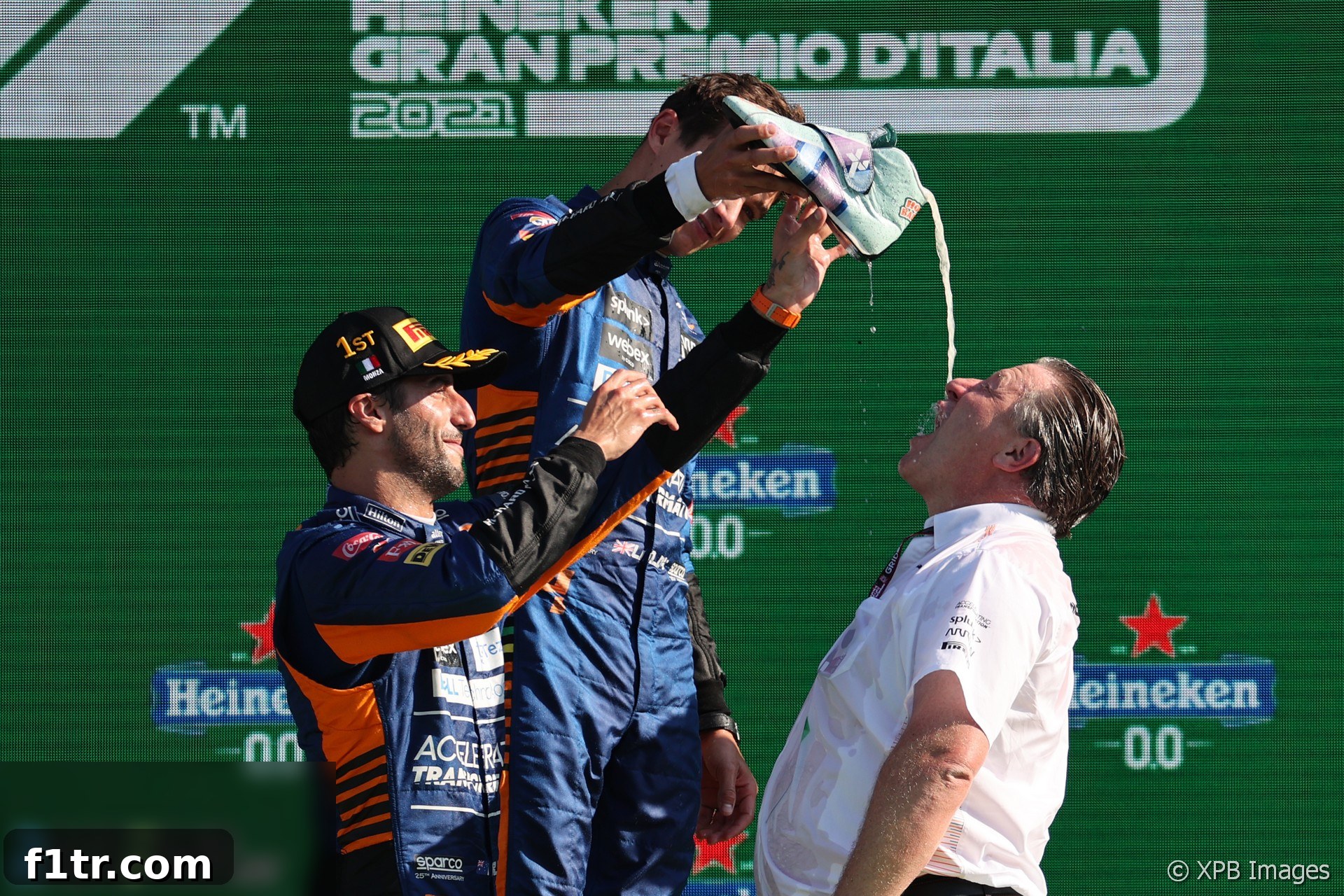
The Monza victory marked Ricciardo’s first win for a team other than Red Bull and the eighth of his impressive career. This achievement places him alongside esteemed drivers such as Jacky Ickx and Denny Hulme in the F1 record books, a testament to his undeniable talent and relentless pursuit of success. For Ricciardo, this victory was particularly sweet, coming after a challenging start to his McLaren tenure where he often struggled to adapt to the car’s unique characteristics and exploit its full potential. His jubilant “shoey” celebration on the podium, a tradition he established, vividly reflected the immense relief, joy, and emotional release of breaking through after a period of intense pressure.
Lando Norris, the rising star of British motorsport, secured his fifth career podium finish at Monza, playing a crucial role in McLaren’s historic one-two. While he had consistently led his teammate home at the majority of races throughout the season, showcasing his exceptional talent and rapid development, it must undoubtedly rankle slightly that Ricciardo was the one to grab the elusive win first. Nevertheless, Norris’s mature, aggressive, and flawless driving ensured McLaren’s first one-two finish since the 2010 Canadian Grand Prix, a truly monumental achievement for the entire team. This dual triumph, with both cars finishing at the very front, emphatically highlights the strength of their dynamic driver lineup and the significant technical progress made with the MCL35M chassis and Mercedes power unit.
The Ricciardo-Norris partnership delivered McLaren’s 48th one-two finish in Formula 1 history. This statistic places them among the elite pairings that have graced the Woking team throughout its storied past. The legendary powerhouse duo of Ayrton Senna and Alain Prost produced the most one-two finishes for the team with an astonishing 14 during their era of unparalleled dominance. Mika Hakkinen and David Coulthard followed closely with 13 such achievements during their successful partnership. The fact that Ricciardo and Norris have now contributed to this proud legacy after such a long gap speaks volumes about their combined talent, the strategic vision of the team, and their renewed competitiveness in the modern era of Formula 1.
Beyond the race win, McLaren’s overall performance at Monza was nothing short of spectacular, culminating in a massive points haul that reverberated through the Constructors’ Championship. Ricciardo’s third-place finish in the sprint qualifying race on Saturday, coupled with his main race victory and the bonus point for setting the fastest lap, meant McLaren scored an incredible 45 points over the single race weekend. This stands as the second-highest points total ever for a team under the current regulations and weekend format. The theoretical maximum a team could possibly score under the current rules, which include a one-two in sprint qualifying and the main race plus the fastest lap, is 49 points. Such a perfect scenario, however, remains an exceedingly rare occurrence, with the Sao Paulo Grand Prix being the only remaining event on the calendar where this ultimate points haul is theoretically possible, adding to the impressiveness of McLaren’s Monza performance.
Constructors’ Championship Battle Heats Up: McLaren vs. Ferrari
This windfall result at Monza had immediate and significant implications for the Constructors’ Championship. McLaren’s dominant performance propelled them back ahead of their fierce rivals, Ferrari, in the intense battle for third place overall. The two historic teams are now separated by a mere 13.5 points, setting the stage for a captivating and potentially nail-biting showdown in the remaining races of the season. Securing third place in the Constructors’ Championship is not just about bragging rights or prestige; it carries substantial financial rewards and significantly bolsters a team’s budget for future development, making this rivalry all the more critical for both McLaren and Ferrari, who are both desperately eager to re-establish themselves among F1’s elite after recent struggles.
While McLaren celebrated their long-awaited triumph, there was huge disappointment for AlphaTauri, just 12 months after their shocking home win at the same circuit. The 2021 Italian Grand Prix proved to be a stark contrast for the Red Bull junior team. Home favourite Yuki Tsunoda failed to start the race due to a technical issue, and their 2020 Monza winner, Pierre Gasly, was unfortunately forced to retire after only three laps following contact. Until last weekend, AlphaTauri had been the only remaining team to have scored points in every race of the year, highlighting the unpredictability and unforgiving nature of Formula 1, where fortunes can change in an instant. Their misfortune further underscored McLaren’s exceptional, clinical performance on a day where many other teams struggled.
The 2021 Italian Grand Prix will undoubtedly be remembered as a pivotal moment for McLaren. It was not merely a race victory; it was a powerful statement of intent, a resounding validation of years of hard work, strategic realignment, and unwavering belief. The Woking team has endured its share of adversity, navigated through challenging partnerships, and faced periods of uncertainty, but its rich history of resilience and innovation has once again shone through. With a dynamic driver pairing, a potent Mercedes power unit, and a renewed sense of purpose, McLaren is now firmly on the path to reclaiming its rightful place at the very top of Formula 1, igniting hope, excitement, and anticipation for fans worldwide as they look towards a bright future.
2021 Italian Grand Prix Insights
- Who was to blame for Hamilton and Verstappen’s collision at Monza?
- Hamilton-Verstappen crash was ‘a racing incident, no danger’ – Alonso
- Hamilton pleased stewards “set a precedent”, Verstappen “doesn’t fully agree”
- Ricciardo didn’t need title rivals’ latest clash for stunning Monza win
- Why Verstappen’s grid penalty differed from Hamilton’s Silverstone sanction
Browse all 2021 Italian Grand Prix articles