Lando Norris’s Evolving Race Starts: From Cautious Beginnings to Aggressive Ascensions in Formula 1
Lando Norris, one of Formula 1’s most promising young talents, has openly discussed a pivotal shift in his approach to race starts. What began as a conservative, experience-focused strategy during his rookie year has now evolved into a markedly more assertive and aggressive style. This strategic transformation, particularly evident in the latter half of his debut 2019 season, has yielded tangible benefits, resulting in significantly improved track positions and stronger overall race performances for the McLaren driver.
The Rookie’s Prudent Beginnings: Learning the Ropes in F1
Entering the highly competitive world of Formula 1 as a rookie, Lando Norris initially adopted a remarkably cautious stance during the chaotic opening laps of Grand Prix races. This measured approach was not accidental; it was a deliberate tactic designed to mitigate the inherent risks of multi-car incidents, guarantee race completion, and ultimately maximize his invaluable on-track experience. For any new driver, avoiding early collisions is paramount, not only for personal development but also for safeguarding the team’s vital championship points and financial investment.
Norris himself articulated this guiding philosophy earlier in his debut year, emphasizing his priority: “I’d rather finish the race.” This statement underscored his commitment to accumulating mileage and gaining a profound understanding of Formula 1’s intricate nuances, free from the setbacks of premature retirement. Such prudence was a sensible and well-justified strategy for a young driver finding his footing in the pinnacle of motorsport, allowing him to observe, learn, and gradually build confidence away from the often unpredictable mayhem that defines the initial corners of an F1 race.
However, while safety and caution offer obvious benefits, they often come at the cost of valuable track position. Throughout much of the first half of the 2019 season, Norris frequently found himself losing ground on the opening lap. This was a direct and understandable consequence of prioritizing self-preservation and consistent race finishes over the immediate, high-risk pursuit of outright aggression.
A Strategic Turning Point: Embracing Aggression from Spa Onwards
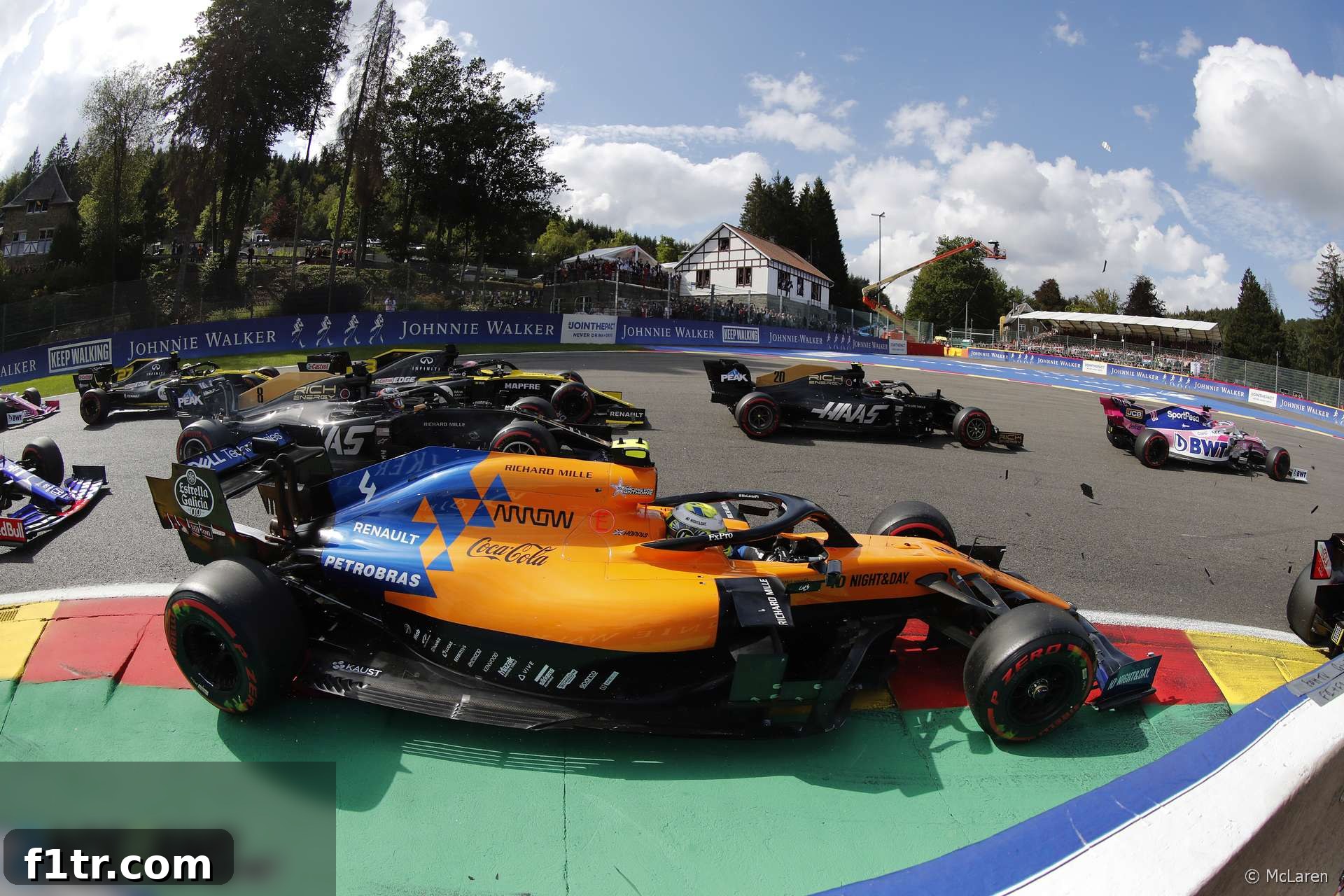
As the 2019 season progressed and Norris diligently accumulated more experience, a discernible shift in his racecraft began to emerge. The pivotal moment, as identified by Norris himself, occurred during the Belgian Grand Prix at Spa-Francorchamps. “From, I guess the best one is from Spa onwards, that was like the perfect example,” he recounted with a sense of accomplishment. “I was a little bit more attacking and it turned out to be my best first corner of the whole season.”
This newfound assertiveness represented a significant milestone in his professional development. Spa’s iconic long run to Les Combes, coupled with its tight and challenging La Source hairpin, demands a unique blend of bravery, precision, and decisive action. Norris’s ability to navigate this demanding section of track with increased aggression signaled a burgeoning confidence in his racecraft and an enhanced understanding of car limits. This profound psychological shift—from a purely defensive mindset to actively seeking opportunities to gain crucial track positions—underscored his rapid learning curve and impressive adaptation to the high-pressure demands of elite Formula 1 racing.
Calculating Risks: The Art of the Strategic Overtake
The transition to a more aggressive style was not born out of reckless abandon; rather, it stemmed from a more calculated and nuanced approach to risk-taking. Formula 1 race starts are often likened to a high-stakes chess match, where split-second decisions and precise execution dictate immediate outcomes and can shape an entire Grand Prix. Norris’s insightful comments perfectly reflect this sophisticated understanding: “If I wanted to and if I really needed to, and if I see an opportunity, then I still go for it. But there’s always a decision whether you take the risk.”
He openly acknowledges the constant internal deliberation that accompanies such decisions: “Maybe it goes well, maybe it doesn’t. Or do you sit behind for one corner and then maybe do in the next corner, something like that.” This candid introspection reveals a maturing driver who is not merely reacting to events but proactively assessing various scenarios, meticulously weighing the potential reward of an immediate gain against the inherent risks of an incident. This thoughtful aggression, tempered by strategic foresight, is an unmistakable hallmark of top-tier F1 drivers who consistently perform at the highest level.
Even as he embraced a more aggressive posture, Norris maintained a commendable degree of self-restraint, recognizing his ongoing learning journey within the sport. “Even now I still want to do the races, I’ve still got a lot to learn, so there’s still maybe a little bit that I leave,” he stated. This balanced perspective ensures that while he continually pushes the boundaries of his performance, he never compromises his primary objective of completing races, gathering invaluable data, and contributing consistently to McLaren’s efforts.
Tangible Results: Data-Driven Performance Enhancement
The profound impact of Norris’s evolving race start strategy is strikingly evident in the statistical data from the 2019 season. Prior to the traditional summer break, Lando Norris, on average, experienced a loss of approximately 1.5 places per race on the very first lap. This meant he frequently faced the arduous task of battling his way back from a suboptimal starting position, often expending precious tire life and limiting strategic options early in the race. Such a deficit can significantly hinder a driver’s ability to score points and execute their team’s intended race strategy.
However, since wholeheartedly adopting his more attacking style in the period following the summer break, his performance on the opening lap has undergone a dramatic and undeniable improvement. On average, he gained an impressive 1.8 places at each race during this crucial phase of the season. This remarkable turnaround of over three positions, on average, per start emphatically highlights the effectiveness and success of his new, proactive approach. Gaining positions early in a Grand Prix is an absolutely critical advantage in modern Formula 1, as initial track position often dictates the entire race strategy and can be a decisive factor in the final outcome, particularly on circuits where overtaking opportunities are scarce.
This significant statistical improvement not only serves as a testament to his personal growth and adaptability but also contributes immensely to McLaren’s overall team performance. Consistently strong starts mean Norris is immediately positioned to score valuable championship points, effectively support his teammate, and allow the team to pursue more flexible and advantageous race strategies. It effectively transforms what was a potential vulnerability into a considerable strength, enabling McLaren to maximize the full potential of their qualifying efforts.
Navigating Incidents: The Unpredictability of F1 Starts
Despite the most meticulous preparation and the most perfect execution, race starts in Formula 1 can still be inherently unpredictable and fraught with unforeseen incidents. Lando Norris experienced this harsh reality firsthand at the Japanese Grand Prix. Despite executing a strong initial getaway that saw him impressively move up to fifth position, he was unfortunately caught up in an incident that was entirely beyond his control and not of his making. “In Japan I was up to fifth or whatever, and then there was the crash in front and I had to back off,” he recounted, describing the chaotic scene.
He subsequently collected debris from the collision between Charles Leclerc’s and Max Verstappen’s cars, an unfortunate consequence that forced an unscheduled pit stop and, regrettably, severely compromised his entire race. This incident powerfully underscores the inherent, uncontrollable risks of the opening lap, irrespective of a driver’s individual aggression level. While Norris’s improved starts consistently place him in a better initial position, the sheer chaos of multi-car interactions in close proximity remains a significant and unpredictable factor. His ability to navigate such precarious situations, even when met with ill fortune, represents yet another crucial layer of his ongoing development as a Formula 1 driver.
Lando Norris’s Starts in 2019: A Detailed Look at Progress
The data from the 2019 season provides a clear narrative of Lando Norris’s performance on the first lap of Grand Prix races, illustrating the number of positions he either gained (represented by positive values) or lost (represented by negative values). This detailed breakdown powerfully demonstrates the distinct shift in his performance trajectory before and after the critical mid-season summer break.
In the initial phase of the season, Norris’s performance was often characterized by slight losses or a tendency to merely maintain his grid position. For instance, in races such as the Australian, Bahrain, Chinese, and Azerbaijan Grands Prix, his first-lap performance generally hovered around zero or slightly negative in terms of positions gained or lost. This reflected his earlier, more cautious strategy as he prioritized avoiding contact and gaining experience.
However, as the season progressed, particularly from the pivotal point of the Belgian Grand Prix onwards, a distinct and encouraging positive trend unequivocally emerged. Post-Spa, his gains on the opening lap became far more frequent and often significantly substantial. This period includes numerous races where he notably moved up several places within the very first lap, showcasing the direct and undeniable impact of his more aggressive, confident, and strategically astute approach. While specific, race-by-race numerical details for each event are not explicitly detailed here, the compelling aggregated averages (a loss of 1.5 places pre-break versus a gain of 1.8 places post-break) strongly corroborate this narrative of substantial and progressive improvement. This consistent enhancement in his start performance has undoubtedly become a key indicator of his rapid growth and increasing maturity as a top-tier Formula 1 driver.
The Significance for McLaren and Lando’s Promising Future
Lando Norris’s remarkable development in his race starts transcends mere personal achievement; it represents a vital and powerful asset for the McLaren Formula 1 team. In a sport where the smallest fractions of a second and mere inches of track space can ultimately define an entire race weekend, a driver’s innate ability to consistently maximize the opening moments of a Grand Prix is an invaluable commodity. Strong starts consistently place the team in a significantly stronger strategic position, open up a broader array of tactical options during the race, and dramatically increase the probability of scoring crucial championship points.
For Norris himself, this evolution unmistakably signifies his increasing comfort, confidence, and growing mastery within the demanding environment of Formula 1. His transition from a promising rookie to a driver demonstrably capable of consistently making up ground at the very start of a race marks a crucial and impressive step in his journey towards becoming a leading contender in the sport. This aggressive yet perfectly controlled mindset, seamlessly combined with his immense natural talent, augurs exceptionally well for his future campaigns with McLaren and his overarching ambition to compete regularly at the very front of the grid.
His impressive capacity to meticulously analyze his own performance, precisely identify specific areas for improvement, and subsequently implement strategic, data-driven changes reflects a maturity and dedication well beyond his years. This unwavering commitment to continuous self-optimization is precisely what differentiates truly good drivers from the truly great ones in Formula 1. As Lando Norris continues to meticulously hone every aspect of his race craft, his electrifying starts will undoubtedly remain a fascinating and critical facet of his performance to watch in the coming seasons.
2019 F1 Season: Related Articles
- Crying in the Melbourne car park at 2019 grand prix was my career low – Ocon
- McLaren Racing reports reduced £71 million loss in 2019
- Kvyat: Hockenheim podium last year was “my biggest achievement” so far
- How the FIA’s new encrypted fuel flow meter targets Ferrari’s suspected ‘aliasing’ trick
- “He smashed my office door”: 23 must-see moments from ‘Drive to Survive’ season two
Browse all 2019 F1 season articles