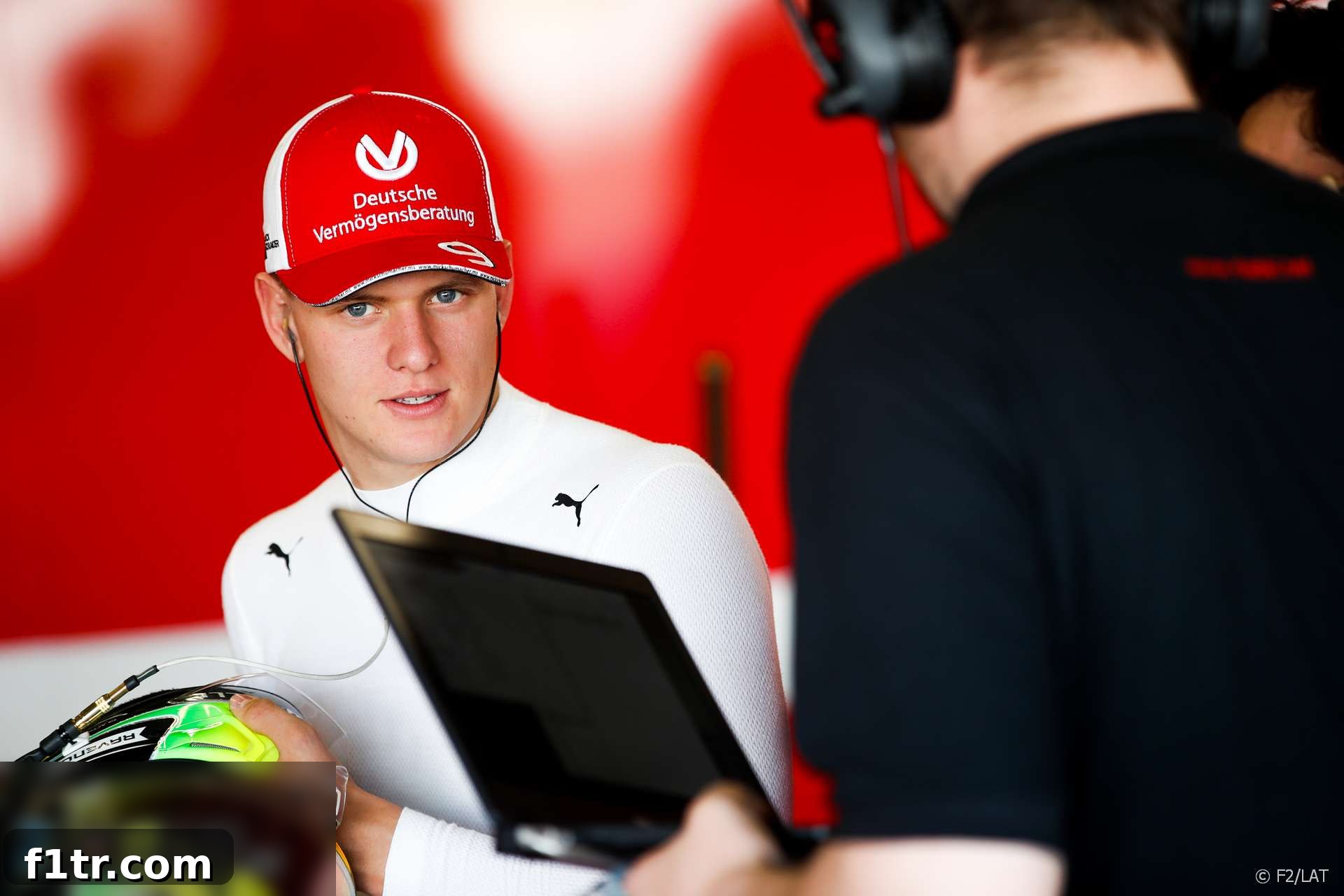
Mick Schumacher Takes First Official F1 Steps with Ferrari and Alfa Romeo
The world of Formula 1 has always been captivated by sagas of talent, legacy, and ambition. Few narratives hold as much intrinsic intrigue as the emergence of a new generation bearing a legendary name. In a moment that flawlessly blended motorsport history with burgeoning potential, Mick Schumacher, the promising son of seven-time Formula 1 World Champion Michael Schumacher, officially embarked on his Formula 1 journey with a highly anticipated test debut. This landmark event occurred during the crucial post-Bahrain Grand Prix test, where the young German talent first took the wheel of a formidable Ferrari before gaining further invaluable experience with Alfa Romeo Racing.
This pivotal step represented a significant milestone for the 20-year-old European Formula Three champion, who is also a proud and integral member of the prestigious Ferrari Driver Academy (FDA). The decision for Schumacher to drive for Ferrari carried particular emotional and historical weight. His legendary father, Michael Schumacher, forged an unparalleled dynasty with the Scuderia, securing an unprecedented five consecutive world championships between 2000 and 2004, thereby cementing his status as one of the sport’s all-time titans. For Mick to follow in such illustrious footsteps, albeit in a test capacity, was a powerful symbol of continuity and ambition.
A Dream Realized: Mick Schumacher’s Reflections on His Debut
Expressing his overwhelming excitement and profound gratitude for this monumental opportunity, Mick Schumacher shared his thoughts ahead of the test, providing a glimpse into the emotions of a young driver on the cusp of fulfilling a lifelong dream. “I am obviously more than excited and would like to thank Ferrari for giving me this opportunity,” said Schumacher, his words reflecting the culmination of years of relentless dedication and hard work. He added, “I am really looking forward to what I’m sure will be a great experience.”
Despite the immense spotlight cast upon his impending F1 test, Schumacher demonstrated remarkable focus and professionalism regarding his immediate competitive commitments. The F1 test was scheduled immediately after his inaugural Formula 2 race weekend – the crucial stepping stone series universally recognized as the final proving ground for aspiring Formula 1 drivers. “For the moment, I am consciously putting all thoughts of the test to one side, because I am also very much looking forward to competing in my first F2 race and would like to focus a hundred percent on the weekend to come,” he explained. This disciplined approach underscored his maturity and unwavering commitment to excelling at every stage of his demanding racing career, showcasing the mental fortitude required for the pinnacle of motorsport.
Behind the Wheel: The Bahrain Test Schedule and Opportunities
The post-Bahrain Grand Prix test served as a critical platform for both established teams and promising young drivers to gather invaluable data and experience outside the pressures of a race weekend. Mick Schumacher’s carefully planned schedule was designed to maximize his exposure and learning across two formidable Formula 1 machines. On the Tuesday immediately following the Grand Prix, he took the controls of Ferrari’s formidable SF90, the very car campaigned by the Scuderia in the ongoing Formula 1 season. This direct immersion into the cutting-edge technology, immense power, and intricate dynamics of a contemporary F1 car from one of the sport’s most iconic teams provided an unparalleled learning opportunity for the young German.
Building on this foundational experience, Schumacher was subsequently slated to drive for Ferrari’s engine customer team, Alfa Romeo Racing, on the following day. This strategic arrangement offered him a broader perspective on Formula 1 machinery and diverse working environments within the paddock. Driving for two different teams, albeit with a shared power unit, allowed Mick to compare and contrast various car setups, engineering philosophies, and operational procedures. This dual exposure is invaluable for a developing driver, providing diverse feedback and insights that are crucial for anyone aiming for a full-time F1 race seat in the future.
Other Key Talents at the Bahrain Test
The Bahrain test was not solely focused on Mick Schumacher; it also served as a vital hub for evaluating other significant talents and conducting essential development work. Sebastian Vettel, Ferrari’s four-time world champion and seasoned veteran, took over testing duties for the Scuderia on day two. His participation provided the team with experienced feedback and crucial benchmark laps, allowing Ferrari to continue its development program with the insights of a driver who knows what it takes to win championships. Meanwhile, Alfa Romeo Racing also extended a testing opportunity to another promising talent from the Ferrari Driver Academy: Callum Ilott, a fellow competitor in the demanding Formula 2 championship and a direct contemporary of Schumacher. This dual opportunity for FDA members highlighted Ferrari’s strategic, long-term investment in nurturing a pipeline of future F1 stars, showcasing their commitment to youth development.
The Ferrari Driver Academy: A Proven Pathway to Formula 1
Ferrari’s unwavering commitment to its young driver program, the Ferrari Driver Academy (FDA), stood as a central theme underlying these significant test opportunities. Mattia Binotto, who served as Ferrari Team Principal at the time, eloquently articulated the profound belief the Scuderia holds in its academy’s mission and value. “We are firm believers in the value of the Ferrari Driver Academy as a high-level training programme for talented youngsters,” Binotto stated, emphasizing the academy’s core objective: to meticulously prepare the next generation of Formula 1 drivers, equipping them with the skills, knowledge, and experience required for the pinnacle of motorsport.
Binotto pointed to a prime, recent example of the FDA’s undeniable success: the meteoric rise of Charles Leclerc. “The decision to give Charles Leclerc a race seat with our team is proof of that,” he explained. Leclerc, a former FDA member, rapidly ascended through the junior ranks, demonstrating exceptional natural talent and remarkable maturity. His swift promotion earned him a coveted Ferrari race seat after just one impressive season in Formula 1 with Sauber (now Alfa Romeo Racing), cementing the FDA’s reputation as a legitimate pathway to the top tier.
Extending this successful philosophy to Mick Schumacher and Callum Ilott, Binotto added, “We are therefore very pleased to be able to give Mick and Callum the opportunity to experience driving a Formula 1 car.” He further highlighted their ongoing progress and future potential: “Mick, who joined the FDA in January, and Callum, who has been with us since 2017, are definitely drivers on their way up and I believe that driving the SF90 in an official setting such as the tests in Bahrain and Barcelona can be very useful at this stage in their career.” This strategic provision of invaluable F1 experience underscores Ferrari’s holistic approach to driver development, offering crucial track time that goes far beyond mere simulator work, providing real-world preparation for the challenges of Grand Prix racing.
The Weight of a Legendary Name: Legacy and Future Potential
For Mick Schumacher, carrying one of the most legendary surnames in motorsport is undeniably both an immense privilege and a significant burden. His father, Michael Schumacher, is universally regarded as one of the greatest Formula 1 drivers of all time. His era at Ferrari, characterized by unparalleled dominance and five consecutive world championships (2000-2004), forged a dynasty that captivated millions worldwide. Consequently, every lap Mick completes, every result he achieves, is inevitably viewed through the prism of his father’s incredible and often incomparable legacy. This adds an extra layer of intense scrutiny and immense expectation that very few young drivers in any sport ever have to confront.
However, Mick has consistently demonstrated a steely resolve and a quiet, yet fierce, determination to carve out his own distinct path. His successes in junior categories, particularly his European Formula 3 championship title, were not merely a product of his famous name but a clear testament to his innate driving talent, rigorous work ethic, and remarkable ability to perform under pressure. His entry into the prestigious Ferrari Driver Academy and subsequent F1 test with the Scuderia itself signifies Ferrari’s genuine belief in his capabilities, recognizing his merit independent of his familial ties, even though the narrative connection remains undeniably powerful and evocative.
The F1 test in Bahrain was far from a ceremonial lap; it was a genuine and crucial opportunity for Mick to showcase his technical understanding, consistency, and fundamental ability to adapt rapidly to the formidable demands of a modern Formula 1 car. For both Ferrari and Alfa Romeo, it was a critical chance to assess his raw pace, the quality and detail of his feedback to engineers, and how quickly he could integrate into a highly professional F1 testing team environment. This initial foray into F1 machinery represents a vital step in what promises to be a long and arduous journey towards a full-time F1 career. While the test undoubtedly provides an exciting glimpse into a potential future, the immediate and overriding focus for Mick remains his challenging Formula 2 campaign, where he must continue to prove his mettle against a highly competitive field.
Beyond the Test: Implications for Mick’s Motorsport Career
The invaluable experience gained in Bahrain, driving both a Ferrari and an Alfa Romeo F1 car, is immeasurable for Mick Schumacher’s development. It provides him with a tangible understanding of the extreme downforce, blistering acceleration, complex hybrid power units, and intricate steering wheel controls that fundamentally differentiate a Formula 1 car from any other racing machine. The detailed data gathered from his runs, the precision of his feedback to the engineering teams, and his demonstrated ability to quickly get up to speed in a demanding new environment are all vital components in his ongoing development as a prospective Formula 1 driver.
This test unequivocally positions Mick as a leading contender among the next generation of exceptional talents currently being groomed for Formula 1. It signifies that he is firmly on the radar of F1 teams and, crucially, that Ferrari sees him as a legitimate and promising candidate for a future role within their extensive motorsport ecosystem, whether that eventually be directly with the Scuderia or through one of their closely affiliated customer teams. While no guarantees exist in the relentlessly cutthroat world of Formula 1, this landmark test serves as a powerful endorsement of his undeniable potential and a strong indicator of his upward trajectory within the sport.
As the demanding Formula 2 season unfolds, all eyes will deservedly remain on Mick Schumacher. His consistent performance and demonstrated prowess in the feeder series will ultimately be the decisive determinant of his readiness for a full-time Formula 1 seat. However, this landmark test in Bahrain will forever be remembered as the significant moment when the son of a true legend took his first official, tangible steps towards potentially emulating his father’s incredible achievements on the sport’s most prestigious and challenging stage.
Explore more articles and in-depth insights from the 2019 Bahrain Grand Prix, where this exciting chapter in Mick Schumacher’s career began.