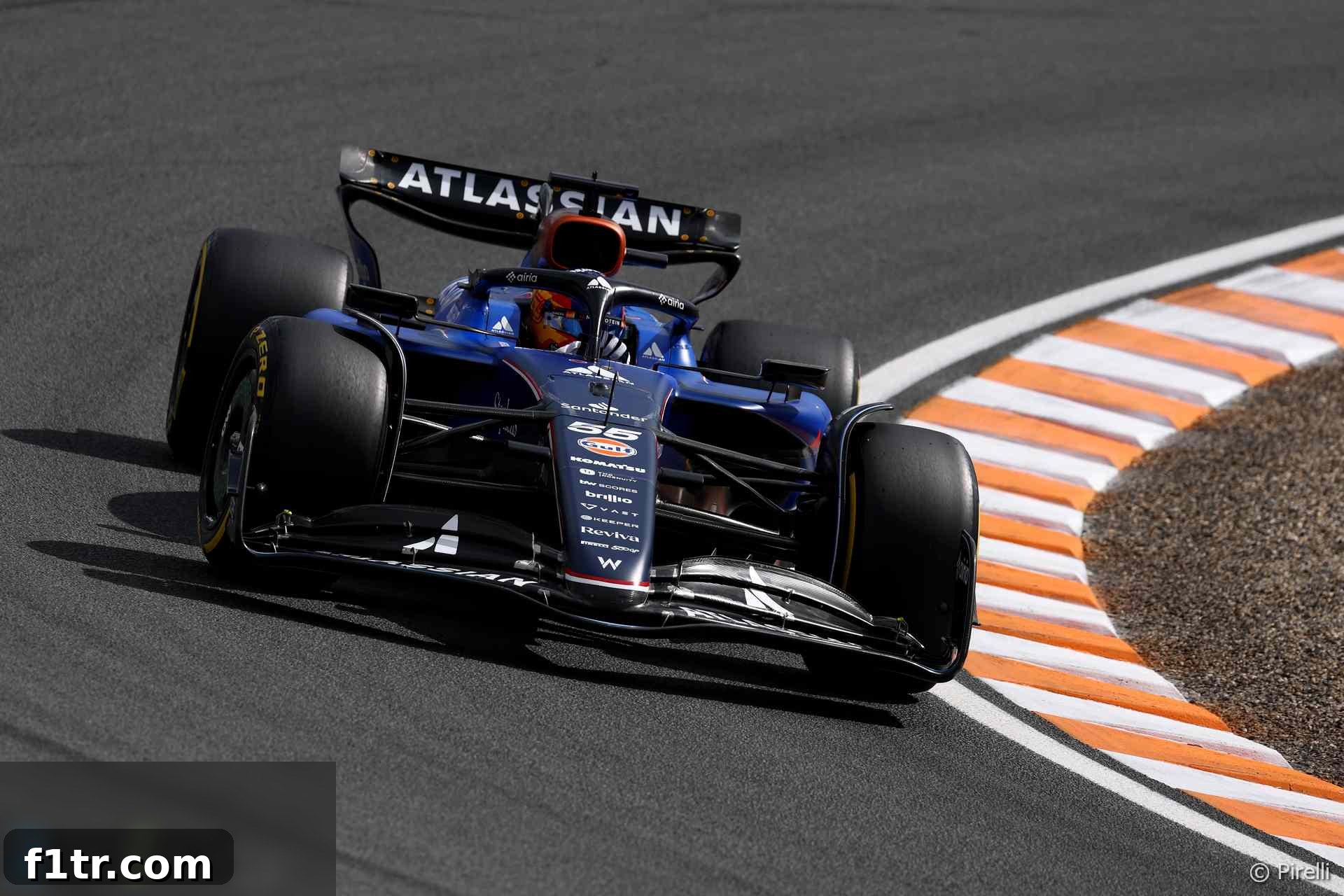
The FIA has officially confirmed the procedural details for the ‘Right of Review’ hearing requested by Williams Racing concerning the contentious penalty issued to Carlos Sainz Jnr during the recent Dutch Grand Prix. This significant development marks another instance where a Formula 1 team seeks to challenge a stewards’ decision, highlighting the ongoing pursuit of sporting fairness and consistency within the pinnacle of motorsport.
The original penalty, a 10-second time addition to Sainz’s race time and two penalty points on his Super Licence, was a direct consequence of an on-track incident at the iconic Tarzan corner. Stewards at the time deemed Sainz primarily responsible for a collision involving Liam Lawson, who was driving for Racing Bulls.
Advert | Become a Supporter & go ad-free
Unpacking the Zandvoort Incident and Stewards’ Initial Ruling
The incident in question unfolded during a critical moment of the Dutch Grand Prix at the challenging exit of Tarzan, a notorious overtaking spot at the Zandvoort circuit. Carlos Sainz, known for his aggressive yet calculated driving style, was attempting to execute an overtake on Liam Lawson around the outside of the corner. However, as both drivers navigated the apex and exit, contact was made between their cars.
This collision resulted in significant damage for both Sainz and Lawson, severely impacting their race. Both drivers, who were previously running in point-scoring positions, fell out of the crucial top 10 as a direct consequence of the incident, losing valuable championship points for their respective teams – Williams and Racing Bulls. Following a thorough post-race investigation, which included reviewing various camera angles and telemetry data, the race stewards concluded that “car 30 [Lawson] had the right to the corner and therefore car 55 [Sainz] was wholly or predominantly to blame.” This ruling led to the imposition of a 10-second time penalty for Sainz, a standard punishment for incidents where one driver is deemed to be primarily at fault. Additionally, two penalty points were added to Sainz’s Super Licence, contributing to his cumulative tally, which can lead to a race ban if 12 points are accumulated within a 12-month period. The immediate aftermath saw strong reactions from the Racing Bulls camp, with team principal Alan Permane publicly accusing Sainz of “crashing into” Lawson and asserting that the incident deprived Lawson of a potential fifth-place finish, a significant result for the team.
The FIA Right of Review: A Detailed Look at Article 14 of the International Sporting Code
The ‘Right of Review’ mechanism in Formula 1 is a cornerstone of the sport’s judicial process, meticulously outlined in Article 14 of the FIA International Sporting Code. It provides a vital, albeit challenging, avenue for teams to contest a decision made by the stewards. The fundamental principle governing such requests is that a review can only be granted if a “significant and relevant new element” is presented that was unequivocally unavailable to the party seeking the review at the time of the original decision. This is a deliberately stringent requirement, designed to uphold the finality of race results and prevent an endless cycle of appeals, while simultaneously ensuring that genuine oversights or injustices can be rectified.
The FIA’s structured process for evaluating these requests is divided into two distinct parts:
- Part One: Admissibility Hearing
The initial phase of the hearing is exclusively dedicated to assessing whether the petitioner – in this current case, Williams Racing – has indeed supplied a new piece of evidence that meets the strict criteria of being both relevant and significant. Crucially, this evidence must have been demonstrably unavailable to them when the stewards originally rendered their decision. During this phase, the stewards will meticulously examine the new information presented, scrutinizing its nature, origin, and potential bearing on the prior ruling. If this rigorous threshold for ‘new evidence’ is not met, the review request is dismissed, and the original decision stands without further deliberation. - Part Two: Reconsideration of the Original Decision
Should the stewards determine that Williams’s evidence satisfies the “significant and relevant new element” requirement, the hearing will then progress to its second, substantive part. In this stage, the stewards will reconvene to thoroughly reconsider their initial decision, now incorporating the newly accepted evidence into their assessment. This may entail further discussions, presentations from all involved parties, and potentially additional questioning. It is only at this juncture that the original penalty might be overturned, modified, or ultimately upheld, based on a comprehensive and fresh evaluation of all available information, including the newly introduced elements.
For the forthcoming hearing, the FIA has specifically mandated the attendance of a representative from Williams Racing. Furthermore, Racing Bulls, as the other party directly involved in the incident, has been notified that a representative from their team will also be required to participate, should the stewards accept Williams’s evidence and proceed to the second part of the hearing. This dual representation ensures that all directly affected parties have a fair opportunity to present their perspectives and arguments. Additionally, to foster transparency and uphold the competitive integrity of Formula 1, rival teams are also extended the option to attend the hearing if they choose, allowing for broader oversight of the proceedings.
Advert | Become a RaceFans supporter andgo ad-free
Official FIA Statement Regarding the Williams Right of Review Hearing
The stewards have formally acknowledged receipt of a petition for Review, submitted under the provisions of Article 14 of the FIA International Sporting Code. This petition was lodged by Atlassian Williams Racing on 4 September 2025, specifically pertaining to the decision documented as ‘document 45’ from the 2025 Dutch Grand Prix. The original decision concerned a breach of Appendix L, Chapter IV, Article 2 d) of the International Sporting Code, directly related to car 55, driven by Carlos Sainz.
In accordance with the procedural requirements, a designated team representative from Williams Racing is mandated to report to the stewards on Friday, 12th September 2025, at 15:30 CEST. This meeting will be conducted virtually via video conference, with specific access details to be communicated separately to the involved parties.
It is crucial to note that this hearing has been explicitly structured to unfold in two distinct phases. The primary objective of the first phase will be to meticulously hear and evaluate the evidence and submissions presented by the petitioner. The focus will be on determining whether Williams Racing can indeed demonstrate the existence of a “significant and relevant new element which was unavailable to the party seeking the review at the time of the decision concerned.” This initial assessment is critical for the progression of the review process.
Should the stewards, exercising their judgment in strict adherence to Article 14.3 of the FIA International Sporting Code, conclude that such a qualifying element does exist, a second part of the hearing will be promptly convened. The exact timing for this subsequent phase will be advised shortly after the conclusion of the first part, in all likelihood without significant delay.
The FIA also confirms that any other party deemed “concerned” by the stewards may formally seek permission to appear and present their views during the hearing, ensuring comprehensive consideration of all relevant perspectives.
The Precedent: A Look at Past F1 Right of Review Outcomes
The history of Formula 1 is replete with on-track controversies and stewards’ decisions that have sparked considerable debate. The ‘Right of Review’ mechanism, while an essential safeguard for sporting justice, has historically proven to be an exceedingly difficult path for teams attempting to overturn penalties. The statistics unequivocally underscore this challenge: out of the last 13 ‘Right of Review’ requests formally brought before the FIA, a substantial 10 were ultimately not upheld. This indicates a success rate of only approximately 23%, highlighting the formidable evidentiary burden placed upon teams seeking to reverse a stewards’ ruling.
Carlos Sainz himself is no stranger to this intricate process. In 2023, his then-team, Ferrari, made a concerted attempt to overturn a penalty he received at the Australian Grand Prix following a collision with Aston Martin’s Fernando Alonso. Despite Ferrari’s robust efforts and presentation of what they believed to be new evidence, their appeal was ultimately unsuccessful. This prior experience for Sainz, coupled with the general trend of review outcomes leaning heavily towards upholding original decisions, adds a significant layer of anticipation and scrutiny to Williams’s current bid. It reinforces the perception that only genuinely compelling and previously unseen evidence stands a chance of swaying the stewards.
Advert | Become a RaceFans supporter andgo ad-free
F1 Right of Review Requests: A Historical Overview (2019-Present)
To better understand the challenging context of Williams’s current request, it is highly instructive to examine previous ‘Right of Review’ applications since 2019. The table below illustrates various high-profile incidents, the teams involved, and the ultimate outcome, clearly showcasing the rare instances where a review has successfully led to a reversal or modification of a stewards’ decision.
| Date of Decision | Team | Event | Incident Description | Outcome |
|---|---|---|---|---|
| 21/6/2019 | Ferrari | Canadian GP | Sebastian Vettel rejoined the track in an unsafe fashion after an off-track excursion, impacting Lewis Hamilton. | Failed |
| 5/7/2020 | Red Bull | Austrian GP | Lewis Hamilton failed to slow sufficiently for yellow flags during qualifying, leading to a grid penalty. | Succeeded |
| 2/5/2021 | Alfa Romeo | Emilia Romagna GP | Kimi Raikkonen failed to re-establish the correct restart order after a red flag, incurring a penalty. | Failed |
| 29/7/2021 | Red Bull | British GP | Lewis Hamilton received a 10-second penalty for colliding with Max Verstappen; Red Bull sought a harsher penalty. | Failed |
| 9/8/2021 | Aston Martin | Hungarian GP | Sebastian Vettel’s car was disqualified for being underweight after the race, losing points. | Failed |
| 19/11/2021 | Mercedes | Brazilian GP | Max Verstappen forced Lewis Hamilton off the track during a wheel-to-wheel battle, no penalty issued initially. | Failed |
| 28/10/2022 | Haas | United States GP | Haas submitted a protest against Fernando Alonso’s loose mirror too late, which was initially rejected. | Succeeded |
| 19/3/2023 | Aston Martin | Saudi Arabian GP | Fernando Alonso failed to serve a five-second time penalty correctly during a pit stop due to jacking the car. | Succeeded |
| 18/4/2023 | Ferrari | Australian GP | Carlos Sainz Jnr collided with Fernando Alonso, resulting in a penalty for Sainz. | Failed |
| 2/7/2023 | McLaren | Canadian GP | Lando Norris was penalised for unsportsmanlike driving under a Safety Car period. | Failed |
| 9/11/2023 | Haas | United States GP | Extensive track limits breaches were identified post-race by Haas regarding several competitors, challenging results. | Failed |
| 5/5/2024 | Aston Martin | Chinese GP | Fernando Alonso collided with Carlos Sainz Jnr during a sprint race, receiving a penalty. | Failed |
| 26/10/2024 | McLaren | United States GP | Lando Norris was penalised for overtaking Max Verstappen off the track, an initial penalty. | Failed |
NB. It is important to distinguish ‘Right of Review’ requests from general ‘protests’. Protests address alleged rule infringements or eligibility issues that occur during an event, such as those brought by Red Bull at the Miami and Canadian grands prix. Conversely, a ‘Right of Review’ specifically aims to reassess a judicial decision already made by stewards, based on the introduction of significant new evidence.
The Stakes: Implications for Williams, Sainz, and F1 Sporting Integrity
The outcome of Williams’s ‘Right of Review’ request carries significant implications, extending far beyond the immediate penalty for Carlos Sainz. For Sainz personally, a successful review would mean the annulment of his 10-second time penalty, potentially restoring any lost championship points from the Dutch Grand Prix. More critically, it would result in the removal of the two penalty points from his Super Licence. While two points might seem minor in isolation, their cumulative effect can be severe over a 12-month period, and drivers consistently strive to maintain a low tally to avoid the threat of a race ban. Furthermore, an overturned decision would offer a degree of vindication for Sainz and Williams, reaffirming their belief in their interpretation of the incident and potentially boosting team morale.
For Williams Racing, a successful review would be a powerful testament to their analytical rigor, their comprehensive data assessment capabilities, and their ability to uncover compelling new evidence that was previously overlooked. It would also set a significant precedent, potentially encouraging other teams to pursue similar challenges if they genuinely believe they possess a robust case. Conversely, an unsuccessful review would reaffirm the stewards’ original decision, reinforce the formidable difficulty of overturning such rulings, and perhaps prompt Williams to re-evaluate their internal review processes.
On a broader scale, the ‘Right of Review’ process itself is absolutely vital for maintaining the overarching integrity and perceived fairness of Formula 1. It functions as a critical safeguard, ensuring that all judicial decisions are ultimately based on the fullest possible understanding of events. While the historically high failure rate for review requests generally reflects the robustness and initial accuracy of stewarding decisions, the occasional successes – such as the reversals of penalties for Fernando Alonso (Saudi Arabian GP 2023) and Haas (United States GP 2022) – demonstrate the system’s inherent capacity for self-correction. The ongoing scrutiny of these decisions, through mechanisms like the ‘Right of Review’, fosters greater trust in the regulatory framework and actively encourages consistent and transparent application of the sporting rules by the FIA, benefiting all competitors and fans alike.
Advert | Become a RaceFans supporter andgo ad-free
Further Reading on the 2025 Dutch Grand Prix:
- Williams’s Sainz penalty review success “will open the door to more challenges”
- Lawson now accepts Sainz collision was a “racing incident” after stewards’ U-turn
- Stewards’ U-turn over Zandvoort penalty shows ‘how far the FIA have come’ – Sainz
- The FIA’s stewards grabbed the chance to correct their mistake – unlike last time
- Sainz’s Dutch GP penalty points cancelled as stewards accept Williams’ request for review
Browse all 2025 Dutch Grand Prix articles