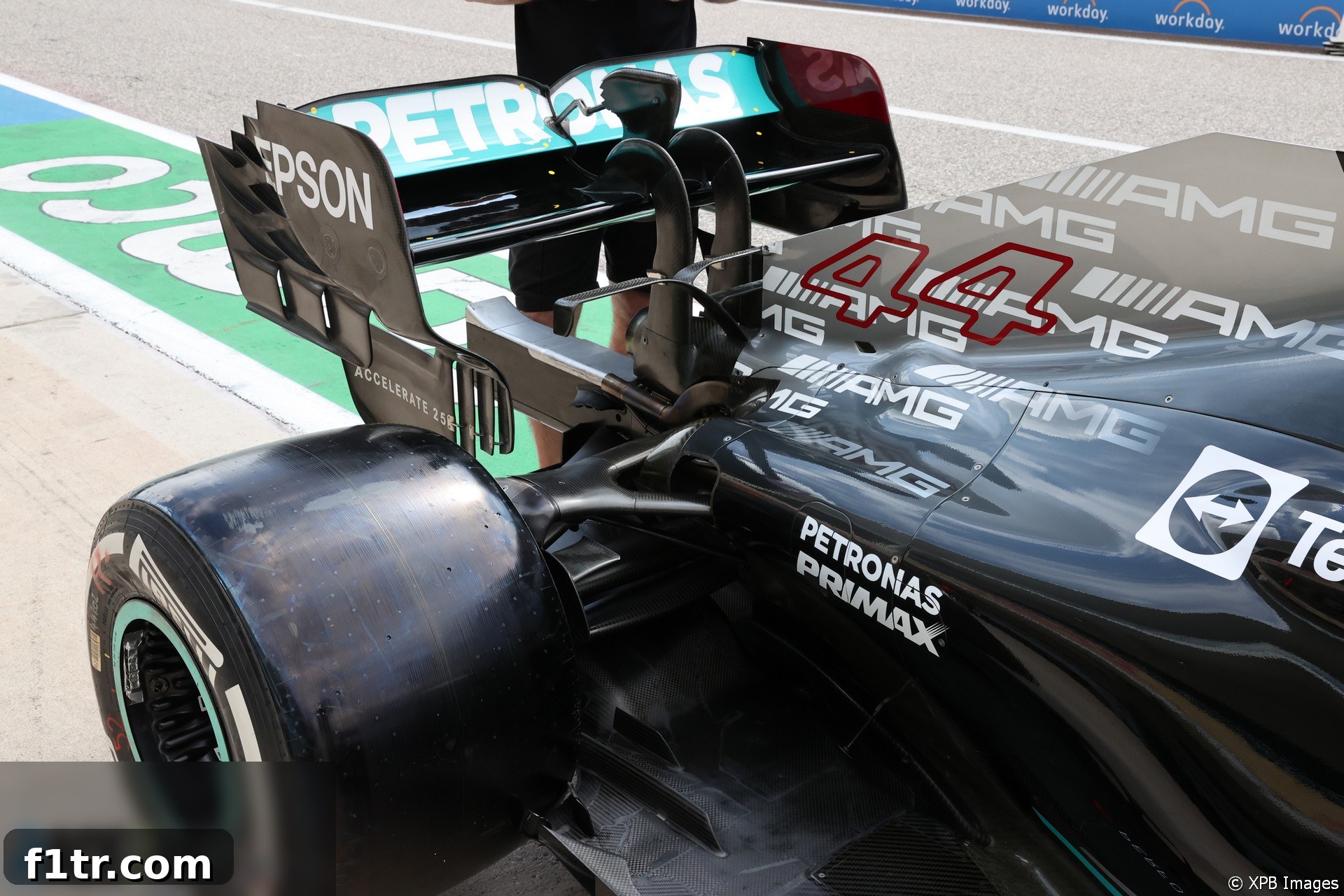
Red Bull Raises Eyebrows Over Mercedes’ Suspected Ride Height Advantage in F1 Title Fight
The intensity of the 2021 Formula 1 season reached new heights as Red Bull Racing team principal Christian Horner publicly voiced his suspicions regarding a perceived technical advantage held by rivals Mercedes-AMG Petronas Formula One Team. Horner believes Mercedes has implemented a sophisticated system capable of lowering their W12 car’s ride height on straights, a maneuver designed to significantly boost their top speed, an area where Mercedes appeared to gain a crucial edge in several pivotal races.
This intriguing theory gained traction following footage from the Turkish Grand Prix, where Valtteri Bottas’ Mercedes W12 was observed to visibly lower itself when speeding down the main straights of Istanbul Park. Such a dynamic ride height adjustment, if indeed controlled or optimized for straights, is thought to be instrumental in stalling the car’s diffuser. By reducing the diffuser’s effectiveness at high speeds, aerodynamic drag is minimized, directly translating into a substantial increase in straight-line performance. This particular strength of the Mercedes package had already been a point of alarm for Red Bull, particularly after their observations from previous races.
The Aerodynamic Puzzle: Mercedes’ Suspected Innovation
The concept of a car actively or passively adjusting its ride height to gain speed is not new in Formula 1, but its potential application in the W12 has sparked significant debate. Aerodynamic efficiency is paramount in F1, and a car’s ride height plays a critical role in how air flows over, under, and around the vehicle. By lowering the car on straights, Mercedes could effectively “stall” the rear diffuser. A diffuser works by accelerating airflow underneath the car, creating a low-pressure area that generates downforce. However, this downforce also comes with a drag penalty. If the diffuser is intentionally stalled or made less effective at very high speeds, the car experiences less drag, allowing it to achieve higher top speeds on the longest sections of the track.
This suspected innovation presents a complex challenge for competitors like Red Bull. While a static ride height is set for a balance between cornering downforce and straight-line speed, a dynamic system could offer the best of both worlds: high downforce in corners for grip and stability, and low drag on straights for maximum velocity. The legality of such a system hinges on whether it constitutes an “active” aerodynamic device, which is prohibited under F1 regulations, or if it is a passive consequence of the car’s inherent design and suspension kinematics. The distinction can be incredibly fine, leading to intense scrutiny from the FIA and rival teams.
Horner’s assertion that “It’s not something that they’ve just introduced” suggests that Red Bull’s technical team may have been monitoring this behavior for some time. This implies a deeper level of analysis and possibly a long-standing concern within the Red Bull camp about the nature of Mercedes’ straight-line advantage, which has often been attributed to their powerful engine but might also be significantly aided by aerodynamic ingenuity.
Red Bull’s Strategic Response Amidst Speculation
When questioned about Red Bull’s potential counter-measures or response to Mercedes’ alleged innovation, Christian Horner maintained a pragmatic stance. He emphasized that Red Bull must primarily “focus on our strengths.” This indicates a strategy of maximizing their own package’s performance rather than getting bogged down in trying to replicate or directly counter every perceived advantage of their rivals, especially if the technicalities of such a system are complex and potentially controversial.
Horner further speculated that the suspected system might not be equally effective at all circuits. “I think it works well at some circuits, perhaps it’s not as use-able at others,” he commented. This observation is crucial, as the effectiveness of aerodynamic devices, especially those related to ride height, can vary significantly depending on track characteristics. Circuits with long straights and fast, flowing corners might allow the system to shine, while tighter, more technical tracks with fewer flat-out sections might negate its benefits. This variability adds another layer to the strategic chess match between the two teams.
Looking ahead, Horner expressed anticipation for the remaining races of the season. “We’ve got some interesting venues coming up that have got all kinds of different challenges so it’s going to stretch both teams to the limit,” he stated. The diverse nature of the circuits on the calendar means that each race could expose different strengths and weaknesses of both the Red Bull RB16B and the Mercedes W12, keeping the championship battle finely balanced until the very end.
Mercedes’ Reliability Conundrum: A Balancing Act
Beyond the technical battle, Mercedes has faced its own set of significant challenges throughout the 2021 season, most notably concerning power unit reliability. The Silver Arrows have repeatedly exceeded their maximum allocation of power unit components, leading to multiple grid penalties for Valtteri Bottas and, notably, for Lewis Hamilton himself. This unprecedented situation for a team that has long been the benchmark for reliability in Formula 1 has surprised many, including Christian Horner.
Horner observed this situation with keen interest, noting, “They’re obviously weighing up that risk versus reward. It’s very unusual for Mercedes [who] have been obviously the benchmark of reliability the last six, seven years. It’s unusual that they’re in this situation.” His comments highlight a crucial strategic dilemma for Mercedes: push the power units to their absolute limit for maximum performance, thereby risking reliability and incurring penalties, or dial back the performance to ensure finishes. The fact that they have opted for the former in such a tight championship fight underscores the immense pressure they are under from Red Bull and Max Verstappen.
The aggressive push from Red Bull has undoubtedly contributed to Mercedes’ predicament. Horner proudly acknowledged, “We are pushing them hard this year. We’re really throwing everything at this season and pretty much every race we’ve managed to give him a hard time.” This relentless pursuit by Red Bull has forced Mercedes to operate at the very edge of their performance envelope, leading to compromises that would have been unthinkable in their dominant years. The reliability concerns, therefore, are not just isolated technical issues but a direct consequence of the fierce, season-long battle for supremacy.
The 2022 Regulations and 2021 Development Dilemma
Adding another layer of complexity to the 2021 championship narrative is the looming shadow of the radical new technical regulations set to come into force in 2022. These sweeping changes mean that teams have had to make difficult decisions regarding the allocation of their resources between developing their current 2021 cars and designing their completely new 2022 challengers. Many teams, particularly those not in a championship fight, have largely ceased development on their 2021 cars to focus entirely on the future.
However, for teams locked in a championship battle like Red Bull and Mercedes, the decision is far more nuanced. Horner indicated that Red Bull might still bring updates to their RB16B before the final race of the season, which was less than two months away at the time of his comments. “Obviously 2022 is a big factor within all the teams at the moment, so it’s making the best of what we have,” he said. “If there’s something that we can get on the car, obviously we will.”
This statement highlights Red Bull’s unwavering commitment to securing the 2021 titles. While diverting resources to 2021 updates risks compromising 2022 development, the immediate prize of a Formula 1 World Championship is an incredibly powerful motivator. This strategic gamble reflects the high stakes involved and the belief within Red Bull that every tenth of a second gained this season is worth fighting for, even if it means a slight delay in preparing for the next era of F1.
A Championship Defined by Innovation, Pressure, and Strategy
The 2021 Formula 1 season has been a captivating spectacle, marked by relentless competition, dramatic shifts in momentum, and intense scrutiny over technical innovations. Christian Horner’s suspicions regarding Mercedes’ ride height system, combined with Mercedes’ unusual reliability struggles and the strategic complexities introduced by the 2022 regulations, paint a vivid picture of a championship fought not just on track, but also in the technical departments and strategic war rooms of both Red Bull and Mercedes.
As the season drew to a close, every race, every technical development, and every strategic decision held immense weight. The battle between Red Bull and Mercedes, Max Verstappen and Lewis Hamilton, transcended mere racing; it became a testament to human ingenuity, resilience, and the relentless pursuit of perfection. Whether Mercedes’ suspected ride height system was a decisive factor or just one piece of a larger puzzle, it undoubtedly added another intriguing dimension to one of Formula 1’s most memorable and hard-fought championships.
Related Articles: 2021 United States Grand Prix
- Mercedes encouraged despite ‘toughest race for a long time’ in Austin
- For the sake of the title fight, F1 must get a grip on its track limits problem
- Pit stop problems costing Ferrari “quite a lot of points” – Sainz
- Sold-out crowd of 380,000 at COTA shows F1 can add third US race – Brawn
- While the pressure’s off I can “push myself” more – Russell
Browse all 2021 United States Grand Prix articles