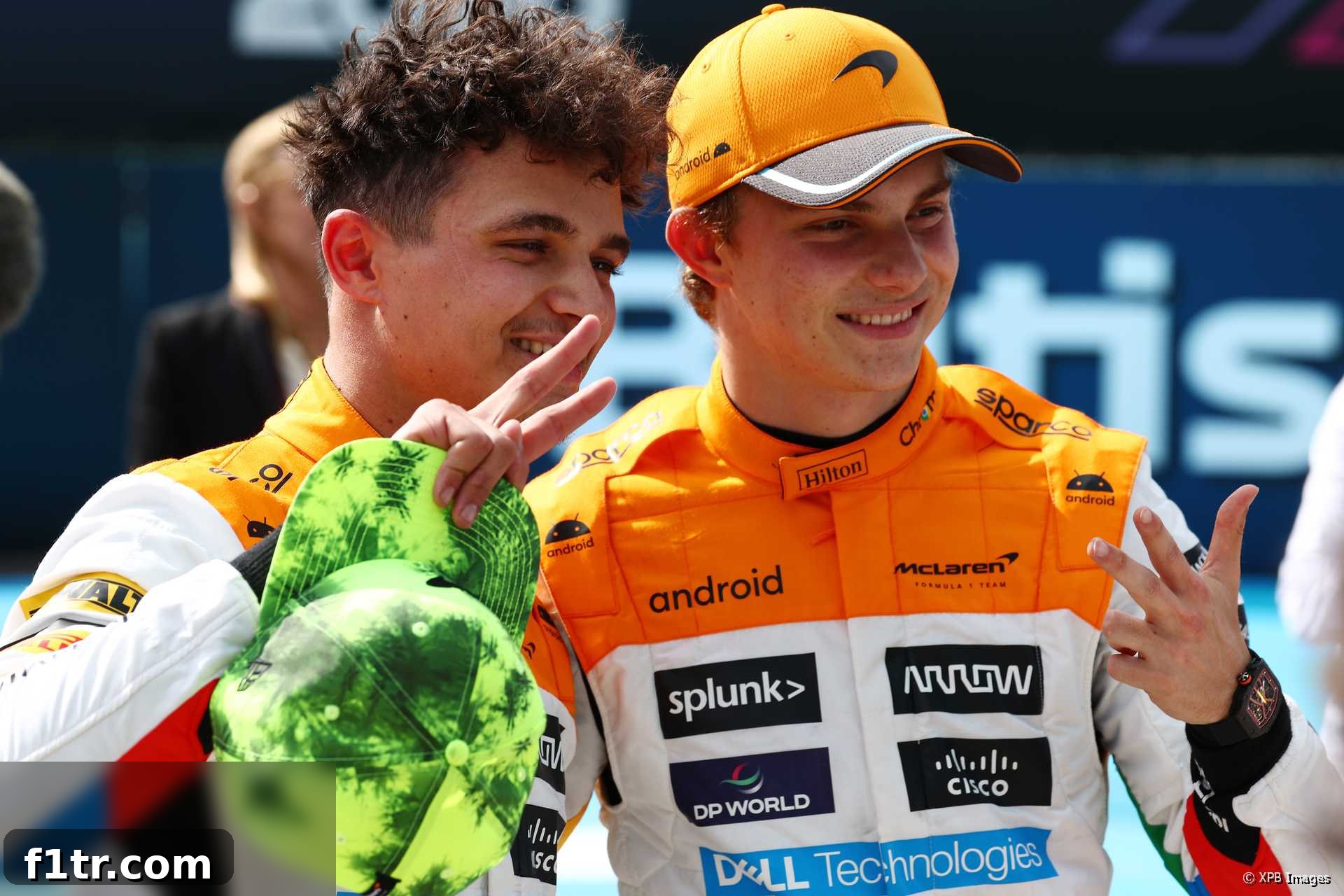
The hallowed grounds of Silverstone bore witness to an electrifying qualifying session for the British Grand Prix, where McLaren, long a revered name in Formula 1, delivered a performance that sent ripples of excitement through the paddock and amongst fans. Lando Norris and Oscar Piastri, piloting their upgraded MCL60s, defied expectations by securing second and third positions on the grid, placing them as the closest challengers to the seemingly untouchable Max Verstappen. This remarkable feat not only reignited hopes for the Woking-based outfit but also earned them widespread acclaim from their rivals, a testament to the significant strides they have made.
While the championship leader, Max Verstappen, predictably claimed his seventh pole position in the opening ten rounds of the 2023 season, the real story unfolded just behind him. The sight of two Papaya-liveried cars occupying the second row was a stark and welcome surprise, underscoring a dramatic resurgence. Norris, securing a sensational P2 in front of his home crowd, and rookie Piastri, achieving a career-best P3, demonstrated not only the newfound pace of their machinery but also their exceptional talent under pressure. This wasn’t merely a good result; it was a statement of intent, suggesting a potential shift in the pecking order of the competitive midfield.
The impressive display from McLaren did not go unnoticed by the reigning world champion himself. Upon being informed by his race engineer, Gianpiero Lambiase, at the conclusion of Q3 that the McLarens had qualified directly behind him, Verstappen’s response was one of genuine appreciation. “That’s a good result for them, they’ve been quick today,” he acknowledged, highlighting the pace the team had shown throughout the session. Speaking further after the session, Verstappen elaborated on his admiration: “It’s great to see both of them up here. A great result for their team. Also where they started off in the year, to see them here, it’s quite impressive as well. So very happy for them. And hopefully, they can also have a very strong race tomorrow.” His comments, coming from a driver whose team has dominated the season, carried significant weight, signifying a recognition of McLaren’s substantial progress from their challenging start to the year.
The McLarens positioned themselves just ahead of the formidable Ferraris of Charles Leclerc and Carlos Sainz Jnr, a clear indication of their newfound competitive edge. The context of this performance is crucial: McLaren had introduced a substantial upgrade package to their car just the weekend prior in Austria, with further enhancements brought to Silverstone. Leclerc, a driver known for his acute understanding of car performance, was quick to commend both the team’s engineering efforts and the drivers’ execution. “They’ve done a great job,” Leclerc stated. “I wouldn’t underestimate also the job that Oscar and Lando have done today, because these are conditions that are very, very difficult. Of course, McLaren has done a step forward, but I believe also that both of the drivers have done a great lap.” His words underscore the dual impact of improved machinery and driver skill, especially in the often-tricky conditions of a British summer qualifying session.
Leclerc’s teammate, Carlos Sainz, echoed the sentiment of admiration for McLaren’s rapid ascent. Sainz, who himself has a keen eye for technical detail, admitted to being profoundly impressed by the strides McLaren had made in boosting the performance of their MCL60 over the initial half of the season. “It’s amazing, the progress that they’ve made recently,” said Sainz. “They’ve brought a lot of upgrades, a bit like us, and I think it’s a track where the McLaren should always be good because they are amazing in the high-speed corners.” This observation from Sainz is particularly insightful, highlighting the specific characteristics of the Silverstone circuit which traditionally favor cars with strong aerodynamic efficiency and stability through fast corners—a traditional strength of McLaren design philosophy. The technical team at Woking seems to have honed this aspect perfectly with their latest iteration of upgrades, allowing Norris and Piastri to truly exploit the circuit’s demanding layout through iconic sections like Maggotts, Becketts, and Chapel.
However, despite the effusive praise for their qualifying heroics, Sainz introduced a note of caution regarding McLaren’s prospects for the main race. His skepticism revolved around whether McLaren would be able to sustain their impressive one-lap pace over a full Grand Prix distance, especially concerning tire management. “Now it’s time to see how the race pace is,” he remarked. “Normally they struggle with deg – a bit like we do – the same kind of issues. So let’s see who comes out on top tomorrow.” This concern about tire degradation, or ‘deg,’ is a common challenge in modern Formula 1 and has historically been a demanding area for many teams, including Ferrari. Sainz’s point raises a crucial question about the delicate balance between outright qualifying speed and enduring race performance, a factor that could heavily influence the final results on Sunday.
Further adding to the cautious optimism was Aston Martin’s seasoned veteran, Fernando Alonso. Known for his pragmatic and often skeptical outlook, Alonso expressed his doubts over whether McLaren’s strongest qualifying performance of the season was a definitive sign that they would become a regular front-running contender for the remainder of the season. “I think they’ve been very fast,” Alonso conceded. “They deserve the position they are in. They’ve been fast and improving, so happy for them. But let’s see tomorrow.” His assessment reflected a broader perspective, focusing on consistency over isolated flashes of brilliance. Alonso drew parallels to previous seasons, noting, “I think McLaren was very fast last year in Austria and Silverstone and they were so-so in the championship. This year they are also fast in certain circuits. So I think we need to go through Budapest and Spa and make a reset after that and see where we are. I think we make the count in Abu Dhabi.” Alonso’s perspective underlines the fluctuating nature of F1 performance, where car characteristics can align perfectly with specific track types, leading to strong results that aren’t necessarily indicative of universal competitiveness. The true measure of McLaren’s resurgence, according to the two-time world champion, will be their performance across a diverse range of circuits, from the high-downforce demands of Budapest to the outright speed of Spa, before making any definitive judgment at the season’s close in Abu Dhabi.
McLaren’s journey from early-season struggles to a dramatic P2 and P3 at Silverstone has been a narrative of relentless development and strategic investment. Their engineering team, led by Andrea Stella, has clearly executed a highly effective upgrade program that has demonstrably transformed the MCL60. This performance not only boosts team morale but also validates the significant efforts behind the scenes. The British Grand Prix often delivers unpredictable and thrilling races, and with McLaren starting from such a strong position, combined with the cautious predictions from their rivals about race pace, Sunday’s event promised to be an enthralling spectacle. Whether McLaren can convert their qualifying heroics into substantial race points and truly mark this as a turning point in their season remains to be seen, but their presence at the sharp end of the grid undoubtedly adds an exciting new dynamic to the 2023 Formula 1 championship.
2023 British Grand Prix
- Norris is “growing” closer to the champion who inspired him to race
- Second supplier part failure ‘a frustrating issue we must solve’ – Alpine
- Albon ‘surprised’ to be quicker than Alonso at end of British GP
- Bottas admits Alfa Romeo ‘were expecting to be better than this’ in 2023
- McLaren now “finding performance quicker” after emulating Red Bull’s design
Browse all 2023 British Grand Prix articles