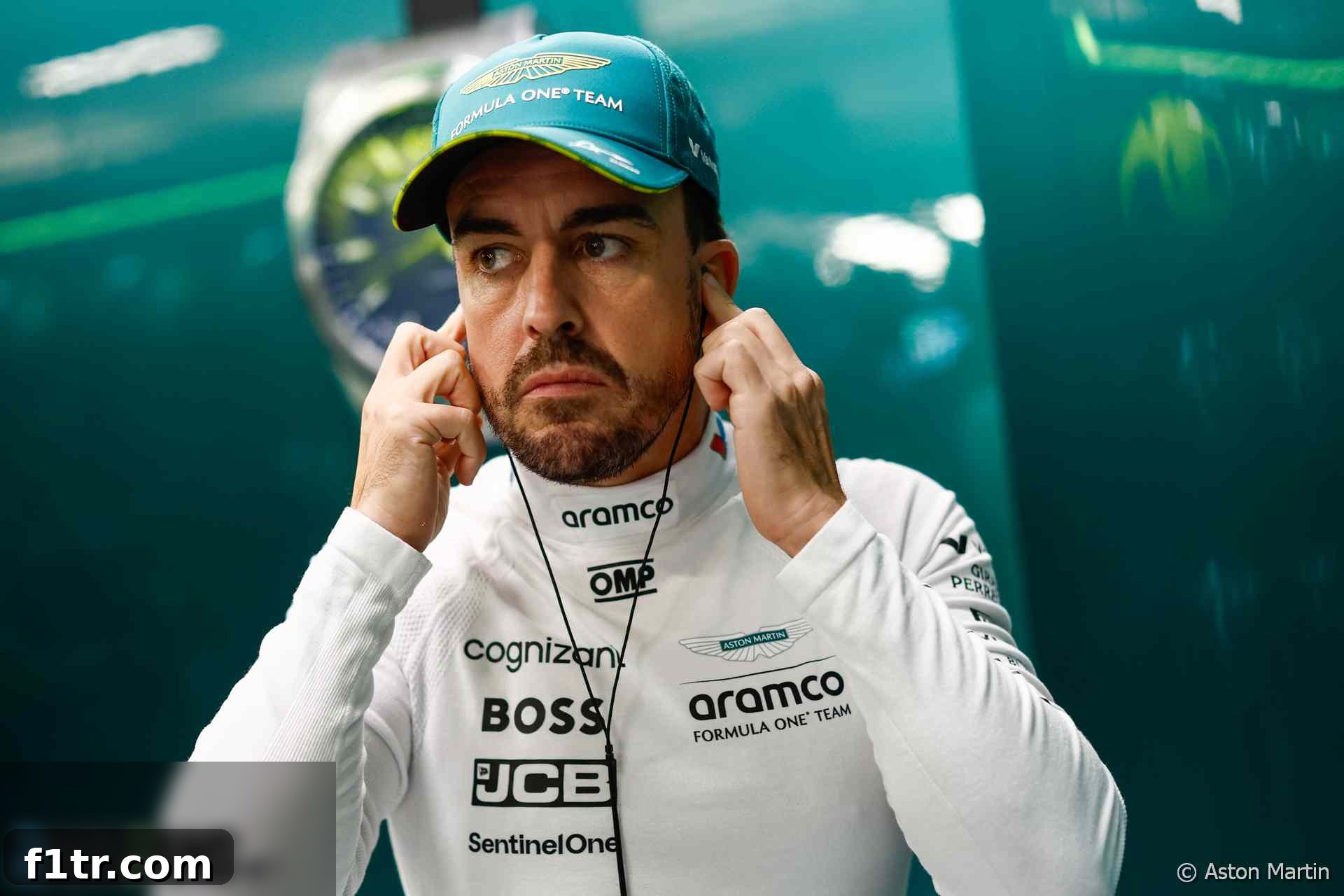
In a candid assessment of Aston Martin’s current struggles, two-time Formula 1 World Champion Fernando Alonso declared that the team would approach the upcoming sprint race at the Brazilian Grand Prix weekend as little more than an extended practice session. This pragmatic stance comes amidst a challenging period for the Silverstone-based squad, as they grapple with a notable lack of pace that has seen both Alonso and his teammate, Lance Stroll, eliminated early in sprint qualifying.
Advert | Become a Supporter & go ad-free
Aston Martin’s decision-making at Interlagos has been heavily influenced by their recent performance slump. Both drivers failed to advance beyond the first round of qualifying for the initial of F1’s two races this weekend, highlighting the team’s ongoing battle to unlock consistent speed. In a telling move, the team has reverted to a floor specification first introduced at the Japanese Grand Prix seven months prior, a clear indicator that their more recent aerodynamic developments have not yielded the desired improvements.
Strategic Sacrifice: Trading Sprint for Grand Prix Glory
Alonso, who will start the sprint race from a lowly 16th position, didn’t mince words when addressing the team’s immediate performance. “We didn’t have the pace in qualifying,” he stated, explaining the strategic compromises made. “We made some changes also after FP1 that we knew that they were maybe detrimental to the pace of the car, but we had to keep ourselves focused for Sunday more than Saturday.” This reveals a deliberate sacrifice of sprint performance to optimize their package for the main event.
The veteran Spaniard further elaborated on the rationale behind this approach. For a team struggling to find grip and speed, the minimal points on offer in a sprint race often don’t justify the risks involved. “In the sprint race, it’s unlikely that we’ll score points. For us, it’s more a free practice,” Alonso asserted. This perspective underlines a shift in priority, where data gathering and setup refinement for the Grand Prix take precedence over a low-reward sprint scramble.
Leveraging F1’s Revised Sprint Regulations
A crucial factor enabling Aston Martin’s strategy is F1’s revised regulations, introduced at the start of the year. These rules now grant teams the invaluable opportunity to alter their cars’ set-ups between the sprint races and qualifying for the Grand Prix. This change provides a tactical window for teams to experiment and fine-tune their cars, a luxury not available under previous sprint formats where parc fermé conditions were much stricter.
Alonso highlighted how Aston Martin intends to exploit this regulatory flexibility. The sprint race, typically a high-intensity, short-form event, transforms into an extended test session. This allows the team to gather vital data under race conditions, evaluate different car behaviors, and confirm setup directions without the pressure of having to chase points they know are likely out of reach. It’s a calculated gamble to forego potential, albeit minimal, sprint points for a better shot at a stronger performance in the more prestigious and points-rich Grand Prix on Sunday.
Alonso’s Critique: The Sprint Format’s Impact on Mid-Field Teams
Alonso was quite vocal about the limited appeal of the current sprint format for teams outside the top echelons of Formula 1. “The sprint race for us really means nothing as there are only eight cars scoring points, and even if you are eighth or seventh, you score one point or two,” he explained. This points system, while rewarding the front-runners, offers scant incentive for those in the middle or back of the grid to push to their absolute limits, especially when factoring in the inherent risks of wheel-to-wheel racing.
The two-time champion continued, “So the format doesn’t reward anything to be fast on Friday night and Saturday. For us, it’s much more focused on Sunday. Sunday is what we need to put all our beans on.” This philosophy underscores a broader dissatisfaction among some teams and drivers regarding the sprint format’s overall value. For teams like Aston Martin, whose championship aspirations are more long-term development-focused rather than immediate points gains in every session, the sprint weekend structure often appears counterproductive.
Indeed, Alonso’s sentiments reveal a deeper strategic decision-making process. The potential for damage in a sprint race, which could compromise the car for the main Grand Prix, is a significant deterrent when only one or two points are at stake. This risk-averse approach prioritizes the integrity of the car and the accumulation of crucial telemetry data over the pursuit of marginal gains. “So that’s the way we treat this weekend, a little bit useless until Saturday afternoon, and it’s the case for this one as well,” Alonso concluded, summarizing his team’s resolute commitment to the Grand Prix.
Lance Stroll’s Alignment and Team’s Collective Challenge
Alonso’s teammate, Lance Stroll, echoed a similar sentiment of frustration and realism. Having qualified on the back row of the grid for the sprint race, Stroll’s assessment was equally blunt: “We just didn’t have the pace to fight for more today.” His comments reflect the team’s collective challenge, indicating that the struggles are systemic rather than isolated to a single driver or car setup. Both drivers are facing the same fundamental issues with the car’s performance, particularly at a demanding circuit like Interlagos.
The alignment between both drivers on the team’s strategy is crucial, especially when facing performance difficulties. It ensures a united front and a shared understanding of the objectives for the weekend. Rather than chasing individual glory in a low-stakes sprint, both Alonso and Stroll are focused on contributing to the team’s broader efforts to improve the car and maximize their chances for the Grand Prix. This unified approach can be vital for team morale and strategic coherence during challenging periods in the championship.
Advert | Become a RaceFans supporter andgo ad-free
Looking Ahead: Hopes for the Brazilian Grand Prix
Despite the disheartening sprint qualifying results, Aston Martin’s focus now firmly shifts to the main event: Sunday’s Brazilian Grand Prix. The team will meticulously analyze all data gathered from Friday’s practice and the sprint race to make informed decisions about the car’s final setup. The ability to make these adjustments post-sprint is a lifeline for teams that initially struggle, offering a second chance to find a competitive window.
Interlagos is known for its unpredictable nature, often featuring changing weather conditions and the likelihood of safety cars. These variables can shuffle the pack and create opportunities for teams starting further down the grid. Aston Martin will be hoping that their strategic sacrifice on Saturday will pay off on Sunday, enabling them to capitalize on any potential chaos or favorable circumstances to climb through the field and secure valuable championship points.
The decision to revert to an older floor specification might also suggest a deeper understanding of the car’s current limitations and a desire to work with a known quantity. While it signifies a step back in terms of raw development, it could provide a more stable platform from which to gather reliable data and make targeted improvements for the remainder of the season. The team’s long-term vision for competing at the front of Formula 1 necessitates this kind of strategic thinking, even if it means enduring short-term setbacks.
The Broader Season Context and Aston Martin’s Trajectory
Aston Martin started the season with strong performances, surprising many with their pace and challenging the established front-runners. However, the development race in Formula 1 is relentless, and other teams have seemingly outpaced them in recent months. This strategic pivot at Interlagos – treating a competitive session as practice – is indicative of a team reassessing its trajectory and focusing on fundamental improvements rather than superficial point-scoring.
The performance in Brazil will be a crucial test of their analytical capabilities and strategic execution. A strong Grand Prix race, even from a compromised grid position, could provide a much-needed morale boost and validate their unconventional approach to the sprint weekend. Conversely, another challenging Sunday could prompt more questions about their development path and overall car concept heading into the final races of the season and the winter break.
Ultimately, Fernando Alonso’s pragmatic declaration reflects a seasoned driver’s understanding of Formula 1’s nuanced challenges. For Aston Martin, the Brazilian Grand Prix weekend is not just about points; it’s about learning, adapting, and laying the groundwork for future competitiveness. The sprint race, in this context, becomes a means to an end – a valuable data-gathering exercise aimed at maximizing their potential in the race that truly matters on Sunday.
Miss nothing from RaceFans
Get a daily email with all our latest stories – and nothing else. No marketing, no ads. Sign up here:
2024 Brazilian Grand Prix
- “I didn’t really want to come back” – Hamilton explains cryptic Brazil radio message
- Ocon’s role in Gasly’s Q2 exit was almost another ‘flare-up’ at Alpine – Oakes
- Interlagos must improve “very bad” new track surface for 2025, say F1 drivers
- “That’s how we silence them”: Verstappen’s stunning Brazil win from start to finish
- Verstappen now has as many wins as F1’s first six world champions combined
Browse all 2024 Brazilian Grand Prix articles