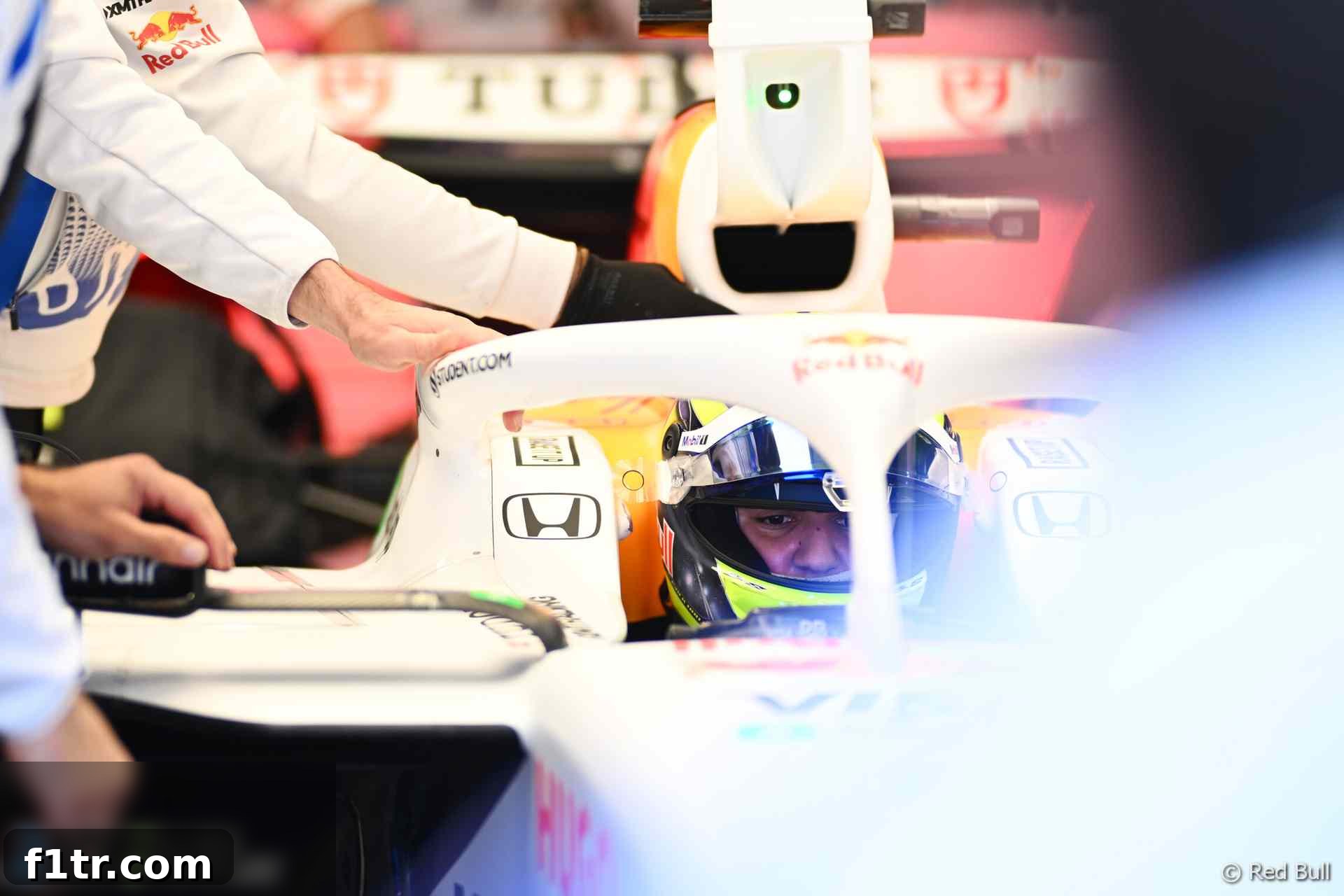
In a testament to his burgeoning talent and unwavering resolve, Racing Bulls driver Isack Hadjar delivered a remarkable qualifying performance at the Japanese Grand Prix, securing an impressive seventh position on the grid. What makes this achievement particularly noteworthy is that Hadjar battled through excruciating pain caused by a persistent seat belt issue, which severely compromised his initial runs and threatened to derail his entire session. His ability to overcome such a significant challenge to reach Q3 and outpace seasoned competitors underscored a maturity beyond his years in the high-stakes environment of Formula 1.
The Suzuka International Racing Course is renowned for its demanding layout, a true test of both car and driver. Its high-speed corners, rapid changes in direction, and iconic ‘S’ curves require absolute precision and immense physical endurance. For a driver to compete at their peak, comfort and stability within the cockpit are paramount. Even the slightest discomfort can translate into fractions of a second lost, or worse, a critical lapse in concentration. This makes Hadjar’s performance, achieved while enduring severe physical discomfort, all the more exceptional.
The problem with Hadjar’s seat belt strap, which was digging into a sensitive area, first surfaced during the final practice session earlier in the day. Despite the team’s efforts, a definitive solution could not be implemented before qualifying began, leaving the young driver to face the intense pressure of Q1 with an unresolved issue. This ongoing discomfort cast a significant shadow over his initial runs, leading to genuine concern that he might fail to progress beyond the first segment of qualifying.
Recalling the challenging experience, Hadjar explained to the official F1 channel, “It compromised my first run in Q1 significantly. The pain was distracting, making it difficult to find the rhythm and push the car to its absolute limit. I genuinely feared I might not make it through to Q2.” He further elaborated on the mental battle, “Thankfully, on that crucial final lap in Q1, I was able to push through the pain and put together a lap good enough to advance. After that, I could somewhat reset mentally and focus purely on driving fast, and remarkably, it worked.” His resilience in that moment was a clear indication of his mental fortitude, a vital attribute for any aspiring Formula 1 driver.
Rising to the Challenge: A Q3 Appearance Against Odds
Against all expectations, and despite the lingering discomfort, Hadjar not only navigated through Q1 but also progressed into Q2, ultimately making it into the top-ten shootout of Q3. This was a significant achievement, especially when considering that his more experienced team mate, Liam Lawson, failed to reach the final session. The pressure on Hadjar, a driver still finding his footing in the competitive F1 landscape, was immense. Yet, he rose to the occasion, demonstrating an impressive ability to perform under duress.
The highlight of his qualifying session was undoubtedly his final run in Q3. With the seat belt issue seemingly mitigated, Hadjar unleashed a blistering lap that placed him an incredible seventh on the grid, even besting seven-time world champion Lewis Hamilton. Reflecting on his near-perfect lap, Hadjar described it as “Nearly fantastic.” He added, with a touch of a perfectionist’s frustration, “I left, like, a whole tenth in the final chicane, which is quite disappointing, but the rest of the lap was absolutely fantastic.” This minor regret, despite such a stellar performance under difficult circumstances, speaks volumes about his high standards and ambition.
For the Racing Bulls team, Hadjar’s Q3 appearance was a much-needed boost, demonstrating the potential within their young driver lineup. Securing a top-seven grid slot at a circuit like Suzuka, known for its unforgiving nature, is a significant marker of progress and competitiveness for the team. It allows them to start the race in a strong strategic position, offering greater opportunities for points on Sunday.
Inside the Cockpit: Hadjar’s Radio Messages on His Seat Belt Problem
The struggle within the cockpit was vividly captured through Hadjar’s radio communications with his race engineer, Pierre Hamelin. These exchanges offered a rare glimpse into the immediate challenges a driver faces and the rapid problem-solving required during a live qualifying session. Following his initial run in Q1, Hadjar immediately alerted Hamelin to the problem, initiating a frantic effort to find a solution.
Their attempts to address the issue between his two Q1 runs were further complicated when Hadjar was randomly called to visit the weigh bridge, a mandatory procedure that consumed precious time the team desperately needed for adjustments. The following transcript reveals the unfolding drama:
| Hadjar | Still same issue, man. Still same issue. In the cockpit. |
| Hamelin | Charge off. Reminder, SOC toggle. |
| Hamelin | SOC toggle on. |
| Hamelin | Box, box. Push on your in-lap. |
| Hamelin | Offset forwards. |
| Hadjar | Yeah… |
| Hamelin | Okay so Liam did a 29.0, your lap time 29.2. |
| Hadjar | I don’t know what’s wrong with me. Fucking hell. |
| Hamelin | Okay we’ll try to adjust it in the garage. Keep your pace up. |
| Hadjar | I mean I just can’t focus, I have so much lap time. It’s just not drive-able. |
| Hamelin | Understood, Isack. We’ll try to reposition it in the garage. |
| Hamelin | What about the flap, Isack? |
| Hadjar | Yeah I’m happy. |
| Hamelin | Copy that. |
| Hadjar | It’s not the main issue. |
| Hamelin | Understood, we’ll help you. We will help you in the garage. We’ll do everything we can. |
| Hamelin | You’re on the bridge. |
| Hadjar | The belts are twisted, you know? |
| Hamelin | Okay, we’ll help you. |
The urgency and frustration in Hadjar’s voice were palpable. The comparison to his teammate Lawson’s lap time further highlighted the disadvantage he was operating under. Hamelin’s calm but reassuring responses aimed to keep Hadjar focused, promising a fix in the garage. The description of “twisted belts” points to a severe ergonomic issue that would make high-speed cornering and braking incredibly painful and distracting.
The Unyielding Challenge: Heading Back Out
Despite the team’s best intentions, as Hadjar headed back out for his crucial final run in Q1, he was dismayed to discover that the problem had not been entirely solved. This realization brought a fresh wave of despair and the fear that his qualifying hopes might be extinguished prematurely. The raw honesty in his radio messages conveyed the immense pressure and emotional toll of the situation:
| Hadjar | If this is what ruins our qualifying, just so you know, I’m very sorry. |
| Hamelin | That’s okay I know you are doing your best on there. |
| Hadjar | Mate the issue is still here. I can’t believe it. Can’t believe it. |
| Hamelin | Copy that Isack. Sorry to hear that. Let’s try to nurse it. Try to do what you can in the back straight. |
This exchange paints a vivid picture of a driver pushing past physical agony and mental frustration. His apology to the team, even while suffering, demonstrated his dedication and the shared burden of performance. Hamelin’s understanding and encouraging words were vital, urging Hadjar to “nurse it” and make the best of an impossible situation.
A Moment of Relief: A Quick Fix Between Sessions
Against all odds, Hadjar managed to set a lap time quick enough to squeeze into Q2. This provided a crucial window of opportunity for the team to address the problem more effectively. Recognizing the severity of the issue, his team agreed to a daring strategy: Hadjar would quickly climb out of the car between the first two sessions to allow the mechanics a final, urgent attempt at a solution. This maneuver, while risky due to the tight time constraints, proved to be a turning point:
| Hadjar | Mate it’s… I can’t believe that. |
| Hamelin | Okay do we need to jump out of the car quickly, question? |
| Hadjar | Yes |
| Hamelin | Okay, push on your way in, please, push on your way in. |
| Hadjar | Copy. |
| Hamelin | Okay. This will have to be quick, Isack. We’ll try to do something. |
The decision to let Hadjar exit the car mid-session was a high-pressure gamble, but it paid off. The brief intervention by the mechanics managed to alleviate the worst of the discomfort, allowing Hadjar to focus almost entirely on his driving for the remainder of qualifying. This quick resolution was instrumental in his ability to deliver those outstanding laps in Q2 and Q3, culminating in his top-seven grid position. His journey through qualifying serves as a powerful reminder of the immense challenges F1 drivers face, both seen and unseen, and the incredible mental and physical strength required to succeed at the pinnacle of motorsport.
Related Articles: Exploring the Japanese Grand Prix and F1 Insights
- McLaren’s Strategy: Balancing Driver Aspirations – An In-depth Look at Team Dynamics
- Verstappen’s Assessment: Norris on Rival’s Car and Team Performance
- Debating Dominance: Verstappen’s McLaren Claim and Piastri’s Perspective
- Race Strategy Evolution: Sainz on Pit Stop Rules and Overtaking at Suzuka
- Tactical Masterclass: Mercedes Analyzes Verstappen’s Pole-Winning Out-Lap at Suzuka
Browse all Japanese Grand Prix articles