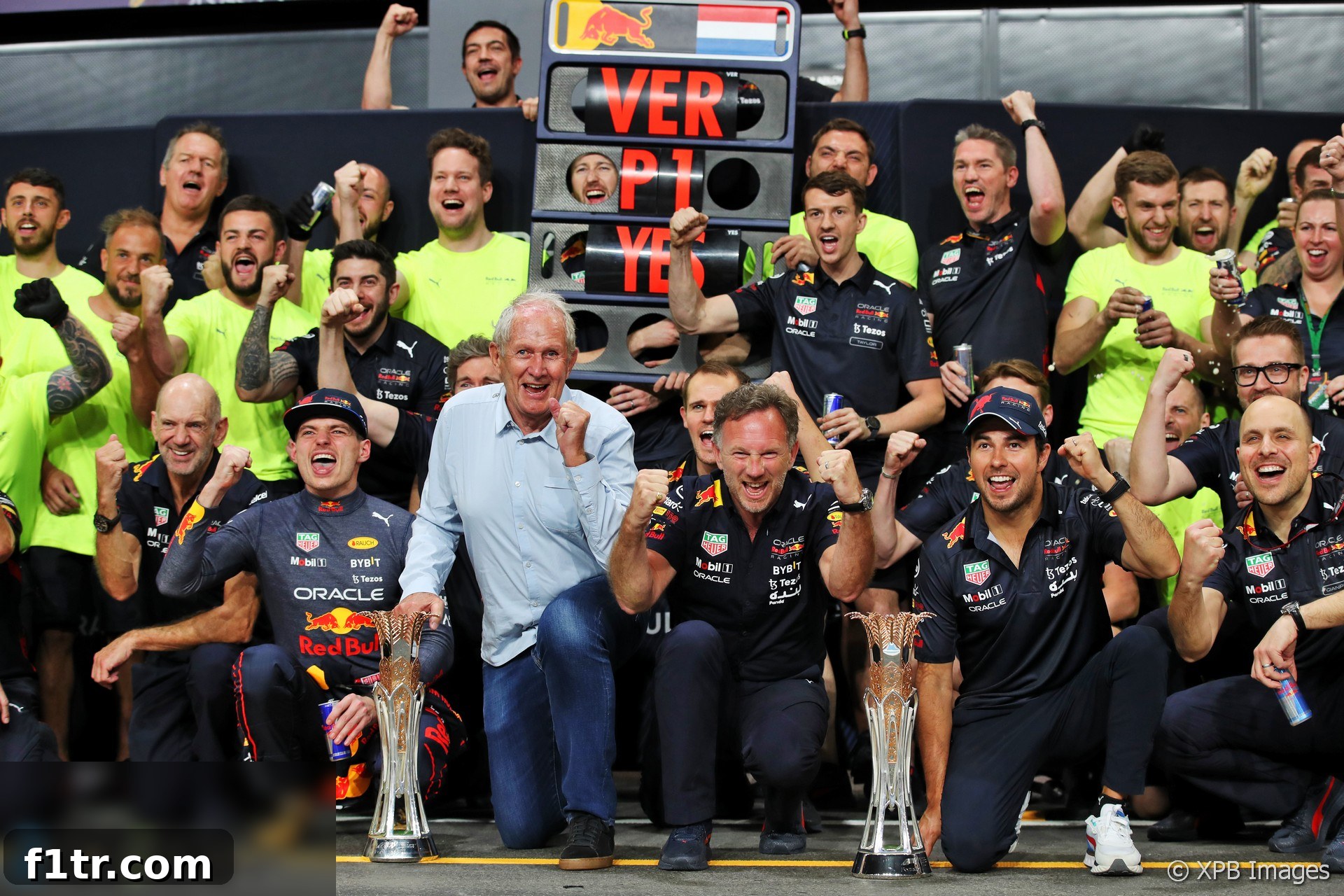
Red Bull’s Astonishing Saudi Arabian Grand Prix Victory: A Triumph of Late-Season Development
Red Bull Racing’s triumph at the Saudi Arabian Grand Prix was a particularly significant milestone, marked by Max Verstappen’s hard-fought victory. According to team principal Christian Horner, this win held special meaning because the Milton Keynes-based squad initiated work on their 2022 challenger, the RB18, considerably later than many of their key rivals. This late start, a direct consequence of the intense 2021 championship battle, set the stage for what would become a remarkable display of engineering prowess and team dedication.
Max Verstappen delivered Red Bull’s first victory of the nascent 2022 Formula 1 season, engaging in a thrilling duel with Ferrari’s Charles Leclerc. The Dutchman ultimately passed his Monegasque competitor with just four laps remaining at the formidable Jeddah Corniche Circuit, cementing a win that reverberated through the paddock. This early season success provided a vital injection of morale and confidence, validating the team’s ambitious approach to the sport’s radical new technical regulations.
The Unconventional Path to Glory: Overcoming a Compressed Development Timeline
The journey to Jeddah’s top step of the podium was anything but straightforward for Red Bull. Having battled Mercedes and Lewis Hamilton tooth and nail for both the Drivers’ and Constructors’ championships right up to the contentious final race of the 2021 season, Red Bull found its resources and focus heavily committed to the outgoing RB16B car. This prolonged championship fight meant that the team had less time to divert its attention to the ground-up design and development of the new-generation RB18, which was mandated by Formula 1’s sweeping technical overhaul for 2022.
Horner openly acknowledged this strategic disadvantage, stating, “What I’m particularly pleased with is we probably came on to the development of this car later than our rivals.” This comment highlighted the extraordinary challenge faced by the entire Red Bull organization. While other teams, notably Ferrari, had made strategic decisions to halt in-season development on their 2021 cars much earlier to fully commit resources to the 2022 project, Red Bull did not have that luxury. Ferrari, for instance, had previously indicated they undertook virtually no in-season development work last year, instead prioritising their approach to F1’s new technical rules with an eye on long-term competitive advantage.
The Herculean Effort at Milton Keynes: A Testament to Team Dedication
The delayed start to the RB18 project placed immense pressure on the entire Red Bull Racing team at their Milton Keynes factory. Engineers, designers, aerodynamicists, and mechanics were all tasked with an accelerated development timeline, pushing the boundaries of what was achievable in such a compressed period. Horner showered praise upon his workforce, recognising the monumental effort involved. “The whole team in Milton Keynes, after the effort that went into [RB]16B last year, the lateness of that championship, the compressed time for this car, they’ve worked incredibly hard,” he stated. The Saudi Arabian Grand Prix victory served as a powerful vindication of their tireless dedication, injecting a much-needed surge of energy and motivation into the factory.
This success story underscores the intricate balance teams must strike between current season performance and future regulatory changes. Red Bull’s ability to transition from a championship-winning 2021 campaign directly into a competitive 2022 season, despite the significant temporal handicap, speaks volumes about the depth of talent and efficient processes within the organisation. It’s a narrative that resonates deeply within Formula 1, illustrating that sheer willpower and smart execution can overcome logistical constraints.
Jeddah Corniche Circuit: A Battleground of Strategic Brilliance and Raw Pace
The Saudi Arabian Grand Prix itself was a spectacle, showcasing the close-quarters racing that the new 2022 regulations were designed to promote. The high-speed Jeddah Corniche Circuit provided a dramatic backdrop for the evolving rivalry between Max Verstappen and Charles Leclerc. Their battle was not merely about raw pace but also about shrewd strategy, precise timing, and psychological warfare on the track. Both drivers displayed exceptional skill, pushing their machines and each other to the absolute limit in a bid for victory. The nature of their fight, characterised by multiple overtakes and strategic deployment of DRS, was a thrilling advertisement for the new era of Formula 1.
This head-to-head encounter also offered valuable insights into the performance characteristics of the new cars. While Ferrari demonstrated impressive straight-line speed and excellent traction, Red Bull showcased strong top-end pace and arguably better tyre management in crucial moments. The ebb and flow of the lead between Verstappen and Leclerc highlighted the finely balanced competitive landscape that has emerged with the new technical rules, promising an enthralling season ahead.
The Dawn of a Development War: Unlocking Potential in Immature Machines
Despite the elation of the early victory, Christian Horner remained pragmatic about the road ahead, anticipating an “intense development fight” with Ferrari and other competitors over the coming rounds. He emphasised that the 2022 cars, still in their infancy under the new regulations, possess significant untapped potential. “The first two races have been great racing between the two teams,” Horner observed. “And I think that it’s now going to be about development, about unlocking potential with these cars that are still very immature.”
The sweeping changes to aerodynamics, particularly the reintroduction of ground effect, mean that teams are still grappling with a deep understanding of their vehicles. Every race weekend, every telemetry data point, and every simulator run provides crucial information that can unlock significant performance gains. This “immature” state of the cars suggests that the early season pecking order could shift dramatically as teams gain a clearer comprehension of the complex interactions between aerodynamics, suspension, and tyres.
The Crucial Role of Data and Tyre Understanding in the Development Race
The immediate future will see an accelerated period of development, especially through the spring. Teams will be relentlessly pushing updates to their cars, aiming to extract every last tenth of a second. Horner highlighted the critical aspects of this development phase: “We can see Ferrari are very, very quick. It’s going to be a very busy period through the rest of the spring now to try and get performance to the cars and understand how the tyres are working and so on over these next few races.”
Understanding the Pirelli tyres is always a cornerstone of F1 performance, but it takes on added significance with new car concepts. How the tyres interact with the increased downforce generated by ground effect, how they degrade under different fuel loads and track temperatures, and how drivers can best manage them for optimal race pace and strategy – these are all questions that teams are actively seeking to answer. The ability to quickly iterate and implement effective upgrades, backed by robust data analysis and simulation, will be paramount in establishing a dominant position as the season progresses. This development battle is not just about raw engineering; it’s about intelligence, efficiency, and adaptability.
Red Bull’s “Creative Solution” to F1 Regulations: A Foundation for Success
A key aspect of Red Bull’s confidence stems from their interpretation of Formula 1’s new technical regulations. Horner expressed conviction that their design philosophy has yielded a strong foundation for the season. “You can see there’s a big variance of interpretations of the rules and I think that we’ve come up with a creative solution, and I think it gives us good potential for the season ahead,” he elaborated. The diverse range of design concepts seen across the grid, from Ferrari’s distinct sidepods to Mercedes’ minimal solution, underscores the scope for different interpretations of the new rulebook.
Red Bull’s “creative solution” refers to their unique aerodynamic package, which appears to have struck an effective balance between downforce generation and drag reduction. The early victory at Jeddah serves as a powerful validation of this design approach, proving that their conceptual framework is competitive and capable of winning races. This initial success not only bolsters team morale but also provides a clear direction for future development, allowing engineers to focus on refining an already potent package rather than grappling with fundamental design flaws. The potential inherent in their car’s design, as Horner suggests, could be a decisive factor in the unfolding championship narrative.
A Glimpse into the Future: The Evolving 2022 F1 Season
The first two races of the 2022 season have set the stage for what promises to be an enthralling championship fight. The rivalry between Red Bull and Ferrari, spearheaded by the compelling individual battles between Max Verstappen and Charles Leclerc, has quickly become the defining narrative. This new dynamic offers a fresh and exciting spectacle for fans, moving beyond the long-standing Mercedes-Red Bull dominance of recent years.
As teams continue to unlock the full potential of their new-generation cars, the competitive landscape will undoubtedly evolve. The relentless pursuit of performance, coupled with strategic decisions and operational excellence, will determine who emerges victorious. Red Bull’s early triumph in Saudi Arabia, achieved against the backdrop of a delayed start, positions them as formidable contenders, ready to engage in a season-long development war that is sure to captivate the world of Formula 1.
Related Articles and Further Reading on the 2022 Saudi Arabian Grand Prix
- Vettel will return to race for Aston Martin at Australian Grand Prix
- Mercedes “a second per lap” off Red Bull’s pace – Russell
- Transcript: How Verstappen fought Leclerc on his radio and on the track in Jeddah
- F1 intends to keep racing in Saudi Arabia despite missile attack
- Paddock Diary: 2022 Saudi Arabian Grand Prix
Browse all 2022 Saudi Arabian Grand Prix articles