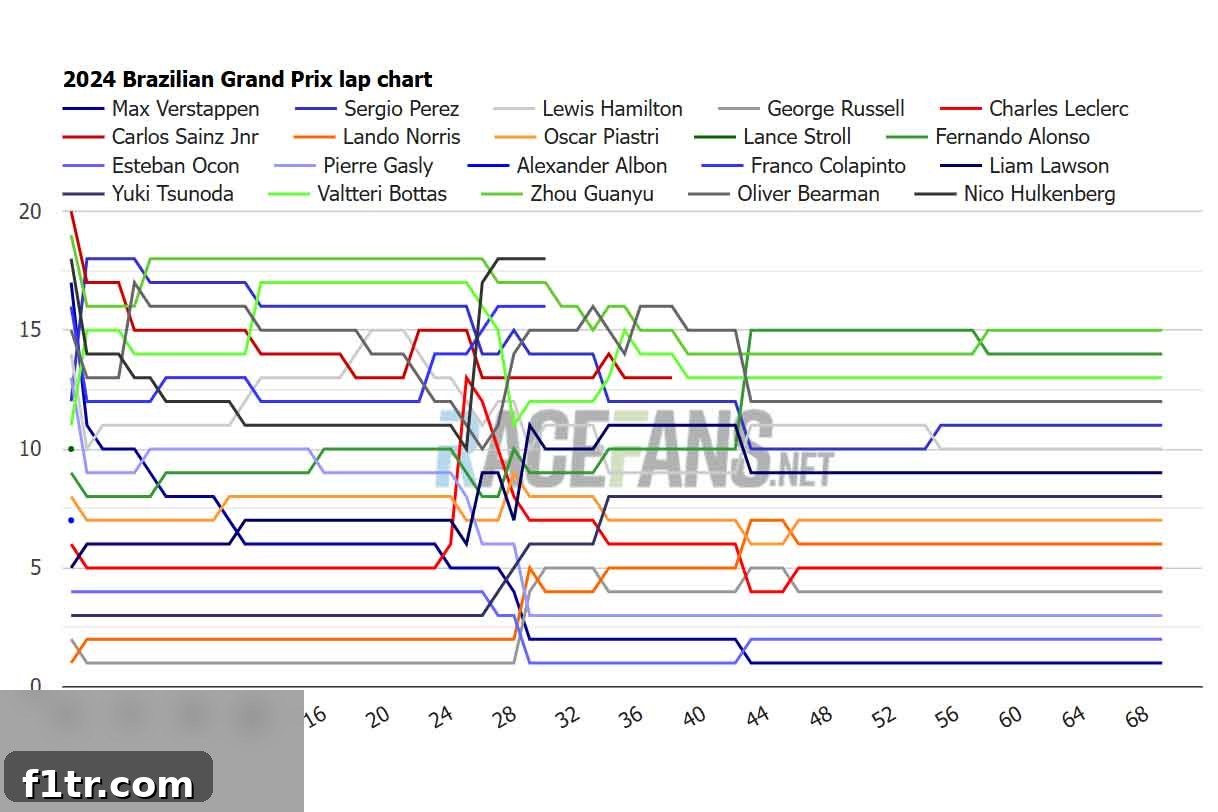
In a Brazilian Grand Prix marked by relentless rain and unpredictable conditions, Ferrari found themselves under intense scrutiny for a tactical decision concerning Charles Leclerc that ultimately failed to deliver the desired outcome. The weekend at Interlagos was a masterclass in challenging weather racing, pushing teams and drivers to their absolute limits, and exposing the razor-thin margins between triumph and strategic miscalculation.
Advert | Become a Supporter & go ad-free
(Dynamic ad content would appear here.)
As the heavens opened, most teams opted for a cautious approach, delaying tyre changes until an opportune moment presented itself – typically under a Virtual Safety Car (VSC), Safety Car (SC) period, or even a red flag. These interventions offer the crucial advantage of minimal to zero time loss in the pits, preserving vital track position. However, Ferrari chose a different path for Leclerc, bringing him in for fresh tyres during full green flag running, a move universally acknowledged as the most detrimental to a driver’s race time and track placement.
This bold, some might say audacious, call from the Scuderia immediately raised questions across the paddock and among fans. At the point of the pit stop, Leclerc was running comfortably in fifth position, maintaining a respectable gap to his rivals, including Max Verstappen who was trailing him. The prevailing theory suggested that Ferrari might have been attempting an ‘undercut’ – a strategic manoeuvre to gain track position by pitting earlier than a competitor, hoping the fresh tyres would allow their driver to set faster lap times and emerge ahead once the competitor also pitted. Perhaps they anticipated Red Bull would soon bring Verstappen in, and sought to preempt this.
However, any hopeful advantage Ferrari sought quickly evaporated. Upon exiting the pits, Leclerc immediately found himself embroiled in traffic, specifically stuck behind the Haas of Oliver Bearman and the Mercedes of Lewis Hamilton. This was a critical miscalculation; Ferrari either overestimated Leclerc’s ability to clear these cars quickly with his fresh rubber, or they misjudged their relative pace. Instead of a swift progression, Leclerc spent two agonizing laps losing valuable time, battling through the spray and sacrificing the very track position the pit stop was meant to enhance. He only managed to pass them when Bearman and Hamilton eventually pitted themselves, albeit under a subsequent VSC period, further highlighting the initial strategic blunder.
Had the race conditions evolved differently, Ferrari’s gamble might have paid off. There was a scenario where, as the rain intensified, Leclerc, on his newly fitted intermediate tyres and with them up to optimal operating temperature, could have held a significant advantage over competitors still struggling on worn rubber. This foresight, however, failed to align with the unpredictable nature of the Interlagos circuit and the rapidly changing weather, leaving Ferrari’s strategy looking isolated and ultimately flawed. The track and race conditions did not, unfortunately for them, materialise as hoped, turning a potentially inspired call into a clear setback.
Adding to the strategic woes, Leclerc was also running ahead of Pierre Gasly when he made his green flag stop. Unlike Leclerc, neither Verstappen nor Gasly had the chance to pit during the fleeting VSC period that followed, which would have offered a cheaper alternative. Consequently, Leclerc plummeted down the order, falling behind both drivers he had been comfortably ahead of. They, along with many others, would eventually make their tyre changes under the more forgiving conditions of a red flag period, further accentuating the cost of Ferrari’s early stop.
When the race eventually restarted, Leclerc found himself P7, a disheartening drop from his earlier strong position. He demonstrated resilience, clawing back positions from Yuki Tsunoda, and then making impressive overtakes on Lando Norris and George Russell during the second restart. Yet, the overall damage had been done, and he later fell behind the Mercedes pair once more. Speaking to the official F1 channel after the race, Leclerc did not mince words, lamenting that the pit strategy had left him “on the back foot” throughout the crucial stages.
Advert | Become a RaceFans supporter andgo ad-free
(Dynamic ad content would appear here.)
“We paid the price a lot,” Leclerc stated candidly. “In the first stop we stopped too early and ended up in the traffic and that cost us three or four positions. So then to come back from that was very difficult.” Despite the frustrations, he highlighted a positive takeaway amidst the challenging circumstances. “But P5 in front of both McLarens, at least it’s a damage limitation weekend where we are only losing four points to them today, which could have been a lot worse.” This perspective underscores the intense constructors’ championship battle, where every point is critical, and mitigating losses can be as important as outright gains.
Beyond the strategic blunders, Ferrari’s weekend was also hampered by the inherent characteristics of their SF-24 car in the treacherous wet conditions. Both drivers reported significant struggles with the car’s balance, a critical factor when grip is at a premium. Carlos Sainz Jnr, Leclerc’s teammate, endured an even tougher day, crashing twice as he grappled with the challenging machine. Leclerc echoed his teammate’s sentiments, bluntly stating that they were “just not fast enough” and that the car was “extremely difficult to drive.”
He elaborated on the specific handling traits: “Very, very pointy, very digital, very oversteer-y and it was very difficult to drive.” This description paints a vivid picture of a car that was twitchy and unpredictable, making it incredibly demanding to control at high speeds on a slippery track. In such conditions, driver confidence and a stable platform are paramount, and the SF-24 evidently lacked the latter, forcing its drivers into a constant battle to keep it on the road, let alone extract maximum performance.
Despite these difficulties, Leclerc maintained a philosophical outlook. “On the other hand, I felt with what we had, we did the best, more or less, we could do,” he added, acknowledging the limits of their package on the day. He also paid tribute to the frontrunners, highlighting their exceptional performance: “If you look at the top three, I think these are the three drivers that put no foot wrong on such a long race, and this is very difficult, and they deserve to be on the podium.” This recognition underscored the immense skill required to master the challenging conditions, a standard Ferrari evidently struggled to meet.
In stark contrast to Ferrari’s struggles, Max Verstappen delivered yet another masterclass in wet-weather driving. After steadily working his way through the field, Verstappen asserted his dominance once he passed Esteban Ocon to seize the lead on lap 43. From that moment, his pace was simply unmatched. Not only did he set the fastest lap of the race, a staggering full second quicker than anyone else, but he also clocked eight additional laps that would have been quick enough to earn the bonus point for fastest lap. This phenomenal consistency and outright speed in the most demanding conditions cemented his status as the benchmark, providing a stark contrast to Ferrari’s strategic and performance woes.
Advert | Become a RaceFans supporter andgo ad-free
(Dynamic ad content would appear here.)
2024 Brazilian Grand Prix Race Dynamics
The Brazilian Grand Prix was a race defined by its strategic complexity and the constant reshuffling of positions due to the evolving weather and various safety car interventions. Observing the detailed lap positions, one could clearly see the dramatic shifts. Charles Leclerc’s early pit stop, for instance, visibly dropped him several places, highlighting the immediate penalty of pitting under green flag conditions when rivals would later benefit from VSC or red flag stops. Conversely, drivers who patiently waited for opportune moments, or those with superior wet-weather pace like Max Verstappen, steadily climbed the order, demonstrating the critical impact of both strategy and raw performance.
(Dynamic lap positions chart data would be displayed here, showing driver positions on every lap.)
Further analysis of the race charts, which plot the gaps between drivers relative to the leader’s average lap time, revealed the ebb and flow of performance. The dramatic swings in conditions meant that even seemingly large gaps could be eaten away rapidly, or conversely, extended by a driver finding an optimal rhythm on track. The periods of intense rain created significant disparities in pace, with some drivers excelling and others visibly struggling, making for a highly dynamic and unpredictable race narrative.
(Dynamic race chart data would be displayed here, illustrating gaps between drivers over laps.)
Advert | Become a RaceFans supporter andgo ad-free
(Dynamic ad content would appear here.)
2024 Brazilian Grand Prix Lap Times
An examination of the individual lap times further underscored the varying performance levels throughout the race. While Max Verstappen’s blistering pace in the latter stages was evident across many laps, the data also revealed the struggles faced by drivers attempting to manage worn tyres or battling difficult car characteristics. Fluctuations in track conditions meant that optimal lap times were often achieved at different points by different drivers, depending on their tyre choice and track position, providing valuable insights into their race management strategies.
(Dynamic lap times chart data would be displayed here, showing individual lap times.)
2024 Brazilian Grand Prix Fastest Laps
The fastest laps set by each driver serve as a testament to their raw pace and the peak performance they could extract from their machinery at any given point in the race. Unsurprisingly, Max Verstappen led the pack, showcasing his exceptional speed and control in challenging conditions. However, the close grouping of several other drivers, including those from McLaren and Ferrari, indicates moments of strong performance across various teams despite the overall strategic and car-handling difficulties.
| Rank | # | Driver | Car | Lap time | Gap | Avg. speed (kph) | Lap no. |
|---|---|---|---|---|---|---|---|
| 1 | 1 | Max Verstappen | Red Bull-Honda RBPT | 1’20.472 | 192.77 | 67 | |
| 2 | 4 | Lando Norris | McLaren-Mercedes | 1’21.517 | 1.045 | 190.3 | 67 |
| 3 | 81 | Oscar Piastri | McLaren-Mercedes | 1’21.532 | 1.060 | 190.26 | 69 |
| 4 | 16 | Charles Leclerc | Ferrari | 1’21.631 | 1.159 | 190.03 | 60 |
| 5 | 63 | George Russell | Mercedes | 1’21.645 | 1.173 | 190 | 66 |
| 6 | 10 | Pierre Gasly | Alpine-Renault | 1’21.645 | 1.173 | 190 | 66 |
| 7 | 31 | Esteban Ocon | Alpine-Renault | 1’21.771 | 1.299 | 189.71 | 64 |
| 8 | 22 | Yuki Tsunoda | RB-Honda RBPT | 1’21.828 | 1.356 | 189.57 | 69 |
| 9 | 44 | Lewis Hamilton | Mercedes | 1’22.041 | 1.569 | 189.08 | 69 |
| 10 | 30 | Liam Lawson | RB-Honda RBPT | 1’22.123 | 1.651 | 188.89 | 67 |
| 11 | 11 | Sergio Perez | Red Bull-Honda RBPT | 1’22.143 | 1.671 | 188.85 | 67 |
| 12 | 14 | Fernando Alonso | Aston Martin-Mercedes | 1’22.293 | 1.821 | 188.5 | 59 |
| 13 | 50 | Oliver Bearman | Haas-Ferrari | 1’22.494 | 2.022 | 188.04 | 64 |
| 14 | 77 | Valtteri Bottas | Sauber-Ferrari | 1’22.877 | 2.405 | 187.17 | 67 |
| 15 | 24 | Zhou Guanyu | Sauber-Ferrari | 1’23.058 | 2.586 | 186.77 | 65 |
| 16 | 27 | Nico Hulkenberg | Haas-Ferrari | 1’23.764 | 3.292 | 185.19 | 21 |
| 17 | 55 | Carlos Sainz Jnr | Ferrari | 1’24.201 | 3.729 | 184.23 | 19 |
| 18 | 43 | Franco Colapinto | Williams-Mercedes | 1’24.296 | 3.824 | 184.02 | 21 |
Advert | Become a RaceFans supporter andgo ad-free
(Dynamic ad content would appear here.)
2024 Brazilian Grand Prix Tyre Strategies
Tyre strategy was perhaps the most pivotal element of the Brazilian Grand Prix, with teams constantly weighing the risks and rewards of different compounds and pit stop timings. The fluctuating wet conditions meant that intermediate tyres were the primary choice for much of the race, but the exact moment to switch, or whether to gamble on full wets if conditions worsened, was a high-stakes decision. Leclerc’s early intermediate stop under green conditions stood out as an outlier, contrasting with the more conventional approaches seen elsewhere, where teams patiently awaited safety car periods for a ‘free’ stop. The varying number of stops and tyre compounds used by each driver across the grid painted a complex picture of adaptation to a truly challenging environment.
(Dynamic driver tyre strategies chart data would be displayed here.)
2024 Brazilian Grand Prix Pit Stop Times
In a race where every second counted, efficient pit stops were crucial, though the impact of actual time spent stationary was often overshadowed by the strategic timing of the stops themselves. While Ferrari executed a relatively quick first stop for Leclerc, its overall effectiveness was negated by the subsequent track position losses. This table highlights the mechanical efficiency of the pit crews, but the broader narrative of the Brazilian Grand Prix demonstrates that even the fastest stop can be rendered ineffective if the strategic call behind it is flawed.
| Rank | # | Driver | Team | Complete stop time (s) | Gap to best (s) | Stop no. | Lap no. |
|---|---|---|---|---|---|---|---|
| 1 | 16 | Charles Leclerc | Ferrari | 24.573 | 1 | 24 | |
| 2 | 4 | Lando Norris | McLaren | 24.764 | 0.191 | 1 | 28 |
| 3 | 14 | Fernando Alonso | Aston Martin | 25.107 | 0.534 | 1 | 27 |
| 4 | 44 | Lewis Hamilton | Mercedes | 25.205 | 0.632 | 1 | 27 |
| 5 | 43 | Franco Colapinto | Williams | 25.239 | 0.666 | 2 | 30 |
| 6 | 24 | Zhou Guanyu | Sauber | 25.248 | 0.675 | 1 | 27 |
| 7 | 43 | Franco Colapinto | Williams | 25.287 | 0.714 | 1 | 26 |
| 8 | 27 | Nico Hulkenberg | Haas | 25.369 | 0.796 | 1 | 25 |
| 9 | 22 | Yuki Tsunoda | RB | 25.431 | 0.858 | 1 | 28 |
| 10 | 63 | George Russell | Mercedes | 25.698 | 1.125 | 1 | 28 |
| 11 | 55 | Carlos Sainz Jnr | Ferrari | 25.92 | 1.347 | 1 | 27 |
| 12 | 81 | Oscar Piastri | McLaren | 26.05 | 1.477 | 1 | 27 |
| 13 | 11 | Sergio Perez | Red Bull | 26.692 | 2.119 | 1 | 27 |
| 14 | 24 | Zhou Guanyu | Sauber | 27.067 | 2.494 | 2 | 28 |
| 15 | 30 | Liam Lawson | RB | 28.167 | 3.594 | 1 | 28 |
| 16 | 27 | Nico Hulkenberg | Haas | 28.59 | 4.017 | 3 | 29 |
| 17 | 50 | Oliver Bearman | Haas | 35.755 | 11.182 | 1 | 27 |
| 18 | 27 | Nico Hulkenberg | Haas | 58.984 | 34.411 | 2 | 27 |
Advert | Become a RaceFans supporter andgo ad-free
(Dynamic ad content would appear here.)
The 2024 Brazilian Grand Prix served as a stark reminder of the fine margins in Formula 1, particularly when adverse weather adds layers of complexity. For Ferrari, it was a weekend defined by a strategic gamble that backfired, compounded by a car that struggled to adapt to the wet conditions. While Charles Leclerc demonstrated admirable damage limitation to secure a P5 finish, the underlying issues – both strategic and performance-related – highlight areas for the Scuderia to address. In contrast, Max Verstappen’s performance was a testament to both driver skill and a meticulously executed strategy, reaffirming the crucial synergy required to conquer the most challenging races. The lessons from Interlagos will undoubtedly be dissected by all teams as they look ahead, particularly Ferrari, who will be keen to avoid such costly missteps in future high-stakes encounters.