The United States motorsport landscape is buzzing with anticipation as a lengthy hiatus for a full-time Formula 1 driver finally concludes this year. The spotlight falls on Formula 2 graduate Logan Sargeant, who joins the iconic Williams team, marking a pivotal moment for American representation in the pinnacle of global motorsport.
Sargeant’s entry is more than just a new name on the grid; it signifies the culmination of decades of ambition and challenges faced by American talent aiming for F1. He is one of only a handful of drivers in recent memory to have competed in F2 under an American license—a list that even includes Mexico’s IndyCar sensation Pato O’Ward. More remarkably, Sargeant stands as merely the third American in the last 40 years to navigate F1’s demanding support series and ascend to the top flight. His journey prompts a critical look at why top US junior single-seater talents, especially those who have honed their skills in the fiercely competitive European circuits or found themselves on the cusp of an F1 seat, have historically struggled to secure a place in the Formula 1 World Championship.
The European Road to F1: A High-Stakes Dead End for Many US Drivers
The 2007 European Grand Prix at the Nürburgring remains etched in memory for its dramatic battle for victory between Fernando Alonso and Felipe Massa, the initial chaos ignited by a sudden downpour, and Markus Winkelhock’s improbable debut lead. Yet, for American motorsport enthusiasts, it marked another significant, albeit somber, milestone: the final race for a full-time American F1 driver, Scott Speed, before Sebastian Vettel took his place at Toro Rosso. As Formula 1 seemingly lost its sole American competitor, a new generation of highly talented young drivers from the USA harbored aspirations of forging a single-seater career across the Atlantic, hoping to break the mould.
Future IndyCar luminaries Conor Daly and Colton Herta are prime examples of this determined cohort. Both embarked on the arduous European single-seater path, achieving notable successes. However, as they pursued their professional racing dreams and sought to extend their junior careers to reach F1, an undeniable pull began to draw them back home to the United States. This trend highlights the unique challenges faced by American drivers, ranging from intense financial pressures to the cultural and logistical complexities of sustained European competition.
Conor Daly, the son of Irish former F1 and CART driver Derek, exemplified this transatlantic dance during his formative years in motorsport. His journey began by mastering fundamental racing skills in America before crossing the ocean to test his mettle. In 2008, as a Team USA scholar alongside fellow F1 aspirant Josef Newgarden, Daly contested England’s prestigious Formula Ford Festival at Brands Hatch and the Walter Hayes Trophy at Silverstone. Daly impressively finished sixth at the Festival, which Newgarden dominated, and then went on to win the Walter Hayes Trophy himself, while Newgarden finished 14th. Their stellar performances in these two premier Formula Ford events unequivocally signaled their arrival on the European racing scene, demonstrating that American talent could compete at the highest levels of junior motorsport.
Despite this promising start, the subsequent two years saw Daly return to America, competing in the Pro Mazda championship, the third tier of single-seater racing there. He utterly dominated the series in his second season, showcasing his undeniable pace and skill. Following this triumph, Daly once again ventured back to Europe for four crucial years. In 2011, he joined F1’s support bill in GP3 while simultaneously stepping up to IndyCar’s primary feeder series, Indy Lights, where he secured a victory in a part-time campaign. His time in Europe, however, proved to be less fruitful overall, with points finishes only thrice in GP3. Yet, he demonstrated significant improvement in his sophomore GP3 season, finishing a respectable sixth in the standings.
Daly’s third GP3 season saw him juggling commitments with races in Indy Lights and IndyCar. Although he initially poured all his focus into a potential step up to GP2 for 2014, the allure and practicality of American racing soon began to pull him back. By 2015, he was combining IndyCar with sports car races back home, a path he has consistently pursued in IndyCar ever since, cementing his status as a prominent figure in American open-wheel racing.
Colton Herta followed a similar trajectory, taking his initial steps in car racing in the USA, progressing through USF2000 before making the crucial switch to Europe. He was part of the distinguished 2015 British Formula 4 grid, which also featured future F1 star Lando Norris. Herta showcased his immense talent by winning four races, securing third place in the championship standings, while his teammate Norris claimed the title. He then made an immediate leap to Formula 3 in Euroformula, where he again demonstrated his winning prowess with four victories and a third-place finish in the points table, all while being remarkably only 16 years old. The logical progression for such a talent would typically have been a move to F2.
However, despite being old enough, the financial implications of an F2 campaign would have been astronomically challenging. Instead, Herta caught the discerning eye of George Steinbrenner IV, who was establishing a new Indy Lights team in collaboration with Andretti Autosport. This presented a clear, direct, and significantly less expensive pathway to IndyCar via the prestigious Andretti outfit. The financial prudence and promising career trajectory convinced Herta to return to America, where he quickly emerged as a rising star in his home nation’s premier racing series. For the time being, at least, his F1 ambitions were placed on hold, highlighting the often-divergent paths for American and European junior talent.
When Career Moves Backfire: The Josef Newgarden Story
As previously highlighted, Josef Newgarden’s European racing career commenced with considerable promise, building on the foundational skills he acquired in the USA. Following his impressive showing as a Team USA scholar, the then 18-year-old made the strategic decision to remain in the UK, competing in the fiercely competitive British Formula Ford series. He secured an excellent second place in the 2009 championship, claiming nine victories throughout the season, and once again reached the finals of both the Formula Ford Festival and the Walter Hayes Trophy. Adding to his accolades, Newgarden also found success in slicks-and-wings racing, performing strongly in Formula Palmer Audi.
The momentum was undoubtedly with Newgarden for a significant step up, perhaps to British F3. However, critical funding for such a move unexpectedly fell through, forcing a change in plans. Instead, through a last-minute deal with Carlin, he made an even more substantial leap directly into GP3. This move, while seemingly ambitious, almost proved to be the undoing of his burgeoning racing career. Newgarden finished a disheartening 18th in the standings, his season plagued by persistent unreliability and only occasional flashes of pace that allowed him to fight for points. He scored points on just four occasions, a stark contrast to his previous successes. This challenging GP3 season severely diminished his reputation and, crucially, his ability to secure the necessary funding for future racing endeavors.
Yet, amidst this professional setback, a vital lifeline emerged, offering him a chance to continue his racing journey, albeit with another significant ascent on the motorsport ladder. Sam Schmidt, a revered figure in American open-wheel racing, demonstrated immense faith in Newgarden, bringing him into his Indy Lights team for the 2011 season. This faith was resoundingly rewarded as Newgarden delivered a stellar performance, securing five wins and ultimately clinching the Indy Lights championship. This triumph not only revitalized his career but also paved the way for an illustrious, multiple title-winning IndyCar career, transforming a potentially career-ending European misstep into a springboard for success in his home country.
Surprise F1 Contenders and the Superlicence Hurdle
Colton Herta’s Formula 1 aspirations, despite his move to Indy Lights in 2017, were far from over. In fact, he re-emerged as a genuinely serious contender for an F1 race seat just last year, highlighting the persistent allure of the pinnacle of motorsport for top American talents. After being integrated into McLaren’s Formula 1 test programme, Herta’s raw speed and talent subsequently captured the attention of Red Bull, who actively scouted him for a potential seat at their junior team, AlphaTauri. This development stirred immense excitement within the American racing community, suggesting that the long F1 drought might finally be nearing its end.
However, Herta’s F1 dream ultimately stalled due to the stringent FIA superlicence requirements. The FIA determined that Herta had not accumulated sufficient points to qualify for the superlicence necessary to compete in F1, and crucially, they remained unsympathetic to calls for an exemption for the talented 22-year-old. This became a major point of contention, particularly given the perceived disparity in superlicence points awarded by different racing series. The issue was primarily exacerbated by a fiercely competitive 2022 IndyCar season where, despite securing two pole positions, a race win, and an additional podium finish, Herta concluded the championship in tenth place. This result yielded him only a single superlicence point, falling far short of the required threshold. At one point, he even contemplated returning to junior racing to accumulate the necessary points, underscoring the severity of the challenge. For 2024, Herta will need to finish within the top four of the IndyCar championship this year to qualify for a superlicence, illustrating the demanding pathway for IndyCar drivers aiming for F1.
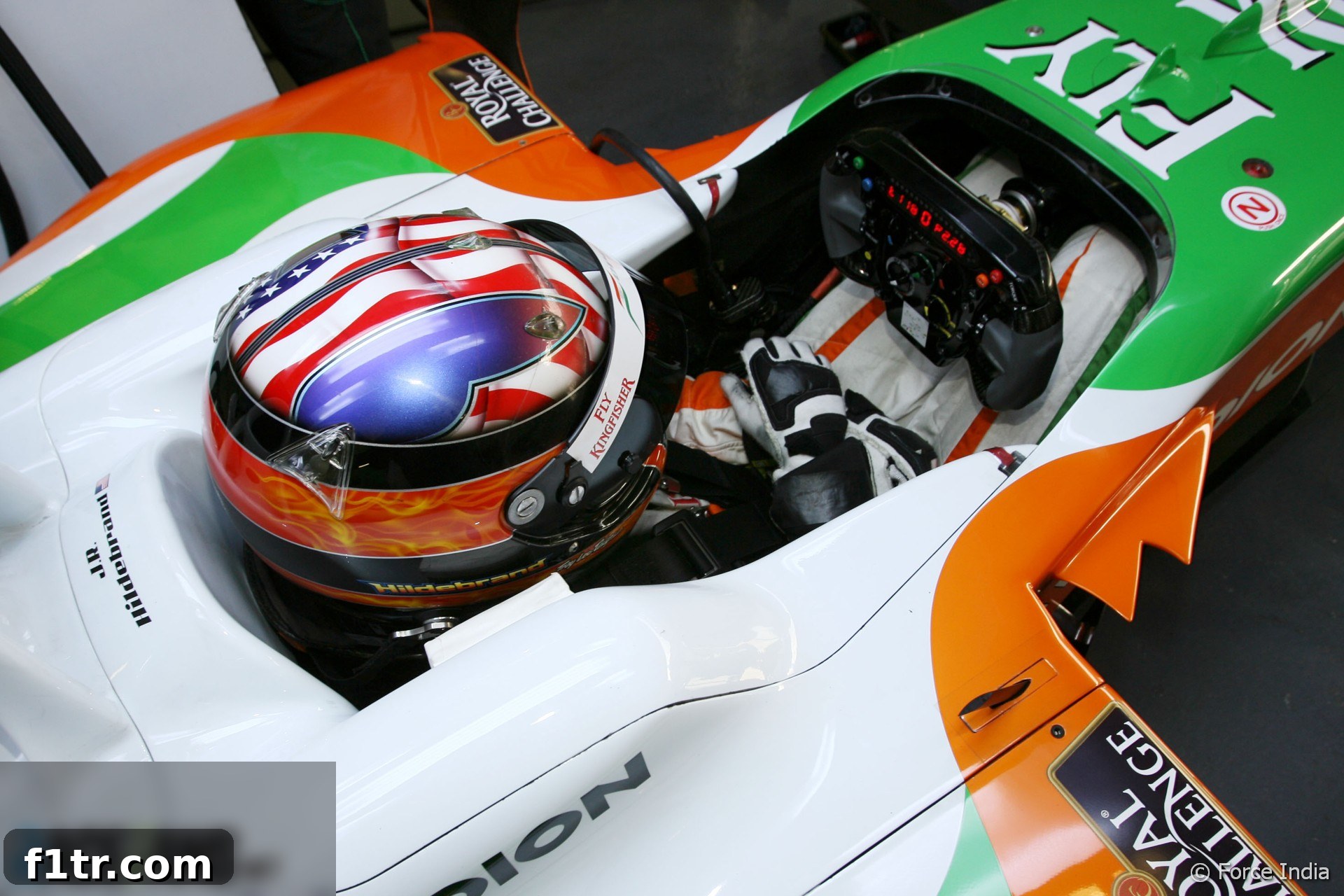
Another American driver who unexpectedly found himself in serious F1 contention, yet ultimately did not make the final leap, was JR Hildebrand. Like many of his compatriots, Hildebrand gained valuable British mileage during his formative years in car racing, a crucial proving ground for aspiring F1 drivers. After triumphing in the 2006 USF2000 title, he made a significant jump directly into the rival Atlantics and Indy Lights series, showcasing his rapid adaptability and talent. In his rookie campaigns, he finished seventh in Atlantics and an impressive fifth in Indy Lights.
Hildebrand continued his ascendancy, staying in Indy Lights for a second year where he clinched the championship title. His career took an intriguing turn through an intricate chain of acquaintances and connections that eventually led to Vijay Mallya, then the boss of Force India. This connection afforded Hildebrand a remarkable opportunity: he was included in a simulator shootout hosted by McLaren, Force India’s technical partner, with the ultimate prize being a seat in F1’s inaugural young driver test. In a testament to his exceptional skill, Hildebrand triumphed over an A1GP champion and a GP2 race-winner to earn his F1 test debut. The stakes were further raised when this test evolved into a direct shootout between Hildebrand and DTM star Paul di Resta for the prestigious role of Force India’s reserve driver for 2010. Although he ultimately lost out to di Resta, the team was so impressed that they were willing to help fund a move to GP2 for Hildebrand, particularly as he had no secure IndyCar seat lined up at the time. While this GP2 move never materialized, Hildebrand eventually made his IndyCar debut and is famously remembered for his heart-wrenching loss of the 2011 Indianapolis 500 to Dan Wheldon at the very last corner of the race, in only his seventh start in the series. He continues to race part-time in IndyCar today, a career marked by both incredible highs and agonizing near misses.
Great Expectations Not Met: The Pressure Cooker of Junior Racing
Over the past decade and a half, countless British and German drivers have been hailed as the “next Lewis Hamilton” or “Michael Schumacher.” A string of exceptional karting results or impressive victories against older, more experienced opposition often thrusts very young drivers into an unforgiving spotlight, burdened with immense expectations. While it is inherently challenging to live up to such lofty comparisons, some drivers, along with their families or management, actively embrace and even fuel these comparisons, believing it can bolster their careers. A compelling example of this phenomenon is Santino Ferrucci. At the tender age of 11, Ferrucci was the subject of a sprawling 3,000-word feature article in GQ, one of the world’s most-read men’s magazines, titled ‘The Great Santino.’
The article extensively focused on Ferrucci’s remarkable ability to beat competitors who were both older and physically taller than him, and it was replete with numerous quotes from the young prodigy about his ambitious career trajectory. His predictions for his future in motorsport were, by all accounts, exceptionally bold. However, once Ferrucci transitioned into car racing, he struggled to consistently stand out among his peers in the highly competitive series he entered. The immense, self-imposed expectations that had loomed over him throughout his junior career became an undeniable burden. Despite these challenges, his unwavering self-belief remained intact, even in series where the primary objective was to fight for a top-ten finish rather than podiums or wins. After reaching F2, his F1 dream tragically ended amidst significant controversy following a contentious clash with his teammate at Silverstone, leading to his dismissal from the team and a ban from the championship.
Yet, in a story of remarkable redemption, when Ferrucci was granted a chance to race in IndyCar, he seized the opportunity to demonstrate a level of skill and tenacity that captured the attention of the entire paddock. Although he has yet to secure an IndyCar podium, his impressive performances and renewed focus earned him a full-time seat in the series once again for 2023. Ferrucci’s journey serves as a powerful reminder of the intense pressures and unpredictable nature of a motorsport career, especially for those burdened by early, overwhelming expectations.
All Speed, No Budget: The Financial Ceiling in Motorsport
Puerto Rico, an unincorporated territory of the United States, is the birthplace of Felix Serralles, a driver whose career perfectly encapsulates the brutal reality of motorsport: immense talent can only take you so far without adequate financial backing. Serralles consistently impressed at every level of junior single-seater racing he entered, displaying the raw speed and racecraft that suggested a future in either Formula 1 or IndyCar. However, he simply never secured the crucial sponsorship and financial support necessary to propel him to the sport’s highest echelons. This challenge is not unique to Serralles; it is a recurring theme for countless gifted drivers globally who often don’t even attempt the higher rungs of the European racing ladder, knowing that the equivalent American series are generally more affordable, allowing them to compete at a higher level for longer before their funding inevitably runs out.
Serralles’ talent was evident early on as he starred in the Skip Barber national championship in the USA before courageously venturing abroad to compete in Formula Renault 2.0. With Fortec Motorsports, a highly respected team, he finished 11th in the Eurocup against formidable competition, including future F1 stars Carlos Sainz Jnr and Stoffel Vandoorne, and secured a podium finish in the fiercely contested UK championship. He remained with Fortec as he made the crucial step up to Formula 3, first winning in the Toyota Racing Series during the winter before his F3 debut. Several strong victories helped him achieve an impressive third-place finish in the British championship, where he notably outpaced Sainz and competed against a roster of other future F1 and IndyCar stars. He then spent a third consecutive year with Fortec, moving up to the prestigious FIA European F3 championship.
However, with each progressive step up the ladder, Serralles found himself competing against increasingly well-funded and established teams. This became particularly evident when he switched to Team West-Tec for his second European F3 season in 2014. In this environment, even impressive performances were harder to discern when he was rarely in contention for podiums and was also involved in a greater number of incidents. It is a known reality in motorsport that driving for larger, better-resourced teams not only tends to yield superior results but also provides access to advanced facilities and highly experienced personnel. These resources are critical for training drivers, preparing them for their next career steps, and helping them maximize future opportunities. Serralles, at times, clearly lacked this essential supportive environment, which ultimately hindered him from fully realizing his immense potential on the global stage.
Despite these funding limitations, Serralles continued to demonstrate his prowess. He raced and secured victories in Indy Lights for two years, and even had a test in IndyCar with the renowned Andretti team. Yet, the critical missing piece remained: no sponsors materialized to fund a sustained pathway to the very top levels of motorsport. Following his time in Indy Lights, Serralles transitioned to GT3 sports cars, spending two seasons with the highly competitive Mercedes team AKKA ASP. His racing career then took a surprising and poignant turn as he made the unexpected switch to join the US Army. Felix Serralles has not competed in motorsport since, his career serving as a stark reminder of how financial barriers can prematurely end the dreams of even the most talented and dedicated racing drivers.
The stories of these talented American drivers—Conor Daly, Colton Herta, Josef Newgarden, JR Hildebrand, Santino Ferrucci, and Felix Serralles—collectively illustrate the multifaceted challenges faced by those aspiring to reach Formula 1. From the demanding financial landscape of European junior categories and the intricacies of the FIA superlicence system to the pressures of early expectations and the sheer difficulty of securing consistent funding, the road to F1 has historically been exceptionally steep for American talent. Logan Sargeant’s arrival on the grid is not just a personal triumph but a beacon of hope, potentially paving a clearer, more accessible path for future generations of American F1 drivers, finally breaking a long and challenging drought.
Become a RaceFans Supporter
RaceFans is run thanks in part to the generous support of its readers. By contributing £1 per month or £12 per year (or the same in whichever currency you use) you can help cover the costs of creating, hosting and developing RaceFans today and in the future.
Become a RaceFans Supporter today and browse the site ad-free. Sign up or find out more via the links below:
- Become a RaceFans Supporter
- RaceFans Supporter FAQ
2023 F1 season
- FIA president cleared of alleged interference in two 2023 races
- First week viewing figures for new Drive to Survive season fall again
- Max who? Drive to Survive season six prefers its favourite faces
- RaceFans’ complete 2023 season review
- The F1 drivers who pulled off the 10 biggest charges through the field in 2023
Browse all 2023 F1 season articles