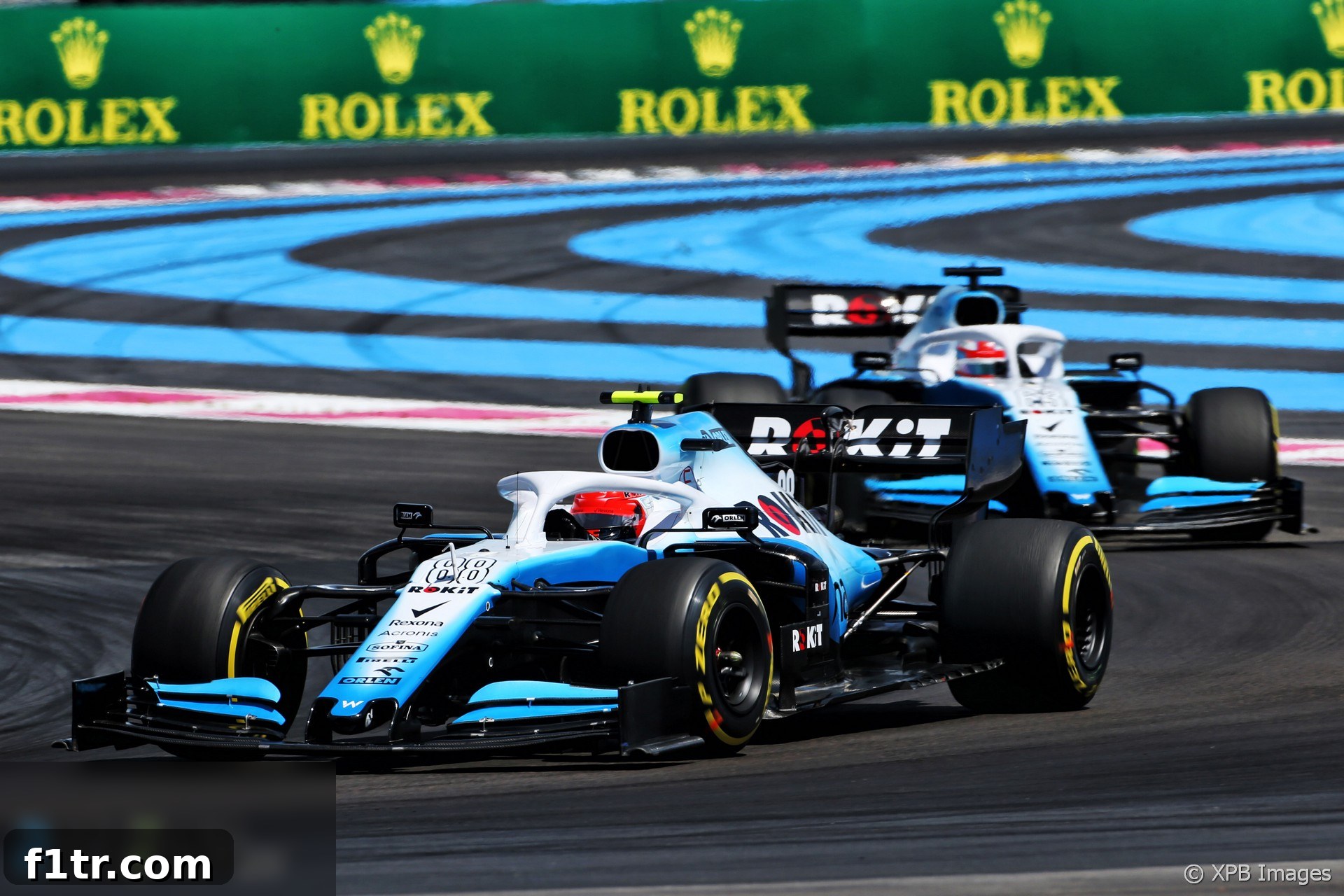
George Russell’s Tenacious On-Track Battle with Robert Kubica: A Rookie’s Quest for Fair Racing in F1
In the demanding and often unforgiving world of Formula 1, every race offers a unique narrative, even for those battling at the very rear of the grid. The 2019 season presented a significant challenge for Williams Racing, a period marked by persistent struggles for performance. Within this difficult landscape, rookie sensation George Russell consistently demonstrated his immense talent and fiercely competitive spirit. One particular highlight from his debut year was a spirited intra-team duel with his more experienced teammate, Robert Kubica.
This battle, far from the spotlight of the points-paying positions, offered a revealing glimpse into Russell’s character and his unwavering commitment to pure, on-track racing. Despite an incident during the fight that ultimately necessitated an unscheduled pit stop for a front wing replacement, Russell emphatically described the engagement as “good fun.” His comment underscored a deep-seated passion for wheel-to-wheel action, even when the immediate rewards in terms of championship points were absent. This encounter proved to be a pivotal moment, showcasing the young Briton’s burgeoning F1 career and firmly establishing his principles regarding team dynamics and individual ambition.
The Genesis of a Duel: Qualifying, Penalties, and Raw Pace
The stage for this compelling intra-team rivalry was set long before the race lights extinguished. George Russell, with characteristic efficiency, had once again outperformed his teammate, Robert Kubica, in qualifying, demonstrating superior single-lap pace. However, an unfortunate grid penalty meant he would commence the race from behind the Pole, adding an immediate layer of challenge to his Sunday drive. This initial disadvantage served only to fuel Russell’s already potent determination.
From the early stages of the race, Russell wasted no time in communicating his conviction to the Williams pit wall: he felt he possessed a distinct speed advantage over Kubica. Yet, despite this clear message regarding his pace, he held a firm and principled belief that team orders should not be used to dictate the outcome of their on-track contest. Russell’s preference was unequivocally for an organic resolution, valuing the integrity of a direct, head-to-head fight over a strategically manipulated position swap. He was there to race, not to be handed a position.
Russell articulated his stance with commendable clarity: “I told the team at the start I felt I was quicker than him but didn’t expect anything to change, I wanted to do it fairly and properly on track.” This sentiment perfectly encapsulated his approach. For a driver in his debut season, especially one burdened by a car that consistently lacked overall performance, every opportunity to demonstrate pure skill and race craft against a direct rival – even a teammate – was paramount. It was more than just about gaining a place; it was about honing his abilities, reinforcing his reputation as a formidable competitor, and proving his worth, irrespective of the machinery at his disposal. This desire to earn his position through merit would become a defining characteristic of his career.
The “Hairy Move”: A Defining Moment of Aggression and Consequence
With his objective firmly in mind, Russell initiated his charge on Kubica. His initial attempt to pass, however, proved costly. Pushing the limits of his car and the track, he ran wide, a maneuver that unfortunately resulted in an impact and discernible damage to his front wing. This first setback, while undoubtedly frustrating, did little to dampen his resolve. Instead, it seemingly intensified his focus and determination to complete the pass.
Undeterred by the initial misstep, Russell quickly regrouped and launched a second, more decisive assault. This subsequent pass was executed with a level of aggression, precision, and commitment that immediately caught the attention of observers, including Russell himself. He vividly recalled the maneuver as “quite a hairy move,” a candid acknowledgment of the fine line between audacious, brilliant racing and potential disaster. It was a high-stakes moment, demanding absolute confidence and skill. Yet, for Russell, this daring overtake was the undoubted “highlight of my race,” a moment of personal triumph and satisfaction amidst an otherwise challenging Grand Prix.
The successful execution of the overtake, however, came at a price, one that wasn’t immediately apparent to the man behind the wheel. While Russell was initially unaware of the extent of the damage, the team’s sophisticated telemetry systems back in the pit lane told a very different story. “From my side I felt no difference,” Russell explained when questioned about the feel of the car post-incident. “But the team were seeing some issues, I think maybe there was just a small crack or something when I hit the polystyrene board.” This disparity between the driver’s subjective feel and the objective data from the pit wall highlighted a common and complex dilemma in motorsport. Despite not feeling any immediate performance degradation or change in handling, the structural integrity of the front wing had been compromised, necessitating a swift and strategic decision from the team.
The Strategic Imperative: Pitting for a New Front Wing
The detection of the damaged front wing presented Williams with a crucial strategic choice. In a scenario where points, podium finishes, or even top-ten positions were genuinely within reach, Formula 1 teams often weigh the risks carefully. They might gamble, hoping the damage is superficial enough to last the remainder of the race distance, thereby avoiding the significant time loss associated with an unscheduled pit stop. The cost of such a stop – not just in terms of precious seconds lost on track but also the psychological impact on the driver and the potential disruption to race rhythm – is immense.
However, for a team like Williams in 2019, battling valiantly at the very rear of the grid with no realistic hope of securing championship points, the strategic calculus was entirely different. In their unique circumstances, the risk of a more catastrophic failure of the damaged wing, which could potentially endanger the driver or lead to a complete retirement from the race, far outweighed any marginal, theoretical benefit of staying out. The safety of the driver and the preservation of the car, even if it meant sacrificing a few places at the back, became paramount.
George Russell himself candidly acknowledged this pragmatic approach: “If we were fighting for points we would’ve stayed out there and gambled but there was no need.” This statement perfectly encapsulated the strategic reality of their position. The decision to pit for a front wing replacement, while consuming valuable time and adding another stop to his race, was a sensible, albeit frustrating, one for the team. It ensured the car’s continued safety and prevented further, potentially more severe, damage, even if it solidified his position at the very back of the field. For Russell, it was a necessary interruption to continue gaining invaluable experience, rather than a strategic blunder that cost a significant result.
Team Orders: A Principled Stand on Sporting Integrity
The aftermath of the incident, particularly the unexpected need for a second pit stop, inevitably led to reflections on whether team intervention might have been the more logical and prudent course of action earlier in the race. From a purely results-driven, team-centric perspective, preventing an intra-team battle that directly led to car damage and an additional pit stop could certainly be seen as an act of responsible team management. Russell, with his characteristic honesty, conceded this point: “In hindsight, yes, because the result of it was a damaged front wing.” However, this pragmatic admission was immediately tempered by his deeply held convictions about the very essence and integrity of racing.
Russell’s philosophy on racing was crystal clear and unwavering: “But I don’t want to overtake him from a pit call I want to overtake him fairly on-track.” This statement speaks volumes about his character, his sporting ethos, and his approach to professional Formula 1 racing. For a rookie eager to establish his credentials and demonstrate his capabilities, particularly against an experienced teammate, proving superior race craft and earning a position through direct, head-to-head competition was paramount. For Russell, it was not merely about getting ahead of Kubica; it was fundamentally about *how* that position was achieved. His belief in “equal opportunities” for both drivers resonated strongly, suggesting a profound preference for sporting integrity and individual meritocracy over strategic expediency, even when such a stance came at a personal cost in terms of pit stops or overall race time.
This incident underscored a fundamental and often contentious tension in elite motorsport: the delicate balance between individual driver ambition and the overarching team strategy. While teams naturally prioritize their collective success, the prudent management of resources, and the optimization of championship results, drivers often push vehemently for the freedom to race, to express their individual talent, and to prove their personal worth. Russell’s unwavering stance in favor of on-track meritocracy, even in a challenging season devoid of points, showcased a maturity, a clear moral compass, and a principled approach that would soon become a defining hallmark of his distinguished career. It illustrated his commitment to the true spirit of racing, a quality that would undoubtedly endear him to fans and earn him respect within the paddock.
Reflecting on the Experience: A Catalyst for Growth
The 2019 season was undoubtedly a baptism of fire for George Russell. It was characterized by the immense technical and competitive challenges of driving an uncompetitive Williams car, often struggling for pace and reliability. Yet, it was precisely within these challenging constraints that moments like his fierce battle with Robert Kubica transformed into invaluable learning experiences. This particular duel, with its captivating blend of aggressive overtaking, unforeseen car damage, and the subsequent complex strategic decisions, served as a comprehensive micro-lesson in various crucial aspects of Formula 1 racing.
The encounter taught Russell about the razor-thin margins of on-track combat, the critical importance of swift and decisive decision-making under pressure, and the absolute necessity of clear, effective communication between driver and pit wall. Furthermore, and perhaps most significantly, it reinforced his personal philosophy on fair competition and the intrinsic value of earning one’s position through skill – a trait that would continue to define his approach as he progressed through his illustrious career. His remarkable openness about the incident and his articulate rationale behind his choices demonstrated a level of self-awareness, professionalism, and introspection that is truly rare for a rookie driver.
Ultimately, this experience was not merely about the result of one isolated race; it was about building a robust foundation for what promises to be a long and highly successful career in Formula 1. A career based firmly on raw skill, unwavering integrity, and an unyielding desire to race at the absolute limit. The incident with Kubica, though a relatively small footnote in the grand scheme of the 2019 season, played a crucial role in shaping George Russell into the formidable and respected competitor he is recognized as today. It clearly highlighted his relentless pursuit of performance, his profound commitment to honest and fair racing, and his exceptional ability to analyze, adapt, and learn from every situation, no matter how challenging or frustrating. This early display of extraordinary character and undeniable talent laid essential groundwork for his eventual, and highly anticipated, ascent to the very front of the Formula 1 grid.
Related Articles: Insights from the 2019 F1 Season
- Crying in the Melbourne car park at 2019 grand prix was my career low – Ocon
- McLaren Racing reports reduced £71 million loss in 2019
- Kvyat: Hockenheim podium last year was “my biggest achievement” so far
- How the FIA’s new encrypted fuel flow meter targets Ferrari’s suspected ‘aliasing’ trick
- “He smashed my office door”: 23 must-see moments from ‘Drive to Survive’ season two
Browse all 2019 F1 season articles