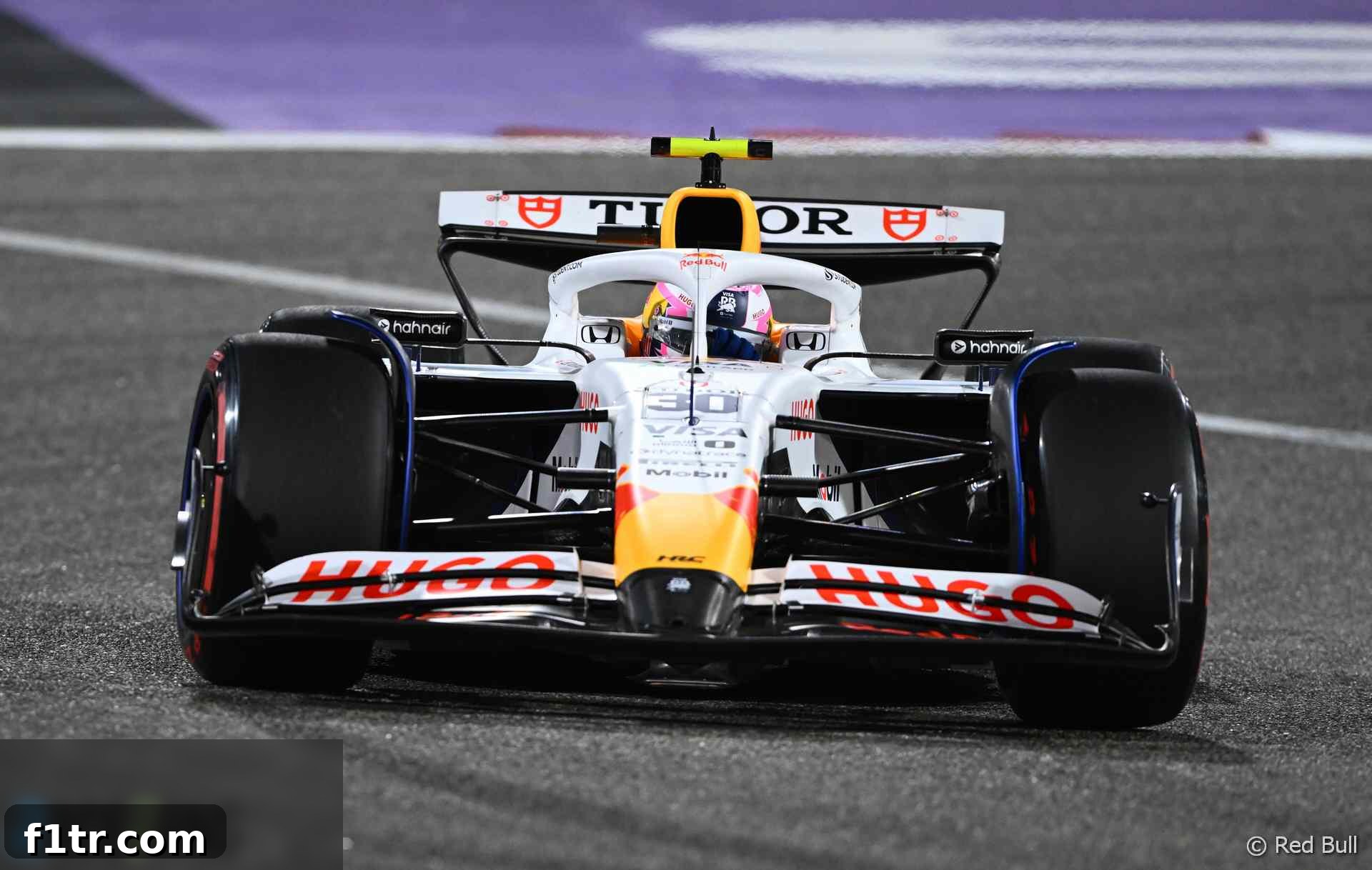
The Fine Margins of Formula 1 Qualifying: Lawson’s DRS Drama and Hadjar’s Missed Opportunity
Formula 1 qualifying sessions are notorious for their cut-throat competition, where milliseconds can dictate a driver’s fate. The recent qualifying round saw Racing Bulls driver Liam Lawson endure a particularly frustrating experience, as what he perceived to be a technical glitch with his Drag Reduction System (DRS) ultimately cost him a crucial spot in Q2. His teammate, Isack Hadjar, fared better by progressing further but still expressed disappointment at narrowly missing out on Q3 due to a conservative approach.
Liam Lawson’s Qualifying Heartbreak: A DRS Mystery Unraveled
The intensity of an F1 qualifying lap demands absolute precision and maximum performance from both car and driver. For Liam Lawson, his Q1 run was marred by an incident that left him puzzled and profoundly frustrated. As he accelerated down the straight, pushing for every last tenth of a second, his DRS flap, designed to reduce aerodynamic drag for higher top speeds, unexpectedly closed. This sudden closure disrupted his momentum and denied him the vital speed needed to improve his lap time, leading to his elimination from Q1.
Lawson’s immediate reaction, shared with the official F1 channel after the session, painted a picture of bewilderment. “Q1 was alright up until that point,” he explained. “I don’t really know what happened but I know I had a wheelspin out of the corner and then opened DRS and then it closed again basically. So it’s pretty frustrating, obviously, but it just sucks.” This statement highlighted his initial belief that the DRS closure was an isolated mechanical issue, rather than a consequence of his own actions on the limit.
The Technical Explanation: Understanding the DRS Mechanism
While Lawson’s frustration was understandable, his team, Racing Bulls, soon provided a definitive technical explanation for the incident. Tim Goss, the team’s Chief Technical Officer, clarified that the DRS closure was not a malfunction but an automatic response triggered by the car’s sophisticated control systems. Goss detailed the sequence of events: “In the tricky conditions, Liam picked up a little wheelspin on exit from Turn 10, resulting in a small throttle lift to keep the car under control causing DRS to automatically close which caused him to lose vital speed on the straight, and cost [him] the place in Q2.”
This explanation sheds light on the incredibly sensitive and integrated nature of modern Formula 1 machinery. The DRS system, while providing a significant speed advantage, is designed with safety and performance parameters in mind. Typically, DRS is deactivated when a driver lifts off the throttle, brakes, or turns significantly, ensuring the car remains stable and controllable. In Lawson’s case, the momentary wheelspin on corner exit, coupled with his instinctive throttle lift to regain control, inadvertently met the criteria for DRS deactivation. This critical loss of momentum on a high-speed straight proved devastating for his lap time.
The Cost of Fractions: Missing Q2
The impact of this incident was immediate and severe. Lawson missed the cut to progress into Q2 by a mere 0.125 seconds. In the hypersensitive world of Formula 1, such a tiny margin can mean the difference between advancing and being relegated to the back of the grid. Furthermore, he found himself over half a second slower than his teammate Isack Hadjar, a gap that undoubtedly added to his disappointment. For a young driver like Liam Lawson, who is constantly under pressure to prove his worth and secure a long-term future in F1, every qualifying session is a critical opportunity to demonstrate his capabilities. An early exit from Q1, especially due to such a nuanced incident, represents a significant setback.
Qualifying position is paramount in Formula 1, especially for teams in the midfield. Starting higher up the grid offers a multitude of advantages: cleaner air, less risk of first-lap incidents, and greater strategic flexibility. Being forced to start from 17th position, as Lawson will, places him in a challenging situation, requiring an exceptional performance in the race to climb into contention for points.
Isack Hadjar’s Close Call: The Perils of Caution
While Liam Lawson grappled with the technical intricacies of his DRS, teammate Isack Hadjar navigated his way into Q2, demonstrating competitive pace. However, his journey through qualifying was not without its own set of frustrations. Hadjar, too, found himself contemplating what could have been, admitting that a conservative approach on his final run in Q2 ultimately prevented him from reaching the coveted Q3 session.
The Tightrope Walk of Q2
Hadjar described his session as “really tricky,” highlighting the challenging conditions and the mental battle to extract maximum performance. His first attempt in Q2 had to be aborted, indicating early difficulties in finding the rhythm and confidence required for a blistering lap. Despite this initial hurdle, he regrouped and mounted a strong challenge on his final run.
“I felt like I had a strong start to the lap on my last attempt,” Hadjar recounted. However, a crucial decision in the latter part of the lap proved costly. “To be fair, I thought that would be enough and I went a bit too conservative towards the end of the lap and it’s not the right approach and it was not good enough.” This self-critique underscores another fundamental aspect of F1 qualifying: the relentless pursuit of perfection, where even a hint of caution can be detrimental. Hadjar missed out on Q3 by less than five hundredths of a second – an agonizingly small margin that vividly illustrates the razor-thin differences separating drivers at this elite level.
The psychological aspect of qualifying is immense. Drivers are constantly balancing aggression with control, pushing the car to its absolute limits without overstepping. Hadjar’s experience is a classic example of this delicate balance; a momentary lapse in aggression, born perhaps from a desire to consolidate a decent lap rather than risking everything for an exceptional one, cost him a significant grid improvement.
Team Dynamics and the Road Ahead
The contrasting fortunes of Lawson and Hadjar in qualifying offer a glimpse into the intense internal competition within the Racing Bulls team and the broader Red Bull driver academy. While Hadjar secured a more favorable starting position of 12th, five places ahead of Lawson, both drivers leave qualifying with valuable lessons learned. For Lawson, the incident with the DRS and throttle lift serves as a stark reminder of the car’s complex interplay of systems and the need for absolute precision even in reactive maneuvers. For Hadjar, the regret of being too cautious highlights the necessity of maintaining peak aggression throughout every meter of a qualifying lap.
The Formula 1 season is a marathon, not a sprint, and every session provides opportunities for growth and refinement. Both young drivers are under immense scrutiny, not only to perform on track but also to demonstrate their ability to learn from setbacks and adapt their approach. The pressure to consistently outperform one’s teammate is a constant factor, as it often dictates future opportunities within the sport.
The Broader Implications for Race Strategy
Starting positions of 12th for Hadjar and 17th for Lawson present distinct challenges and strategic considerations for the upcoming race. Hadjar, positioned within striking distance of the points-scoring positions, will likely focus on maintaining track position and capitalizing on any opportunities presented by front-runners. His starting spot allows for a wider array of strategic options, including tire management and potential overtakes.
Lawson, starting further back, faces a steeper climb. His race strategy will likely involve maximizing tire life, making aggressive overtakes when safe, and hoping for incidents or safety cars to bunch up the field and provide an advantage. Overcoming a five-place deficit to his teammate will be a significant undertaking, but also a chance to prove his racecraft and resilience.
Conclusion: The Relentless Pursuit of Perfection
The qualifying session served as a powerful illustration of the fine margins that define Formula 1. Liam Lawson’s DRS drama, stemming from a seemingly minor wheelspin and an instinctive throttle lift, underscores the intricate relationship between driver input and vehicle systems, where technical nuances can have race-defining consequences. Isack Hadjar’s regret over a conservative final sector highlights the mental fortitude required to extract every last millisecond from an F1 car, emphasizing that even a fractional drop in aggression can be decisive.
Both drivers will carry these experiences forward, applying the lessons learned to future sessions. As they prepare for the race, their focus will undoubtedly shift from the qualifying performance to maximizing their potential from their respective grid slots. The journey of an F1 driver is one of constant learning and adaptation, and these events serve as crucial chapters in their ongoing development within the pinnacle of motorsport.