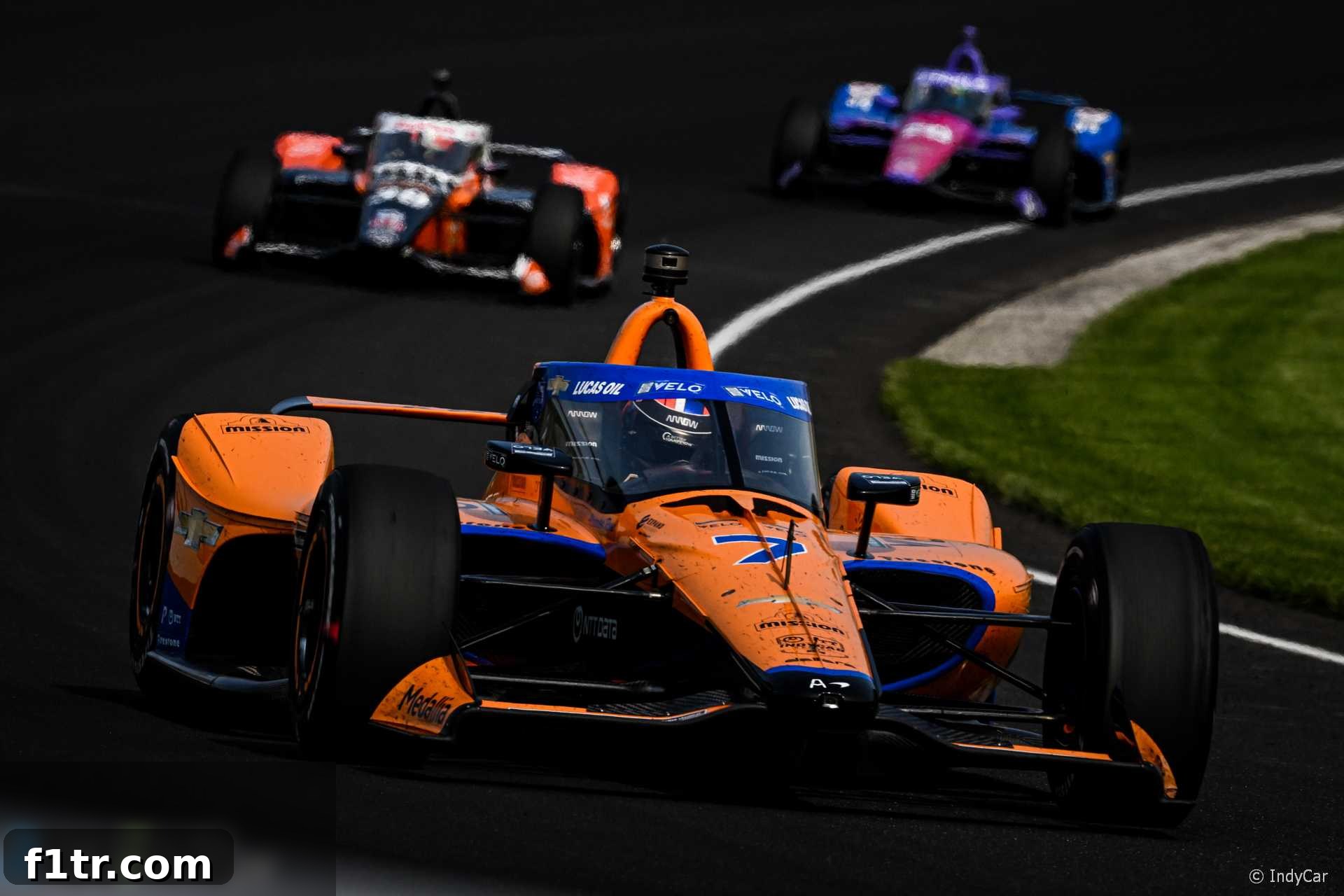
IndyCar’s Downforce Boost Fails to Spark Overtaking at Indianapolis 500
Despite IndyCar’s proactive efforts to enhance the on-track action and facilitate closer racing at the iconic Indianapolis 500, recent aerodynamic modifications allowing teams to run increased downforce have not yielded the desired improvements, according to multiple drivers following initial practice sessions. The feedback from the paddock points to an ongoing struggle with aerodynamic challenges, particularly in the high-speed, packed conditions of oval racing.
The Aerodynamic Conundrum: Aeroscreen and Dirty Air
The introduction of IndyCar’s Aeroscreen safety device three years ago marked a pivotal moment for the series, significantly altering the aerodynamic characteristics of the cars. While a monumental leap forward in driver safety, the robust cockpit protection system inherently generates additional turbulent air, often referred to as “dirty air.” This disturbed airflow makes it considerably more difficult for following cars to maintain optimal downforce and grip, thus hindering a driver’s ability to run closely behind another competitor, especially on high-speed ovals like the Indianapolis Motor Speedway.
The phenomenon of dirty air essentially reduces the aerodynamic efficiency of a trailing car. When a car is running directly behind another, it encounters air that has already been disrupted by the leading car’s passage. This turbulent air reduces the pressure difference over the following car’s wings and bodywork, leading to a loss of downforce. With less downforce, the tires have less grip, forcing drivers to either lift off the throttle, brake earlier, or risk losing control, all of which impede overtaking opportunities. On tracks where slipstreaming (drafting) is crucial, an increase in dirty air can negate the benefits of the tow, making it harder to close the gap needed for a pass.
IndyCar’s Strategic Adjustments and Mixed Results
In response to these aerodynamic complexities, IndyCar has been actively pursuing solutions, primarily by expanding the aerodynamic setup options available on the specification Dallara DW12 chassis. These efforts had previously shown promise, most notably earlier this year at the Texas Motor Speedway, where drivers widely praised the changes for fostering a more competitive and entertaining race. The success at Texas, a high-banked oval, suggested that the series was moving in the right direction.
Encouraged by the positive outcomes in Texas, some of the very same parts and setup options were subsequently approved and made available for the Indy 500. Teams were granted permission to utilize a steeper rear wing angle and to fit additional downforce-producing components at both the front and rear of their car floors. These adjustments were designed to give teams more tools to fine-tune their cars, theoretically allowing them to generate more downforce and improve stability, thereby making it easier for drivers to navigate traffic and execute overtakes.
The hope was that these modifications would mitigate the adverse effects of the Aeroscreen-induced turbulence, particularly on the long straights and through the four distinct corners of the Indianapolis Motor Speedway. By enabling cars to run with greater aerodynamic grip, IndyCar aimed to empower drivers to push harder in pursuit, leading to more dynamic wheel-to-wheel battles and a reduced “follow-the-leader” scenario that has sometimes characterized oval racing in recent years. The anticipation was that the world’s greatest race would once again showcase breathtaking passing maneuvers throughout the field.
Driver Feedback: Disappointment on the Track
Pato O’Ward’s Candid Assessment
Despite the series’ intentions, the initial feedback from prominent drivers painted a less optimistic picture. McLaren’s Pato O’Ward, a consistent top-six finisher in the last three Indy 500s and a strong contender, voiced his concerns clearly. “We’re not quite there,” O’Ward told NBC, expressing disappointment. “The aero bits seem to have done nothing for racing.”
O’Ward elaborated on the persistent difficulties faced by drivers caught in the mid-pack. “Obviously it’s not ideal for when you’re running 10th or 11th in a pack, you can’t do anything, even when you’re sixth, seventh you can’t do anything,” he explained. His observations suggest that the ability to make progress through the field remains severely limited. He noted that only the front-runners truly have the freedom to engage in competitive overtaking. “Only the first two lead cars can be kind of overtaking each other, maybe a third car can join the party. But other than that it’s pretty much a follow-the-leader situation.” This stark assessment underscores the challenge of moving through traffic without a significant aerodynamic advantage or a misstep from a competitor.
Furthermore, O’Ward articulated the dreaded “freight-trained” scenario, a term used in racing to describe how a driver who pulls out of the slipstream to attempt a pass can quickly lose momentum and be overtaken by multiple cars from behind. “If you pull out of the bubble, you’re going to get a freight-trained,” he explained. The aerodynamic “bubble” behind a leading car provides a tow, but venturing outside of it into turbulent air significantly compromises speed. This makes daring overtakes a high-risk, low-reward proposition. “The guys in front of you are getting towed, so you’re not able to suck up to ’em like if you were sucking up to a lead car.” O’Ward concluded that the racing dynamic shows “no change from what ’21 and ’22 have been,” indicating a lack of significant improvement over recent seasons.
Simon Pagenaud’s Perspective: A Mixed Blessing
Simon Pagenaud, the victor of the last Indy 500 before the Aeroscreen was introduced, also shared his reservations. While acknowledging the positive aspects of the new setup options, he remained concerned about the fundamental issue of overtaking in traffic. “I feel like we have a good range of downforce level, parts that we can use to make the car behave a certain way,” Pagenaud stated, recognizing IndyCar’s efforts to provide teams with more tuning flexibility. “IndyCar allowed us to have a bigger [range] and I feel like it’s better for racing.”
However, Pagenaud quickly qualified this by highlighting the enduring challenge: “But it doesn’t stop the fact that when you are fifth in line, it’s still very difficult. The car ahead of you is still drafting, going same speed as you. Even if you’re good there doesn’t mean you’re going to pass.” His insights suggest that while teams have more tools to optimize their individual car performance, the inherent aerodynamic disadvantages of following closely in a pack persist. The “better range to work with” might improve a car’s handling in general, but it doesn’t fundamentally alter the dynamics of multi-car battles. He expects the race to continue featuring “first, second trading every single lap, similar,” indicating that the real action will likely remain concentrated among the very front-runners.
Conor Daly Echoes the Sentiments
Conor Daly, another experienced IndyCar competitor, echoed the concerns of his peers. “In traffic it still is a challenge I would say,” the Ed Carpenter Racing driver remarked after practice. His observations confirmed that deep within the pack, irrespective of the car’s inherent performance, making significant forward progress was a rare occurrence. “If you’re deep in the pack, it didn’t matter what car it was, it was rare to see people making progress unless people were letting people by.” This highlights a potential scenario where positions only change due to strategic pit stops or voluntary yielding, rather than genuine on-track overtaking prowess.
Daly, like O’Ward and Pagenaud, noted the stark contrast between the leading cars and the rest of the field. “The first two cars, boy, it looked like they were having a heck of a race.” This observation suggests that the downforce changes, while potentially benefiting the lead battle by allowing for closer competition between two unencumbered cars, have done little to democratize overtaking throughout the entire field. “So I don’t know if that’s the case. I don’t think it brings us closer. I think the entire field is just closer because everyone is really good, and the teams are really good.” Daly’s final point introduces another factor: the overall competitiveness of the IndyCar field. While the cars themselves might be incredibly close in performance, the aerodynamic limitations still prevent this closeness from translating into widespread overtaking.
The Persistent Challenge of Oval Racing Dynamics
The discrepancy between the success seen at Texas Motor Speedway and the difficulties encountered at the Indianapolis Motor Speedway underscores the complex and varied nature of oval racing. Texas, with its higher banking and shorter layout, presents a different aerodynamic challenge compared to the flatter, longer straights and unique turn profiles of Indy. What works effectively on one oval may not directly translate to another, especially when dealing with the specific demands of the Indy 500, where sustained high speeds and strategic drafting are paramount.
The drivers’ feedback strongly suggests that while IndyCar has provided more tools for aerodynamic tuning, these tools haven’t fundamentally altered the core issue of dirty air’s impact on overtaking in larger groups. The pursuit of safety through innovations like the Aeroscreen, while undeniably crucial, has introduced an intricate aerodynamic puzzle that the series and its teams are still working to solve. The aim remains to achieve a balance where safety is paramount, but the spectacle of thrilling, competitive racing with ample overtaking opportunities is not compromised.
Implications for the Spectacle and Future Developments
For fans, limited overtaking can diminish the excitement of a race, potentially leading to a more processional event rather than a dynamic one. The Indianapolis 500, renowned for its dramatic finishes and bold passing moves, relies heavily on the ability of drivers to challenge for positions throughout the race. If overtaking remains restricted to only the very front of the pack, or if it primarily occurs during pit cycles or due to strategic variations, it could subtly alter the cherished narrative of the “Greatest Spectacle in Racing.”
Looking ahead, IndyCar will likely continue to explore further aerodynamic refinements. This might involve re-evaluating the current chassis, considering alternative aerodynamic packages, or perhaps even investigating different downforce philosophies that minimize wake turbulence. The challenge is ongoing for oval racing in general, as series strive to maintain high speeds and safety standards while simultaneously ensuring a compelling and unpredictable race product. The delicate balance between safety, performance, and racing spectacle will undoubtedly remain a focal point for IndyCar’s technical team in the seasons to come.
Further Reading: IndyCar News and Analysis
- IndyCar driver McLaughlin cleared of injury after crashing through barrier at Barber
- Schumacher says his IndyCar feels like ‘an F2 car, just with better tyres’
- IndyCar “way faster than Formula 1” in some corners, says Grosjean
- FIA to award more F1 superlicence points to IndyCar drivers from 2026
- Schumacher to race full-time in IndyCar with RLL in 2026
Browse all IndyCar articles