Max Verstappen’s Nurburgring GT3 Test: Unpacking the Controversy Over Car Specifications
Four-time Formula 1 world champion Max Verstappen recently found himself at the center of a spirited debate following a highly anticipated test drive in a GT3 car on the legendary Nurburgring Nordschleife. Verstappen vehemently denied claims from a rival driver that he enjoyed an unfair car advantage when setting impressive lap times during the private session.
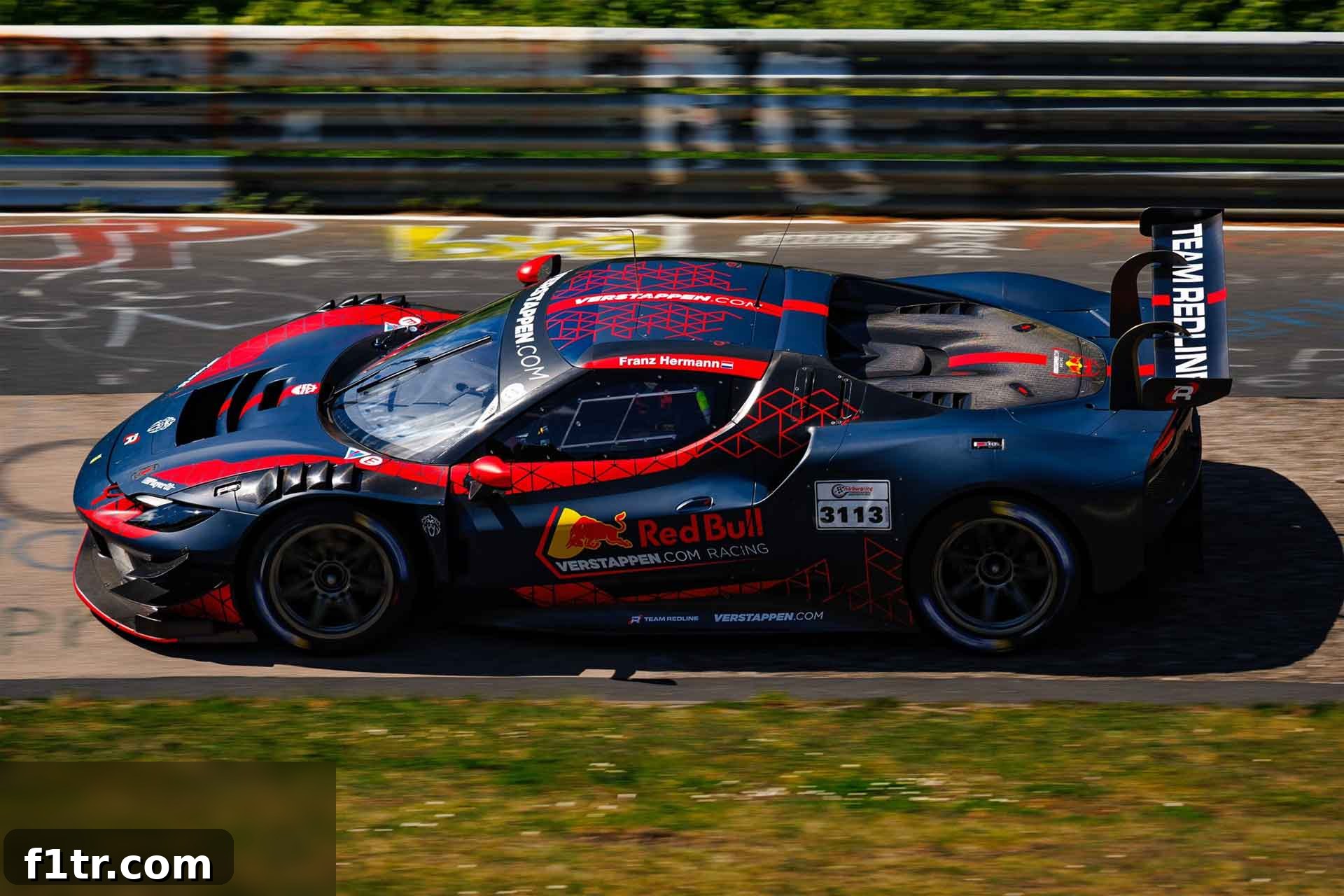
The Dutch motorsport sensation, renowned for his aggressive driving style and exceptional talent in Formula 1, indulged his passion for endurance racing by taking to the famed 14-kilometre German circuit in a powerful Ferrari 296 GT3 car. The test, which took place last week, saw Verstappen discreetly participating under the pseudonym ‘Franz Hermann’ as part of his familiar Team Redline squad, a nod to his extensive sim racing background.
The Nordschleife Challenge: A Unique Test for an F1 Champion
The Nurburgring Nordschleife, often dubbed the “Green Hell,” stands as one of the most demanding and iconic race tracks in the world. Its immense length, over 70 corners, and significant elevation changes present an unparalleled challenge to even the most seasoned drivers. For a Formula 1 driver like Verstappen, accustomed to precise, modern circuits, tackling the Nordschleife in a GT3 machine represents a distinct shift in driving dynamics and a true test of adaptability. This natural curiosity and desire to conquer new challenges highlight Verstappen’s deep passion for motorsport beyond the pinnacle of Formula 1.
Initial reports from Red Bull motorsport consultant Helmut Marko suggested that Verstappen had not only adapted quickly but had also shattered the class lap record by a remarkable two seconds. Such a feat, especially on a first visit to the circuit in a GT3 car, would undeniably underscore Verstappen’s extraordinary talent and versatility across different racing disciplines.
Maro Engel’s Allegations: The Balance of Performance Debate
However, the praise was soon met with skepticism from Maro Engel, a highly respected and long-standing Mercedes-AMG factory driver. Engel, who competes in the GT3-based DTM (Deutsche Tourenwagen Masters) series and is intimately familiar with the intricacies of GT racing and its various regulations, quickly took to social media to cast doubt on the circumstances surrounding Verstappen’s alleged record-breaking performance.
Engel’s primary contention revolved around the car’s Balance of Performance (BoP) specification. He asserted that Verstappen’s Ferrari 296 GT3 was not configured to the standard Nurburgring Langstrecken-Serie (NLS) BoP, which governs endurance races on the Nordschleife, including the prestigious 24-hour race. Instead, Engel claimed the car was run in “DTM spec BoP,” implying significant performance advantages. “A few facts to Franz Hermann GT3 Nordschleife test,” Engel stated in his widely circulated social media post. “Car was run in DTM spec BoP (less weight, more power, lower ride height than NLS BoP).” He acknowledged the impressive nature of the reported 7-minute, 48-second lap time for a first visit but strongly hinted at the non-standard setup.
Understanding Balance of Performance (BoP) in GT Racing
To fully grasp the core of Engel’s claim, it’s essential to understand the concept of Balance of Performance (BoP) in GT racing. BoP is a crucial regulatory framework designed to equalize the performance potential of diverse GT cars from various manufacturers. Without BoP, different cars would naturally have inherent advantages due to their design philosophies, engine configurations, aerodynamics, and chassis setups. The goal of BoP is to create a level playing field, ensuring that driver skill, team strategy, and execution are the primary determinants of success, rather than a car’s innate superiority.
BoP adjustments typically involve modifications to a car’s weight (ballast), engine power (through restrictors or boost pressure limits), aerodynamic settings (rear wing angle, front splitter height), and ride height. These adjustments are meticulously calculated and applied by sanctioning bodies based on extensive data from testing, qualifying, and race performance. Critically, BoP specifications are tailored for specific championships and tracks. The DTM series, a sprint racing format, has its own unique BoP rules, optimized for shorter, more intense races on conventional circuits. The NLS, on the other hand, designed for long-distance endurance racing on the challenging Nordschleife, employs a different BoP philosophy, often emphasizing reliability and consistency over raw, peak performance, and taking into account the unique demands of the circuit’s profile and surface.
Therefore, Engel’s accusation of Verstappen’s car running in “DTM spec BoP” on the Nordschleife implies that the Ferrari 296 GT3 might have benefited from a lighter chassis, higher engine output, and a lower aerodynamic stance—settings typically more aggressive and less constrained than those permitted under NLS regulations for the Nordschleife. Such differences could indeed shave precious seconds off lap times, making a direct comparison with NLS record laps misleading.
Verstappen’s Swift and Concise Rebuttal
In a rare and direct response on social media, Max Verstappen emphatically denied Engel’s allegations, labeling them simply as: “False.” He followed up with a pointed remark, challenging the basis of Engel’s claim: “Don’t spread things when you don’t know how the car was set-up and our engine settings. Why would I join a NLS track day with the wrong BoP.”
Verstappen’s rebuttal highlights a key logical point: participating in a track day ostensibly aimed at understanding the Nordschleife and potentially preparing for future NLS events with a non-compliant BoP would be counterproductive. His argument suggests that his team, Team Redline, would have meticulously prepared the car according to the appropriate specifications for the intended purpose of the test, whether it was for NLS familiarization or simply a high-performance shakedown.
The intensity of this social media exchange underscores the fierce competitiveness inherent in motorsport, where even private test sessions involving an F1 superstar can ignite passionate debates over technical details and perceived fairness. It also reflects the deep respect and scrutiny that drivers like Verstappen command, with every move on track—real or virtual—being analyzed and discussed.
Beyond F1: Verstappen’s Enduring Passion for Endurance and Sim Racing
Max Verstappen’s interest in GT racing and the Nurburgring Nordschleife is far from new. The Red Bull driver has openly expressed his desire to compete in the demanding Nurburgring 24 Hours race in the future, showcasing a broader ambition beyond his Formula 1 career. This test drive can be seen as a tangible step towards realizing that goal, allowing him to gain invaluable real-world experience on a circuit that demands immense respect and preparation.
His affinity for endurance racing is also evident in his highly successful sim racing career. Last year, Verstappen demonstrated his prowess by winning a virtual 24-hour race on the Nurburgring course in iRacing, alongside his Team Redline teammates Chris Lulham, Florian Lebigre, and Diogo Pinto. This virtual victory, achieved during an Emilia-Romagna Grand Prix weekend, not only highlighted his exceptional talent in the digital realm but also his serious commitment to understanding the nuances of the Nordschleife and endurance racing strategy. For Verstappen, sim racing is not merely a hobby but a serious training ground that hones his skills and provides a deeper insight into car setup and track characteristics, directly transferable to real-world performance.
His dedication to sim racing, combined with this recent GT3 test, paints a clear picture of a driver who lives and breathes motorsport. It’s not just about Formula 1 glory for Verstappen; it’s about the pure joy of competition, the challenge of different machinery, and the thrill of conquering legendary circuits like the Nordschleife. His willingness to engage in other forms of racing, despite the potential scrutiny and the demands of his F1 calendar, speaks volumes about his character and his boundless passion for speed and competition.
The Green Hell Awaits: Future Prospects for Verstappen
The Nurburgring Nordschleife has a mystique that draws in motorsport enthusiasts and professional drivers alike. Its unique blend of history, danger, and sheer exhilaration makes it a bucket-list track for many. For a driver of Max Verstappen’s caliber, conquering the Green Hell in an actual 24-hour race would be another significant feather in his already illustrious cap. This recent test, despite the ensuing controversy, has only intensified speculation and excitement about his potential participation in the Nurburgring 24 Hours in the coming years.
The debate surrounding the car’s BoP specification serves as a potent reminder of the microscopic level of detail and competitive intensity present at all levels of motorsport. Even in a private test, the performance of an F1 world champion is scrutinized, and the rules governing car specifications are paramount. While the precise details of Verstappen’s car setup during the test may remain a point of discussion, his denial underscores his professionalism and integrity.
Ultimately, the incident highlights a broader narrative: Max Verstappen’s journey extends beyond the confines of Formula 1. His exploration of GT racing on the Nordschleife signals a genuine love for the sport in all its forms and a relentless pursuit of new challenges. Motorsport fans eagerly anticipate the day they might see him officially line up on the Nurburgring grid, ready to tackle the Green Hell in earnest, perhaps settling any remaining questions about his pace and car configuration in the ultimate test of endurance and skill.
His impressive lap times, irrespective of the BoP debate, serve as a testament to his raw talent and adaptability. It’s clear that wherever Max Verstappen races, he brings an unparalleled level of commitment and speed, captivating audiences and challenging the conventional boundaries of an F1 champion’s career. The Nordschleife, with its history and unforgiving nature, offers the perfect stage for the next chapter of his diverse racing ambitions.